04 March 2009

In the Suite of the God's Wife of Amun (MultipleUpdates )


This amazing uppity woman is quite dead.
And mummified. And therein lies a tale.


But, before we talk about her mummy, let's first go back to roughly the time she was born -- perhaps 30 years before her lamentably early death (and she died somewhere around the year 800 BCE). That was a tough time to have entered the world, as she did, in the city of Thebes in Egypt.

For, give or take a few years, around 840-835, the crown prince of Egypt -- whose name was Osorkon -- consulted the ram-headed god Herishaf (right) on a potentially catastrophic matter of state.

All Egypt was then under the rule of Libyan kings (the 22nd dynasty, ca. 943-716) -- foreign interlopers, although they were quite Egyptianized by now. These kings descended from the military elite of tribes that had settled in the Nile Delta at the end of the New Kingdom. As the state grew weaker, the Egyptian army recruited ever more Libyan mercenaries until they made up the bulk of the army.

It must have seemed a good idea at the time.

Now, their royal residence was at Tanis in the very north-east of the Nile Delta. From this northern fastness, it is hardly surprising that they had repeated difficulty keeping the whole country under their political control. And especially the southern districts around Thebes, always a potential centre of rebellion, kept testing the limits of royal authority. The great Theban temple of Amun had been transformed into the capital of a state often as strong as that ruled by the presumptive pharaohs in the north. The south had become a kind of theocracy ruled by Amun's high priests who could draw on a prodigious income from the cult, temple, and broad estates of the great god. At times, the high priests had even adopted the trappings of royalty, wearing the pharaoh's double crown and placing their names in royal cartouches.

To prevent that happening again, a son of the Tanite royal family now regularly filled this post.

The Storm Breaks

That's why, around ca. 835 BCE, Prince Osorkon, eldest son of the Tanite pharaoh (the aptly-named Takeloth II) was appointed High Priest [the 1st prophet] of Amun. Or, rather, as he put it, the god chose him:
whom Amun appointed according to his own desire, to the [high priest of] Amun in Thebes.
Although still in his 20s, Osorkon was already Governor of the South and commander of the army. He had earned his spurs beating down enemies in the interior of the land, which had fallen into turmoil in his time. He was young, energetic, perhaps precocious, and probably just a wee bit impatient to get his hands on the temporal riches of Amun. Badly handled, such appointments outside of the Theban nobility could be viewed as infringements of local prerogatives and were often contested. This was such a moment. In naming Osorkon, the pharaoh had brusquely passed over the claims of a previous High Priest's family -- whose eligible grandson didn't even get the job of 2nd prophet. The possessive and independent Thebans promptly rebelled.

We know what happened next because Osorkon carved a long text on a gateway at (what was then) the very front of the temple of Amun.

In Year 11 of his father's reign

Before leaving his headquarters in Middle Egypt, Osorkon checked in with the ram-god, who gave him an oracle:
When Thebes rose [in rebellion] against the protector of the land and the gods who were in it, the great god heard the appeal made to him. The beneficient ram, [Herishaf] came to him in his [sleep?*] as he had wished, so he might suppress wrong-doing. Thus he came forth at the head of his army....

Prince Osorkon sailed south for Thebes, intending to remind both priests and people that the Libyan dynasty still ruled all of Egypt. Sensibly he tried diplomacy first, giving handsome gifts to Amun -- and perhaps lucrative backhanders to discontented Thebans:
his hands bearing a million of things, and offerings consisting of all good things ... good and pure, pleasant and sweet, supplied with ten thousands and thousands without end as a daily offering in excess of what existed before.
This worked a treat (backed up, as it was, by the powerful army he had brought with him). As we are told, all the prophets, priests, and people of Thebes came crawling, bearing flowers, and denouncing the rebels for having wrecked the sacred rites and plundered the temple. Justice was swift. The bound prisoners were brought before Osorkon tied up (in a picturesque phrase) like bundles of pinioned goats, and all of them (except, it seems, the grandson who survived to fight another day) were burned with fire in the place of his crime [at] Thebes. This was a doubly cruel punishment: after a horrible death, the destruction of their bodies also meant that they would not live on in the afterlife. Having crushed the opposition, Osorkon made new appointments to priestly posts, issued decrees dealing with temple administration and, of course, revenues, and sailed back to his headquarters in Middle Egypt.

It was about now that our uppity lady Meresamun ("She Loves Amun") was born, presumably into a loyalist family.

Her early years cannot have been fun. There were just four years of peace.

In Year 15 of his father's reign

Suddenly, "even though the sky did not swallow the moon" (so, without even a lunar eclipse to warn of the oncoming disaster), the whole of Egypt erupted into civil war. The kingdom was shaken to its foundations.
a great convulsion broke out in this land ... the children of rebellion stirred up strife in both South and North. [For his part, Osorkon] did not weary of fighting in their midst ... years passed by, when one could not repel the depredations of one's fellow.
The conflict dragged on for nearly a decade -- into the 24th year of Takeloth II. The Prince admitted to his followers, "I am worn and afflicted." Repression having so obviously failed, it was finally time to try conciliation. Once again loaded with rich gifts for Amun, Osorkon sailed with a vast fleet to the south. After a tumultuous welcome, he made great offerings to Amun and, again, peace seemed assured.

In Year 26 of his father's reign

It was the briefest truce. Within a year, Thebes and the southern provinces again rose in rebellion against the detested northern dynasty -- and, this time, all was lost for Osorkon.
"The grandees within this land [rebelled and] he was there quite alone, such that there was not one friend [with him]
So, the Theban lords finally triumphed. Osorkon lost the high priesthood and probably the rule of the south as well. Rubbing natron into his wounds, the grandson of the former high priest -- he who had been passed over in Year 11 -- replaced Osorkon as 1st prophet. The prince's misfortunes were not yet at an end. At this inconvenient moment, his father died. With Osorkon far away from Tanis, personal enemies at court schemed to deprive him of the succession: the old pharaoh was quickly buried and the prince's much younger brother Shoshenq III came to the throne instead.

Singer in the Interior of the Temple of Amun

... so we'll leave the poor prince in his misery, shut out of Amun's temple,** and turn to Meresamun, who proclaims her proud title as Singer in the Interior of the Temple on her coffin (left) -- and who may have lived through some or all of these dramatic events.

Women who held the same title are known to have been the sisters or daughters of kings, governors, mayors, and high priests. "In the Interior" meant they had a level of purity that allowed them to enter the most sacred part of the god's complex. They were musician-priestesses chosen from the highest levels of Theban society to sing and make music for Amun. The percussive rhythm of their ritual rattles (sistrums) and beaded necklaces (menats) was meant to calm the god and make him more amenable to protecting and helping mankind.

See her, her hand shaking the rattles to give pleasure to the god, her father Amun. How lovely she moves, her hair bound with ribbon, songstress with perfect features....Pleasure there is in her lip's motions.... her heart is all kindness, her words gentle to those upon earth. One lives just to hear her voice.

Three times a day, a priest ceremonially opened the doors of Amun's inner sanctuary, purified the divine statue, offered it food and drink, and then adorned it with clothing, jewellery and perfumes. While this was going on, grand ladies like Meresamun would make music and sing to the god with a sweet voice.

Meresamun's fragile coffin was never opened and the body never unwrapped because generations of curators at the Oriental Institute of Chicago (where it has been since 1920) couldn't bring themselves to destroy its beautiful decorations. The coffin shows Meresamun wearing the vulture headdress that was worn by priestesses as well as other women of high rank. On the close up image (right), you see the vulture wings sweeping down on either side of her face. Her chest is covered with rows of lavish floral collars: just as flowers bloom, she too would revive in the afterlife. The coffin itself was an expensive one, befitting her rank. This, the inner coffin, was brightly painted with symbols of health and rebirth, and hieroglyphs that are shorthand wishes for life, eternity, and dominion.

Meresamun has a rather pretty face, somewhat idealized of course, so it doesn't tell us much about how she looked in life.

No matter, it's how she looks in death that counts now.

A One-Woman Show

For Meresamun is having her own one-woman show at the Oriental Institute. And in that show her face has been revealed to the world for the first time thanks to an X-ray with a light ten billion times brighter than the sun.

Meresamun is the first ever mummy to be studied with the new Philips Healthcare iCT ("Intelligent CT") 256-channel scanner. This scanner is allowing experts to examine a wrapped mummy in a sealed coffin as never before. Known as Joint Engineering, Environmental and Processing beamline or Jeep, the cutting edge technology uses intense radiation known as synchrotron light to see through solid objects. Watch the story of her being 'virtually unwrapped' on this video.


These scans reveal exceptionally clear and detailed images of the mummy, still wrapped in linen bandages. You can see her remaining organs and even the stone- or pottery-amulets placed over her eyes. Her eyeballs are shrunken but intact.

University of Chicago radiologist Dr Michael Vannier commented: "The pictures of the mummy are breathtaking, we could see subtle things - wear patterns on the teeth, a clear view of the embalming incision, precise indications of her age - that were not apparent before."

She was tall by ancient standards -- approximately 168 cm (5'5") -- and was in her late 20s or early 30s when she died. Her features were regular with wide-spaced eyes (as on her mummy portrait) but she had an overbite (corrected by the painter for the afterlife). Her body showed no signs of childbearing. Although her teeth were badly worn down -- probably due to wind-blown sand in the flour and bread -- she still had them all, including her wisdom teeth, and there is no evidence of tooth decay. In short, she appeared to be a fit and healthy young lady. Dr Vannier concludes: "Meresamun was, until the time of her death at about thirty, a very healthy woman. The lack of arrest lines on her bones indicates good nutrition through her lifetime and her well mineralized bones suggest that she lived an active lifestyle."

A Virtual Treat

"In a virtual way, people will be able to meet this remarkable woman and, through her eyes, learn what it was like to live in Egypt 2,800 years ago," said Dr Emily Teeter, an Egyptologist at the Oriental Institute and the curator of the exhibition. "It’s—it’s like magic; it is so extraordinary to be able to — it’s like X-Ray eyes, you know, just looking beyond."

Watch, as this magic happens.


The Burning Questions

I can hardly contain my curiosity: how did she die? She has been treated with the kind of forensic attentiveness usually reserved for a crime scene investigation. Yet we still don't know the cause of death. Her mummy, however, clearly shows some severe fractures, particularly around the thoracic inlet, with no signs of healing. As Dr Vannier says, "it takes a good deal of force to fracture the spine, collarbone, and upper ribs." Foul play? Imagination runs riot. Did she suffer a violent death in these turbulent times? Or were these fractures caused, perhaps, by a bad tumble (did she fall, or was she pushed?)? Less luridly, they could be post-mortem injuries (possibly from the embalming process). Despite now having studied her with the intensity of a police procedural detective novel, the good doctor wisely brought in an open verdict.

It's maddening not to know how this healthy young woman came to such a premature end.

In any case, she did not die in childbirth (easily the most common cause of death for females of her age). The scan shows that she almost certainly never bore children. Which leads to my second burning question: was Meresamun a virgin? This is not trivial nor meant to be flippant. It's never been decided if priestesses of her rank were understood as married to the god, and thus must have remained earthly virgins.

Let's skip over the next rank -- 'Overseer of the Singers in the Interior of the Temple' -- and go right to the very top of the hierarchy to look at a woman who might have been (partially) contemporary with Meresamun, and who ruled over all the priestesses of the temple. She is Karomama (left) , God's Wife of Amun, the very highest of high-priestesses. She was Amun's earthly spouse and definitely a life-long virgin. Her life was devoted entirely to the god. She held the status of a queen, and is portrayed in this exquisite bronze and gold statue dressed in a robe encircled by vulture wings. A tall crown once fitted into the round headdress adorned with a uraeus. She ruled as a sovereign in her own right and wore the royal insignia; her names were enclosed in cartouches. She was honoured during major festivals, when an effigy was displayed on the model bark alongside a statue of Amun.

Her titles were of the loftiest: 'the God's Wife, Lady of the Two Lands ... Daughter of Re, Lady of Epiphanies,' and also 'Adoratrix of Amun, of pure hands.'

Who was Karomama? She may (or may not) have been a half-sister of Takeloth II. In the Libyan period, every holder of this office was a king's daughter:
I have given to [Amun] my daughter to be a god's wife and have endowed her better than those who were before her. Surely he will be gratified with her worship and protect the land who gave her to him.
Although she held this office before Takeloth II came to the throne, she continued to officiate during his reign -- the two are shown together in a Theban chapel. We have no idea how long she lived. Nor do we know who was her immediate successor.

All we can say is that she was luckier than the luckless Prince Osorkon, to whom she was certainly related by blood.


The exhibition The Life of Meresamun: A Temple Singer in Ancient Egypt is on view at the University of Chicago's Oriental Institute Museum through December 6, 2009.

Update 26 March 2009: The University of Chicago Magazine has the most amazing interactive feature now on-line, Meresamun: A Life in Layers. You can go into the coffin -- layer by layer -- from Decoration to Contour, to Flesh and Skeleton. Click on each layer's pop-up labels to see and hear more. Don't miss Egyptologist Emily Teeter telling you about how the music of the sistrum transformed the snarling lion goddess into a sweet pussy-cat (click on Decoration, Sistrum). And check out what she thinks about Meresamun's celibacy (Skeleton, Childbirth).

Many thanks to Joy Olivia Miller for sending me news of this new peek into the singer's wondrous coffin.


Update 20 April 2009: The I-Miss-My-Music Meresamun Song Contest!

Mummy Meresamun has a Facebook page . We already have five friends in common (that makes six of us with time to waste). Now, for something new: once she accepts you as a friend, you can enter her song contest. The mummy -- who seems to like bad puns -- writes:

I was a singer in the Temple of Amun. I sang some beautiful songs in honor of Amun and Hathor, and I loved playing my sistrum and menat in the temple. But after 2,800 years, I really need some new tunes. Can you help?

Set an old tune to lyrics or create an original song that I might appreciate. I love all types-folk, pop, "wrap", any style.

There are two competitions- Video submission or lyrics only.

The contest closes on May 7, 2009 at 11:59pm (Central Time, I guess, it being Chicago). Meresamun will decide on Friday, May 15, 2009 which song is most creative and send the winning composer their prize. More information at I Miss My Music!


I am grateful to the blog Egyptology News for first alerting me to this exhibition and the remarkable CT scans.

* The 4th century BCE Stela of Somtutefnakht suggests that the ram-god's advice was given as a sleep oracle: "Thereafter I saw you [Heryshaf] in my sleep. Your Majesty saying to me: Hurry to [your native city]. I protect you." Translated text in Miriam Lichtheim, Ancient Egyptian Literature III, 41-44.

** It's entirely possible (though disputed) that Prince Osorkon made a complete comeback. He recovered his position at Thebes in Year 39 of Shoshenq III, and finally may have became pharaoh as Osorkon III (ca. 777-749 BCE). If so, he lived to a very ripe old age. I'd like to believe he deserved it.

I'm much indebted to
Karol Myƛliwiec, The Twilight of Ancient Egypt for a partial translation of 'The Chronicle of Osorkon, 51-54; and to K. A Kitchen, The Third Intermediate Period in Egypt (1100- 650 BC), the standard work on this period.


We're very lucky to have a more living picture of another wealthy young woman from 22nd Dynasty Thebes, a lady by the name of Djed-Khonsu-wes-Ankh ("[the god] Khonsu says she will live"). Possibly, she was a priestess -- at least, her father had priestly titles. On this painted wooden stela, she is pouring an offering of cool water for a god seated behind a table piled high with fruits and flowers. She is dressed to the nines for the occasion. She wears a voluminous pleated gown of the finest transparent linen. Her dress is edged with green and white fringe that echoes the colours of her wide beaded collar.

She's just a little chubby, as was the fashion at this time.

Catalog # 11 (p. 43) in OIMP 29. The Life of Meresamun: A Temple Singer in Ancient Egypt. Edited by Emily Teeter and Janet H. Johnson. 2009. The Oriental Institute generously allows its catalogues to be downloaded free of charge as well as sold in a paper edition.

Other Illustrations:

Top centre: CT Scan of Meresamun, (Oriental Institute Museum) Suite101.com

right: Heryshaf (also known as Harsaphes, Arsaphes, Herishef, etc.) Louvre 032008 15 (via Wikipedia Commons)

upper left: Reliefs on the walls of the Temple of Amun showing the founder of the Libyan Dynasty, Shoshenq I (via Wikipedia Commons)

middle left: Catalog # 1 (p. 21),Photo by Anna Ressman; as above


right: Catalog # 1 (p. 21) Photo by Anna Ressman; as above

lower left: Statue of Karomama, the Divine Adoratrice of Amun', Louvre N 500 , lost-wax bronze casting, inlays of various copper alloys, gold, and silver.


17 February 2009

Where Did Zenobia Die?

The 6th century historian Procopius of Caesarea (c. 500-565 CE) tells us that Queen Zenobia built the city on the Euphrates River (below) that even today is known by her name:
on the road to Roman territory, Zenobia, wife of Odenathus, who was ruler of the Saracens in that district, once founded a small city in earlier times and gave her name to it; for the name she gave it was Zenobia, as was fitting. (Buildings 2.8)

By the side of Zenobia, Procopius continues, flows the Euphrates River, passing to the east of it and coming very close to the circuit-wall on that side; but since high mountains rise beside the river at this point, the stream cannot spread out at all, but by reason of the proximity of these mountains and because it is constrained by its banks, which are hard, it would gather its stream into an extraordinarily narrow space


Actually, mountains rise on both sides of the Euphrates here, making a sort of gorge through which the turquoise waters of the river in pre-dam days used to run with great speed. On the opposite bank -- some 3 km (2 miles) downstream -- she may also have founded Zenobia's sister city, Zalebiye (seen below).


Zenobia and Zalebiya are surely the two towns mentioned by the Persian historian and commentator on the Koran, al-Tabari (839-923 CE), who wrote a History of Prophets and Kings, ten thick volumes in Arabic recounting the history of the world from the Creation up to the events of his own day. When he reaches the time of Zenobia, Tabari tells us that
Al-Zabba [Zenobia] built herself a fortress on the western bank of the Euphrates. She used to spend the winter with her sister, and the spring at Batn al-Najjar from where she would go to Palmyra.
The connection with Palmyra makes it clear that Tabari's Al-Zabba is the same as our Queen Zenobia. Later, Tabari says that she also built a castle beyond the Euphrates with a tunnel under the river to link the two banks.

This seems to be a half-remembered reference to twin towns on opposite banks of the river. We'll come back to Tabari and his story of Zenobia's life in a moment. But, first, let's have a look at the archaeology of her cities.

Zenobia and Zalebiye

The two towns control the river crossing at this narrow point -- undoubtedly the reason these forts were established by the queen, or her husband, or by someone else entirely. Very little is left of Zalebiye on the eastern bank because the cliff on that side of the river has partly collapsed into the Euphrates. What remains shows, however, that Zalebiya was probably built following the same plan as Zenobia (aka Halebiye, named after the peninsula on which it is located). Happily, Zenobia itself is amazingly well preserved, even if the city we now see is much later in date than the 3rd century.

What's the background?

As far as is known, the original city was built when Palmyra moved its troops into the area, certainly well before 266 CE. In Zenobia's time, the forts may have been meant to replace Dura Europos which had been destroyed by the Sassanian Persians in 256 or 257 CE [see the map below]. Their geo-strategic importance is clear: from here, the Palmyrans maintained control of the Middle Euphrates valley and the routes across the desert.

Pity, then, that the emperor Aurelian, in destroying Palmyra, had clobbered the essential buffer state which held back the Persians and inadvertently opened the eastern empire to multiple invasions. Without Palmyran power, the frontier was wide open. Palmyra's commercial empire collapsed, too. And with it went the wealth it had brought to Rome. Just like many plans gone awry -- in saving the Roman empire, he helped destroy it. Well, we all know how that feels, nowadays.

After Palmyra fell in 272 CE, the Romans took over Zenobia-Halebiye as one of their main forward defences against the Persians. The city was rebuilt and fortified twice, first under Diocletian who, more than most emperors, was able to see beyond immediate material gains, and who tried to strengthen his defences in this area. That still wasn't enough to reverse Aurelian's damage.
The long period of time that had elapsed since [Zenobia's foundation of the city] had reduced its circuit-wall to a ruin, since the Romans were quite unwilling to take care of it, and thus it had come to be altogether destitute of inhabitants. So it was possible for the Persians freely, whenever they wished, to get into the middle of Roman territory before the Romans had word of the hostile inroad.

The great period of Zenobia's expansion came under the Emperor Justinian (527 - 565) in a renewed effort to fortify the Euphrates against the continuing Persian threat. Justinian provided it with massive defences around 545 CE -- and this is basically what we see today.

Justinian demolished the old city walls which had been sufficient protection against attacks by nomads but not nearly strong enough to withstand a Persian siege or to guard the rest of Syria from attack:
He also found that portion of the city's circuit-wall which faces the north dangerously weakened by the passage of time; so he first took it down, along with the outworks, clear to the ground, and then rebuilt it.
At the same time, the emperor gave the city of Zenobia all the trappings of a Byzantine-Roman town: there are still traces of a north-south street (the cardo maximus), several baths (complete with frigidarium, tepidarium, and caldarium), two Christian basilicas, a gymnasium, and a forum.

But there can be no doubt that Zenobia was, first and foremost, a military post.

Anti-Persian Ramparts

[The] Emperor Justinian rebuilt Zenobia completely and he filled it quite full of inhabitants, and he stationed there a commander of select troops and a thoroughly adequate garrison, and made it a bulwark of the Roman Empire and a frontier barrier against the Persians; indeed he did not simply restore its previous form, but he actually made it very much stronger than it was before.

The walls of Zenobia resemble a triangle (left) with its base parallel to the Euphrates and its apex on the highest hill where he built the fortress that dominates the town. The encircling walls, made of basalt stones, measure 1400 m (4300') long and are punctuated by 38 rectangular bastions. The walls still stand 10 m (30') high in places.

The site, which covers 15 hectares (30 acres), is mightily impressive: the massive towers and the Praetorium (barracks) are almost intact, just like Justinian's fantastic walls.

The Praetorium (left), about halfway up the hill, has vaulted rooms surviving even today up to three storeys high, and a very large hall. It is built of blocks of local white crystalline gypsum. I don't know if anyone has estimated the number of troops that could be quartered there, but it was undoubtedly a serious commitment, as Procopius said.

The local gypsum is a handsome building stone, but terribly susceptible to erosion -- and it does rain surprisingly often on the Euphrates. The structure is collapsing. As are the two churches and the bits of the inhabited city that were exposed in early excavations.

The French to the Rescue

Since 2006, a Franco-Syrian Mission has been active at Zenobia-Halebiye. The main goals are the conservation of existing buildings and -- what is really exciting -- the exploration of the town before Justinian's 6th century refortification and urbanization. Was it really founded by Queen Zenobia? What did it look like in her lifetime? We may soon learn.

But, keeping to the ultimate point of this post: did Zenobia, in fact, die here -- in her own city on the Euphrates?

A Tale of Two Cities

Tabari may indirectly suggest that she did. He tells an entirely different story about Queen Zenobia from the one given in the Historiae Augustae -- or in any other Greek or Roman source -- and it is just as fabulous. Those who would miss none of his tale of Blood Revenge, Deceit, and Royal Murder in the desert should read my post about Tabari and Zenobia's Arab history in The Zenobia Romance.

But the heart of the matter is this. He tells us three new things:

1. That the queen built herself a fortress on the western bank of the Euphrates -- by which he must mean the town of Zenobia-Halebiye.

2. As part of her plot to take revenge on her father's murderer, the Arab sheikh, Jadhima, she builds a castle beyond the Euphrates with a tunnel under the river to link the two banks. This castle on the eastern bank must surely be a reference to Zalebiye.

3. Her tunnel-building isn't over yet. Presumably in case her plans go awry, she later 'builds a tunnel from the audience hall ... to a fortress inside her city, an escape route (as it were).

Two (legendary) tunnels should raise eyebrows in even the most trusting of readers. According to Tabari, she succeeds in killing Jadhima. His murder, in turn, now demands blood revenge. So, Jadhima's sister's son, Amr ibn Adi, attacks her city and, through a folkloric trick, sneaks his army into the town and massacres her soldiers. Amr pursues Zenobia, who attempts to flee via her tunnel. But the enemy is waiting for her inside. She evades capture by swallowing poison. Her kingdom passed to Amr.

Where was that tunnel?

There is a real possibility that Tabari meant the (legendary) tunnel to be understood as at Zenobia-Halebiye. The 'city' Amr attacked is never named. Everyone has always assumed that it was Palmyra. In truth, Tabari mentions Palmyra only once in his story -- merely saying that Zenobia goes there in the spring. Given that two tunnels are a bit much, there may have been just one in the 'original' story -- the one supposedly dug under the Euphrates.

And that must be where she was thought to have met her end.

What Now?

Outside Zenobia, on the northern and southern sides of the city, are two cemeteries with a total of 120 tombs, including funeral towers and monumental underground tombs. Many boast painted and plaster decorations, and grafitti and inscriptions. Perhaps a thorough survey would turn up just one hoped-for grave, dated ca. 272 CE

.... and who knows?


Footnotes and Illustrations credits:

On the map (left), the big red spot marks Palmyra and the middle-sized Dura Europos.

Further information on Halebiye at Livius.Org (in French) at France Diplomatie , and from the UniversitĂ© Paul ValĂ©ry, Montpellier (under the direction of Sylvie BLÉTRY),

Photograph top centre: Campagnes 2007 Mission franco-syrienne : Sylvie BLÉTRY, UniversitĂ© Paul ValĂ©ry, Montpellier.

2nd centre: ForumFr

3rd centre: Livius.Org

All others from: Campagnes 2007 Mission franco-syrienne : Sylvie BLÉTRY, UniversitĂ© Paul ValĂ©ry, Montpellier, or Programme d’Ă©tudes archĂ©ologiques et de consolidations sur le site de ZĂ©nobia-HalabiyĂ©.

Translation Procopius Buildings 2: via LacusCurtius

05 February 2009

Time Gazing at the Pantheon in Rome

What's the time now?

An expert in ancient timekeeping thinks we can tell the time from this sunbeam entering the Pantheon in Rome. The building is, he says, a colossal sundial.

The Pantheon, a Roman temple dedicated to "all the gods" , was finished by the Emperor Hadrian in 125 CE. It consists of a cylindrical chamber topped by a domed roof with a big open hole in the top (the oculus) which lets through a dramatic shaft of sunlight -- bang, as you see on the left.

Paranormal blogs have got quite excited by this news ... but what is it all about?

Robert Hannah, author of Time in Antiquity, argues that the Pantheon is just a vastly larger version of the sundial used by the Greeks and Romans -- a hollowed-out hemisphere with a hole in the top -- to tell the time as well as seasonal information (solstices and equinoxes). The Roman comic poet Plautus (250-185 BCE) complained bitterly that the town was already full of those accursed sun-dials:
The gods confound the man who first found out
How to distinguish hours! Confound him, too,
Who in this place set up a sun-dial,
To cut and hack my days so wretchedly
Into small portions.
Like those unutterably smaller dials, the Pantheon's dome forms a perfect hemisphere inside. Hannah reckons that this is no coincidence but, he says, "a deliberate design feature."


You enter through gigantic bronze doors – the originals. There were once veneers of precious marbles within, pure gold tiles on the roof, and the bronze doors, weighing twenty tons each, were themselves once covered with plates of beaten gold. Inside the temple is one immense circular room. The interior is a cylinder above which rises the hemispherical dome, constructed of stepped rings of solid concrete with less and less density as lighter aggregate (pumice) is used as it rises. The only natural light enters through the oculus at the centre of the dome and through the bronze doors to the portico.

As the sun moves, striking patterns of light illuminate the walls and floors of porphyry, granite and yellow marbles.

Its roof represented the dome of the sky -- where Romans believed the gods resided. Cassius Dio (who saw it in its glory days) says as much:

Also [Hadrian] completed the building called the Pantheon. It has this name, perhaps because it received among the images which decorated it the statues of many gods, including Mars and Venus; but my own opinion of the name is that, because of its vaulted roof, it resembles the heavens.(53.27)

At equinox, the sun is on the celestial equator -- where Earth's equator would lie if projected into space -- which was seen as the most stable part of the sky, a perfect eternal home for the gods.

M AGRIPPA L F COS TERTIUM FECIT

The inscription on the architrave reads “Marcus Agrippa, son of Lucius, third time consul, made this temple.” Originally constructed in 27 B.C. by Agrippa, the Pantheon was rebuilt by the Emperor Hadrian in 118-125 CE to reflect the terrestrial and cosmic order.
The interior space was designed around a perfect sphere 43.3m (142 feet), in diameter, the largest dome ever constructed in masonry. Its mathematical perfection is underscored by its symmetry: the width and the height of the dome are equal. A whole sphere can be inscribed in the interior volume, with the diameter at the floor of the cylinder of 43.3 m (143 feet) equalling the interior height.

The sphere (or orb) was a symbol of the world and universe and consequently doubled up as a symbol of the Emperor's power over the world. It's not far-fetched to see the Pantheon as also a political message marking the symbolic connections between the cosmos and the empire, and between the sun and the emperor.

There is a progressive narrowing of the five coffered rows of the cupola’s interior, so that the eye is drawn to the centre. And up, up, up to the oculus. The 9 m. (30' ) hole in the roof allows in light (and rain!). When the sun is shining, the shaft of light travels across the interior of the building. It takes little imagination to conclude that a cosmic effect was being sought rather like being in a large scale observatory where the heavens are turned outside-in.

In her Memoirs of Hadrian, Marguerite Yourcenar speaks of
"this open and secret temple, conceived as a sundial. The hours were to circle the center of its carefully polished pavement where the disk of the day was supposed to rest like a golden buckler; there the rain would make a limpid pool from which prayer could transpire like smoke toward the void where we place the gods.”
All other Roman temples before and since cope perfectly well without the oculus solution. Even Hadrian himself designed the enormous temple to Venus and Rome without such a device. Hannah thinks that by marking the equinoxes, the Pantheon was designed to elevate emperors who worshipped there into the realm of the gods.

How It Could Have Worked

During the six months of summer the noon sun falls on the walls and floor of the temple, and in winter (when the sun is lower in the sky) it falls onto the inside of the roof itself. But at the exact moment of the two equinoxes, in March and September, the sun falls at the junction between the roof and the walls, directly above the northern doorway, and shines through a grill there onto the porch floor beyond.

A grille above the door allows a sliver of light through to the front courtyard -- the only moment in the year that it sees sunlight if its main doors are closed. So, it seems certain that the building served some sort of important function on the equinoxes. Extinguish the torches ... and it's easy to imagine that, twice a year, the emperor would get to stand in that ray of light.

The Pantheon probably doesn't work as a sun-dial (the necessary markings are not there; or, at least, have not survived) but imagine the impact of the emperor's entrance. And, then, his prayers rising through the open oculus to the heavens, a union of earth and sky, from the god on earth to all the gods above.


Illustrations

Top: From Great Buildings.com

Upper left: From The Monolithic Dome

Middle left: From Roman Pantheon

Below: No place like dome: the Emperor Hadrian's connection with the Pantheon at TimesOnLine


And with thanks to Dea Adria Mallin at The Cultured Traveller: the Oculus, and to MariaMilani, Antiquities of Rome: Purpose of the Roman Pantheon


28 January 2009

Laser Scanning the Hung-e Azhdar Rock Relief


Why laser scan a rock ?


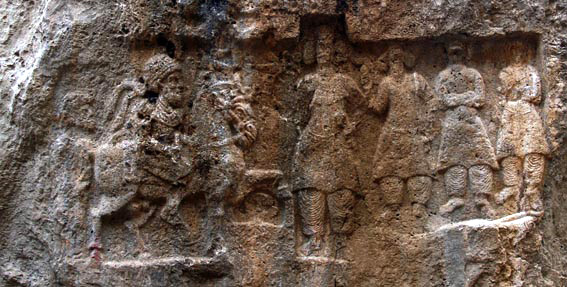
This extraordinary relief is carved on a huge limestone boulder at the cliff edge of a remote, not to say 'hidden' valley in the rugged mountains of northeastern Khuzistan [at the southwestern edge of the Iranian plateau, sharing a border with southern Iraq (= the big red blob on the map, below right)]. In ancient times, this was the heartland of Elymais, sometimes a small empire, more often a vassal to more powerful states.

At the time this relief was carved, Elymais was under Parthian rule.

Or was it?

Well, yes and no. As so often, scholars differ.

Look closely at the relief. You'll see that it is divided into two very different compositions -- and carved in entirely different styles. So, the question is: does this relief record a single historical event? Or are two different happenings accidentally fused together by craftsmen too lazy to smooth away an earlier unfinished relief?

What and When?

In the absence of inscriptions, the relief can only be studied through the images themselves. We'll start with the easier bit.

There's no doubt that the four standing figures on the right -- all pictured frontally in the Parthian manner -- belong to the Parthian period and were sculpted some time between the 1st and 3rd century AD. They wear the long tunics and baggy trousers of local Elymaid bigwigs. The tallest of the standing figures is clearly the main subject of the relief. He is the largest figure, topping the horseman on the left by almost a head. His prominent weapons and the gesture of the left hand on the sword hilt shows that he is a warrior prince, surely an independent ruler. And I think he must be one of the last Elymaid kings, for the mass of rounded, puffy curls on either side of his head also appears on Elymaid coinage at this time (left), before the kingdom is finally and forever vanquished. That would date him to the end of the 2nd or 3rd century AD

The King of Elymais (for so we must think of him) and his retinue seem to greet the man on the horse -- who is, in turn, followed by a single attendant. Both horseman and attendant are in profile view. These are the only figures among all of the Parthian rock reliefs pictured in profile.

Who is this rider? He wears a diadem tied at the nape of the neck with long fluttering ends, a symbol of kingship worn by Elymaid, Parthian, and Seleucid rulers. So we know he's a king -- but where is his homeland? The profile head with short hair and a naturalistic, bearded face suggest a Hellenistic Greek portrait so strongly that the entire relief has been dated in the 2nd century BC by comparison with coin portraits of Mithradates I (171-138 BC). Mithradates was the first 'Great King' of Parthia, who conquered Elymais in about 140 BC -- temporarily only, as it reappeared a few decades later as an independent kingdom (lasting on and off until its conquest by the first Sassanian king, Ardashir).

In close-up, this is how they compare.

I'm not convinced by the resemblance (although it's possible, of course, that after 300 years his exact image was lost). For example, the sculptor has carefully depicted a heavy necklace (a torc) around the rider's neck, a detail that never appears on Mithradates' coins but sometimes on coins of his successors. Perhaps the sculptor substituted the image of a later Parthian ruler for that of the 'Great King'. But what brings him to Elymais? The bird with a wreath and a palm branch flying towards the horseman (visible on the close-up, below left) is a clue. This is a Roman victory symbol (based on the Roman eagle) which becomes common on Parthian coins from the 1st and 2nd centuries AD. The bird could apply to either Mithradates I or II, both of whom were victorious in Elymais.

But, wait a moment. A second bird is flying toward the Elymaid king -- and he's pictured a head taller than his presumed conqueror. I suppose we could imagine that the horseman is not an historical character but meant to be more than human -- a deified or heroized early king. Whether human or super-human, he's badly out of proportion: his head is much too large. That may suggest that the head was copied from another source and clumsily attached to a ready-made body.*

And, then, there's his horse.

The prancing horse with arched neck and raised foreleg is a Greek image which spread throughout the Near East during the Seleucid period. This stallion (quite clearly male) has the short, clipped mane and high flowing tail of Greek horses. His bridle ornaments and fluttering ribbons, too, are very un-Parthian.

If the rider is heroized, his mount might be too. Could he be copied from Bucephalos, the famous horse of Alexander the Great? He does look a bit like a marble statue; doesn't he? In which case, we are certainly in the realm of myth or legend.

Anyway, why would an Elymaid ruler in the later Parthian period order a relief which shows him greeting or venerating a mounted figures also embellished with borrowed Roman victory motifs?

With the decline of Parthian power, Elymais was again independent and relatively powerful. The tall standing figure could be a nameless, late Elymaid king paying homage to his real or imagined ancestor in order to stress the legitimacy of the local dynasty's rule. That assumes, of course, that he had at hand suitably ancient images which -- with a bit of cut and paste -- served as a model. And that he was sophisticated enough to adorn this long-ago king with the correct trappings of his own era.

I don't think so.

Whichever way you look at it, the arguments are tortuous.


Enter lasers.

The whole story depends, of course, on the left and right sides of the relief being contemporary. Naturally, there are two opposing views about that. The carving in the two halves of the scene looks different. Some argue that the horseman is sculpted in higher relief than the standing men. This may only be an illusion based on a swelling in the rock surface which makes the horse seem in higher relief than the tallest standing figure. So, if the entire relief was indeed executed at one time, the stylistic differences have no chronological significance.

Lasers should settle the question, or so we hope. A study now underway will allow a detailed examination of the sculpted surface and precise measurement of the carving’s depth at different points of the scene, and should shed light on the carving techniques of all the figures.

The Iranian-Italian Joint Expedition in Khuzistan: 1st Campaign (March 4 - 12, 2008)

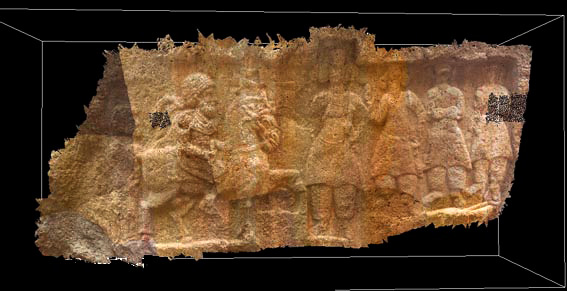
The sculpted surface of the boulder (above, left) was divided into 34 squared sectors. About 15,000 markers were placed on the surface to allow the scanner to recognize its position in a 3D model. Note that the scanner itself never touches the surface of the rock, so the process is non-destructive.

Vertices have been located on the ground by a GPS receiver and by traditional topographic method, while 70 ground control points, placed on the sculpted surface (below) are located to define a network. This network has 4 main vertices, while the ground control points orientate the frames acquired by the laser scanner and the digital photogrammetric camera.


The acquired frames were merged to create a 3D digital model of the rock relief consisting in 7.692.104 points, with an accuracy of 0.2 mm approximately [ I like that approximately!].

A specific software has been created to analyse these data. This software manages all the elaborated files: traces of tools on the sculpted surface, differences in the depth of the carving, and the natural conformation of the rock will be examined in order to verify whether there are also differences in the carving technique and evidence of re-sculpting in the two halves of the relief.

The first results (reported on 5 December 2008) look like this:


It's the best image ever. The contradictions in iconography and style are perfectly clear. Isn't science grand!

-- Do we have our answer?

-- No, not yet.

Tune in for the results of the second season -- coming next month.


* This idea does not hold water (in my opinion) since the attendant on foot behind the mounted figure -- although possibly unfinished -- also has an overly large head. It seems more a stylistic trait than a copying error.

References: I have made much use of T.W. Kawami, Monumental Art of the Parthian Period in Iran, Leiden, 1987.


21 January 2009

Entropa Rules OK


Entropy + Europa = Entropa


While the eyes of the whole world were fixed on Washington D.C., I was also following the Entropa brouhaha in the capital of Europe. In case the drums and trumpets of the American inauguration drowned out the noise of this second installation, let me explain.

Entropa (left) is now on display at the normally dull and grey European Council building in the centre of Brussels. It's an artwork that lampoons all 27 EU national stereotypes, which has caused some countries to throw a fit. Others are unusually quiet.

Entropa portrays Bulgaria as a Turkish squat-down toilet, France is out on strike, Lithuania has three statues urinating on Russia, and my beloved Netherlands sinks beneath the waves (below, right) with only the towers of minarets poking through -- to the tune of wailing muezzins. Oh, and by the way, the United Kingdom is that empty space at the top left-hand of the work: in short, absent entirely -- exactly as Eurosceptics have always wished.

This is undoubtedly the first exhibition in the history of EU Council art displays to cause a diplomatic incident, the usual intent being to get by unnoticed and avoid criticism at all costs. In truth, so successful have they been before the current Czech presidency that I don't know anyone who has even heard of such an art event in Brussels. Until now!

Entropy is a measure of the disorder of a system

The Czech Republic, which holds the rotating EU presidency for the first six months of 2009, thought it had commissioned a joint work from 27 European artists -- one from each EU country, a cute (if fuzzy) idea.

But it turned out to have been entirely completed by the notorious Czech artist David ČernĂœ and two of his mates. Mr ČernĂœ, 41, first gained fame in 1991 by painting a memorial to a Soviet tank in Prague a shocking pink (the then Minister for National Defence offered hasty official apologies to the Soviet Embassy), while his spoof sculpture of Saddam Hussein preserved in formaldehyde has been banned in two countries.

Art Attack

Entropa is subtitled Stereotypes are barriers to be demolished, in accord with the Czech EU Presidency motto of "Europe without barriers". The Czechs boasted that the artwork, based on an outline of each country, would speak where words fail.

Er, I wonder what that German autobahn (right) is saying....

According to the artist's proposal, alongside the Italian entry (the map of Italy with nine footballers) is the legend "It appears to be an autoerotic system of sensational spectacle with no climax in sight." And next to the alleged British entry, an Airfix kit of Europe (where there is now a blank space): "this improvement of exactness means that its individual selective sieve can cover the so-called objective sieve."

If that gobbledegook was not enough to warn the Czechs, they have only themselves to blame.


The Czech Presidency is keeping its collective head down. The Deputy Prime Minister, however, bravely stated that "in today's Europe there is no place for censorship. I am confident in Europe's open mind and capacity to appreciate such a project."

His confidence was soon tested.

International Incidents

The Polish piece recreates the flag-raising at Iwo Jima, with the U.S. Marines and Stars and Stripes replaced by Catholic monks erecting the rainbow flag of the Gay Rights movement. Or are they a gaggle of gay priests? Hard to tell. Still, the public in Poland appears to be largely in favour, with 64% considering it "spot on" and only 13% thinking it "an insult to Polish people", according to an on-line poll.

The Romanians, seeing their country turned into a Dracula Disneyland, hauled in the Czech ambassador to complain (I want to know if they bit his neck).

Slovakia, the truncated half of once Czechoslovakia, is portrayed by what looks like a strangled sausage. Rubbing salt into the sausage, it is tied up in the Hungarian tricolour -- a reference to a little ethnic spat between the two EU lands. Slovakians officially claim that it resembles a wrapped-up corpse. The Foreign minister lodged a formal protest, calling it an offence to the Slovak nation.

But most peeved (if that's the word I want) is Bulgaria. The country's ambassador wrote undiplomatic letters of complaint to the Czech EU presidency and the EU foreign policy chief demanding that the sculpture be taken down before the official launching. The first secretary for the Bulgarian office to the EU, said:

“I cannot accept to see a toilet on the map of my country. This is not the face of Bulgaria.”

Individuals outside the government as well expressed outrage about the image:

It is one thing portraying, say, France as a country on strike, but quite another to show my homeland as a toilet. That is downright wrong.

Point taken. Though the French might not agree.

An EU Compromise

EU officials expressed concern. One said: 'This is very provocative for an official building and does not seem to have been properly discussed in the appropriate forum."

The Czechs were bloody but unbowed:

What we approved was a blank map; we decided not to censor anything. When we saw the finished work, we thought it might be too much. That remains to be seen. At any rate, it is an expression of freedom, we decided not to censor it.

Until they did.

Yesterday, as the hands of the clock moved towards midnight, Brussels bureaucrats came up with one of their famous half-way measures: they decided to leave the piece in place but decorously covered it with a black cloth. A map of Bulgaria was pinned to it in case you didn't know what was hidden from view.

What was that famous axiom about Entropy?

The algebraic sum of all the transformations occurring in a cyclical process can only be positive, or, as an extreme case, equal to nothing.

11 January 2009

The Ara Pacis in Colour!

From the aptly named Roman blog, eternallycool, this stunning news:

Last week, the Comune di Roma treated the eternal city to a full-colour illumination of the front of the Ara Pacis or Altar of Peace.


As part of an actor-led tour that dramatically recounted the stories of Romulus and Aeneas in order to explain their presence on the front of the Ara Pacis, lights were used to superimpose dazzling colours onto white marble facade of the altar. The goal was to give visitors an idea of the monument’s appearance at the time of its dedication in 9 BC.


Though the altar is all-white now, scholars agree that such monuments — as well as sculptures — were once brightly coloured. Thus, vivid blues, greens, yellows, and reds characterized the illumination.

Vatican Museums Director, Antonio Paolucci, who co-organized the project, said that the projected colours were chosen based on traces of paint recovered from the monument in the 1930's, such as red ochre and gold leaf.


The Ara Pacis was built in celebration of the end of the civil wars and the advent of peace under the reign of Rome’s first emperor, Augustus.

Though the colour projections were a temporary holiday event, organizers say they hope to make the demonstration a permanent part of Ara Pacis Museum in December 2009.


Reproduced under eternallycool's generous Creative Commons License

09 January 2009

QUEENS HAVE MAGIC


Three Minor Mysteries of a New Tomb
(Updated)

This is all that is left of the body of Queen Sesheshet -- a skull, legs, pelvis, and scattered bones, once carefully wrapped in linen. Sesheshet was the mother of Teti, first pharaoh of the 6th Dynasty (r. 2323 - 2291 BC).

Her new pyramid was found at Saqqara last November. Although now topless, it had once been as high as a five-storey building.

As Zahi Hawass (Secretary General of Egypt's Supreme Council of Antiquities) whooped:

You can discover a tomb or a statue, but to discover a pyramid, it makes you happy. And a pyramid of a queen -- queens have magic.

Still, after digging down through 7 metres (23') of sand to reach the pyramid, archaeologists must have been miffed when they spotted a gaping vertical shaft already dug through its upper structure -- evidence that the pyramid had been robbed in antiquity.

Yesterday, the archaeologists, too, entered the tomb.

Inside a spacious burial chamber (22-m [72'] long and 4-m wide), they discovered the queen's granite sarcophagus, some six tons in weight. A team of workers spent five hours lifting its heavy lid. Sadly, her disarray and paltry adornments showed that the robbers had been there first. Only some gold finger wrappings had been left behind. It had been thoroughly ransacked.

Mystery # 1

Who put the lid back on the sarcophagus, and why?

Mystery # 2

Was Sesheshet an Uppity Queen, or not?

To be honest, almost nothing is known about her. Her husband's name -- and, thus, the father of the new king, is unknown. Her estates under the title King's Mother are mentioned in the tomb of the early sixth dynasty vizier Mehu. That title points to her being a royal mother but hardly suggests (as reported on some sites) that she ever ruled as pharaoh herself.

Rather, she was said to be instrumental in enabling her son to gain the throne and reconciling two warring factions of the royal family. Teti's chief wife, Queen Iput, was probably a daughter of the last king of the 5th Dynasty, Unas -- and one can easily imagine that Sesheshet had a hand in arranging the marriage. Marriage to the previous king's daughter legitimized Teti's rule but that doesn't mean that his accession was peaceful. A less than easy transition is suggested by his Horus name, Seheteptawy, which means, "He who pacifies the Two Lands".

The rest of the story is just as murky (to say the least).

Mystery # 3

Was Sesheshet the "Queen Who Had No Hair?"

A Queen Mother named Shesh is mentioned in the Ebers medical Papyrus, the most important Egyptian pharmaceutical record to have survived (ca. 1550 BC, although its content is undoubtedly much older). It tells us how to make the very same hair-restorer that Queen Shesh had used herself!

Another remedy to make the hair grow , prepared for Shesh, the mother of his Majesty, the King of Upper and Lower Egypt, Teti the justified
.

The remedy was made from the claw of a dog, the hoof of a donkey, and some boiled dates.

This was a fairly unpretentious hair-restorer for a great queen but her celebrity endorsement undoubtedly popularised it. If that didn't work, however, another sure-fire remedy for baldness advised the sufferer first to recite this invocation to the sun god:
O Shining one, thou who hovers above!
O Disk of the Sun!
O Protector of the Divine Neb-Apt
and then swallow a mixture of burned prickles of a hedgehog immersed in oil, fingernail scrappings, and a potporri of honey, alabaster, and red ochre.

Hair still falling out? Stir up and rub on the scalp “the fat of a horse, a hippopotamus, a crocodile, a cat, a snake and an ibex. Then mix in the tooth of a donkey crushed in honey.” Just collecting the ingredients would be a fairly hair-raising business, which might have been the general idea.

Did any of this help Queen Sesheshet? We don't know, but I suggest that the archaeologists now going through her tomb with a fine-tooth comb keep an eye out for plaits and fringes of false hair. A hair-piece might have supplied the deficiency rather better than brew of dogs' claws and donkey's hoof had done.

Not really uppity -- but she might have set the fashion for Egyptian wigs.

Update: 20 January 2009

Mystery #1 is solved! Elementary, my dear Shesh: the early reports of the sarcophagus having been opened by the tomb robbers turns out not to be the case:

The thieves entered through a tunnel from the top, because they couldn't get through the main entrance, said Zahi Hawass, secretary general of Egypt's Supreme Council of Antiquities

Fortunately, Seshseshet's mummy was inside a granite sarcophagus with a six-ton lid,* so the thieves left the body and its decorations of gold jewelry untouched.

They didn't open the sarcophagus; they were using their hands, said Hawass, whose team used heavy machinery to remove the lid.

Here's a close-up of Seshseshet's mummy. It certainly doesn't look 'untouched' -- but I'm more prepared to believe that something horrible happened to her during embalming than that the thieves lifted the lid with their hands ... and then carefully replaced it.

* Surely it's the sarcophagus that weighs 6 tons, not the lid by itself!

My thanks to Talking Pyramids for signalling the update.


Blog Archive