25 April 2010

Eti, the Eritrean Queen of Punt?


Arriving at the goodly way into God's Land, journeying in peace to the land of Punt.


The Egyptians who sailed off to the land of Punt (Pwenet) are seen on the walls of Queen Hatshepsut's stupendous temple of Deir el-Bahri, a complex of terraces, ramps, colonnades and rock-cut chapels unique in the history of Egyptian architecture. Hatshepsut would have known the temple as Djeser-Djeseru, or "Sublime of the Sublimes". It really is sublime -- and not just for architectural reasons: texts chiselled on the walls tell us about this journey to this far-away God's Land, and row after row of painted reliefs picture the adventure all the way from its beginning to its triumphant conclusion.

The only thing that it doesn't tell us is where in the world is Punt.

Or, for that matter what is wrong with Eti, Queen of Punt (seen above; hobbling, we must imagine, behind her fashionably thin husband, King Perehu). Many different explanations have been offered for her strange appearance, ranging from suffering from an unknown disease (she's been given her own special 'Queen of Punt syndrome') to being simply overweight. None seems quite to fit the bill.

Scholars have argued for generations, too, about where Punt should be located.

Lots of texts mention Punt, but none gives detailed instructions for the voyage.

You could reach Punt by land or by sea or, more likely, a combination of both (see map). Occasional envoys from Punt are pictured in tomb paintings, but their images cannot be related to any known geographic region. Hatshepsut's reliefs give many clues: we see the Puntite village on the waterside, fish in the water (Red Sea varieties), trees on the shore (ebony, palms, and myrrh), animals (monkeys, donkeys, short-horned cattle, rhinoceros and giraffe). We see remarkably realistic looking people. In fact, no other representation from pharaonic times pictures a country outside Egypt so completely with its inhabitants and landscape. Punt is the only land whose geographic reality is expressed so clearly but -- paradoxically -- Punt exists as if in a void and its exact whereabouts remain unknown.

So, where is it: Yemen, Somalia, Ethiopia, Eritrea, the Sudan?

As of today, we now know (or think we do).

But, first, some background on an extraordinary voyage.

It all began when Hatshepsut (Year 9 of her reign) received an oracle from the god Amun-Re, her putative father, who had made her pharaoh of Upper and Lower Egypt.
Instructions were heard from the Great Throne. an oracle from the god himself.

"Explore the route to Punt, open the road to the Myrrh-terraces, and lead an expedition on water and on land to bring exotic goods from the God's land to this god who created [your] beauty."
The Egyptians were not good sea sailors. Navigating the dangerous waters of the Red Sea to the very edge of the known world must have seemed to them as daunting as a mission to the Moon to us. Myrrh made it worthwhile. It was not just a sweet-smelling perfume (though it was that too: Hatshepsut rubbed it on her legs to impart a divine fragrance*), but an incense that was essential to the proper worship of gods and for the after-life.

Myrrh (Commiphora myrrha) was burned in vast quantities during the daily temple rituals, and used in embalming the bodies of pharaohs and for the mummification of lesser folk, too. As early as the Fifth Dynasty, a single expedition had brought back to Egypt no less than 80,000 measures of myrrh. Demand, however, was apparently insatiable.

Therefore, besides having orders to import the desired incense from Punt, the expedition also -- and this was Hatshepsut's innovation -- was to collect complete trees and bring them back to Egypt as well. These would then be cultivated in the temples of Amun at Thebes. At Deir el-Bahri itself, on the right and left sides of the ramp leading to the middle terrace, stumps of trees were found around artificial water basins, possibly the remnants of the myrrh-trees that were brought from Punt.

A Voyage to the Southern End of the Earth

So off they went, commanded by a high official, the state treasurer named Nehesj. He sailed with five ships, each manned by some 150 sailors and soldiers, and they probably spent a month at sea before they sighted the shores of Punt.

That made it possible for Hatshepsut to boast: My southern boundary is as far as the lands of Punt.

Coming ashore, the natives greeted Nehesj warmly. The Chief of Punt -- Perehu -- with his wife, Eti, right behind him (top left) steps forward to greet the Egyptian envoy. They express their amazement at the visit:

Why have you come into this land, which the people of Egypt do not know? Did you come down the ways of heaven, or did you sail upon the sea and upon the waters of God's land? Or have you trodden the path of the sun?


Nehesj stands opposite, on the other side of a pile of gifts intended for the Chief of Punt. He must have been a real 'bean-counter' (as Treasurer of Egypt) for the pile is a rather motley collection of merchandise: strings of beads, an axe, a dagger, some bracelets, and a wooden chest. He hopes to exchange this miserable stuff for the fabulous goods of Punt -- not only their own produce of myrrh, ebony and short-horned cattle, but also products from other African lands, including gold, ivory and animal skins.

Unsurprisingly, Nehesj has a well-armed escort behind him: confronted with such poor gifts, the natives might have turned nasty. But they didn't. They reached an agreement and Nehesj, Eti and Perehu went off to share a splendid banquet.

Nehesj seems to have made the best deal ever, prior to the Dutch buying Manhattan island from the Indians for $24 worth of tat.

Then the work began, surely many weeks of work. Egyptians must even have ventured into the interior since palm trees (lowest left) do not grow on the sea shore. Then, the great prize:

"...loading of the ships very heavily with marvels of the country of Punt; all goodly fragrant woods of God's-Land, heaps of myrrh resin, with fresh myrrh trees, with ebony and pure ivory, with green gold ..., with cinnamon wood, khesyt wood, with two kinds of incense, eye-cosmetics, with apes, monkeys, dogs, and with skins of the southern panther, with natives and their children. Never was brought the like of this for any king who has been since the beginning."

You see in the middle of the ship (circled in red; click on photo to enlarge) one of the apes, a baboon to be exact. And therein lies the breaking news.

The Baboon

Sailing, arriving in peace, journeying to Thebes.

Three baboons were on board this ship, one of them -- as is clear in this close-up (left) -- squatting in their characteristic upright position. Very many baboons must have gone off into exile in Egypt in this way. When the Egyptians observed baboons barking at the rising sun, they imagined that the apes were worshipping the sun just as people did. That's why the baboon became an aspect of the sun god, Amun-Re, and whole colonies of these animals were kept in his temples.


When they died (and they didn't live long in the Egyptian climate**), they were mummified.

Now, thanks to mummified baboons (like this sad, partly unwrapped ape [left]) -- and some really smart, cutting edge science -- the search for Punt appears to be coming to an end.

At the 61st annual meeting of the American Research Center in Egypt (23-25 April 2010), a team from the University of California Santa Cruz, led by Professor Nathaniel Dominy, presented the results of their analysing the hairs of three mummified baboons from Thebes and the Valley of the Kings, and comparing them with living specimens from Eritrea and Ethiopia.

The team took hair samples from baboon mummies in the British Museum and examined them by using oxygen isotope analysis. Oxygen isotopes act as a 'signal' that can let scientists know where the hairs came from.

It works like this: depending on the environment where an animal lived, the ratio of various isotopes of oxygen will be different. “Oxygen tends to vary as a function of rainfall and the water composition of plants and seed,” explained Prof. Dominy. One baboon from Thebes appears to have spent some time living in Egypt as an exotic pet. All that time, it consumed the local diet so its oxygen isotope value changed. That change means that researchers could not tell where it originally came from. But two baboons apparently died fairly soon after arrival in Egypt and retained the isotope values of their homeland.

So the winner for the place of Punt is....

When the researchers compared the oxygen isotope values in the ancient baboons to those found in their modern day brethren, they discovered that “all of our specimens in Eritrea and a certain number of our specimens from Ethiopia – that are basically due west from Eritrea – those are good matches,” said Dominy.

“We think Punt is a sort of circumscribed region that includes eastern Ethiopia and all of Eritrea.”

Somalia, Yemen and Mozambique do not match.

But where in Eritrea?

Eritrea is a big place. Can they narrow it down further?

The team has a working hypothesis which they hope will locate exactly where the Treasurer Nehesj docked his ships in God's Land.

“If you have a map in front of you and you can zoom in on Eritrea there’s a major harbour there,” said Dominy. It's located near the modern port of Massawa.

Massawa is the so-called 'pearl of the Red Sea'. The town is located on two islands --absolutely perfect for a trading post, combining as it does, safety and accessibility. It should be clear by now that Punt was an early African trade emporium, not only trading its own products but other products of Africa, and probably Arabian frankincense as well. So an island location fits very well.

And the baboons agree.

The researchers say, "We have a specimen from that same harbour and that specimen is a very good match to the mummy.”

Welcome home, Queen Eti!

And I hope, one day, your fatness will be seen in this light, with you as a steatopygous princess of your people -- pictured through the prism of an astounded Egyptian artist.


*One of Hatshepsut's perfume flask on my blog post Hatshepsut Smells as Sweet.

** Though baboons were considered to be worshippers of the sun-god, and must have been given considerable care, investigations into the animal necropolises have revealed that their life expectancy in Egypt was very limited. Of the 200 or so specimens that have been examined, hardly any lived into their sixth through tenth years. Unfavourable living conditions resulted in undernourishment and the lack of freedom of movement and sunlight led to rickets, degenerative bone diseases and probably tuberculosis.

My thanks to Owen Jarus at Heritage Key's 'The Ancient World in London', 23 April 2010 (with a photograph of one of the British Museum baboons; under copyright) for the first report on the scientific breakthrough described above.


Other main sources include D. Meeks, 'Locating Punt' in (D. O'Connor and S. Quirke), Mysterious Lands, 2003, 53-80; R.S. Bianchi, Daily Life of the Nubians (Greenwood Press), 2004; and special mention for a paper by my friend, J. Phillips, 'Punt and Aksum: Egypt and the Horn of Africa', Journal of African History, 1997, 423-57; more useful material available on-line at the website of Dr K.H. Leser; the website of tripod.com (with excellent plans and photographs of Deir el-Bahri); and the website of Exploring Africa: Timeline, Index and Other Issues .


Update: 9 May 2010

Readers who enjoy (as I do) intermingling ancient and contemporary visions in art may like to contemplate this image (left) kindly sent to me by Zenobia-blog reader, Hetty Boomkamp of The Netherlands.

From her collection: 'Double Pharaoh Portrait, Hatshepsut and the Queen of Punt' , a lithograph (1985) by my favourite Dutch artist, Gerti Bierenbroodspot.

I publish it with especial pleasure as today is Bierenbroodspot's birthday.


Illustrations


Top left: Queen Eti of Punt, King Perehu of Punt (AboveTopSecret).

Map: AboveTopSecret.

Middle left: Men carrying myrrh trees with roots in pots (AboveTopSecret).

Centre: Egyptian ship being loaded with produce of Punt (maat-ka-ra.de).

Left: Close-up drawing of above (ExploringAfricaBlogspot).

Inset: Baboons worshipping the sun god with Ramesses III at Medinet Habu (R.Hiller, The Baboons and Monkeys of Ancient Egypt).

Lower left: Mummified baboon in Cairo's Egyptian Museum (Al-Ahram Weekly, Issue 537).

Lowest left: A scene from Punt with ape climbing palm tree, short-horned cattle, head of giraffe (ExploringAfricaBlogspot).


10 April 2010

An Uppity Dutch Master (Part III)

(Uppity Dutch Master Part I, Part II)

Post-Marital Stress Disorder

While still a single woman in her early twenties, Judith Leyster became a master in the artists' guild of Haarlem, set up her own shop and took pupils (the only woman painter in Holland to do so). Although she had this remarkable career as a professional painter, it has always been believed that she stopped painting when, in 1636 at the age of 27, she married fellow artist, Jan Miense Molenaer.

After her marriage, she took on the responsibility of running her husband's studio, wheeling and dealing in real estate, and bringing up five children (only two of whom survived their parents).

If this picture is true, she had been an independent painter for a mere seven years.

So why are we surprised when this 'leading star' (her pun on the name of Ley-ster) was eclipsed by the fame of her male contemporaries, including that of her own husband? Especially so, or so the story goes, since she had the bad luck to have worked in the same time and place as the highly esteemed Frans Hals (1582-1666). As a satellite to this towering figure, her own work was soon forgotten -- attributed to Hals, or his 'circle' or left to languish as utterly 'Anonymous'.

In any case, we can all agree, she was no victim of the patriarchy. Painting in the Dutch Golden Age was a craft like any other: it's what you did for a living. Even successful male artists, as well known in their time as ours (such as Ferdinand Bol and Meindert Hobbema) abandoned their careers when they made advantageous marriages. If Leyster made the same choice, we should not assume it was because she was a woman. Not a gender choice, it seems, but a savvy business decision.

But hold on a moment.

If, between her retirement in 1636 and the tulip catalogue of 1643 [above left], she had given up her art, how could she possibly have changed her style? For the tulip catalogue pages were painted in watercolour -- as far as we know, a new medium for her -- and used a novel technique of drawing with a silverpoint-instrument on specially prepared parchment.

Well, we can explain that.

Possibly she continued to paint from time to time (the tulips suggest as much) and very likely, using the props and models of her husband's studio, they worked together on some paintings that went out into the world under his signature. Yet her distinct monogram -- her entwined initials JL and and attached shooting star -- does appear on the tulip page [rightc]. And if it can appear there, seven years after her marriage, how sure are we that her monogrammed but undated paintings are inevitably pre-1636.

The renowned historian Simon Schama, for one, points to the many pictures of children, "probably their own [children], that Molenaer and his wife, Judith Leyster, produced between them ...." Take, for example, Leyster's undated double portrait, Two Children with a Kitten and an Eel, [left] -- usually assigned to circa 1635. The little girl, making the 'crazy' gesture at her brother, could be Helena (baptised 1643) with her brother Jacobus (1639) which would date the painting somewhere around 1649.

Impossible?

Let's check the little we do know about her later career.

In 1648, a local historian, Theodore Schrevel, picked up the pun on her name and praised Leyster as a "true leading star of art" (‘de rechte leyster in de kunst’) and the best of the "many exceptional women in the field of painting who are still renowned in our time." That doesn't sound like the description of a housewife or art dealer; does it? But rather someone who is known as a painter and is still working under that name.

At some point, however -- certainly by the mid 1650's -- she started to sign her works with her married name. We always had a clue that this was the case, but no one paid much attention since it didn't make sense if she had ceased painting.

This was the clue. In autumn 1659, Leyster and her husband both became seriously ill and, on 6 November, they made their last wills. Three months later, she was dead. Molenaer recovered and lived on for another eight years. After his death (1668), the inventory of paintings still in his estate records seven works by "Mrs Molenaer", "Judith Molenaer", and "wife of the deceased" -- which does rather suggest that she was painting under her married name. One piece is further described as "a flower pot [painting] by Mrs Molenaer" (blompotje van Juffr. Molenaer).

And now we have this very painting! Signed, sealed, and delivered: Ju[...] molenaers 1654.

Enter a Lady Luck

The still life of tulips, lilies, an iris and carnations arranged in an imported Chinese vase [left] has been hanging in a Belgian home since the 1970's. A woman named Mrs Luck (her real name: I couldn't make it up!) found it in an art gallery in Oostend, Belgium, and bought it for about Euro 500 ($ 670, £ 435). This is not a case of ignorance rewarded: she knew exactly what she was buying.

She hung the painting in her best room, above the fireplace -- quite possibly where Leyster's original client would have hung it, too -- and kept her purchase secret for more than 30 years. The painting was, she said, her pearl.

What a pearl.

The dark background, contrasts of light and dark in the bouquet, the flowers partially overlapping with a few blossoms seen from the back, shows the artist's originality, certainly for a painter who was not strictly specialized in this genre. At a time when still lifes were generally painted with the greatest possible precision, Leyster's handling is, on the contrary, rather loose: painting 'loosely' with coarse, recognisable brush strokes was considered a particularly difficult challenge and many art lovers greatly admired such brushwork.

Since the painting is in excellent condition, with only the varnish turned a little yellow with age, it is probably worth more than a million euro's today. Mrs Luck can be forgiven for keeping her secret: "I was afraid that the painting would not be mine any more if I made the news public." She certainly could never have afforded the insurance premiums!

But when she heard that the Frans Hals Museum in Leyster's home town of Haarlem would celebrate the artist's 400th birthday (1609-2009) with a special exhibition, she decided to come forward. As she said, this felt like the right moment.

Frima Fox Hofrichter, whose monograph on Judith Leyster: A Woman Painter in Holland's Golden Age did so much to bring Leyster out of obscurity, is a happy scholar:
Many art historians have often assumed that Judith Leyster gave up painting upon her marriage. With the discovery of the flower still life and its date of 1654, we now have documentation that she continued her career as a painter. It is likely that Leyster moved to still-lives and botanical studies after her marriage, perhaps to split the market with her husband.
So that's what she was doing eleven years after she married. Who would have predicted a still life painted like this? She was still experimenting -- rather than, like other artists of the time (including her husband), fixing on a simple, identifiable and marketable 'personal manner'. Whether she was painting a portrait or a still life, half-length figures or a group at full length, using fine brushwork with dark colours or broad strokes and bold tones, or changing the vantage point, now looking from above, then from below, she transformed each standard ploy into something boldly alternative. Her work is thus filled with surprises and hard to classify. No wonder scholars cannot agree on which paintings should now be attributed to Leyster. Hofrichter considered 48 works (47 paintings and one etching) authentic. More recently, other scholars suggested only about 20 oil paintings (and the tulip watercolour) can rightfully be assigned to her hand.* With disputes such as this, Hofrichter is surely right to say that "we are still in the preliminary stages of forming an understanding of this fascinating and unjustly neglected painter."

The 'blompotje van Juffr. Molenaer' hangs in Haarlem on temporary loan to the Frans Hals Museum until 9 May 2010. After that, a Lady Luck will decide.

Dutch-speakers can now listen to Mrs Luck on the Netherlands talk show De wereld draait door (below). She hopes that we'll forgive her for hiding her Judith Leyster for so long, "but if you look at the quality of the work," she says, "I think you'll understand why I did it. It was a pearl in my house."

I, for one, forgive you, Madam. I would have done the same.


* In the exhibition catalogue of A Dutch Master and her World, J.A. Welu and P. Biesboer have either "pruned" or "ripped off" -- depending on your viewpoint -- many of Hofrichter's attributions. Unfortunately, they rarely give any reasons for their decisions which makes it impossible for an outsider to form an opinion. A particularly glaring example is their rejection of A Portrait of Vincent Laurensz. van der Vinne (Hofrichter catalogue # 46), a painting signed and dated 1652 (no less!), which has vanished without a word. Was there something wrong with the signature; or was the date too late from their standpoint? Hofrichter is not amused.

Quotation from Simon Schama, The Embarrassment of Riches: An Interpretation of Dutch Culture in the Golden Age (1987) 553-554. Sources for the three-part post include: reviews of J.A. Welu & P. Biesboer, A Dutch Master and her World, by Xander van Eyk in Simiolus 22, 1993 - 1994, 105-109; and by M. Hollander in The Art Bulletin, 76, 1994, 541-544 . L.B. Gellman, review of F.F. Hofrichter, Judith Leyster. A woman painter in Holland’s Golden Age in Woman's Art Journal 13, 992 , 34-36. W. Liedtke, 'Judith Leyster. Haarlem and Worcester', in The Burlington Magazine, 135, 1993, 856-857. A.Silvers, 'Has Her(oine's) Time Now Come?' The Journal of Aesthetics and Art Criticism, 48, 1990, 374-5.


Illustrations

Upper and lower left: from the Frans Hals Museum catalogue accompanying the exhibition,
Judith Leyster: The first woman to become a master painter (photograph of 'Flower still life, 1654' by Margareta Svensson, Amsterdam).

Centre left:
A boy and a girl with a cat and an eel, The National Gallery, London.


29 March 2010

An Uppity Dutch Master (Part II)


(Part I at Uppity Dutch Master)

The Forgotten Master


After Judith Leyster married fellow artist Jan Miense Molenaer in 1636, she apparently gave up painting. As far as we knew, only a single work dates from after her marriage -- a hyper-Dutch catalogue of tulips pictured in watercolours (1643).

Instead of painting, we are told, she devoted her energies to the financial management of her husband's affairs. In the Dutch Republic, nothing was more common than a craftsman's wife serving as the salesperson for his products. Thus, she abandoned her creative role and professional success in order to take on a traditional woman's role -- albeit a non-domestic one.

And then, too, there was this:

Joannes (baptised 1637)
Jacobus (baptised 1639)
Helena (baptised 1643)
Eva (baptised 1646)
Constantijn (baptised 1651)

So she had quite a lot on her plate besides her art.

Anyway, what was she really giving up?

The eclipse of a 'leading star'

As one critic put it,* Leyster's short career had not been exactly a "stellar success".
Over the seven years of her active career, her output seems to have been low (about fourteen paintings a year), and the highest price for one of her works recorded in a contemporary source is 18 guilders. This means that the most she could have been making was 250 guilders a year, less than the wage of a skilled laborer.
Her husband was clearly the superior breadwinner, "a prolific artist with an individual and apparently highly marketable style, whose work brought much higher prices than those of his wife." She, however, was a clever clogs and switched to the business side of art. As an art dealer and by deftly managing their legal affairs, Leyster did more to raise the family income than she could ever have done as a painter. The Molenaers invested their subsequent profits in real estate, including an expensive country estate midway between Amsterdam and Haarlem.

No surprise, really, that the world forgot about her. After her death in 1660, her paintings became completely unknown. Between 1660 and 1893, no museum held any works attributed to her, her name was not recorded in sales catalogues, and no prints after her paintings were inscribed with her name. The history of painting in the Golden Age seemed complete without her.

What's wrong with this picture?

Quite a lot, actually.

In 1892, an irate English art dealer went to court in connection with a painting he had purchased as a Frans Hals.

What was the problem? The painting, he fumed (now known as 'Carousing Couple; left), was not genuine. For, when cleaned of the grime of age, just above the man's shoe was discovered Judith Leyster's characteristic tiny monogram. Irrefutable evidence that it was by her hand. The lawsuit was settled by the seller reducing the price of the work by 25%.

As a result of the publicity generated by the trial, seven more paintings thought to be by Hals were quickly identified as Leysters, six of them bearing her monogram.**

After centuries of silence, the Dutch art historian, connoisseur, and collector, Cornelis Hofstede de Groot (he who had recognized her monogram on the shoe), published the first article on her work in the prestigious Jahrbuch der Königlich Preussischen Kunstsammlungen. Her rehabilitation was under way.

But it was never going to be easy.

Pop Goes the Weasel

Women, in general, possess no artistic sensibility ... nor genius. (Jean-Jacques Rousseau)

How true. Having discovered the authentic creator of the 'Carousing Couple', the work immediately lost market value (25%) despite having previously received critical accolades for the fine brush strokes and nuances of character portrayed in the portraits. Now that the painting was a 'Judith Leyster', critics carped that it was weak and lacking in vigour:

Some women artists tried to emulate Frans Hals but the vigorous brush strokes of the master were beyond their capability; one has to only look at the works of a painter like Judith Leyster to detect the weakness of the feminine hand…( James Laver, 'Women Painters', Saturday Book, 1964).

But why, we may ask, did it take so long for this wishy-washy weakness to be observed? The 'Carousing Couple' had been firmly attributed to Frans Hals since 1758. So, many had looked and not seen ... until Leyster's monogram let the genii out of the bottle.

Critical attention today is more respectful but, still, her work is often judged as if it were a hodgepodge of male influences. Her fading from fame may thus be read as largely self-imposed (sotto-voce: and deserved): she could only hope "to achieve some measure of recognition by imitating the styles of her successful contemporaries, Frans Hals, Dirck Hals, and [her future husband] Jan Miense Molenaer."

Even in the catalogue of a recent show dedicated to Leyster, we are barraged with a list of her influences and left to conclude that her work is essentially a stylistic pastiche of her male mentors. So, in a sense, she still does not exist as an independent painter.

This is wrong on several levels. The question is not "Is she as good as Frans Hals?" but rather "How good is she?"

Enter Frima Fox Hofrichter
Hofrichter wrote a pioneering Judith Leyster: A Woman Painter in Holland's Golden Age (her doctoral dissertation) in 1989.*** She may be credited more than anyone with plucking the female Dutch Master from obscurity and turning her into today's 'Light in the Galaxy':

My sense that Leyster was forgotten, dismissed, overlooked, absent, and invisible engendered in me both indignation and a sense of mission. So my work began as an adventure. I was exploring unknown territory—trailblazing as a historian and a feminist. That was in the 1970s, when the world was different. It was not enough just to attribute paintings to her, though that was hard enough; I also had to address the question of their meaning. Where did Leyster fit in? What issues did she tackle? ... And how could I know this dead woman except through her cleverness and her wit and by understanding what was left of her—her paintings?

She began by exploring a painting that touched on many of these issues, with the underlying theme of the relationship between men and women—The Proposition (1631, left), which depicts a smiling man offering coins to a woman who sits sewing by candlelight.

Propositions and Whores

This was a popular subject in the 16th and 17th centuries but Leyster's viewpoint contrasts with other artists' treatment of the subject, which often stressed a whorishness in the female figures: the women were dressed provocatively and were willing participants in the exchange; an older woman was often included in the picture as a boisterous procuress. In Leyster's painting, on the other hand, the woman is dressed modestly and ignores the man, continuing intently with her task. Hofrichter sees this as a woman's perspective and possibly a critical response to the way male artists handled the scene. One might go further: I suspect it is a woman's reaction to a man who stubbornly refuses to believe that his attentions are unwelcome. What woman hasn't faced a similar predicament?

Technically, too, this is a striking painting. Leyster filled more than half of the picture with evocative shadows -- something no other painter had done before her. Hofrichter credits Leyster with the innovation of the nocturnal scene with a candle as the visible source of light and most critics would now probably agree that her rendering of artificial lighting was unsurpassed by any genre painter in Haarlem, Hals included. While filling in the background, which was painted last, she leaves a minute space around the silhouettes of the figures which lends a sparkling quality to her work. She uses an unexpected vantage point -- half-length figures viewed from below -- which, together with her strong diagonals, produce a distinctive compositional type.

Leyster's concentration on the psychology of the relationships also sets her apart. Her 'Game of Tric-Trac' (top left) is another common subject that Leyster handles quite differently from other painters: the two men at the game board in this beautifully lit night scene are accompanied by a woman, dressed not in the deep decolletage of her counterparts in similar scenes but covered up to the neck in starched linen, like a good housewife. Nevertheless, the woman grins and offers a pipe to one of the men with an almost masculine casualness. This straightforward woman so comfortable among men seems meant as a stand-in for Leyster herself.

In the 'Carousing Couple' (centre left), too, the smiling woman offering a drink to the youth who is merrily fiddling his time away, may also represent Leyster. The couple looks to be just this side of tipsiness; the one more glass she is about to pour will be one too much. Are you sure you want this drink? Imagine the psychology of a woman artist portraying herself in this role: she is the seducer: she is tempting Beauty but she is also the Painter. In such a scene, she declares for herself a creative role that is actually more active and more controlling than that of any (seduced) male artist could ever be.

There is still more to tell about Judith Leyster but I've run out of time today. I'd particularly like to talk about what happened after she supposedly stopped painting in 1636 -- and to report on a spectacular discovery made quite literally by a lady Luck. So, Part III will follow (albeit a bit delayed by travel).

An Uppity Dutch Master (Part III)


* From E.A. Honig, review of J.A. Welu & P. Biesboer, A Dutch Master and her World, in Woman's Art Journal, No. 2 (Autumn, 1995 - Winter, 1996)44-47.

** For example, some misattributions:
Laughing Man with Wine Glass, was attributed to Gerard Honthorst; all the following were attributed to Frans Hals: The Jolly Companions, sold in 1890, (Leyster’s monogram had been altered to an interlocking FH); The Jolly Toper, monogrammed and dated 1629, sold at the Hotel Drouot in 1890 (acquired by the Rijksmuseum in 1897); another Jolly Toper bought in 1874 by the Kaise-Friedrich Museum; Leyster's Self-Portrait, 1633 (now in the National Gallery of Art, Washington, DC: see previous post); her Portrait of a Woman, dated 1635, now in the Frans Hals Museum. Even during her lifetime, Amsterdam artist Cornelius Danckerts (1603-56) engraved a work by Leysters, 'Two Children with a Cat' (1630), with the inscription F. Hals pinxit -- although it includes her monogram.

One is just a wee bit tempted (along with The Artist's Muse) to wonder if the jaunty
Portrait of Willem van Heythuysen, Seated on a Chair (right) might not be an unrecognized Leyster as well. This spontaneous and informal portrait is unusual within Hals' oeuvre and among Dutch portraiture of the time, but makes a fine pendant to Leyster's self-portrait. As Sharon Hart remarks: One may accuse me of wishful thinking -- of being delusional enough to suggest the possibility that the recent painting that sold at Sotheby’s may be not be a genuine Frans Hals work. However, only four years ago, the same painting was sold at an auction in Vienna to an anonymous buyer for a mere $700,000, as the catalog description read, “Studio of Frans Hals”. It was only later authenticated to have been painted by the renowned painter.

***
F. F. Hofrichter, Judith Leyster. A woman painter in Holland’s Golden Age (Doornspijk NL 1989).

Illustrations

Upper left: 'Carousing Couple' (formerly attributed to Frans Hals) 1630. Louvre Museum. Photo credit: Texas A&M University.

Centre left: 'A Game of Tric-Trac' (identified and located by F.F. Hofrichter) ca. 1630. Worcester Art Museum, Worcester, MA; (accession number 1983.58).


Lower left: 'The Proposition (named by F.F. Hofrichter) 1631. Mauritshuis, The Hague.


21 March 2010

An Uppity Dutch Master

Yesterday, I went to see a small show of paintings by Judith Leyster (1609-1660), the first woman to be recognized in the Dutch Golden Age as a 'Master Painter'. Nowadays, we'd gender-bend the term and call her, quite rightly, a Mistress of Painting.


Once accepted into the guild of master-painters, she had the right to open a workshop, take on apprentices, and sell her paintings independently.

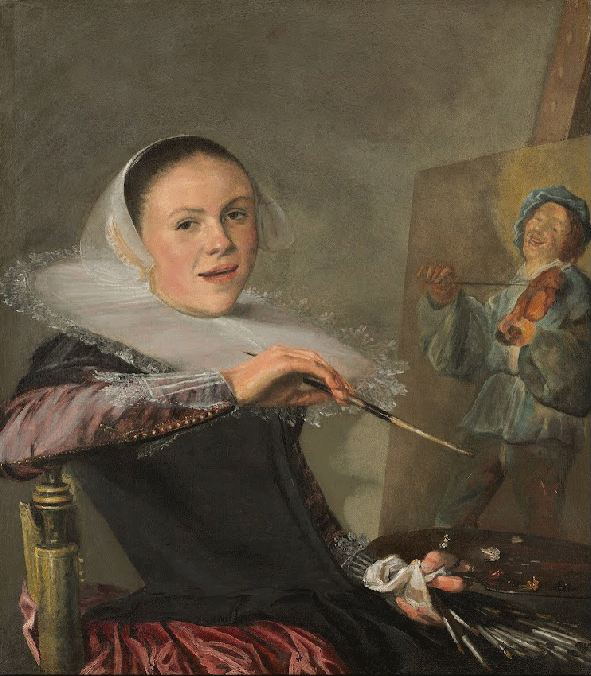
But first, she had to prove her skills. So, in the time-honoured manner, when she was 24 years old, Leyster presented a major painting to the Guild of St Luke in her home town of Haarlem, Holland. That was the original meaning of a 'master-piece' -- the proof of the pudding, as it were. Judith's proffered masterpiece was a unique self-portrait of the artist herself (left).*

So, yesterday, in the Frans Hals Museum in Haarlem -- at an exhibition in honour of her 400th birthday (it opened last December and runs till the 9th of May) -- I stood looking at Judith who turned away from her easel to look out at me. Her right arm rested on the back of her chair, her elbow jutting out, and I slowly realized just how extraordinary this self-portrait was.

Elbows do not jut in portraits of women in the Golden Age.

This informal, spontaneous pose was a convention made popular a few years earlier by Frans Hals, the premier painter of Haarlem, in whose studio Judith may have spent some of her apprentice years. Hals, of course, only painted male figures in this forceful pose, which was meant to give a sense of active engagement between the viewer and the pictured world. His women are more demure, with hands (and elbows) well tucked away within the picture space. Judith thus makes a big claim here. Not only is she a Master Painter, but her jutting elbow suggests she is challenging the prerogatives of a man.

This is a painter full of confidence. She knows her own worth, too. That may well be why she signed her paintings with a very distinctive monogram -- JL entwined with a star (right) -- punning on her last name, 'leyster', which means in Dutch 'leading star' or 'lodestar'.

A new star in the Golden Age of Dutch art

How did this happen?

Women artists prior to the 19th century were usually born into artist families and apprenticed in the family workshop. But Judith Leyster was one of nine children of a Flemish immigrant silk weaver who, as far as we know, had no interest in art. Her father's success in his adopted city of Haarlem enabled him to invest in real estate, eventually buying a brewery. Although brewing was a step up the social/economic ladder, it turned out to be one tread too far, for he went bankrupt in 1624. The children now had to earn their own livings. Financial catastrophe explains Judith going out to work, but doesn't tell us what motivated her to paint professionally. Possibly, she began by designing figurative patterns for what survived of her father's weaving business, but we don't really know.

In fact, we know nothing more of her until she unexpectedly appears in The Description of Haarlem written by Samuel Ampzing (1628). He mentions her as apparently co-apprentice with Maria de Grebber, the daughter of the history painter and portraitist Frans Pieterzn de Grebber. We learn that Frans Pieterzn was teaching his daughter to paint, so there would have been female company in his workshop. While Maria is faintly praised for her accomplishment ("Who ever saw a painting made by the hand of a daughter?"), Judith is described more honourably: "Here is somebody else painting with good and bold sense."

After receiving this basic instruction, she probably worked as an assistant in the studio of Frans Hals. No records survive to prove that Leyster studied with Hals (or with his younger brother, Dirck Hals), but a number of her works shows her to have been one of his closest and most successful followers. Should Leyster have been part of either Hals studio, she would have been there prior to 1629, the year she starts to sign and date her paintings.

The Serenade (1629, left), painted when she was 20, shows a crystal-clear affinity with Frans Hals, yet demonstrates that she was already an artist who charted a course of her own. Fascinated by light effects, she captures the effect of flickering candlelight on the dreamy face of the young lute player. The light shines from below, casting remarkable shadows and making his expression more intriguing.

Her Young Flute Player (1635, below right), on the other hand, with its sensitive lighting and soft, loose modelling of the face, bears only the remotest resemblance to Hals' work. A flute and a violin hang on an old, uneven wall (yielding beautiful light effects). Together with the cast shadow at the left, they create a serene rhythm in the painting and anchor the figure in space.

Despite having opened her own workshop, it seems that her relationship with Frans Hals remained warm: it is almost certain that she was a witness at the baptism of one of Hals' daughters in November 1631.

But they did, inevitably, hit a rocky period.

As a Master Painter, she could augment her income by taking apprentices. Students who entered a master's workshop had to a pay tuition fee. She had three such pupils when, in 1635, one of them left without her permission to study under Frans Hals. Hals refused to send the boy back, so Judith brought the dispute before the Guild board. The governors ordered the boy's mother to pay Master Leyster half of the tuition due and ordered Hals to return him to her studio or pay a fine (worth about 1/3rd the price of a small painting). So Judith won her claim but, as so often in judicial matters, it turned out that her own guild affairs were not quite in order: she had neglected to register and pay a guild contribution for her pupils. She had to do so now.

No matter.

What happened next had more effect on her income than any guild dispute.

On 1 June 1636 she married Jan Miense Molenaer (1610-1669), a fellow artist and at times, too, a close follower of Frans Hals. He also produced the genre scenes which had come into fashion for Haarlem's demanding art market: musicians, children and pets, jolly drinking and smoking scenes (as well as melancholy warnings of the vanity of such frivolity), portraits, and -- less typical of Hals but very much flowing from Judith's palette -- seduction scenes and women at domestic activities such as sewing or cleaning a child's hair. That's going to cause a big problem when we try to disentangle Judith's future work from her husband's prolific output.

But, first, the newly weds immediately had to cope with a deepening economic crisis in Haarlem. Its art market had always been highly competitive and, now, they faced a shrinking clientele as well. The couple left their home town and moved to Amsterdam, a boom city where the art market was much more active. In Haarlem, Judith had been part of a constantly interacting artistic milieu. What will she be in Amsterdam? Part II follows.

An Uppity Dutch Master (Part II)


*Although one should refer to the artist as 'Leyster', I allow myself, as one Judith to another, to place myself on first-name terms. It is certainly not meant to demean my namesake in any way.Illustrations

Above left: Self-Portrait, c. 1630, National Gallery of Art, Washington DC (Gift of Mr. and Mrs. Robert Woods Bliss
1949.6.1).

Other illustrations from the Frans Hals Museum catalogue accompanying the exhibition, Judith Leyster: The first woman to become a master painter (text by Anna Tummers).

14 March 2010

Women's Progress is Human Progress

Fifteen years ago, delegates from 189 countries met in Beijing for the Fourth World Conference on Women.

And First Lady Hillary Clinton spoke up that day loudly and clearly:

If there is one message that echoes forth from this conference, let it be that human rights are women’s rights and women’s rights are human rights once and for all.


This week, on the anniversary of the Beijing Conference, Secretary of State Clinton was at the United Nations, still leading from the front.

[That] was a call to action – a call to the global community to work for the laws, reforms, and social changes necessary to ensure that women and girls everywhere finally have the opportunities they deserve to fulfil their own God-given potentials and contribute fully to the progress and prosperity of their societies.

And for many, those words have translated into concrete actions. But for others they remain a distant aspiration. Change on a global scale cannot and does not happen overnight. It takes time, patience, and persistence. And as hard as we have worked these past 15 years, we have more work to do.
(From her Remarks at the UN Commission on the Status of Women).

Women's empowerment and gender equality, she said, are linked to economic development, ending poverty, and improving health. And added, to loud applause from the dozens of government ministers and more than 2,000 women activists attending the conference, "The status of the world's women is not only a matter of justice. It is also a political, economic, and social imperative."

Deliberately echoing her own words of 15 years ago, she then ringingly declared, "Women’s progress is human progress, and human progress is women’s progress.”

Thank you, Secretary Clinton. Thank you for your continued advocacy on behalf of women and girls. For far too long, over half of the population has not been treated as full and equal human beings with their own rights and aspirations, but as lesser creatures undeserving of the treatment and respect accorded to their husbands, their fathers, and their sons.

I remember once driving through Africa with a group of distinguished experts. And I saw women working in the fields and I saw women working in the markets and I saw women with wood on their heads and water on their heads and children on their backs. And I remarked that women just seem to be working all the time. And one of the economists said, “But it doesn’t count.” I said, “How can you say that?” He said, “Well, it’s not part of the formal economy.” I said, “Well, if every woman who did all that work stopped tomorrow, the formal economy would collapse.”

Go Hillary. The fight for equality for the world's women and girls is truly the moral imperative of the 21st century.

So today, let us renew our commitment to finishing the job. And let us intensify our efforts because it is both the right thing to do and it is the smart thing as well. We must declare with one voice that women’s progress is human progress, and human progress is women’s progress once and for all.

Listen to her speak. It's Women's History Month, after all.


Photo credit of Hillary: by Mario Tama/Getty Images North America


08 March 2010

Afi Ametepe of Amoussoukopé

In honour of International Women's Day, I just made a loan of $ 25 to Afi Ametepe of Amoussoukopé, Togo -- through KIVA "Loans That Change Lives".


First things first.

Who, or What, or Where is KIVA?

KIVA (a Swahili word meaning "unity" or "agreement") is a grassroots micro-finance project starting out with one big idea: one-to-one, real-time lending on the internet to help alleviate poverty around the world. It's mission is to serve the financial needs of people who have been excluded from traditional financial systems.

100% of loan funding raised on their website goes to KIVA entrepreneurs in poor countries. Over time, the recipient repays her loan. When lenders get their money back, they can re-lend to another entrepreneur, donate their funds to KIVA (to cover operational expenses), or withdraw their funds -- a virtuous circle, in short.

In just this one week, KIVA has organized 18,528 loans. That's one loan every 16 seconds.

Here's how it works:


Now, who is Afi Ametepe?

Afi Ametepe is 45 years old, married and mother of two children. She lives in Tovegan, located a few kilometres/miles from Amoussoukopé. She has been a retailer of ‘sodabi’ (a traditional liqueur, distilled from palm wine) for the past five years. The loan from Kiva will allow her to buy more corn and brew and sell more sodabi liqueur.

With her earnings, Afi wants to assist her husband in taking care of the family, and also put some money aside so that she can expand her business in the near future.

She needs $ 275 in total. I kicked off the loans with my $ 25.

A Woman's Day gift from a Wein-Garten to a Palm-Wein woman.

Join me, if you would, with another $ 25 loan for Afi or any of the hundreds of woman entrepreneurs you can meet on the KIVA website.

Help lift women out of poverty. Nothing could be easier than with KIVA and few things will give you a warmer feeling.


This year, Gender Across Borders has called on all bloggers to participate in the first year of Blog for International Women’s Day.

This is Zenobia's simple contribution.

28 February 2010

The Unknown God of Palmyra

A new altar, freshly dug up (left), was dedicated in the Palmyrene language "to the One Whose Name Is Blessed Forever". An offering to an unnamed god who was -- and remains -- unknown.

It doesn't look like much as it comes out of the ground but, flip it around 180°, and you have the upper part of an inscribed altar (compare the complete altar, below left, also dedicated to the so-called Anonymous God, now in the Istanbul Museum).

These altars are half-columns with a very small bowl, only large enough for burning incense, while altars dedicated to other gods have space for the sacrifice of bigger and different kinds of offerings (even a garlanded bullock, as pictured at bottom left).
You can see just such an incense offering in the famous fresco from the Temple of the Palmyran Gods in Dura Europos (below, dated ca. 230 C.E.): An officer named Julius Terentius leads the soldiers of the XXth Palmyrenes, a cohort of mounted archers stationed on the Euphrates, in a ritual of bloodless sacrifice. He burns incense in honour of the three cult statues of gods dressed in military costume (Yarhibol, Aglibol, and Arsu), ranged on their pedestals on the upper left side of the fresco. Beside Terentius is the standard bearer of the cohort with the troop colours and, next to him, a seated goddess who wears the mural (city) crown: an inscription identifies her as the gad (Tyche/Good Fortune) of Palmyra.*


So, this is a picture of an incense sacrifice offered to known and individually depicted divinities that took place within the official sanctuary of the Palmyran gods.

All clear and above board.


Whose name is blessed forever, the merciful and good

Worship of the 'Anonymous God' is entirely different. First of all -- and no small matter in a polytheistic religion -- the "one whose name is blessed forever" is never pictured (at least, no image is ever shown attached to this formula). His altars are small incense burners like the one just found by the Italian archaeologists. Hundreds of such altars appear as early as the first century C.E. all over Palmyra. Most are dedicated "to the one whose name is blessed forever". Further epithets are "Lord of the World" or "of Eternity", and "the good and merciful one". Sometimes, the person making the dedication explains that he gives the altar "Because he called upon [the god] and he has answered him.

Why do people bring incense to a god not known to them by name?

Here's why two brothers (named Zabdibol and Moqimu) dedicated an altar to the nameless god in December 188 C.E.:

In thanksgiving every day, Zabdibol and Moqimu, sons of Gadda ... [dedicate this altar] to the merciful, the good and compassionate [god] for the well-being of themselves and of their sons and all their house.**
Nameless he may be, but he has all the best features of a named god -- mercy, compassion, goodness. By dedicating this incense burner and the act of burning incense, the brothers are expressing both their gratitude and honouring the deity.

The cult of this so-called 'Anonymous God', did not take place in any known sanctuary; he had no temple of his own nor did he inhabit the temple of any other god. Rather, the hundreds of small altars dedicated to him could be set up virtually anywhere in the city.

And by almost anyone, it seems: there are incense burners gifted by the city and paid for out of treasury funds -- and it runs right down the social scale to a man identified as a 'butcher' or 'cook' and to dedications made by freed slaves. That may be why nearly all of these dedications are written only in Palmyrene (fewer than 5% are bilingual [Palmyrene and Greek***] compared with about half of the major honorific inscriptions from statue bases and columns).

Some altars are even offered by women. Because the role of women in public life was restricted at Palmyra, the nameless god can best be considered as belonging primarily in the private sphere of religion. This is a god who listens, too, to an individual's prayers -- because he called upon him and he has answered him. That response establishes a personal relationship between the god and his worshippers, a relationship, they hope, that extends to their immediate family. In this sense, they mean 'their house' as almost a residential (rather than genealogical) term.

So it is no great surprise that, among the very first finds from the new middle-class quarter of the city (the South-West Quarter , which we wrote about last week), the Italians uncovered an altar dedicated to the Anonymous God. Still, however personal this worship came to be, a great number of the altars dedicated to the nameless god were found in or near the Efqa spring -- one of the most sacred places in Palmyra from ancient times. There was definitely a need, too, to publicize the worshipper's relationship with the nameless god.

What could be the reason so many men and women worshipped a god not identified by name?

Unknown and Nameless Gods

It may be a case of a foreign god whose name and image is unknown.

At least for the Greeks and Romans who wrote about it, the god of the Jews fits this description. For polytheists, the Jewish god was an unknown god because he could not be called by name and had no image even in the innermost recess of his unapproachable sanctuary in Jerusalem. A god without a name and without an image is an unknown god. Since an unknown or anonymous god is also attested in pre-Islamic Arabia, the nameless god of Palmyra might be thought of as a quasi-monotheistic Semitic trait.

Or it could be a god about whose identity one is in doubt. In ancient religions, it was of great importance to know the right name of the deity. If you erred in invoking the god's name, he might be offended -- with possibly dire consequences. This is a widespread and very ancient fear. Sinuhue, the hero of an early Egyptian tale (ca. 1800 BCE), flees for his life to a foreign country; alone in this strange land, he pleads, "O god, whosoever you are who has decreed this flight, have mercy and bring me home." The same invocation is found in Homer (Od. V 455), "Hear Lord, whoever thou art!"

Ten centuries later, an ancient Roman prayer begins, "Dis Pater, Veiovis, Manes, or by whatever other name it is allowed to address you.... (Macrobius, Saturnalia, III, 9, 10). Even at Athens, altars were erected to placate the unknown god responsible for bringing a plague -- and thus the logical one to end it; as witness St Paul (Acts of the Apostles 17:23):

Ye men of Athens, I perceive that in all things ye are too superstitious. For as I passed by, and beheld your devotions, I found an altar with this inscription, TO THE UNKNOWN GOD. Whom therefore ye ignorantly worship
Another reason might be that the god is unknown to outsiders but has been revealed to insiders and whose name should not be mentioned to the non-initiated. Complex processes of concealment and revelation are pivotal in the life of many mystery cults. Just like images or objects will only make sense in initiate cults if you have some kind of mental key (which is why we don't understand them), the god's true name will never be known to the profane. Is the turning away from blood sacrifice in the worship of the Anonymous God a sign of such exclusiveness, possibly in opposition to the animal sacrifices celebrated in the temples?

Of course it is imaginable, too, that the Anonymous God is an illusion. His dedications may be indirect ways of referring to a god who is otherwise known. Some think that the Anonymous God is 'really' Baal-Shamin, with whom he shares his main titles (e.g. "Lord of Eternity"); others see him as Yaribol, the ancestral god of Palmyra and protector of the Efqa spring, where so many of his incense burners were found. In any case, the Palmyrans had no difficulty dealing with two 'supreme gods' (Bel and Baalshamin; both 'Zeus' in Greek) whose jurisdictions must have overlapped a good deal. So there's no reason that they couldn't call the same god by different names or titles on various offerings.

Yet there remains something strange about the Anonymous God. While his worshippers must have travelled to places like Dura Europos and further abroad, his cult -- unlike those of other Palmyran gods -- did not travel with them. This implies a strong sense of localism: he always remained close to home, a personal and familial deity. Although his altars were set up in public places, very few of his dedications were translated into Greek. So, what his cult may have offered was not the ritual assertion of civic pride but a strong sense of local identity. Was he, in fact, a middle-class, and hopelessly parochial god?

When the Italians finish excavating the South-West Quarter, we should know a lot more about this unknown god.

We'll just have to sit tight and wait.


* The word gad frequently appears in Palmyrene inscriptions. It can mean 'luck' or 'good fortune' but usually refers to the protector deity of the city, i.e. the gad of Palmyra.

** The Palmyrene formula
appears in such invocations as 'for the life of X and the lives of [his] sons. I find this phrase awkward in English so I used the slightly less accurate Greek equivalent of 'well-being'.

***Translated as Zeus and/or Theos Hypsistos (God Most High), a divine title common among pagans, Jews and Christians.

I have made use of the following resources: K. Dijkstra, Life and Loyalty: a study in the Socio-Religious Culture of Syria and Mesopotamia, Leiden, 1995; L. Dirven, The Palmyrenes of Dura-Europos: a study of religious interaction in Roman Syria, Leiden, 1999; J. Elsner, "Cultural Resistance and the Visual Image", Cl. Phil. 96, 2001, 260-304; P.W. van der Horst, Hellenism, Judaism, Christianity: essays on their interaction, Leuven, 1990; T. Kaizer, The Religious Life of Palmyra, Mainz, 2002.


Illustrations

Top left: University of Milan: Progetto Palmira Archeologia

Centre: Fresco of Julius Terentius from the so-called Temple of the Palmyran Gods, Research on Dura-Europos, University of Leicester website

Middle left: Altar dedicated to the 'Nameless god' (Istanbul Archaeological Museum), via BiblePlaces

Bottom left: Fresco depicting Elijah making sacrifice on Mt Carmel, from the synagogue at Dura Europos, via Wikimedia (wrongly labelled as 'worshipping the gold calf").


20 February 2010

"Home Sweet Home" in Palmyra

Until this very year, there was a great unexplored chunk of ancient Palmyra right outside the central city (marked reddish-brown on the aerial photograph, below).

Despite the monuments on all sides of the area -- the Agora to the east, Diocletian's walls on the south, the Transverse Colonnaded Street on the west and, for the whole of its northern length, the Great Colonnade -- this quarter of Palmyra has been an archaeological blank.

Not any more.

A little over two years ago, Italian archaeologists started work in this sector. Zenobia reported on the planned excavations in New Italian Explorations at Palmyra -- and now, here is the latest news on what the team is discovering.

Using the most modern electronic imaging instruments, the archaeologists first brought to light the graphic bones of a residential quarter (below right) -- blocks of stone buildings with columns, pediments, thresholds, and door jambs still in situ. Most of the buildings seem to be modest houses separated by small open areas but one structure is larger and boasts a peristyle courtyard with six columns on each side. Small streets run through the area -- five crossing north/south and one east/west.

An invisible town began to take shape.

Domus dulcis domus

What we are seeing, for the first time, is a middle class Palmyran neighbourhood.

Imagine a precinct something like the Paddington district of London or the Upper West Side of New York (though without high rises and modern transport): close to the central city, but not inhabited by the wealthiest of families. Still, not for the hoi polloi either.

That would be something like Palmyra's South-West Quarter.

This is is where more modest merchants and their wives would have lived, in small but comfortable houses, probably close to their kin and within easy walking distance of local markets. And not very far either from the classier shops and businesses lining both sides of the Grand Colonnade. In short, a bustling neighbourhood: "Home Sweet Home" for a whole community, something completely new, not only in Palmyra but almost unique anywhere in the Eastern Roman Empire.


With that prize in sight, the Italians began digging.

The 2009 Season

The archaeologists set up their tent in the middle of what was a bleak, almost empty space (left).

The first reports of their season have just appeared on their website (in Italian only at the moment; the photo gallery is worth a visit in any event).


They concentrated, first, on the peristyle house. Even before they dug, some of its columns were poking up through the rocky soil (right).

Watching the dig advance (below), we can see that the work crew has opened the inner courtyard (with twelve of its columns still in situ) and begun to clear the associated structures.

The quality of the construction is impressive, with fine blocks of limestone masonry (preserved to a height of two metres [6']), some red-painted plaster floors, and much use of decorative stucco and marble embellishments.


By the end of the season, much more of this urban house has come to light. And that once-bleak field is no longer so empty (below).

In your mind, walk in, walk around. The peristyle house is becoming a living place, not a ruin but a home, and in a neighbourhood soon to be filled with shops and houses, where people lived their lives and told their stories.


Among the finds coming from the peristyle house* is a small altar dedicated to the so-called 'Anonymous God' of Palmyra.

Now, why would people worship and bring sacrifices to a nameless god?

That's what I'll talk about in my next post.


* More precisely, the altar was reused in a Byzantine structure above, but very likely originally was located in the peristyle house.

Illustrations

All illustrations are from the project website or the reports by the excavation direction, M.T. Grassi, Il 'progetto Palmira', in Vesuviana 14-16 January 2008, and in LANX 2 (2009) 194-205. My warm thanks to Prof. Grassi and to Lilia Palmieri, Member of the joint mission and webmaster, for providing the photographs and links.

12 February 2010

Abracadabra, O My Jerusalem

As you may have heard, archaeological excavation in the heart of the Old City has just revealed Jerusalem's main road during the Byzantine period (4th-7th centuries).

But let's step back for a moment.

Of course, it wasn't really Jerusalem at that time.

Abracadabra # 1

Some sixty years after the destruction of Jerusalem by Titus at the end of the First Jewish Revolt (70 AD), the emperor Hadrian decided to rebuild the city. The imperial initiative was probably a major factor in the outbreak of the Bar Kokhba revolt, which was suppressed in 135 AD. Hadrian's new city was a sharp break with the past. It was named Aelia Capitolina in honour of the emperor (after his nomen gentile, Aelius) and its new chief god, Jupiter Capitolinus, whose temple was built on the site of the razed Jewish temple on the Temple Mount. Those Jews who had survived the massacres and exile were not permitted to settle in the new city or even in its close vicinity. Although we have information about a small Jewish congregation in Aelia Capitolina, the city became effectively pagan.

And pagan it remained until the early 4th century, with the two minority communities of Jews and Christians living somewhere within spitting distance of each other on today's Mount Zion, south of the southern wall of the city.

Abracadabra # 2

The next name change occurred after the conquest of the East by Constantine, the first Christian Emperor, in 324 AD. The pilgrimage of Helena, Constantine's mother, marked the beginning of the project of the discovery of Jesus' Tomb and the building of the Church of the Nativity and the Church of the Ascension (but Helena was probably not the force behind, as often claimed, the lavish basilica of the Holy Sepulchre).

Subsequently, the Christian community of Jerusalem grew at an accelerated pace until it reached its peak in the sixth century. A new Christian Jerusalem was designed. The city's name was now 'Aelia', no longer Capitolina, when this pagan part of the name was eliminated, probably during the fourth century. Aelia remained the official name of the city throughout the Byzantine period.

Digging the Byzantine street


In a land where every shovel might unearth something ancient, Israeli law requires the Israel Antiquities Authority to inspect construction zones for ruins before work begins. Now, because of a municipal plan to build an electric cable system, the municipality is renewing the infrastructure next to the entrance to David Street (known to tourists as the stepped-street with the shops), the main covered market which descends from the Jaffa Gate square toward the Temple Mount. Thus, it is now possible for both archaeologists and the public to catch a rare glimpse of what is going on beneath the flagstone pavement.

Over the years, important buildings in Jerusalem have been uncovered or have survived to this day, but this large street from the period when Jerusalem became a Christian city has not been discovered until now. The archaeologists believe the street was the main entrance to the city and linked to various important sites, like the Holy Sepulchre, the markets and residential areas.

Dr Ofer Sion, the excavation director, explains that "Jerusalem has been explored for 150 years but there have never been excavations in this particular area. This is the first time we could start digging down. We knew we needed to find the street, and we waited for the pick-axe to hit a stone. When we heard a stony sound and uncovered half a pavement tile, we realized we were on an ancient street."

That 'ping' came at 4.5 meters (14') below the current street level.

Now they have cleared a 6-metre (20') long section of the wide, white stone street. Dr Sion remarks, "It's nice to see that today's David Street, a bustling market route, pretty much preserves the route of another bustling street, 1,500 years its senior." The section of street passes from the west into the centre of Jerusalem's Old City, and stands upon a large cistern that supplied water to the city's 30,000 to 40,000 inhabitants of the time.

The Israel Antiquities Authority said that the excavations confirm the accuracy of the famous Madaba map (below left), an ancient mosaic map uncovered in 1894 on the floor of a church in Madaba, Jordan, and dated to the mid-sixth century AD. The map depicts Jerusalem and the Holy Land in the late Byzantine period.

Abracadabra # 3

The walled oval of Jerusalem is the most prominent site on the map. The city is seen as if from the air and is presented in three-dimensional form with a considerable degree of realism. Note that the map is not orientated north-south like modern maps (and our reconstructed map of Byzantine Aelia, above) but east-west -- so that the position of places on the map coincides with actual compass directions.

The inscription at the top of the mosaic (in Greek; top green arrow) reveals the artist's attitude: the city is called by its old-new name -- 'The Holy City Jerusalem'. By calling the city Jerusalem -- and not its official name of Aelia -- the artist locates himself in the realm of Christian topography and ideology. Although big parts of the map are lost, it seems clear that the depiction of Jerusalem was located in the centre of the map, showing that the Holy City was conceived as the very centre of the Holy Land. This is a Christian interpretation of the concept of Jerusalem as the navel of the earth.

Scholars agree that Jerusalem, as it appears in the map, reflects in large part the actual state of late-sixth century Jerusalem. The churches can be identified by the red roofs that are portrayed on the map. Despite the stereotypical design of the buildings and the selectivity in choosing them (for example, the ruined Temple Mount, the largest structure in Jerusalem -- but sacred only to Judaism at this time -- nowhere appears), it gives a tangible depiction of the city's walls, towers and gates, streets and main buildings.

And thus we find that today's Jaffa Gate (lower green arrow) stands very near to a gate of Byzantine times and that the street just excavated corresponds almost perfectly with modern David street which now runs some five metres above it.

That was the state of play until 633 AD.

Abracadabra # 4

The city was one of the Arab caliphate's first conquests and stayed under Islamic rule until the Crusaders conquered it in 1099.

Arab coins of the late 7th and first part of the 8th centuries have the mint name of Iliya; in other words, the Arabic transcription of Aelia.* Whether or not the name 'Aelia' was abandoned officially, the coinage shows that it had entered into and continued in common speech.

But no one should be surprised to hear that it wasn't that simple. The name of Jerusalem, too, persisted into early Islamic times: a late 7th-century coin issue -- contemporary with other Arab issues using the full Greek names of cities -- is stamped IEROCOLYMWN ('Ierosolymon' in Greek letters), evidence for the Graeco-Latin equivalent of Jerusalem.

Abracadabra # 5

Only in the early 9th century does a coin issue appear with the mint name "al-Quds," "the holy," the ordinary non-official Arabic name of the city in historical texts. That, of course, is still the Arabic name today.

And the beginning of quite another story.


'Abracadabra'', a magical invocation thought to be of Semitic origin. It might (or might not) be derived from Aramaic, meaning "I will create as I speak"; or just possibly (or impossibly) combining the Hebrew words for father, son, and a holy spirit. The only thing known for sure is that 'Abracadabra' first surfaced in a Latin medical poem of the 2nd century AD.

* I am indebted to the lively discussion on the Lt-Antiq. list ("Streets of Aelia Capitolina/Jerusalem"), and especially to Michael Bates, Curator Emeritus of Islamic Coins, The American Numismatic Society, for his post on the early Arab coinage of Jerusalem.

I am also indebted to the excellent discussion of the Madaba map and its relation Byzantine Jerusalem by Yoram Tzafrir, 'The Holy City of Jerusalem in the Madaba Map', at Franciscan Cyberspot.

Illustrations

Top left: © 2010 The Associated Press, via Archaeology Daily News.

Second left: Map of Byzantine Jerusalem from Franciscan Cyberspot.

Middle left: Photo by David Silverman/Getty Images Europe via Zimbio.com.

Below left: The Mataba map from Wikimedia Commons (W:en:User:Brandmeister).

Bottom left: Map of Islamic Jerusalem as it appeared 958-1052 according to Arab geographers, from Wikipedia.


Blog Archive