06 October 2010

Queen Helena Returns to Jerusalem

At last!  Helena is back in the city where she was buried.  This is her sarcophagus and Queen Helena was once resting inside.

No, not that Helena.  

I don't mean the mother of Constantine, FLAVIA JULIA HELENA AUGUSTA, who went to the Holy Land in 326 AD, found the True Cross, and built the Church of the Holy Sepulchre -- and who, along with her son, became a saint in the eastern church.  Anyway, that Helena was an Empress, not a mere Queen.  She died in Rome (330 AD) and was interred in the imperial vault of the Church of the Holy Apostles in Constantinople.  

Where her body isn't to be found any more; but that's another story.

There's no doubt about it.  This sarcophagus is inscribed (twice) with her name.* 


So who is our Helena and why has she been returned to Jerusalem?

Helena of Adiabene


Nearly 3,000 km [2,000 miles] from Judea, east of the Tigris River, lies the ancient land of Adiabene -- nowadays more or less Iraqi Kurdistan (upper middle of map).  In Helena's time, during the early first century CE, Adiabene was a client kingdom of the Parthians.  According to the Jewish historian, Josephus,** it was also where the remains of Noah's ark were still visible and could be shown to anyone who was interested in such things.  

Some time around 30 CE, Monobazus, king of Adiabene, married his sister, our Helena.  Brother-sister royal marriages were not uncommon in the Parthian and Persian east and no eyebrows were raised by the deed.  They had one son (also called Monobazus) and then Helena became pregnant again:

But as [the king] was in bed with her one night, he laid his hand upon his wife's belly and fell asleep, and seemed to hear a voice, which bade him take his hand off his wife's belly, and not hurt the infant that was therein, which, by God's providence, would be safely born, and have a happy end. 

This god-chosen younger son was given the name Izates (said to mean 'angel').  Despite having many other sons by a bevy of wives, the king loved his little angel best.   Naturally, Izates' half-brothers were jealous of his open affection for the last-born son.  Among Parthian princes, jealousy was not merely a private affair: the fight for the throne would be a fight to the finish.  Knowing this, Monobazus sent Izates away to the kingdom of Charax on the shores of the Persian Sea (lower-right black dot on the map) to keep him safe from the envy and hatred of his half-brothers.  The king of Charax received him gladly and gave him his daughter in marriage along with a country estate from which he received large revenues.   

Something totally unexpected happened to Izates while he was at Charax: he was converted to Judaism.

Izates, the God-Fearing Jew

Now during the time that Izates resided at Charax, a certain Jewish merchant named Ananias visited the king's wives [the harem], and taught them to worship God after the manner of the Jewish tradition.  It was through their agency that he was brought to the notice of Izates, whom he similarly won over with the cooperation of the women.

Luckily for the young man, Ananias did not insist that Izates be circumcised.  On the contrary, he said that the king could worship God without performing this rite as long as he otherwise followed the Jewish law entirely.  In short, according to Ananias, worship of God was of a superior nature to circumcision and, he added helpfully, God would forgive him this lapse.

When the aged Monobazus realized he had but a short time to live, he recalled Izates to Adiabene.  Ananias went with him.  Imagine their surprise when they discovered that a (nameless) Mesopotamian Jew had also converted Queen Helena to Judaism and that she was highly pleased with the Jewish customs.  What a happy coincidence!  Or, as we may suspect, Josephus conflated two different stories of the conversions.  No matter.  It's certain that both queen and prince became Jewish proselytes and  established close contacts with Jerusalem and Palestinian Jews.

You can't have too much of a good thing

Monobazus now gave his son the western country of Carrae (perhaps because that was where Noah's Ark had come to rest).  Izates stayed in this land until after the king's death.

On the very day that the king died, with Izates far away, Queen Helena called an assembly of noblemen, district governors, and army commanders in the royal palace at Arbela [modern Arbil]The grandees first of all paid their homage to the queen, as their custom was.  Then, she explained that Monobazus had chosen Izates to succeed him and had thought him worthy to do so.  She appealed for their support.  

The fact that the queen summoned the council and had the honour of speaking first -- rather than her eldest son --  bolsters the idea that brother-sister royal incest increases the power and status of a queen [as recently discussed in my post on the incestuous Ptolemaic queen Arsinoë II].

Meanwhile, the assembled grandees said that they confirmed the king's determination, and would submit to it.  Following protestations of joy, they advised the queen to slaughter all of Izates' half-brothers and kinsmen -- a brutal but effective way, as they pointed out, to avoid future and fratricidal civil wars.  Helena thanked them for the advice but said that the decision to murder all and sundry belonged to Izates; she agreed, however, to hold their relatives-in-law in prison until he should arrive.  Her next move was unexpected, perhaps even naive: she entrusted her eldest son, Monobazus, with the diadem and insignia of office until Izates could get to Arbela and begin his reign.  

Perhaps  Helena knew something that  cynics didn't know: Monobazus duly surrendered his temporary powers, and Izates was crowned king in 36 CE.  Inspired by his religious scruples, we are told, Izates acted with a clemency extraordinary for the age: rather than kill his kinsmen, he sent them away as hostages to Rome and Parthia.

A man's got to do what a man's got to do

Afterwards, Josephus tells us, another Jew  named Eleazar came to Adiabene from Galilee to pay his respects to the  Jewish king.  Eleazar had a reputation for being extremely strict concerning the ancestral laws.  He entered the Royal Palace, possibly at the request of the increasingly pious but hesitant Izates, and persuaded Izates to become circumcised.  When he found the king reading the law of Moses, Eleazar admonished him:
 In your ignorance, O King, you are guilty of the greatest offence against the laws and thereby against God.   How long will  you continue to be uncircumcised?
Shortly thereafter, Izates agreed.  And the deed was done.  

When his brother Monobazus and other relatives saw that the people admired Izates due to his zeal, they also abandoned the ancient Parthian gods and adopted Judaism and the Jewish way of life.  The high nobles in Adiabene reacted negatively to their conversion and made political and military moves to have them removed, but in vain.  The rebels were executed by King Izates.

Now that all was peaceful in the land and the throne secure, in 46 CE Helena decided to go to Jerusalem, in order to worship at that temple of God which was so very famous among all men, and to offer her thank-offerings there

Helena's pilgrimage to Jerusalem

When Helena reached the Holy City, she found that a terrible famine was spreading in Judea -- the same famine as mentioned in Acts xi.28 -- and people were starting to die of hunger.  

The queen immediately sent some of her servants to Roman Alexandria with money to buy a great quantity of grain, and others of them to Cyprus, to bring a cargo of dried figs. The food arrived quickly and was distributed under the queen's direction.

But it wasn't her only good deed.   The queen also made offerings to the Inner Sanctuary of the Great Temple (the Kodesh).  The Talmud remembers one such item thus:
Over the doorway of the Kodesh was a carving of a golden menorah donated by Queen Helena, a convert to Judaism. The morning service could not begin before sunrise.  The Temple was surrounded by high walls, and it was not possible to see the rising sun, so a priest had to be sent outside to see if it was time for the service to begin.  After Queen Helena donated the Menorah, it was no longer necessary to send a priest outside the Temple.  As the sun rose in the east it shone against the menorah and the reflected light was cast into the [courtyard].   (Yoma 37b; Tosefta Yoma 82)

Since the queen had decided to remain for a time in Jerusalem, she built herself a palace. Its location in the lower City of David (above left) was only discovered in 2007.  Two thousand years ago, this area was home almost exclusively to the city's poor.  The palatial building is by far the largest and most elaborate structure yet discovered in the vicinity.  

Since Josephus mentions just one wealthy family living in the area -- the family of Queen Helena -- it's more than likely the archaeologists have indeed uncovered her palace.

The remains of the building (left) includes massive foundations, some walls built of stones that weigh hundreds of kilograms, halls preserved to a height of at least two stories, remains of polychrome frescoes, water installations and ritual baths (miqve’ot).  

The palace was destroyed along with the temple and the rest of the city when Roman legions crushed the first Jewish revolt against the Romans (66-70 CE). That ghastly event was still some years in the future. 

Last Act in Jerusalem

In 55 CE, Helena received news that Izates had died.  Despite the political turbulence on all sides of Adiabene (wars, rebellion, pressure from Rome through Armenia; the ups and downs of Parthian imperial rule), the king had managed to stay in power for 24 years and died a natural death at the age of 55 years.  He gave an order that his older brother, Monobazus, should be king after him.
When Helena, his mother heard of her son's death she was greatly distressed , as was but natural, upon her loss of a most dutiful son.  Yet it was a comfort to her that she heard that the succession came to her eldest son.  Accordingly she went to him in haste, and after she arrived in Adiabene, she did not long outlive her son Izates [died 56 CE].  But Monobazus [II] sent her bones, as well as those of Izates, his brother, to Jerusalem and gave an order that they should be buried at the tombs which their mother had erected.


Helena's royal sepulchre was the subject of both enthusiastic literary descriptions and archaeological investigations. Josephus tells us that Helena in her lifetime built three pyramids (which no longer exist) over the intended tomb. Pausanias (Description of Greece 8, 16, 5), mentions a unique mechanism that opened the tomb automatically at certain times and sealed it at others:
They have contrived to make the door of the tomb, which is stone like all the rest of it, so that it opens only on a certain day of the year at a particular season: at that moment the machinery opens the door on its own, holds it open for a little while, and then closes it up again.  At the time you can get in like that, but if you tried to open it at any other time it would never open -- you would have to break it down first.
The tomb was re-discovered in 1863 by the French archaeologist Louis Félicien Caignart de Saulcy who conducted the first systematic archaeological dig in Jerusalem.  De Saulcy thought the magnificent facade looked royal enough to associate the monument with the kings of Judah; hence, erroneously referred to as the Tomb of the Kings, it should, of course, be called 'The Tomb of the Queen'.  

The stone sarcophagus, weighing almost  1,200 kilograms [more than a ton] wound up in France after it was discovered almost by accident.  On the third day of the dig -- which was undertaken after the Ottoman authorities issued a firman, or formal permit, for it -- one of the workers stepped on a tile in the floor of a structure. The tile moved, revealing an alcove beneath the floor that contained the sarcophagus.  During the troubles of the Second Jewish War (132-135) it had been hidden in this small chamber. In order to bring it to its hiding place the corners of the chest were knocked off. 

Helena in Exile

News of the discovery of human bones, and from a Jewish queen moreover, inflamed the Jewish community in Jerusalem. The community petitioned prominent figures in Europe and lobbied the Ottoman authorities. De Saulcy was forced to suspend his excavation, but not before managing to send the sarcophagus and his other findings to France.  Since then the queen's coffin has languished, largely unseen, in the basement of the Louvre in Paris.

And Now She's Back 

The sarcophagus arrived at the Israel Museum in Jerusalem on 21 September 2010 on special loan from the Louvre Museum.  It will be on display for four months in the Museum’s newly re-opened Archaeology Wing as the centerpiece of the inaugural exhibition: Breaking Ground: Pioneers of Biblical Archaeology.


Breaking Ground revolves around the stories of three European explorers: Félicien de Saulcy of France, Sir Flinders Petrie of Great Britain (pictured on the museum wall) and Conrad Schick of Germany, who together with members of the London-based Palestine Exploration Fund, were among the first archaeologist-researchers to reach the Holy Land in the mid–late 19th century. They were the first to photograph, document and report on their excavations, laying the foundations for modern archaeological research.

Our Helena

If you have a chance to visit Jerusalem and see the show, take a walk afterwards down to the centre of Jerusalem to the street called 'Helena the Queen' (Heleni HaMalka).  In the time of the British Mandate, this street was already known by this name but it was meant to honour that Helena: Saint Helena, empress of Rome.  It has since been re-baptised (if one may put it so) in honour of a queen altogether more favourable to the Jewish people -- and another reading of history. 


* The centred fainter inscription is written in Palestinian Aramaic in a 1st C script; the second, that runs a bit across the first, is Syrian Aramaic (Syriac) perhaps of somewhat later date.  Both read Tzadda[n] Malka[ta], Sadan the Queen; that is, a Semitic transcription of the Greek 'Helena'.

** Citations and further direct quotations in the text from Josephus, Antiquities 20.17-96, unless otherwise noted.  The chapters of Josephus give us the most elaborate texts on a conversion to Judaism in all of ancient literature.  The passages are available on-line in Lawrence H. Schiffman, Texts and Traditions: a source reader, via GoogleBooks


I am grateful to Antonio Lombatti of the Pseudoscienze blog for alerting me to this exhibition of Helena's sarcophagus.

My sources for this post include: on Adiabene, Encyclopaedia Iranica; John P. Dickson, Mission-commitment in Ancient Judaism, 33-46 (partly available via GoogleBooks ); P. Borgen, Early Christianity and Hellenistic Judaism, 52-55 (via GoogleBooks).

Illustrations

Top centre:  Sarcophagus of Queen Sad(d)an.  Photograph (via Archeogate.org): © Ch. Larrien/Museo del Louvre

Middle centre: Aramaic inscriptions on a 1st century Sarcophagus of Queen Helene that was excavated in 1863 at the 'Tombs of the Kings' in Jerusalem and now on loan from the Louvre Museum at the Israel Museum in Jerusalem.  Photo: Getty Images

Top left: map of Parthian Empire and eastern Roman Empire, adopted from WorldNews.com 

Middle left: Rock relief at Bātās, Iraq, depicting Izates II (r. 36-62 CE); drawing by H. von Gall.  Via WithinLandofKurda blog.

Lower left:  Aerial view of Temple Mount and City of David: Bible Places.com (Palace of Queen Helena Found?)

Still lower left: Skyview of the excavation of Helena's palace.  Photo: IAA (via Ferrell's Travel Blog)

Lower centre: Reconstructed facade of Helena's tomb (J. Finegan, The Archeology of the New Testament, page 315)

Lowest left: Helena's sarcophagus in the Israel Museum in Jerusalem.  Photo: Haaretz Daily Newspaper, by: Michal Patael

17 September 2010

Oh my gods, Rome is burning (again)


In heaven's name, what happened? The Colosseum was struck by thunderbolts ...and such a blaze followed that its entire upper circuit and everything in the arena was consumed, and the rest of the structure was ravaged by the flames and reduced to ruins. Neither human aid could avail against the conflagration, though practically every aqueduct was emptied, nor could the downpour from the sky, which was most heavy and violent, accomplish anything....

You can't say it wasn't foretold.  

As Roman newspapers were quick to report, a  mule gave birth to a mule and a sow to a piglet with four ears, two tongues and eight feet.  While, on the other side of the Palatine, bees formed honeycombs in the heart of the cattle-market.  It was all too much.  Gladiatorial games are postponed indefinitely.

Oh sorry, that was in 217 C.E.  And the intrepid reporter was Cassius Dio (79.25).

But after dark tonight, the Colosseum will go up in flames again.

A huge virtual inferno is set to blaze inside the building, while flames flickering through the Colosseum's arches will be visible down to the far end of the Roman Forum.

Who's Fiddling Now?

On the nights of 17, 18, and 19 September  you can take in an extraordinary video installation conceived by the artists Thyra Hilden (Denmark) and Pio Diaz (Argentina): video screens placed in the arches of the Colosseum will make it appear as if the amphitheatre is on fire. 

Hilden and Diaz achieve this fantastic illusion by displaying a pre-recorded video of real fire on a scale of 1:1 using a series of powerful projectors.  By digitally manipulating the footage, they create the effect of wind blowing through the monument in a wave of flames.

The 'Colosseum on Fire,' is part of a wider project, City on Fire, to which the artists have devoted themselves to for some years, creating virtual fires in important institutions, monuments, museums, and churches throughout Europe. 

This is how the young artists explain their pyromaniacal urges:
This world is on fire. Modern life and technological development wipe away our cultural roots and heritage. Throughout history, we have torn down to build up. Cultural evolution involves destruction. Damage and destruction can be fertile, like the Italian Futurists preached before they experienced the terror of World Wars. Fire is an obvious symbol for this ambiguous process. Fire is an irrational, uncontrollable destroying force or a warm embracing source. Fire is also a symbol of spiritual transcendence and personal transformation - or terrifying acts by man destroying life and civilization.
Over the last four years, the Danish-Argentine artist couple has been working with the city of Rome to realise the ultimate site for this project, and following intense negotiations, the pieces have finally fallen into place.  Tonight, the Colosseum will burn!

"This multimedia installation will create an amazingly realistic impression of the Colosseum in flames," said the installation's curator, Gianni Mercurio. "The artists' aim is to show just how fragile and transitory mankind's creations are, even great buildings that are considered symbols of eternal culture."

But beware Gianni, beware Rome! 

As the Venerable (even if pseudo) Bede prophesied in the 8th century:
As long as the Colosseum stands, so shall Rome; when the Colosseum falls, Rome shall fall; when Rome falls, so falls the world.
Meanwhile, enjoy the spectacle.


My thanks to the EternallyCool website for the heads-up on this imminent project.

Illustrations

Top left: EternallyCool

Lower left: from the artists' webpage, City On Fire 

12 September 2010

Myrtis and the End of the Golden Age

The Long War
 
By any reckoning, the Peloponnesian War (431-404 BCE) was a great war -- a war to be compared with World War I -- not only a world-shattering conflict in itself but in its bitter consequences.  As a struggle between imperial democratic Athens and its autocratic enemies (Sparta & allies), it opposed two irreconcilable ways of life.  It lasted off and on for 27 years and caused terrible suffering to the innocent and guilty alike.  With vast swathes of countryside devastated and whole cities destroyed, the war marked a dramatic end to the golden age of Greece.

Blowback

The unintended consequences of war were as devilish then as they are  now. 
Pericles, the renowned Athenian general, saw the fight between Athens and Sparta as an inevitable clash of imperial ambitions. Convinced that his city was militarily stronger, he incited the populace with a sort of arrogance and a love of strife. Later writers, rightly or wrongly, blamed him for being the sole instigator of the disaster (Plutarch, Pericles xxix.5-xxx).  

His strategy was to wear out Sparta by evacuating the Attic countryside before the Spartans invaded.  The displaced inhabitants would then retreat behind the city's unassailable walls while the superior Athenian navy harassed Spartan troop transports and cut off enemy supply lines.  They would thus be able to 'Starve the beast'.  The Athenians took his advice and brought in from the country their wives and children and all their household goods, including slaves.  They sent their sheep and cattle across to the islands off the coast.

What Pericles didn't foresee were the consequences of adding so many people from the countryside to an already well-populated city. 


The Spartan offensive

During the second year of the war, in the early days of summer, the Spartans and their allies invaded Attica and put Athens under siege.  Almost immediately, in the heat and the dirt of the overcrowded city, an epidemic broke out,
a pestilence of such extent and mortality as was nowhere remembered.  The plague wiped out tens of thousands of Athenians.  


The Greek historian Thucydides,* writing from personal experience, tells us about its horrors:
Words fail one when one tries to give a general picture of this disease; and as for the sufferings of the individuals, they seemed almost beyond the capacity of human nature to endure....  Nor was any human art or science of any help at all. Equally useless were prayers made in the temples, consultation of oracles, and so forth; indeed, in the end people were so overcome by their sufferings that they paid no further attention to such things.
Even the vultures abandoned the city.
Here in particular is a point where this plague showed itself to be something quite different from ordinary diseases: though there were many dead bodies lying about unburied, the birds and animals that eat human flesh either did not come near them or, if they did taste the flesh, died of it afterwards.  Evidence for this may be found in the fact that there was a complete disappearance of all birds of prey: they were not to be seen either round the bodies or anywhere else.
People died like flies.

The bodies of the dying were heaped one on top of the other, and half-dead creatures could be seen staggering about in the streets or flocking around the fountains in their desire for water.  The temples in which they took up their quarters were full of the dead bodies of people who had died inside them....  All the funeral ceremonies which used to be observed were now disorganized, and they buried the dead as best they could.

Fast forward 2,500 years 

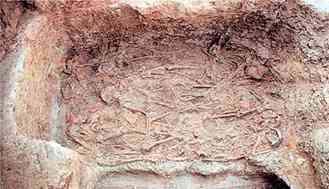
In 1994, while excavating for the new Metro (underground/subway), workmen uncovered the skeletons of about 150 men, women and children, all hastily buried in a 'plague grave' (above, left) at Kerameikos, the ancient  cemetery of the city.

According to its excavator, E. Baziotopoulou-Valavani, the mass grave did not have the slightest monumental character.  The offerings were of common, even cheap, burial vessels; black-finished ones, some small red-figured, as well as white lekythoi (oil flasks) .... The bodies were [randomly] placed in the pit within a day or two ... with no layers of soil between them. 


Among the bones was an almost intact cranium of a young girl, her sex defined by the anatomy of the skull, complete with her jaw and a mixture of 28 milk and adult teeth preserved.  She was about 11 years old when she died.  The Greek archaeologists gave her the name of 'Myrtis'.

Although she was buried in the Kerameikos cemetery, it is not known if she was an Athenian, a resident immigrant (that is, a Metic) or a slave.  My guess is that she was not from a citizen family.  Despite the death rate, Thucydides shows that people did try to maintain proper funeral rites, which at this time meant cremation and burial of ashes, not interring of bodies.  Even those who could barely cope burnt the corpses somehow:

Because so many deaths had already occurred in their households, [many people] adopted the most shameless methods.  They would arrive first at a funeral pyre that had been made by others, put their own dead upon it and set it alight; or, finding another pyre burning, they would throw the corpse that they were carrying on top of the other one and go away.
Of course, Thucydides was not interested in the disposal of dead Metics or slaves, so I think it likely that such lower-class victims would be dumped, uncremated, into mass graves.   

What killed Myrtis?

Historians have long tried to identify the disease behind the Athenian plague -- an infectious disease virulent enough to carry off one-third of the population (and a quarter of the army) in just four years.  Was it bubonic plague, smallpox, typhus, measles, ebola fever, or some deadly disease that no longer exists? 

We now have the answer.

A group of Greek scientists (led by Dr M. Papagrigorakis of Athens University’s School of Dentistry) examined the dental pulp of teeth recovered in remains from the grave.  They discovered microbial DNA sequences very similar to Salmonella enterica serovar Typhi, that is, typhoid fever.  Typhoid's clinical characteristics, too, are in close accord with the agonizing symptoms described by Thucydides -- who himself fell ill with the plague and was among the lucky few to recover. Overcrowding and poor standards of hygiene in the besieged city would have allowed the disease to appear and then develop into a deadly epidemic.

Now Meet Myrtis

Scientists have been able to reconstruct her face almost down to the last detail (top of the post, left, and below).  This kind of facial reconstruction requires the expertise of a physical or forensic anthropologist and extensive experience of the anatomy of the face as well as good artistic abilities.

Oscar Nilsson, a Swedish sculptor and model-maker, carried out the recreation.
By combining knowledge of the tissue-depth of the human face with the technique of building up the face muscle-by-muscle, an individual appearance is achieved.  The shape and size of eyes and nose are calculated from the size of the ocular and nasal cavities.  Myrtis evidently had a straight nose and slightly protruding teeth.  On the assumption that she was Greek, she was given reddish-brown hair and brown eyes (although if a resident alien or slave, her ancestry is unknown; further DNA studies will be needed to confirm hair and eye colour). 
 
Myrtis: Face to Face With the Past


Tomorrow, 13 September, Myrtis will move to the National Archaeological Museum of Athens for temporary display (until 30 November).  It is an ideal setting for her to be placed among so many Classical burial sculptures and funerary reliefs.  

Through the face of little Myrtis, sepulchral monuments and memorials of the 5th century BC come back to life and talk with us.  They remind us of the common human fate, death, but also of its defeat by means of memory.  It is no coincidence that Myrtis was declared “Friend of the Goals of the Millennium” by the United Nations.

Her picture has been posted on a website supporting the UN Millennium Goals
on disease prevention and the campaign, "We Can End Poverty". And, needless to say, the 21st-century Myrtis has her own website The 11-year from Athens has posted a letter to the leaders of the world:

My death was inevitable. In the 5th century BC we had neither the knowledge nor the means to fight deadly illnesses. However, you, the people of the 21st century, have no excuse. You possess all the necessary means and resources to save the lives of millions of ... children like me who are dying of preventable and curable diseases.
Even today, typhoid fever is a major health problem in the developing world where overpopulation, inadequate water supplies and hygiene, as well as poor access to health services, allow epidemics to spread. Every year there are about 20 million new cases that lead to 600,000 deaths.  With only five years left until the Millennium deadline, the achievement of the goal of prevention looks doubtful. 

Well, reborn Myrtis is doing her bit.


But, why in the world was she called Myrtis?    


I assume that the archaeologists named her after the ancient woman poet.**  This 5th-century Myrtis, remembered as 'Sweet-voiced', was said to have been the teacher of two of the best Greek lyric poets, Corinna (another woman) and Pindar.  It is a pity that all of her verse is lost; not a single word survives.  So I borrow a fragment from Corinna, appropriately composed, I think, for public performance by a choir of young girls:

Enjoying the gifts of the Muses
I tell my story in song...
If you are in Athens this autumn, do visit Myrtis at the National Archaeological Museum. She may not sing but she's otherwise brought to life rather well.  


*Thucydides, The Peloponnesian War, 2.47-55, translated by Rex Warner, Penguin, 1954.

 ** I assumed this, really, because I have named one of my Siamese cats 'Myrtis' and, yes, I had the Boeotian poet in mind.  The truth is sadly more mundane.  Prof. Papagrigorakis asked the archaeologists to come up with a list of girl's names from the classical era.  He chose a two-syllable sonorous name that is still in use today (Myrto in modern Greek).My thanks to Prad Patel on Heritage Key (1 September) for alerting me to the temporary exhibition of Myrtis in Athens.

Illustrations 

Above left: from the press release of the National Archaeological Museum

Middle left: Mass grave containing the remains of 150 plague victims.  Photograph Ta Nea Online 10/04/10 (via Archaeology News Network 

Insert left: Image of Myrtis' skull.  Photograph Ta Nea Online 10/04/10 (via Archaeology News Network)

Lower left: Close-up of Myrtis (via dimos-nestoros.gr


Lowest left:  Myrtis (via the WHBC-gr website)


29 August 2010

The Uppity Queen Arsinoë II (Part II) [Updated]

(Part I, click here)

To Reign or Rule?

Some scholars pooh-pooh the idea of Queen Arsinoë II having had any share in real power.  They can't deny that some later Ptolemaic queens did rule in their own right, if often briefly (Cleopatra Berenice, Cleopatra Tryphena, another Berenice, and -- most exceptionally -- the glorious Cleopatra VII); but there seems to be an unspoken assumption that female rule was only possible because later male Ptolemies were degenerate -- and it serves them right for all that  incest!   

But when Arsinoë II was queen, the dynasty hadn't had nearly enough time to degenerate and, anyway, neither she nor Ptolemy II were children of incest.  So, they argue instead that the queen's power was more apparent than real: 

Philadelphos trusted her, possibly confided in her, and gave her a social role in the affairs of his kingdom". (emphasis mine)

The upshot is that she had no part in the formation of public policy.

 Arsinoë II Rules OK

Feminist historians look at it differently.  To their eyes,  Arsinoë's political sway was far above what was customary for royal consorts.  Some even suggest that Ptolemy II was a weakling and Arsinoë II the real power in the land.  Certainly, unlike his father, the king was not a military man; he started lots of wars but won few.  In fact, when Arsinoë married Ptolemy, Egypt was in the midst of losing a war against Seleucid Syria:
The new queen set her hand to rectifying the situation.  She reorganized the army; she accompanied it on its campaigns; she won the Syrian war.  Her grateful husband acknowledged his debt to her policies with a public inscription in 266 B.C.
Naturally, after she died, Ptolemy went on to lose a Second Syrian War because she was not there to help him.

Mimimize or Maximize? 

So which story is closer to the truth? 

Arguing the pro's and con's from our surviving sources can be devilishly difficult (below, I give some on-line sources for those who like the nitty-gritty). But, however deeply you go into it, the fact remains that there is no proof either way.  Whether you come down on one side or the other depends, in the end, more on hunches than the solid weight of evidence.  

Two new points might help: one, admittedly, a matter of opinion; the second,  a pictorial matter of fact.

Holy Incest

Brother-sister royal incest from the queen's point of view is a win-win bet.  That doesn't mean that it wasn't awfully daring for Arsinoë II to take this leap into the unknown (and, since she's seen as stronger and smarter than Ptolemy, historians generally assume that it was her idea and not the king's), but there's little doubt that the pairing was of great benefit to queenship: almost inevitably, it conferred greater power on the queen.   

Sibling incest for the Ptolemies, as also for earlier Pharaohs, established an equality between king and queen as co-rulers. Accordingly, Arsinoë shared every title of honour with her brother and was deified together with him. Brother-sister marriage did not of itself grant the queen political power and control, but it put her in a position to take power if and when the opportunity arose.  And this remained true for future queens of the dynasty: their power and prestige was related to the continuing prevalence of sibling marriage. 

After all, you are the daughters of gods

That's really part of the self-aggrandizing message of the Theoi Adelphoi coins (scroll down [or click] to see the images in Part I).  The title of 'gods' appears above the heads of their deceased parents on one side, while Ptolemy and Arsinoë, pictured on the reverse, are simply labelled 'siblings'.  However, anyone handling the coin would mentally link the titles and read it as a coin of the 'sibling gods'.  

The Ghost of Alexander the Great 


After Alexander had conquered Egypt, he wasted no time in crossing the western desert where he was said to have been led by two snakes to the Oracle of Amun at Siwa Oasis (winter/spring, 332/331 BCE).  This oracle of the ram-headed god Amun (left) was famous throughout the Greek world.  Almost certainly, Alexander went there to seek the god's approval for his plan to found a city on the shore of the sea

A city like the joyous spring.
In populousness and spaciousness like Paradise; 
For it was both a market-place and a sowing-place.
They [would give] to it even the name of Alexandria.

But Amun granted him even more than the future metropolis.


Just as Alexander approached the oracle, he was greeted by the priests as "son of Amun", their usual form of address to new pharaohs.  From this time on, like several Egyptian pharaohs, Alexander was pictured on  monuments (below) with the ram-horn of Amun to publicise his position as son of the god and legitimate king.


Naturally, all the Ptolemies desired to associate themselves with the glory of Alexander.  So much so, that the first Ptolemy hijacked Alexander's funeral cortege as it travelled, with astonishing pomp, from Babylon on its way home to Macedonia. When the cortege had reached the Mediterranean sea at Alexandria-ad-Issum (a city in Syria, founded by Alexander to celebrate his victory over the Persians), Ptolemy arrived with an army and forced the gold-and-jewel-covered cart with the coffin to take the road south to Egypt.

The gold-encased body of the hero was eventually transported to Alexandria and placed in what would become the royal cemetery of Ptolemy's line.  Over the next three centuries, as each of Ptolemy's descendants died, he was buried in an opulent mausoleum in the royal cemetery, near the central tomb of Alexander.  The dynasty's cult was celebrated there and Alexander's tomb, especially, was treated as a shrine.  Ptolemy I thus not only exalted his hero but, by doing so, elevated his own status as the guardian of the body of the greatest king, who was also a god.

Despite this close association, no Ptolemy ever adopted the divine ram's horns.  No male Ptolemy, that is, for the remarkable exception was Queen Arsinoë II.

On her coins (below), and on hers alone, the ram's horn appear below the ear  -- and you can just see the outline of the horn beneath her veil.  


The ram's horn is common on her posthumous coins but hardly ever appears on cult statues. I know of just one case: that's the head of a small basalt statue (below), carved in the Greek style with some slight Egyptian influence.*


Just as we  imagine it on the coins, here the horn emerges in 3-D from the hair to curl backwards and downwards behind the ear.  It seems to grow naturally from the wavy locks, yet its outline and striations clearly define it as a ram's horn. 

Why would a queen wear the ram-horn of Amun?


An inscription left by her brother-husband after her death, in a temple of Mendes (another god worshipped in the form of a ram) tells us a little of what happened: 
Princess great of favour, sweet of love, beautiful queen, who has received the crowns of Upper and Lower Egypt, whose loveliness fills the palace, beloved of the Ram, priestess of the Ram, sister of the king, wife of the king, his beloved, mistress of the Two Lands, Arsinoë.... His Majesty commanded that her ram-image be erected in all temples... at the side of the living rams.
So, Ptolemy II initiated the practice -- which makes sense since the great gold octadrachms which usually clearly show the tip of the horn are part of her posthumous honours. The horn is a sign of godhead, certainly, but Ptolemy II and his successors -- though living gods and given divine honours -- were never pictured with it.  So it is, at the very least, an exceptional mark of Arsinoë's divine status.  

But did the king also intend to associate his queen with Alexander?

One Coin Is Worth 1000 Words

I cannot see how any contemporary of theirs would fail to make that connection.  Just as the Theoi Alelphoi coins, described above, implied the 'sibling gods' (but didn't directly state it), the ram's horn would inevitably link Arsinoë II to the revered Alexander -- for they are only two rulers in the Ptolemaic world who shared this divine attribute.**   

It is entirely possible that Arsinoë herself chose this honour before she died.  She would have been acutely aware of its symbolism and the potency of the image: for the first coins showing Alexander wearing the ram's horn were struck by none other than her first husband, King Lysimachos, in Thrace, when she was still married to him.  So, yes, I do think it likely to be an intentional link, meant (in the royal minds at least) to raise the queen to the level of the one-and-only Alexander.  

If that isn't a statement of real power, what is?


* Published by D. Burr Thompson, "A Portrait of Arsinoe Philadelphos", American Journal of Archaeology 59 (1955) 199-206.

** Even if, on a higher plane, Alexander wore the symbol of Amun and Arsinoë that of the god Mendes, they were visually the same; it is doubtful if any but the priests of Egypt would have made a distinction.

For the minimalist position, see R.A. Hazzard, Imagination of a Monarchy: studies in Ptolemaic Propaganda, University of Toronto (2000) Ch. 2 & 5 (partly available on Google Books). For a maximalist argument, Julia K.W. Wong, Cleopatra I: the first female Ptolemaic regent, M.A. thesis,. Univ. of British Columbia, 1998, Ch. 3.1.  Other important sources included D. Burr Thompson's article (reference in the footnote above); C.G. Johnson, 'The Divinization of the Ptolemies and the Gold Octadrachms Honoring Ptolemy III', Phoenix 53 (1999) 50-56;  E. Teeter, 'Egyptian Art', Art Institute of Chicago Museum Studies 20 (1994), 27-29; and see references listed in Part I.

Illustrations

Upper left: Arsinoe II as Isis-Selene (Louvre Ma4891).  Photographer: Jastrow 2008, via Wikimedia Commons.


Upper middle left: black granite statue of Arsinoe II as Isis-Aphrodite.  Franck Goddio/Hilti Foundation - Photos: Christophe Gerigk.  You can read about this extraordinary underwater find on my blog post, Will The Real Cleopatra Please Stand Up.

Lower middle left: gilded and painted limestone statue of Arsinoe II as goddess. Metropolitan Museum of Art, Rogers Fund, 1920.

Below left: ram-headed Amun, Abu Simbel, via Africa Timeline Index.


Centre, upper (left): Thracian silver coin issued by Lysimachos, struck circa 280 BC. Diademed head of Alexander to right, ram’s horn over his ear. Photograph from CoinArchives.  (right): Silver coin issued by Lysimachos (thought to be a copy of a portrait of Alexander by Lysippus), reproduced by permission of trustees of the British Museum.


Centre, lower (left): Gold octadrachm of Arsinoë II, Year 6, struck at Ake-Ptolemais mint. Photograph by Wildwinds.  (right): Gold octadrachm of Arsinoë II, struck under Ptolemy II.  Photograph from CoinArchives .  Both sites have many other illustrations of her coins.


Updated 9 November 2010


As we said, many scholars argue that Arsinoë's royal titles were given to her posthumously as a part of a program instituted by Ptolemy II. If that is true, they need reflect little or nothing of her power during her lifetime.  But now, a new doctoral dissertation (Maria Nilsson, THE CROWN OF ARSINOË II, THE CREATION AND DEVELOPMENT OF AN IMAGERY OF AUTHORITY) identifies two, possibly three honorary scenes that date to Arsinoë's lifetime.  These scenes depict the queen's unique crown (made up of the red crown, ram horns, double feather plume, cow horns and a solar disc). 

Nilsson argues that Arsinoë's royal titles were embedded in the complex symbolic structure of her crown, and directly connect to her socio-political as well as religious role; all relate to the cult of Amun in one way or another.  These are the titles, she believes belonged to the living queen/female king:

1. Arsinoë's epithet “Banebdjedet” (the ram god) can be identified with the oldest conventional royal title, the Horus name. As a local form of Amun, Banebdjedet is depicted with horns identical to those of Arsinoë.  The ram horns symbolize her socio-political position as a (living) co-regent of Egypt (King of Lower Egypt), and her general associations with the ram god.

2. The second royal title, the Nebty name, signifies the Two Ladies, the vulture and cobra, Nekhbet and Wadjet, and their divine protection of the pharaoh.

3. The Golden Horus name in Arsinoë's title “Beautiful of appearance”, has its pictorial counterpart in the solar disc.

4.  Her throne name is identified with the designation “She who is in the heart of Shu/King, Beloved of all the Gods”. The symbolic correlation with the crown of Arsinoë is provided in her coronation prefix “King of Lower Egypt".  This is symbolized by the red crown, a fundamental element in
Arsinoë's crown.
 
5. Arsinoë‟s birth name prefix “Daughter of Amun” is expressed by the complete structure of the crown, describing her cultural position as the King of Egypt – the legitimate daughter of Amun.
 
Nilsson concludes that the crown of Arsinoë was created for the living queen and reflected three main cultural positions: her royal position as King of Lower Egypt, her cultic role as high priestess, and her religious aspect as thea Philadelphos. It indicates that she was proclaimed female pharaoh during her lifetime, and that she was regarded the female founder of the Ptolemaic Dynasty (pp. 497-501).


The full dissertation, The crown of Arsinoë II. The creation and development of an imagery of authority is available on-line at http://gupea.ub.gu.se/handle/2077/23417


20 August 2010

The Uppity Queen Arsinoë II

Who's the Woman Behind this Giant Coin?

The news that a rare Ptolemaic gold coin was found in Israel -- weighing just under one ounce (27.71 grams) of almost pure gold -- seems to have overshadowed the woman whose portrait is literally heads-up on it.*  The coin  -- more a medallion, really, than money meant to be spent -- is  worth a cool $1,184 at today's price just for its gold (never mind a premium of $$$$ for antiquity and rarity).  It commemorates Queen Arsinoë II -- one of the feistiest Hellenistic queens ever.

And, believe me, the competition for 'feistiest Hellenistic queen' was stiff.

In many ways, Arsinoë II was their role model. 

The Early Ptolemies

Alexander the Great conquered Egypt in 332-331 BCE.   When he died at Babylon in 323, his eight senior generals agreed to divide the empire among them, each to govern his respective territory as a vassal for the kings of Macedonia.  Ptolemy son of Lagus, was appointed to govern Egypt.  He declared himself king in his own right in 304, founding the Ptolemaic dynasty that would rule Egypt for almost 300 years. The dynasty lasted until the death of the great Cleopatra VII and the Roman conquest of Egypt in 30 BCE, easily the best-known event of ancient history.

Ptolemy I - Berenice I 'Of the gods'
Arsinoë was born in 316 BCE, the only daughter of Ptolemy I and his fourth wife, Berenice I.   The king became known as Ptolemy Soter, that is 'Saviour'.  He and Berenice were later deified, given a cult and priesthood, and described as 'gods' (ΘΕΩΝ on the coin above).   

At the age of 15 or 16, Arsinoë was sent to the Balkans and married to Lysimachus, king of Thrace and Macedon.  Lysimachus was another of Alexander's top generals: he had been married at least twice before and was old enough to be her father (about 55 when they married).  She was said to have been aroused rather by one of his sons, Agathocles, who virtuously rejected the young queen's advances.  Miffed at the insult, Arsinoë may have poisoned him or at least persuaded Lysimachus to do so.  The prince's death conveniently opened the way to Macedonian kingship for the sons of her own marriage.  Her husband finally died in battle in Feb 281 (fighting against yet another of Alexander's  generals), at the age of 74. Now, alone with her three young sons, Arsinoë commanded the garrison at Cassandreia, one of the most important Macedonian cities.

The Plot Thickens

Early in 280, her half-brother, Ptolemy Keraunos seized the Macedonian throne, thereby depriving Arsinoë's sons of the succession.  Now, in a move so characteristic of the future of this dynasty, Ptolemy Keraunos tricked his half-sister into a half-incestuous marriage,** took the city of Cassandreia for himself, and murdered her two younger sons -- though not for want of trying to kill the eldest too.  The marriage thus abruptly terminated, Arsinoë and her surviving son fled into exile on Samothrace.  Soon after, Ptolemy Keraunos was driven from his throne, and the immortal gods inflicting vengeance on him for so many perjuries, and such cruel murders, he was taken prisoner by marauding Gauls who killed him and carried his head about as a mascot on their further campaigns.

Arsinoë spent some time on Samothrace trying to regain the throne of Macedon  for her remaining son (yet another Ptolemy, perhaps Ptolemy Nios) but that prize eluded her.

The Tigress Queen

Arsinoë and son then sailed to Egypt where her younger brother, Ptolemy II had succeeded to the throne.  Ptolemy II was married to Arsinoë I (I know this is confusing, but I can't help it), a daughter of Lysimachus -- presumably by a wife or two before he had married Arsinoë II.  It didn't take long for Arsinoë II to get the better of Arsinoë I and boot her out: though the mother of his three children, Ptolemy II found her guilty of plotting against his majesty and exiled her to Coptos in Upper Egypt, where she vanishes from history.

Egyptian Bombshell

Now, the way to the throne was clear.  In winter 276/5, Arsinoë II took part in the first (but far from the last) full-sibling marriage of the dynasty, marrying her brother Ptolemy II.  There is no record of what their Egyptian subjects thought of this incestuous pairing but Graeco-Macedonian opinion was shocked.  To counter this, the royal couple commissioned the court poet, Theocritos, to explain why brother-sister incest was a great idea.  Theocritos (Idylls 17) obligingly likened the marriage to that of Zeus and Hera, brother and sister, king and queen of the gods.  It is toe-curling stuff:
From Zeus let us begin ..., for of immortals he is best; but of men let Ptolemy be named first, last and in the midst, for of men is he most excellent..., he and his noble wife, than whom none better clasps in her arms a husband in his halls, loving with all her heart a brother and a spouse.  After this fashion was accomplished the sacred bridal also of the immortals.
Common gossip saw it differently.  As a singularly imprudent poet named Sotades put it, "You are thrusting your prick into an unholy hole."  The royals were not amused: one of Ptolemy's generals arrested Sotades and, thrusting him into a leaden jar, carried him out to sea and sank him beneath the waves.

Ptolemy II and Arsinoe II 'Siblings'

On the reverse of coins dedicated to their parents as gods, they put their conjoined portraits with the added word 'siblings' (Adelphoi) -- just in case you missed the point. In fact, both king and queen took the title Philadelphos, 'Sibling-lover' -- used thereafter on documents and coins -- which deliberately highlights their incestuous union.  


Arsinoë added a touch of her own.  Instead of the typically Ptolemaic cornucopia (horn of plenty) -- a symbol of wealth, abundance, and the good things of life -- she depicted a new double cornucopia on  her coins (left) --  surely an allusion to the doubling of the royal blood.  That is the emblem on the reverse of the gold octadrachm (at the top of the post); she is named as Arsinoë Philadelphos. 


Why stress incest?

Full sibling marriage was, as Theocritus implies, the prerogative of the gods; and to behave like the gods is to assimilate oneself to them.  Not only Greek Zeus and Hera, but also Egyptian Isis and Osiris were mated sibling gods who provided the divine precedent (followed, too, by some earlier Egyptian Pharaohs). The king also bestowed on her the pharaonic title of 'royal wife and sister'.  In Egyptian, she was nsw-b'itj = "Queen of Upper and Lower Egypt", an exceptional title which had been given only very rarely to pharaonic queens.  In 272/1 BCE, the royal pair added the cult of the 'Sibling gods' to their dynastic priesthood, established shrines and publicly celebrated their own divine rites.  

Sister-goddess-queen

Arsinoë became the most honoured Graeco-Macedonian woman during her lifetime with her deification as a goddess.  She received an abundance of cults, statues, priestesses, and dedications from her subjects and her husband, not just in Egypt but throughout the Greek world.  The Ptolemaic admiral of the fleet, to give just one example, dedicated a temple to her as the goddess Aphrodite:
While on the sea and when on land, keep in your prayers this shrine of Arsinoe-Aphrodite Philadelphos, whom admiral Kallikrates first consecrated here to rule over the headland of Zephyrium. She’ll grant good sailing or make the sea, for those who call upon her in the storm, smooth as oil. (Poseidippos, in Athenaios 7.318d)

In 267, her son, Ptolemy Nios, who was thwarted of the Macedonian throne, finally made it to the top, when he was named by her husband as co-regent.

Life must have seemed perfect.

Alas, despite being the daughter of divine parents and herself deified, Arsinoë was not immortal.  After about five years in power, the queen suddenly died.  The country was filled with lamentations; everyone was dressed in black.  Towns and streets were given her name so that she would be remembered and the great province of the Fayoum was renamed 'Arsinoë'.  Ostentatious  memorials were built.  The poet Callimachus wrote a dirge, The Deification of Arsinoë, still partly preserved:

O bride, already up under the stars of the Wain
snatched away ... you were speeding past the full moon...
Queen Arsinoë has gone... our star was quenched,
and overflowing grief taught the great husband 
to light fires as an offering for his wife...
It was all very sad.  Arsinoë's status as a cult figure after her death is not in doubt.  Not least, gold octadrachms continued to be produced in her name for well over a century.  The coin/medallion just found in Israel, which kicked off this post, was actually minted in 191 BCE by Ptolemy V -- whose wife, by the way (Cleopatra I), was the first queen-regent of the dynasty; she ruled on behalf of Ptolemy VI, who went on, in his turn, to issue octadrachms in Arsinoë's honour.  Her posthumous importance is undisputed.  

Much more contentious is the question of the nature of her power during her five years on the throne. Did she wield real political power or was she just a pretty cult face on the gold coins?

We will tackle that burning question next week in Part II, when I'll present the main arguments, pro and con -- and add what I think is something new to the mix.


* The coin was found at Tell Kedesh in Israel near its Lebanese border. It is technically an octadrachm (also called mnaieion, meaning a one-mina coin), equivalent to 100 silver drachms, or a mina of silver.  

** In Athens (and perhaps elsewhere in Greece and the Balkans),  marriage was allowed between half-sister and half-brother if they shared the same father -- as was the case here -- but not if they shared the same mother.

Trying to sort out the genealogy and chronology of the Ptolemies is like stepping into a morass: just when you think you are on firm ground, you slip into a hole instead.  Undoubtedly, the best guide is the website of Chris Bennett; but this is not for the faint-hearted (myself often included).  The question of Ptolemaic incest and its meaning is brilliantly examined by Sheila L. Ager, "The Power of Excess: Royal Incest and the Ptolemaic Dynasty" in Anthropologica 48 (2006), 165-186; and, aimed more at classicists, "Familiarity Breeds: Incest and the Ptolemaic Dynasty" Journal of Hellenic Studies, 125 (2005) 1-34.

Illustrations

Upper left & middle left: the Tell Kedesh octadrachm (both sides) photography by Sue Webb via the Israel Antiquities Authority.


Middle (above):  Gold octadrachm with Ptolemy I/Berenice I as gods on obverse; (below): Ptolemy II/Arsinoë II as siblings on reverse.  Photograph: Ancient & World Coins

08 August 2010

Building An Invisible City

The Invisible City of Zenobia
 
Italo Calvino’s invisible city of Zenobia was one of the most suggestive surreal images of the late 1900's.  Now, the invisible has became 'the possible'.  It is a real-life project , even (perhaps) a practical proposal.  If ever built, Zenobia (below) will be a 'decipherment', and a city like no other.

Now I shall tell of the city of Zenobia, which is wonderful in this fashion: though set on dry terrain it stands in high pilings, and the houses are of bamboo and zinc, with many platforms and balconies placed on stilts at various heights, crossing one another, linked by ladders and hanging sidewalks, surmounted by cone-roofed belvederes, barrels storing water, weather vanes, jutting pulleys, and fish poles, and cranes.

No one remembers what need or command or desire drove Zenobia’s founders to give their city this form, and so there is no telling whether it was satisfied by the city as we see it today, which has perhaps grown through successive superimpositions from the first, now undecipherable plan. But what is certain is that if you ask an inhabitant of Zenobia to describe his vision of a happy life, it is always a city like Zenobia that he imagines, with its pilings and its suspended stairways, a Zenobia perhaps quite different, a-flutter with banners and ribbons, but always derived by combining elements of that first model.

This said, it is pointless trying to decide whether Zenobia is to be classified among happy cities or among the unhappy. It makes no sense to divide cities into these two species, but rather into another two: those that through the years and the changes continue to give their form to desires, and those in which desires either erase the city or are erased by it.


(From Le Città Invisibili by Italo Calvino; translation William Weaver)

Designed by Italian architects Alessandro Tonni and Manuela Spera,  the city Calvino inspired is meant to create a meeting point between architecture and literature.  Calvino, I think, would have relished it.

Invisible Cities

In a garden sit the aged Kublai Khan and the young Marco Polo -- Tartar emperor and Venetian traveller. The mood is sunset. Kublai Khan has sensed the end of his empire, of his cities, of himself. 

Marco Polo diverts the emperor with tales of cities that he has seen within the empire and Kublai Khan listens, searches for a pattern in Marco Polo's cities.  Here are all the cities ever dreamed of, strange magical invisible cities that nobody else ever saw. All are named after women (as they must be, since cities are feminine in Italian) -- Raissa, Irene, Phyillis, Olinda, Armilla, Chloe, Valdrada...
The ancients built Valdrada on the shores of a lake, with houses all verandas one above the other, and high streets whose railed parapets look out over the water. Thus the traveler, arriving, sees two cities: one erect above the lake, and the other reflected, upside down. Nothing exists or happens in the one Valdrada that the other Valdrada does not repeat, because the city was so constructed that its every point would be reflected in its mirror, and the Valdrada down in the water contains not only all the flutings and juttings of the facades that rise above the lake, but also the rooms' interiors with ceilings and floors, the perspective of the halls, the mirrors of the wardrobes.
And Zobeide...
From there, after six days and seven nights, you arrive at Zobeide, the white city, well exposed to the moon, with streets wound about themselves as in a skein. They tell this tale of its foundation: men of various nations had an identical dream. They saw a woman running at night through an unknown city; she was seen from behind, with long hair, and she was naked. They dreamed of pursuing her. As they twisted and turned, each of them lost her. After the dream they set out in search of that city; they never found it, but they found one another; they decided to build a city like the one in the dream. In laying out the streets, each followed the course of his pursuit; at the spot where they had lost the fugitive's trail, they arranged spaces and walls differently from the dream, so she would be unable to escape again.
The emperor soon determines that each of these fantastic places is really the same place.

Marco Polo agrees: "Memory's images, once they are fixed in words, are erased...."

But the traveller still cannot stop.
- he must go on to another city, where another of his pasts awaits him, or something perhaps that had been a possible future of his and is now someone else's present. Futures not achieved are only branches of the past: dead branches.

"Journeys to relive your past?" was Kublai Khan's question at this point, a question which could also have been formulated: "Journeys to recover your future?"

And Marco's answer was: "Elsewhere is a negative mirror. The traveller recognizes the little that is his, discovering the much he has not had and will never have."
The dialogue continues (Cities & Memory, Cities & Desire, Cities & Signs) yet, as Calvino tells us, "most of the time they remained silent and immobile."

Finally, Kublai Khan recognizes that all cities are tending toward the concentric circles of Dante's hell.
He said: "It is all useless, if the last landing place can only be the infernal city, and it is there that, in ever-narrowing circles, the current is drawing us."

And Polo said: "The inferno of the living is not something that will be; if there is one, it is what is already here, the inferno where we live every day, that we form by being together. There are two ways to escape suffering it. The first is easy for many: accept the inferno and become such a part of it that you can no longer see it. The second is risky and demands constant vigilance and apprehension; seek and learn to recognize who and what, in the midst of the inferno, are not inferno, then make them endure, give them space."
Of course Zenobia will never be built. 

Which would suit Calvino perfectly.  As he said of himself, "The ideal place for me is the one in which it is most natural to live as a foreigner."


I've made much use of the brilliant review of Calvino's Novels by Gore Vidal (New York Review of Books)

Major Calvino websites at: Emory UniversitySwarthmore College and Outside the Town of Malbork

Illustrations from 'Reinterpreting Italo Calvino's Zenobia' at Evolo us News 31 July 2010.  The architects may be found at Architizer.


Blog Archive