28 May 2014

Egyptian 'Tomb Treasures of the Late Middle Kingdom'


The Archaeology of Female Burials

Ask anyone: the glory of Middle Kingdom art is its sculpture --  and I agree: it really does reach an extraordinary high level, especially during the 12th Dynasty (ca. 1983-1778 BCE).  Most of the grandest statues, of course, depicted kings and princes but royal sculpture also extended, if less often, to the females of the ruling families.  One of the finest such pieces is this masterly polished head of Princess Ita, a child of Pharaoh Amenemhat II (1919–1885 BCE), the beloved king's daughter of his body.*  

We actually know something about this princess.

The reason I want to tell you about her is that I've just read a fascinating new book by Egyptologist Wolfram Grajetzki, Honorary Research Associate at University College London.   In his Tomb Treasures of the Late Middle Kingdom: The Archaeology of Female Burials, Dr Grajetzki pulls together for the first time all possible information on Middle Kingdom tombs belonging to elite and royal women (the so-called 'Court Type' burials of people closest to the king; in a word, his courtiers).  It's a surprisingly short list.  So many of their tombs were excavated in the nineteenth or early-twentieth centuries when, to be honest, archaeologists were more interested in getting objects for museum collections than in recording details of the dig, let alone correctly sexing the skeletons.  Most tombs were also massively looted in antiquity resulting in fragmentary finds and badly-disturbed contents. 

There was no such insult to the grave of Princess Ita.  She and other females of her family were the lucky ones.

Horus has placed gold on his eye, a gold collar (Pyr. spell 742)

Ita's tomb was found in the pyramid complex built by her father, Pharaoh Amenemhat II, at Dahshur, about 30 km (19 miles) south of Cairo.  The pyramid was re-discovered  by the French archaeologist Jacques de Morgan (left) in 1894 but it was in deplorable state -- a shapeless heap of rubble with only piles of white limestone chippings -- the remains of its outer casing -- to mark the spot.  Around the west enclosure wall of the pyramid, however, De Morgan found three underground galleries, each of which contained two burials.  

Miraculously, the burials had been missed by grave robbers and they produced sumptuous examples of Middle Kingdom funerary objects.  

If  you've got it, flaunt it!


The first gallery excavated by De Morgan's team belonged to the king's daughters Ita and Khenmet.

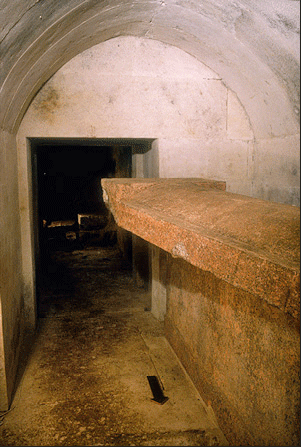
Princess Ita's tomb consisted of two chambers, one completely filled by the sarcophagus, while the other contained her burial goods.  Her body was found inside a set of three containers. The outer sarcophagus was a simple sandstone rectangular box.  Then, a middle coffin decorated with gilded edging and inscribed on the inside with religious texts and on the outside with wedjat eyes D10 , symbols of protection and royal power.  The poorly preserved inner anthropoid coffin (that is, shaped like a human mummy) was embellished with inlaid silver eyes, a headdress in blue with golden bands, and a broad beaded collar on the breast.  The actual mummy wore around her neck the remains of a broad collar made of silver and beads of lapis lazuli, carnelian, and turquoise, and was decked out with multiple armlets and bracelets.  
We don't know if Princess Khenmet, who was buried near Ita in the same gallery, is her sister or not.  Like Ita, she was laid to rest in a set of three containers: an outer sarcophogus made of quartzite, a wooden coffin with inscriptions almost identical to those found inside Ita's coffin, and a badly-decayed inner anthropoid coffin -- its head covered in blue and gold and with inlaid silver eyes.  She too was described as a king's daughter but boasted the additional title of "the one united with the white crown" (Khenmetneferhdjet, perhaps not a title but a longer version of her name).

Khenmet's jewellery was drop-dead gorgeous.


The broad collar around her neck had gold falcon-head terminals.  Look at them closely: the eyes, eyebrows and mouths of the falcons are inlaid with lapis lazuli.  The collar is made of 103 pieces of gold in the shapes of the ankh (life!), djed (stability!), and was (power!) signs. 

The two golden crowns right under the words 'flaunt it!' (up above) belonged to her too.  The circlet on the left consists of a series of golden flowers with carnelian, lapis lazuli, and turquoise inlays, each connected by gold wires to smaller gold flowers.  The second crown is of heavier gold and inlaid with the same gemstones.  In the middle, between rosettes and flowering plants, stretches the figure of a vulture made of gold leaf and with black obsidian eyes.  The vulture suggests that Princess Khenmet was a queen; if so, her elevation may have happened quite late in life -- after most of her funerary equipment had already been made, since the title of a king's wife never appears.  

She had lots more gold jewellery (five bracelets on each arm, chokers, and clasps among other items), as well as a collection of separate gold pieces (above), perhaps from several different necklaces, which looks quite un-Egyptian in character and is more  reminiscent of goldwork from the Aegean, perhaps Minoan Crete.

Despite its beauty, I'd really like to get away from the fabulous golden gee-gaws and consider something quite different.  No one doubts that the jewellery reflects the personal identity of these women.  They are the adornments, so to speak, of their social and religious functions at the royal court.  It is also exactly what we expect wealthy ladies to take with them to the grave.  But other objects found in both Khenmet's and Ita's tombs are more debatable: such as wooden staffs and sceptres (signs of authority), a set of bronze tools, including chisels, burins, and knives, a mace (symbol of power), and daggers.  Khenmet had a dagger made of gilded wood.  But Princess Ita trumped her royally in daggers.

Royal Insignia

Near Ita's waist,  perhaps having dangled from her belt, was this remarkable dagger (left).  The crescent-shaped pommel is made of lapis lazuli.  The grip is beaten gold and inlaid with disks of lapis lazuli and green feldspar. The disks are inlaid with crosses of thin gold and between the disks are squares inlaid with light brown carnelian. A solid gold shoulder holds the bronze blade attached by three gold rivets. The gold was surely too weak to support the pressure of a thrust if the dagger was meant to be used -- so it must have been made as a funerary object for the tomb.  Just like the foreign pieces (above) of Khenmet's necklace, this dagger is also un-Egyptian in style: the rosette-like pattern of the handle is a fairly common design on Minoan Crete, while the blade's shape points to manufacture in Byblos on the northern coast of Lebanon.  

I have taken the time to describe this dagger in detail not only because it is one of the masterpieces of ancient metalwork but because it should make us ask the question: what is this superb weapon doing in a woman's tomb?  She was not alone in having a  dagger.  Princess Khenmet was buried with a gilded dagger as well as a mace.  Some elite women in similar 'Court Type' graves elsewhere had daggers, too, and often other weapons: maces, bows, arrows, and even spears.  If jewellery in the tomb describes a woman's identity, weren't these weapons also part of that identity? Yet, when the daggers are even noticed (other than for their craftsmanship), they are usually explained as weapons to be used against the evil forces to be met in the underworld.  In other words, they have nothing to do with the woman in life.  In fact, as we see from Dr Grajetzki's careful listing of finds from the few intact female burials, weapons as well as wooden staffs and sceptres are standard features of the "Court Type" burials -- for women as well as men.  Why, then, are they weapons when found with men, whereas with women they become magical tools for the afterlife?** 

We'll come back to this eternal question in Part II of this post.  We'll also consider the rich burials of women in other pyramid complexes; and, yes, look at more jewellery, too. Tomb Treasures of the Late Middle Kingdom may not be an easy book but the suitably cautious and meticulous author has given us a real boost in our understanding of The Archaeology of Female Burial.

Part II: Continuing our review of 'Tomb Treasures of the Late Middle Kingdom'


*This identification is not certain but the head strongly resembles that of a small, badly damaged sphinx statue  (now in the Louvre Museum) from the Syrian site of Qatna, inscribed with her name and text.

** My regular readers will be reminded of the story last October about the Etruscan prince found buried with a spear, who turned out to be, upon osteological analysis, a female: How a Prince Became a Princess: Quick Sex Change in Etruria.  Whereupon the spear was no longer seen as a weapon and symbol of authority but morphed into a symbol of the union of man and wife -- regardless of the fact it was found with her body, not his.  Later, discovering some needles in a bronze pyxis near her body (Part II: What's up with Etruscan gender?), the spear vanished from the story and the tomb was re-baptised 'The Embroiderer's Tomb', a perfect example of the conservation of gender regardless of the finds and their context. 


Tomb Treasures of the Late Middle Kingdom:

The Archaeology of Female Burials

By Wolfram Grajetzki

University of Pennsylvania Press

E-ISBN-13: 9780812209198
E-ISBN-10: 0812209192
Print-ISBN-13: 9780812245677
Page Count: 288
106 illus.
Publication Year: 2013


Illustrations

Top: Head from a Female Sphinx, ca. 1876-1842 B.C.E. Chlorite, 15 5/16 x 13 1/8 x 13 15/16 in., 124.5 lb. (38.9 x 33.3 x 35.4 cm, 56.47kg). Brooklyn Museum, Charles Edwin Wilbour Fund, 56.85. Creative Commons-BYImage: Brooklyn Museum photograph.

Upper left: Jacques de Morgan, Director of the Egyptian Antiquities Service, 1894/5: the illustration is  from the 'illustrated London News' and shows the dramatic moment of the discovery of Princess Khenmet's diadem.  Photograph via http://ib205.tripod.com/intact_burials.html

Middle centre: Golden crowns from the tomb of Princess Khenmet.  Original photograph: Emile Brugsch in Maspero 1908, Cat. Egyptian National Museum, vol.1, via Athena Review Image Archive.

Below left: Burial chamber of Princess Itakayet, daughter of Amenemhat II, at Dahshur.  Photo credit:  A. Oppenheim, "Queens and Princesses in the Pyramid Complex of Senwosret III, Dahshur". In Heilbrunn Timeline of Art History. New York: The Metropolitan Museum of Art (October 2004).

Lower centre: Gold pectoral with semiprecious gem stones worn by Khenmet's mummy: via  http://ib205.tripod.com/intact_burials.html.

Below centre: Gold jewellery from Khenmet's tomb (from Crete?). Egyptian Museum, Cairo 52975-9.  Via K. Benzel, 'Ornaments of Interaction: the Art of the Jeweler' in (J. Aruz, K. Benzel, J.M. Evans, eds.) Beyond Babylon, Metropolitan Museum of Art (2008) p. 102, Fig. 33.

Bottom left: Dagger from the tomb of Princess Ita.  Photograph via Eternal Egypt website.

08 May 2014

A DIRGE TOO SOON?

[My long blog silence was caused by the pressure of work + a computer crash.  I mark my return with something not close to my subject but close to my heart.]

Some faint hope for Zenobia, the Syrian ibis

Zenobia, queen of the ibis colony in Syria
Almost exactly a year ago, we were grieving not only for Syria and its raging civil war, but for Zenobia, seemingly the last ibis of Palmyra (left). 

Zenobia was the only Northern Bald Ibis to make it back to the breeding grounds in the desert near Palmyra after their annual winter migration to the Ethiopian highlands (the whole, sad story in Zenobia, Last Ibis in Syria). 

It had started out so well.

Right on schedule, Zenobia flew off with her mate, Odeinat, the one and only hope for her to continue the dynasty:

Taking flight after tagging
Zenobia had been paired the previous year to Odeinat, the last surviving male ibis.  But his satellite tag stopped transmitting before he ever reached Ethiopia -- the final bleep having been sent from southern Saudi Arabia in July 2012....  

After which he went radio silent.  Zenobia returned to Palmyra alone and no other birds followed her home.  Since no sole bird, not even a queen, can breed by herself, the Syrian branch of ibises -- once numbered in the thousands -- moved from Red-List Endangered (the highest level of threat) to the edge of Extinction.

On the Brink

That didn't stop Zenobia, however.  According to her satellite transmitter, in autumn she set off again to fly to Ethiopia for her winter break -- which meant crossing seven countries and flying over 6,000 kilometres (3,800 miles) to the Ethiopian highlands.

But was she alone?

Or did some Turkish ibis fly with her?  

A Turk in Time?

In July 2013, six birds from the semi-wild Northern Bald Ibis population at Birecik, Turkey were released in a trial re-introduction to nature.  Three were fitted with satellite transmitters and ringed. Four of the birds were juveniles, and two were one-year-old birds. The hope was that the gang of six would survive and migrate.

For the first two weeks, the birds remained very close to their home breeding station.  However, excitement mounted as five of the birds departed south, and the intriguing news was that they had stopped off very close to Palmyra in mid-August, where the remaining wild population was now just the one individual, our intrepid Zenobia.

What happened next is unknown.  The war had spread to Palmyra, making it almost impossible for the Syrian team of Bird-Life International to continue field checks at the ibis breeding site in the desert.

A Flutter of Hope 

Ibis grabbing tasty scorpion prey by its sting
A trusted Ethiopian field-worker of Bird-Life International, however, picked up the trail.  News from the highlands moves slowly: in February, as I've only just heard, he visited the site where the relict Syrian birds mainly overwintered.  He reported spotting three adult northern bald ibis!  These included the female Zenobia, who was accompanied by an unringed adult.  Another lone ibis was also sighted it the area.  So, there’s a faint hope that Zenobia and the unringed bird (one of the Turks?) are indeed a pair, and might make it back to breed in Syria. 

If so, they should be returning to Palmyra any day now. 

Keep your fingers crossed for Zenobia, that rarest of rare birds and last queen of the colony at Palmyra.


Sources: We have been following Zenobia's story from March 2007 (Zenobia's Triumphant Return to Palmyra) with further hopeful flights of Latest News in 2011 and 2012, only to be grounded in 2013 with  Zenobia, Last Ibis in Syria


Illustrations


Top: Zenobia the ibis, during satellite tagging at Palmyra in 2006. Photo courtesy of G. Serra (via NATGEO News Watch)

Upper left: Conservation officer, Adel Abouajaja, releasing Nader  (meaning 'rare'), at the Northern Bald Ibis Conservation Project in Morocco.  Photo Credit: Víctor García Matarranz (via SEO/Grepom).

Lower left: Northern Bald Ibis.  Photo credit: Brian Stone (via SEO/BirdLife).

Bottom: Ibis catching scorpion by its sting.   Undoubtedly this is a skill learned when they’re young, demonstrating the importance of learning in these birds.   Photo Credit: Víctor García Matarranz (via SEO/Grepom).

02 February 2014

A Lyrical Literary Miracle: More Sappho (2 Updates)

The Tenth Muse

Although they are
only breath, words
which I command
are immortal .*

So said Sappho over 2,600 years ago and time has proved her right. 

Yet, until 2004, the world could read only three complete poems by the Lesbian poet.  In that year, a fourth poem was discovered and, now, just this January, we have been given a fifth. 

More about the new poems in a moment.  Be patient, and you'll be among the very first to read the newest of the new poems in an English translation which appeared only two days ago.  But, first, a word about what we don't have.

There were once nine books of her poems that were written down in the 7th century BCE.  By the time of Tzetzes, a 12th century CE chronicler, most of her poems had already vanished (Since the passage of time has destroyed Sappho and her works, her lyre and songs....).  All that is left to us now are small scraps of papyrus, often with just a single legible word or two (such as down-rushing to describe a wind, or gold-knobbed goblets with no explanation) and disjointed phrases giving the middles of some lines and the ends of others (like my favourite, tender but obscure,  far more sweet-sounding than a lyre . . . more golden than gold . . .).  Sixty-three fragments retain a complete line while only 21 can boast a whole stanza.  That's what had survived of the writings of a woman who, as Plato said, should be honoured not merely as a great lyric poet but as one of the Muses, the goddesses who inspire all art:
Some say there are nine Muses: how careless!
Look -- Sappho of Lesbos is the tenth!
Poem # 4

Then, just a decade ago, a papyrus manuscript containing fragments of three of her poems, one previously unknown, was discovered in the archives of the University of Cologne.  That papyrus (left) was found in the cartonnage of an Egyptian mummy -- that is, the flexible layer of papyrus strips which was moulded while wet into a plaster-like surface around a mummified wrapped body, so that designs could be painted on it.  The text had been copied onto the original papyrus scroll early in the third century BCE, not much more than 300 years after Sappho wrote, which made it the earliest manuscript of her work then known. 

The scholars who unwrapped it realized that parts of the new poem corresponded to a fragment found in 1922 in one of the ancient rubbish heaps of the Egyptian town of Oxyrhynchus.  In the Oxyrhynchus portion, we had only line-ends, preceded and followed by line-ends of other poems, and it was not clear where one poem ended and the next began. By putting all the bits and pieces together, rather like a jigsaw puzzle, they recreated a substantially complete poem of twelve lines, made up of six two-line stanzas.  This brought the number of Sappho's complete poems to four. 

As 'A New Sappho Poem', it was published in the Times Literary Supplement (TLS 24 June 2005) with the 'new' original Greek and an English translation by Prof. Martin West, emeritus fellow of All Souls, Oxford, a renowned translator of Greek lyric poetry, and on any reckoning the most brilliant Greek scholar of his generation.  Remarkably, within a month, two poets, Lachlan Mackinnon and Edwin Morgan, published further translations with slight differences in tone and emphasis, also in the TLS (click on their names to read them).  

Three translations in so short a time feels like an embarrassment of riches!

Some will prefer West's version, some Mackinnon's or some again Morgan's, but I say that the finest, which appeared in the TLS half a year later, is by Richard Janko; and here it is:

Pursue the violet-laden Muses’ handsome gifts, my children, and the loud-voiced lyre so dear to song;

But me - my skin which once was soft is withered now by age, my hair has turned to white which once was black, my heart has been weighed down, my knees give no support which once were nimble in the dance like little fawns.

How often I lament these things. But what to do?

No being that is human can escape old age.

For people used to think that Dawn with rosy arms and loving murmurs took Tithonus** fine and young to reach the edges of the earth; yet still grey age in time did seize him, though his consort cannot die.
I imagine that Sappho's contemporaries must have heard a song ringing something like this, perhaps responding to it as did Solon ( ca. 638-558 BCE), ruler of Athens and no mean poet himself, who asked for someone to teach him her song "so that I may learn it and die."

Poem # 5

Papyrus fragments that were recycled as mummy casings continue to surface on the market, since many of them belong to private collectors.  Last year, a very lucky private collector walked into the office of Dirk Obbink, Lecturer in Papyrology and Greek Literature at Oxford University and Director of the Ancient Lives Project for imaging papyri.  The anonymous collector, who presumably had no idea of what it contained, showed Dr Obbink a tattered scrap of papyrus, probably dating to the late 2nd or early 3rd century CE.

The papyrologist quickly realized what he was looking at  -- "indubitably" in his words, parts of two previously unknown poems by Sappho.  Dr Obbink asked for permission to publish the papyrus and his preliminary article, which includes a transcription of the fragmentary poems, has just appeared in an on-line version (link restored).

This is a spectacular literary discovery. 

One of the poems is remarkably well preserved, with just a few letters missing and not a single word in doubt.  Elements of this longer poem link up with fragments already known to be by Sappho, while the metre and dialect in which the poems are written point to her as well.  The clincher is a reference to her brother, Charaxos – who is named by Herodotus, the fifth-century BC historian, when describing a poem by Sappho that recounts the tale of a love affair between Charaxos and a beautiful slave in Egypt; as well as to her younger brother Larichus who was previously known only by name.  Appropriately, this has been dubbed 'the Brothers poem'.

The Brothers poem depicts an exchange between two people concerned about the success of Charaxos’ latest sea voyage. The speaker -- perhaps Sappho herself -- advises that a prayer to Hera would be the best way to ensure this success, and expounds on the power of the gods to aid their favourites. The poem’s final stanza speaks of Larichos, Sappho’s younger brother, “becoming a man…and freeing us [Sappho’s family?] from much heartache.”

And now -- just two days ago -- Prof. Tim Whitmarsh (University Lecturer in Greek and Professor of Ancient Literatures at Oxford University) published the first translation of this poem in The Guardian newspaper.  'Read Sappho's "New" Poem' here:
But you always chatter that Charaxus is coming,
His ship laden with cargo. That much, I reckon, only Zeus
Knows, and all the gods; but you, you should not
Think these thoughts,

Just send me along, and command me
To offer many prayers to Queen Hera
That Charaxus should arrive here, with
His ship intact,

And find us safe. For the rest,
Let us turn it all over to higher powers;
For periods of calm quickly follow after
Great squalls.

They whose fortune the king of Olympus wishes
Now to turn from trouble
to [ … ] are blessed
and lucky beyond compare.

As for us, if Larichus should [ … ] his head
And at some point become a man,
Then from full many a despair
Would we be swiftly freed.
The new Sappho papyrus probably came from Egypt and perhaps from Oxyrynchus, but its provenance may never be known. A thriving black market for papyri means that many of them emerge not from archaeological digs but from souks, bazaars and antiquities shops. And there are yet more thousands of unpublished papyrus fragments in museum and university collections. 

The bottom line: two papyri with 'new' poems by Sappho have appeared in just the last ten years.  There is hope, there is hope.  
You may forget but
Let me tell you
this: someone in
some future time
will think of us.***


* Most unusually, this text (Edmonds [Loeb 1928] Lyra Graeca 1a) comes not from a papyrus but from a vase painting. Translation by Mary Barnard, Sappho: a New Translation, Berkeley, 1958, no. 9.

** As in so much Greek poetry, Sappho invokes myth to make her point.  Tithonus was a youth so beautiful that the dawn-goddess took him as husband. At her request Zeus granted him immortality. But she forgot to ask for eternal youth.  So, unlike his immortal lover, Tithonus grew old and feeble, having eventually to be shut in his chamber "where he chatters away endlessly but barely has the strength to move", as Dr West says.  Dr Janko has a more elegant explanation:  a crucial feature of the myth of Tithonus familiar to Sappho’s contemporaries, but unknown to all but a few of her readers today, is that, in legend, the aged Tithonus turned into a cicada, a 'singing' insect that the Greeks thought had an immortality of a sort, since it  rejuvenated itself by shedding its skin.  Thus, Tithonus can continue to sing for ever -- an ideal image for the aged poet herself, with her wish to have her poetry win glory beyond the grave.

** Edmonds (Loeb 1928) Lyra Graeca 76. Translation by Mary Barnard, Sappho: a New Translation, Berkeley, 1958, no. 60.

Updated  4 February 2014

Three major items in the last few days:

1. Who was first to translate the 'Brothers Poem' into English?  Tim Whitmarsh (who is quoted above) was certainly first to publish in the major media (The Guardian and, again, in HuffPost Culture UK), both appearing on 30 January.  But he may have been pipped at the post by Steve Dodson who translated the poem on his blog LanguageHat, as 'New Sappho!' on 29 January (followed by an interesting discussion and revisions in the comment section).

But the first first-prize really must go to the eminent literary critic (and author of Sappho's Gift: The Poet and Her Community [in Italian 2007; in English 2010]) Prof. Franco Ferrari whose translation into Italian appeared on the 19th of January at Roberto Rossi's website, Il grecoantico: versioni, cultura, testi, letteratura, 'Se Larico diventasse finalmente uomo!  A real treat for my Italian readers.

2. The second, quite scrappy poem on the new papyrus has now been translated by Thomas H. Buck and Katy Waldman on the Slate Culture Blog (along with their own version of the 'Brothers Poem') on 31 January: 'Read Two newly Discovered Sappho Poems in English for the First Time' -- which is true of the second if not of the first.  Here is their version of what remains of the Aphrodite (Cyprian goddess) poem:
How could anyone not gorge always
Cyprian goddess, whomever you should love
and fervidly wish to call back to you?
You have …

Having summoned me idly you cut
longing …  
This is normally what you get, the little that remains of nearly all of Sappho's poems -- which underlines just how exceptional is the virtually complete 'Brothers Poem'.

3.  All is not well in academia.  Dr Dirk Obbink has taken his draft article off-line (so it's no use clicking on the link given above; it is broken) after being harshly criticized for pre-publishing the new Sappho papyrus which is without provenance and the property of an anonymous collector.  5 February 2014: the link has been restored.  Strictly speaking, scholars are not supposed to publish dodgy papyri, however enticing (and authentic) their contents.  The increasingly acrimonious tone of blogging and twittering is best caught on Adrian Murdoch's Bread & Circuses blog, 'Growing Anger at Lack of Response to Sappho Discovery'.  I, for one, hope that Dr Obbink will come back on-line to calm his critics.  More updates will possibly follow.

Updated 6 February 2014

Dirl Obbink returns to the fray with a punchy article, 'New Poems by Sappho', in the Times Literary Supplement (TLS 5/02/14), that staunch support of Oxford dons.  He calls the new Sappho poems 'an Oxford secret' -- which is a secret you tell one person at a time.  It seems to me that he may have intended his pre-publication online draft simply as an alert to papyrologists -- hence, the new texts were given in Greek only -- whereas the TLS  is meant to reach a wider educated and academic audience.  Perhaps he hadn't planned on Sappho going viral.

Of especial note, Dr Obbink writes about provenance, telling us first that "the papyrus’s text was found to overlap, in two narrow vertical bands of letters, with fragments of two previously published papyri containing fragments of Sappho."  If I understand correctly, this fragment is from the same scroll as two fragments published long ago, which presumably had passed provenance muster.  And he states unequivocally that it has "documented legal provenance."  I hope this closes the rather sordid episode of loud whispering and twittering.

The TLS article also gives a new English translation of the 'Brothers Poem' by Christopher Pelling, Regius Professor of Greek at the University of Oxford.  It seems, doesn't it, that Sappho and Oxford go together like love and marriage.  And there is a translation, too, (also by Prof. Pelling) of the fragment now dubbed the 'Kypris poem'.  Which translations do I prefer?  Ah, that's an Oxford secret.


Sources: In addition to those published in the TLS (all clickable, above), I have made use of James Romm, Scholars Discover New Poems from Ancient Greek Poetess Sappho, The Daily Beast, 28/01/14; Charlotte Higgins, Sappho: Two Previously Unknown Poems Indubitably Hers, Says Scholar, in The Guardian, 29/01/14; Laura Swift, New Sappho Poems Set Classical World Reeling, on The Conversation, 30/01/14; Richard Welland Crowell, Sappho's Lyric Poetry, AncientGreekOnLine, 2009;  Holt N. Parker, Sappho Schoolmistress, 1993; D.A. Campbell, Greek Lyric I (Loeb) 1982; Sappho biography by The Poetry Foundation

Illustrations

Top:  Bronze Bust of Sappho. Roman copy of Greek original of ca. 350 BCE, Naples, Museo Archeologico Nationale, Inv. 4896.  Photocredit via King's Collections, King's College London.

Above left: University of Cologne Papyrus (2004). Photocredit via William Harris, Sappho: New Poem No. 58from the Koln Papyrus.

Middle left: Portrait of Sappho, identified after other inscribed portraits representing the poet with the same hairstyle.  Black basalt, modern copy (16th–18th centuries) after a Greek original, possibly an ancient bust reworked. Photocredit: From the Kircherian Museum in Rome, Accession number Inv. 65167, Photographer/Source Jastrow (2006). 

Bottom left: Plaster cast of  middle-to-late 1st century BCE bronze bust from the peristyle garden of the House of the Papyri, Herculaneum; Allard Pierson Museum, Amsterdam, Inv. Nr. 16162.  The Allard Pierson is doing a clever fund-raiser, Haal ons van zolder (Take us down from the attic) to move their many beautiful plaster casts of Greek and Roman sculpture into newly furbished public exhibition rooms.  To pay for the costs of the move, they are 'auctioning off' the casts.  Sappho cost just Eur 75 -- I 'bought' her, so she should be on her way out of the closet quite soon.

19 January 2014

Wrack and Ruin in Syria


It's hard to understand the scale and spread of killing in Syria, until you see this map.  

So, Jacopo Ottaviani, a freelance journalist who also describes himself as a map lover, made this map which has just appeared in Foreign Policy magazine:

It visualizes the approximately 74,000 people who died  [in Syria] from March 2011 to November 2013. Every flare represents the death of one or more people, the most common causes being shooting, shelling, and field execution. The brighter a flare is, the more people died in that specific time and place.
Ottaviani's map -- unlike mine -- is animated so you can watch the flares  growing in size and frequency as the fighting spreads from a smattering of towns three years ago to reach the political and commercial capitals of Damascus (= scus, its last letters just seen on the lower-left of the map) and Aleppo -- that most ancient and glorious city now so badly damaged that its battered buildings, debris fields, and bomb craters can be seen from outer space.  Meanwhile, the Death March moved relentlessly on to the borderlands and into the Kurdish northeast.  Growing like a cancer, as Ottaviani puts it.

And then the counting suddenly stops -- at 74,000 deaths, a grim milestone reached in November 2013.  Not because the violence had subsided.  On the contrary, best estimates now reckon more than 100,000 Syrian lives lost.  But because United Nations is no longer updating its casualty figures:
"It was always a very difficult figure," a U.N. spokesman told the Associated Press. "It was always very close to the edge in terms of how much we could guarantee the source material was accurate. And it reached a point where we felt we could no longer cross that line. So for the time being, we're not updating those figures."
Counting or not, the brutal war grinds on.

The plucky independent Syrian Observatory for Human Rights (SOHR) still keeps a daily tally. Today's figures are not yet out but yesterday 194 people were killed; the day before, 201 died.  The reports become almost laconic:
The SOHR received footage of the slaughter of the 3 members of the military intelligence ambushed by the town of al-Husun, initially reported on 12/1/2014. Their throats were slit and their heads cut off by fighters from Jund al-Sham. This was done in the Krak des Chevaliers, a UNESCO World Heritage [Site]. The video also showed the summary execution of a man accused of dealing with the Syrian intelligence.
And so it goes.

Krak des Chevaliers is far from being the only archaeological site under fire.  

Spot the tanks 

Moderate to severe war-related damage has been confirmed by satellite images at 10 out of 30 studied sites in a recent survey.

Take Tell Qarqur in northwest Syria (near Hama), for example -- hardly a World Heritage Site but its mound (left) contains the history of 10,000 years of human occupation.  Recent images show pretty clearly what's happening there: tanks are sitting inside bunkers carved into the top of the mound (at the black arrows).  Apparently, the prominent surfaces of ancient mounds built up over several millennia serve as strategic grounds for military installations overlooking the flat surroundings.

Palmyra

Tanks are up on the hilltop citadel that overlooks Palmyra, too.  And, as you see from Ottaviani's map, the fighting has not spared Zenobia's city. I counted over 60 incidents flashing on the map, starting slowly, then one-right-after-the-other, a pause, and it flared up again, rat-a-tat-tat.  Zenobia's blog has been covering the violence in Palmyra since March 2012 but, after a suicide bombing in February 2013, it became eerily silent.  As the map shows, however, there was no pause in the killing.  Nor does there appear to have been a pause in the looting of its archaeological treasures.

Aqma is missing. 

The limestone funerary portrait of Aqma, daughter of Atelena Hajeuja (left) has just appeared on the Emergency Red List of Syrian Cultural Objects at Risk.  She is number 9 on this list published by the International Council of Museums.  Aqma died some time in the middle of the 2nd century CE and her effigy was placed in the elegant Breiki family tomb in the southeast necropolis.  After the Breiki tomb was excavated (1958), her portrait was taken along with those of her relatives to the Palmyra Museum.  If she was stolen, I fear the worst.

Museums, auction houses, art dealers and collectors are encouraged not to acquire such objects without having carefully and thoroughly researched their origin and all the relevant legal documentation.... Any cultural good that could have originated from Syria should be subjected to detailed scrutiny and precautionary measures.

Fat chance!  Aqma is probably already hanging on a marble wall somewhere in Saudi or in the Gulf .  The interest such collectors have in the preservation of Syrian antiquities is always in inverse proportion to their desire to flaunt their riches.

The kidnapped Aqma was last seen with her right hand touching the edge of her veil where it drapes over her shoulder -- as if in the act of drawing a curtain around her personal space.*  It is now truly curtains, I fear, for Aqma.


* Quotation from Jennifer Heath, The Veil: Women Writers on its History, Lore, and Politics.  Univ. of California (2008) 28.

Sources: In addition to Jacopo Ottaviani's article, 'Death March' in the January 15, 2014 issue of Foreign Policy, I have made use of the Facebook page of the Syrian Observatory for Human Rights (SOHR); Denise Chow, writing for LiveScience on August 19, 2013 , 'Syria Civil War Scars Seen from Space';  Megan Gannon, again for Live Science on January 17, 2014, under the same title.

Illustrations

Top: With the kind permission of the developer, Jacopo Ottaviani, a screenshot of his CartoDB map, the original of which appeared in the January 15, 2014 issue of Foreign Policy. 
 

Middle: Military tanks inside bunkers carved into the ancient mound of Tell Qarqur.  Photo credit: Google Earth (view full size image here), via  Live Science, January 17, 2014.

Below: Limestone funerary  relief ca. 150 CE from the Brieki Tomb.  Inscribed "Aqma, daughter of Atelena Hajeula, Alas!"  Her hair is piled up in the ornate Roman style called melon rib, fashionable from the middle of the second century into the third.  Her jewellery was once gilded and other parts were painted, traces of which can still be seen.  Palmyra Museum B  2666/8967.   Photo credit:  Syria, Land of Civilization, Travelling Exhibition 1999, Quebec, Cat. # 334.

06 January 2014

Sex Play in Ancient Canaan (Part III)

(Part I,click here; Part II, click here)

The collection and interpretation of mother-goddesses is just a harmless outlet for the sexual impulses of old men.

Minet el-Beida (Ugarit) Syrian coast, 14/13th BCE. H. 9.2 cm
Thus spoke the great archaeologist Gordon Childe shortly before he jumped to his death from Govett’s Leap in the Blue Mountains of Australia.  Of course, his insight into the male passion for ancient goddesses had nothing to do with his suicide -- but, still, he knew that his time was running out....

Come on, sailor

I confess that it's easy to conjure up a lascivious fantasy or two about this voluptuous naked lady (left) discovered in Minet el-Beida, the port of Ugarit. 
Ooh baby, ooh baby
You've got me reelin'
You've got me swingin' to your melody
I'm in a hot house
Come on, sailor.
Her hairdo with long Hathor curls falling almost to her pubescent breasts, wide pubic triangle and rounded thighs make an alluring image of femininity.  Perhaps the long-stemmed flowers she was holding in her hands hinted at her heavenly smell.   And standing on a crescent moon that floats above some stars could have promised an otherworldly experience. 

So much for the fantasy. 

Now, back to earth.  Is she, in fact, the Q-goddess, Qedeshet?

L: Tel ed-Duweir, 1300-1050 BCE. H. 8.5.  R: Akko, bronze pendant. ca.1300 BCE. H. 8.3

The Q-goddess

So who, really, is Qedeshet? 

Her name Qdš(-t) simply means 'holy'.  As such, it can be attached to almost any goddess, including the whole of the A-team: Anat, Astarte, Asherah and Athirat.  The question is: did there exist an independent goddess named Qedeshet at all?  She is not known from any Canaanite or Ugaritic texts or inscriptions.  Rather, she only appears as a named goddess in Egypt.  There, she is honoured with such typical titles as 'Lady of heaven' and 'Mistress of all the gods' -- which are not specific to her but could equally apply to any goddess in Egypt.

What seems to have happened is this.  From the late Middle Bronze Age (ca. 1600 BCE) onwards, Canaan was under Egyptian rule. 
Deir el-Medina  (Thebes) 19th Dyn. Qedesh with Min & Reshep
Gods and goddesses moved with the armies back and forth in both directions.  Canaanites were envious (I would imagine) of the power of Egyptian deities and freely borrowed their attributes -- in our case, all those Hathor curls and lily-lotus flowers.  In return, Canaanite gods travelled to Egypt on the backs of soldiers, POW's and slaves. Once installed there, some became very popular with native Egyptians as well and were integrated with interesting local deities (as right, the Canaanite naked goddess with Egyptian Min on her left).  So, when we see a picture of the naked goddess in Egypt inscribed with words such as Qedeshet, lady of heaven, great of magic, mistress of the stars, we wonder if the artists were illustrating the Canaanite Q-lady, or a generic Canaanite naked goddess that had been taken over and developed in Egypt itself.  In other words, when the Egyptians borrowed the naked-female, did they mistake 'holy' for her own name?  In which case, the goddess may have been baptized in Egypt and not in her original Canaanite home.


Nakedness

Minet el-Beida (Ugarit), Syrian coast. 14/13th C BCE.
Meanwhile, back in Canaan, we have seen a considerable variety in the looks of the nude females whether on gold pendants or clay plaques.  The way she is pictured varies tremendously.  As Kim Benzel says, "it is fair to state that the sole common denominator among these objects is their emphasis on nudity."*

At the risk of being vulgar, I would go further: while nudity is certainly important, the pubic triangle is absolutely vital.  The pudendum is almost always inescapably emphatic, not just overly large but often embellished with hair-dots and, sometimes, even with a slit.  Little or nothing is left to the imagination.

You could hardly be more explicit. 

Rings on her fingers, bells on her toes

Tel Batash, Palestine. 14th C BCE. H. 13

Forget for the moment all the supposed fertility and mother goddesses.  Remember what we said earlier (Part I): While there was a multitude of goddesses, there were even more women than goddesses.

What if the naked female is just a woman?  In that case, she is clearly a woman who is visually defined by the pubic area + breasts + prominent face + (in most cases) jewellery.  The jewellery is often profuse,  either pictured as the necklaces and/or bracelets, armlets and anklets worn by females (like the bracelets and anklets on the plaque, left) or it is both pictured and inherent in the object itself as when the pendant is made of gold.  In other words, the image carries -- perhaps it even promotes -- a specific idea of a woman.

Certainly, you can relate the pudendum and breasts to ideas of fertility but then you have to explain away the prominent face and all the jewellery, neither of which has any direct bearing on fertility. But what if the idea behind the image is an expression of female sexual desire? This is what Kim Benzel argues in a refreshing new approach to the nude female pendants and plaques.*  As she says, "In combination (my emphasis), these features seem far better suited to a reading of female eroticism than the ... interpretation of fertility alone." 

Sex in the Raw? 

Tel Harasim, Palestine, LB II. H. 7.7.
Let's get rid of Protestant prudery once and for all.  People in the ancient Near East were far more comfortable with the idea of overt sexuality than those of us still lingering in the Hellenistic or Judeo-Christian traditions today.  Chastity and virginity apparently had no special importance for them and women were not expected to conceal their deepest sexual impulse. On the contrary, sexuality had an unequivocally positive connotation.  Sexual allure (kuzbu in Akkadian) was enhanced by jewellery and facial cosmetics as well as through nudity, and was specifically linked to sexuality -- and not to fertility.  As Benzel puts it,
[I]t is the nude, bejeweled, and beautified body that represents the physical manifestation of eroticism and sexual attractiveness, features and characteristics equated in the ancient Near East with vitality, power, and well-being rather than with indecency and vulgarity.*   
Tel el-Ajjul, Palestine, 1600-1500 BCE. H. 8.0
Benzel thus understands the function of the pendants and plaques as the physical expression of sexual allure, or kuzbu.  This does not, of course, deny other piggy-backing interpretations.  A pendant could also refer to a myth, a goddess, a cult or votive act, in addition to being an erotic item of personal adornment.  The gold pendants were meant to be worn on the body as jewellery, to attract the eye and draw attention to the body wearing it.  The worn surfaces of the clay plaques testify to extensive handling in some related activity.  But, whether precious pendant or cheap plaque, "the primary and most consistent interaction between image and object seems to be one that refers to the elemental aspects of eroticism and sexuality."  The naked female thus represented the ideal of female sexuality.  "I believe," Benzel concludes, "these ornaments represented personal, private, and highly animated expressions of sexual allure, or kuzbu -- images that interacted ... powerfully with the individual bodies they adorned". 

If she is right, the pendants and plaques were ultimately images about themselves: in a sense, they perform sexuality. In doing so, they surely endowed their wearers with similar eroticism and sexual allure.  
Now I'm lovin' and it feels okay
We let our lovin' take us far away
Ooh baby, ooh baby.


* K. Benzel, 'Ornaments of Interaction: Jewelry in the Late Bronze Age', In (J. Aruz, S.B. Graft, Y. Rakic, eds.) Cultures in Contact from Mesopotamia to the Mediterranean in the Second Millennium, MMA, New York (2013) 258-267.

Sources: In addition to those listed in Part I and II, Chaka Khan – Be Bop Medley, lyrics of 'Come on, sailor' via Lyricsfreak

Illustrations

Upper left:  Louvre Museum AO 14716. Embossed gold leaf plaque, 13th C BCE, Minet el Beida, port of Ugarit, Syria: "A few tombs in Ugarit that have survived intact have given up a rich hoard of jewelry. This gold pendant, representing the nude figure of the great goddess of fertility, was part of a necklace consisting of several pieces of gold leaf and carnelian beads." Photo credit: © 2004 RMN/Franck Raux.

Centre: (left)   BM 1980,1214.2266. Terracotta plaque from potter's workshop, Tell ed-Duweir (Lachish), dated 1300-1050 BCE. (right)  Bronze applique plaque cast in mould, from Akko tomb B3, ca. 1300 (stolen).  Drawings after Keel, Uehlinger, Gods, Goddesses and Images of God in Ancient Israel, Continuum, 1998, Figs. 69, 70.

Right: BM EA 191, upper register of limestone stele of chief craftsman Qeh.  Naked goddess identified as 'Ke(d)eshet, lady of heaven' flanked by the ithyphallic Egyptian god Min and Syro-Palestinian god Reshep.  Deir el-Medina (Dynasty 19).  Photograph © Trustees of the British Museum.

Lower left 1: Gold pendant with nude goddess, Minet el-Beida (port of Ugarit), c. 14-13th C BCE, Louvre Museum.  Photo credit: © A.K. (Insecula).

Lower left 2: Institute of Archaeology, Hebrew University, Jerusalem.  Terracotta plaque from Tel Batash (Timnah north), 14th century.  Photo credit:  Israel Antiquities Authority, IAA 2001-2232 (© The Israel Museum, Jerusalem, 1995 - 2014).

Lower left 3: Museum Hashephela, Kfar Menachem.  Terracotta plaque from Tel Harasim (near Beth Shemesh), LB II.  Photo cf.: Cornelius, The Many Faces of the Goddess, Fribourg, 2004, Cat. 5-24.

Lower left 4: Ashmolean Museum (number not known).  Gold pendant from Tel el-Ajjul, 1600-1500 BCE.  Photo credit: Eva, Mutter alles Lebendigen, Bibel und Orient Museum, Fribourg (via Doris Wolf: Das andere Aegypten-Buch).

24 December 2013

Sex Play in Ancient Canaan (Part II)

(Part I click here)

If this isn't love, tell me what it is....

Minet el-Beida, N.Syrian coast, c. 1300 BCE. H. 7.3
What's the message of this naked woman on the gold pendant (left), pictured in some detail with Hathor hairdo, thick necklace,  and holding long-stemmed lotus flowers and papyrus plants in each hand?

She's not pornographic.

She's scarcely even erotic.

Rather, she seems profoundly and proudly vulvic. 

If that's what she's saying, her message is redoubled by the  pear-shape form of the pendant itself which recalls as clearly as it can the shape of her pubic area.  You can hardly doubt what she's telling you about.  In that she is typical of the Canaanite nude females.  Whether reduced to the barest female essences of face, breasts, navel and broad pubic triangle (e.g., the first two pieces in Part I) or picturing the full body, all the ladies lead, so to speak, with their pudenda. 

L O V E, what is in me?
L O V E, oh, if this isn't love


Yet a tiny detail makes us pause: those little punched-out star discs running around all sides of the pendant.  That's the only hint that the scene is not entirely of this world.

Minet el-Beida, N.Syrian coast, 14-13 C BCE. H.8.4
There are other clues that these nude females are more than mere mortals.  Unlike the ladies moulded on clay plaques (Part I), those pictured on gold pendants commonly have one or another suggestion of the supernatural -- whether or not they themselves are meant to be goddesses.  For example, the jewelled lady (left) wears above her Hathor hairdo an additional headdress consisting of horns -- a sure sign of divinity.  Instead of holding the lotuses which grow along her sides, she grasps two rams by their feet, so that they hang upside down on either side of her, in the well known symmetrical pose of the so-called Mistress of Animals.  

In this role, she has a male counterpart, the Master of Animals, a well-known figure in the ancient Near East -- already appearing in Mesopotamia and Egypt from at least the 4th millennium onwards.  Yet the Mistress  of Animals didn't really become a fixture until the late second millennium ... and even then she scarcely made a splash outside of the Aegean area, far to the north.  There, she is shown
Agate Minoan-Mycenaean gem ca. 1370
bare-breasted in the good old Minoan style (right), but was always covered up from the waist down.  So, while the Canaanites may have borrowed the image and her pose, they didn't stint on full nudity.  Traditionally, both Master and Mistress of Animals display their powers by hoisting pairs of wild beasts which can be a visual description of the powers that maintain order in a wild, wild world -- and, thus, by extension, a symbol of religious or royal domination over natural forces.

The Canaanite Mistress has some sisters.

Uluburun shipwreck, ca. 1318 BCE.  H 9.1
This golden girl loaded with jewellery was found in the Uruburun shipwreck not far out to sea from Kas off the Turkish coast near Rhodes.   The pendant was tucked away with other gold treasures in the stern of the ship, presumably to be used as bullion (clipped or melted down) if needed during the voyage.

Her hair is braided into long strands and topped by a tall cylindrical crown, another probable sign of divinity.  She wears a many-stranded necklace, heaps of bracelets and anklets.  She, too, is a Mistress of Animals, holding in each hand an upright horned gazelle. 

If one divine sign is good, two must be better and redoubling yet again better still. 

Why take any chances? 

Double, double toil and trouble
Fire burn, and caldron bubble

Minet el-Beida, Syria, 1450-1365 BCE. H.5.5

So here is a nude bejewelled female with Hathor hairdo (apparently, hair styles are interchangeable), who has pulled out all the divinity stops:

1.  She wears a low cylindrical crown (divine sign);

2.  She holds upright gazelles in her hands (Mistress of Animals);

3.  She is standing on a lion (a position restricted to heavenly divinities);

4.  Interwoven serpents emerge from behind her waist (netherworld?);

5.  The background is filled-in with embossed dots that indicates the starry heavens.

It's impossible not to wonder who she is. 

The A-team

Anat, Astarte, Asherah and Athirat are the 'A' goddesses known from texts written in Ugarit which mostly date to the 13th C BCE.  The A-team players are thus prime candidates to be identified as those nude females depicted with (or, for that matter, without) divine attributes.  Still, there were many other goddesses gadding about Canaan at the time: some we know by name, such as Shapsh, Kotharat, Pidray and many of the daughters of the great god Baal/El as well as such clusters of female deities as the seven goddesses involved in pregnancy and childbirth.  Yet other cherished sexy goddesses remain (to us) nameless:
The two wives are the wives of El,
The wives of El, and forever.
He stooped: their lips he kissed.
O, how sweet were their lips,
as sweet as pomegranates;
from kissing came conception,
from embracing, impregnation....
Both of them crouched
and gave birth to Shahar [the morning star] and Shalem [the evening star].*
The problem in a nutshell is that it is difficult, if not impossible to consider the pendants as presenting a coherent picture of any one specific goddess -- a problem tackled very recently by Kim Benzel of the Department of Ancient Near Eastern Art in the Metropolitan Museum of Art.**  As she explains, whichever way you look at the A-team, it may feel like a good fit here and there ... but, then, on the whole it does not.  

Scholars used to call these nude females plaques and pendants after the Canaanite goddess Astarte who was primarily associated with sexuality and war -- and, a little later, with fertility having been confused or merged with the 'A' of Asherah.  Astarte is frequently shown nude and on horseback and wearing the Egyptian feathered atef crown, so it must be because of her nakedness (rather than horses or her menacing weapons or that crown) that links her to our nude females.  That's not enough to identify her on the pendants and plaques because those nude females never display any other of Astarte's attributes.  One A-goddess down.

Anat is another Canaanite goddess connected  with violence, war and hunting, but she is also famed for her beauty.  Like Astarte, she is often seen with weapons such as axes or clubs (armed goddesses were common in the ancient Near East) and/or wearing the atef crown.  A woman acting as a man (preeminently "the victorious" warrior) doesn't strike me as a really good candidate for the nude female images.  Second A-goddess down.

The image of Asherah remains a mystery.  After the discovery of three texts reading "To Yahweh ... and his Asherah" at the 8th century Israelite trading station Kuntillet Arjud in the Sinai desert, and again at Khirbet el-Qom near Hebron (Judah) a veritable Asherah boom, if not craze began to 'reinstate' the divine woman in Judaism.  Alas, current evidence makes it impossible to decide if the Israelite Asherah is a goddess, and perhaps Yahweh's consort, or a cultic symbol in the form of a stylized tree.  This is not an argument that I am going to get into (even if I had the expertise) but would simply warn against any claim to be certain that this or that image shows us Asherah: Asherah objects multiplied like mushrooms after the rain, so beware -- there are many poisonous ones.***.  Her Canaanite counterpart from Ugarit is the last of the A-team, Athirat, the 'Great One', chief goddess of the teeming Ugaritic pantheon.  Athirat is the creator and 'mother of the gods', with 70 sons, perhaps (or perhaps not) fathered by El.  The only problem is that she's a senior goddess and probably not the nubile, young, if not adolescent images seen on the plaques and pendants. If Asherah and Athirat are one and the same, you'd think there would be at least one picture of Asherah with her name on it.  But, no, there isn't.  Which leads us to a conundrum: the visual identification of Asherah can only be made if she is equated with another elusive divinity called Qedeshet.  So, with the A-team eliminated, it is time for the Q-question to step forward. 

A hop, skip, and a jump into 2014

Unfortunately, Christmas is upon us and I have run out of time.  So, I must postpone the Q-question and Kim Benzel's proposed solution to the identity of the nude females on the plaques and pendants until a third post.  With any luck, Part III will appear at the very start of 2014.

So, along with the whole A-team, I wish you all 'Happy Holidays' and hope to see you again on my blog early next year.

L O V E, oh, if this isn't love


(Part III: click here)


*N. Wyatt, Religious Texts from Ugarit,  Sheffield 1998 [KTU 1.23 V 50].

** K. Benzel, 'Ornaments of Interaction: Jewelry in the Late Bronze Age', In (J. Aruz, S.B. Graft, Y. Rakic, eds.) Cultures in Contact from Mesopotamia to the Mediterranean in the Second Millennium, MMA, New York (2013) 258-267.

***  R. Kletter, The Judean Pillar-Figurines and the Archaeology of Asherah, Oxford (1996) 77.

Sources: Those used in Part I, as well as Othmar Keel, Christoph Uehlinger, Gods, Goddesses and Images of God in Ancient Israel, Continuum, 1998; J. Kien, Reinstating the Divine Woman in Judaism, Universal Publishers, 2000.  Jennifer Hudson If This Isn't Love Lyrics.

Illustrations:

Top left: Gold pendant with nude female, Minet el-Beida, c. 1300 BCE. National Museum, Aleppo, M 10450 (via Benzel, note ** above, Fig. 3).

Left 2: Gold pendant with nude goddess, Minet el-Beida, c. 14-13th C BCE, Louvre Museum, AO 14.717 (via Cornelius, The Many Faces of the Goddess, Pl. 5.27). NB: a colour photograph may be viewed on KacMac Syria Guide web page but the quality was not good enough for reproduction.

Right: Agate amygdaloid engraved gem said to be from Mycenae. L. 3.0, W. 1.7 cm. Ashmolean Museum, Oxford, CMS VI 315 (Photograph courtesy of ARACHNE). 

Left 3: Gold pendant with nude female, Uluburun shipwreck. Dated by dendrochronology 1318 p/m 2 (references in Cornelius, The Many Faces of the Goddess, Cat. 5.29).  Bodrum Museum of Underwater Archaeology, KW 703 (Photography via Beyond Babylon [Part I] Cat. 213).

Lower Left: Gold pendant with nude female, Minet el-Beida, 1415-1365 BCE.  Louvre Museum, AO 14.714 (via Benzel, note ** above, Fig. 4).

Blog Archive