Via that wonderful Roman site, Eternally Cool.
on the road to Roman territory, Zenobia, wife of Odenathus, who was ruler of the Saracens in that district, once founded a small city in earlier times and gave her name to it; for the name she gave it was Zenobia, as was fitting. (Buildings 2.8)

By the side of Zenobia, Procopius continues, flows the Euphrates River, passing to the east of it and coming very close to the circuit-wall on that side; but since high mountains rise beside the river at this point, the stream cannot spread out at all, but by reason of the proximity of these mountains and because it is constrained by its banks, which are hard, it would gather its stream into an extraordinarily narrow space


Al-Zabba [Zenobia] built herself a fortress on the western bank of the Euphrates. She used to spend the winter with her sister, and the spring at Batn al-Najjar from where she would go to Palmyra.The connection with Palmyra makes it clear that Tabari's Al-Zabba is the same as our Queen Zenobia. Later, Tabari says that she also built a castle beyond the Euphrates with a tunnel under the river to link the two banks.
The long period of time that had elapsed since [Zenobia's foundation of the city] had reduced its circuit-wall to a ruin, since the Romans were quite unwilling to take care of it, and thus it had come to be altogether destitute of inhabitants. So it was possible for the Persians freely, whenever they wished, to get into the middle of Roman territory before the Romans had word of the hostile inroad.
 The great period of Zenobia's expansion came under the Emperor Justinian (527 - 565) in a renewed effort to fortify the Euphrates against the continuing Persian threat. Justinian provided it with massive defences around 545 CE -- and this is basically what we see today.
He also found that portion of the city's circuit-wall which faces the north dangerously weakened by the passage of time; so he first took it down, along with the outworks, clear to the ground, and then rebuilt it.At the same time, the emperor gave the city of Zenobia all the trappings of a Byzantine-Roman town: there are still traces of a north-south street (the cardo maximus), several baths (complete with frigidarium, tepidarium, and caldarium), two Christian basilicas, a gymnasium, and a forum.
 [The] Emperor Justinian rebuilt Zenobia completely and he filled it quite full of inhabitants, and he stationed there a commander of select troops and a thoroughly adequate garrison, and made it a bulwark of the Roman Empire and a frontier barrier against the Persians; indeed he did not simply restore its previous form, but he actually made it very much stronger than it was before.
 The Praetorium (left), about halfway up the hill, has vaulted rooms surviving even today up to three storeys high, and a very large hall. It is built of blocks of local white crystalline gypsum. I don't know if anyone has estimated the number of troops that could be quartered there, but it was undoubtedly a serious commitment, as Procopius said.
 Footnotes and Illustrations credits:
 An expert in ancient timekeeping thinks we can tell the time from this sunbeam entering the Pantheon in Rome. The building is, he says, a colossal sundial.
The gods confound the man who first found outLike those unutterably smaller dials, the Pantheon's dome forms a perfect hemisphere inside. Hannah reckons that this is no coincidence but, he says, "a deliberate design feature."
How to distinguish hours! Confound him, too,
Who in this place set up a sun-dial,
To cut and hack my days so wretchedly
Into small portions.
 You enter through gigantic bronze doors – the originals. There were once veneers of precious marbles within, pure gold tiles on the roof, and the bronze doors, weighing twenty tons each, were themselves once covered with plates of beaten gold. Inside the temple is one immense circular room. The interior is a cylinder above which rises the hemispherical dome, constructed of stepped rings of solid concrete with less and less density as lighter aggregate (pumice) is used as it rises. The only natural light enters through the oculus at the centre of the dome and through the bronze doors to the portico.
At equinox, the sun is on the celestial equator -- where Earth's equator would lie if projected into space -- which was seen as the most stable part of the sky, a perfect eternal home for the gods.Also [Hadrian] completed the building called the Pantheon. It has this name, perhaps because it received among the images which decorated it the statues of many gods, including Mars and Venus; but my own opinion of the name is that, because of its vaulted roof, it resembles the heavens.(53.27)
 The interior space was designed around a perfect sphere 43.3m (142 feet), in diameter, the largest dome ever constructed in masonry. Its mathematical perfection is underscored by its symmetry: the width and the height of the dome are equal. A whole sphere can be inscribed in the interior volume, with the diameter at the floor of the cylinder of 43.3 m (143 feet) equalling the interior height.
"this open and secret temple, conceived as a sundial. The hours were to circle the center of its carefully polished pavement where the disk of the day was supposed to rest like a golden buckler; there the rain would make a limpid pool from which prayer could transpire like smoke toward the void where we place the gods.”All other Roman temples before and since cope perfectly well without the oculus solution. Even Hadrian himself designed the enormous temple to Venus and Rome without such a device. Hannah thinks that by marking the equinoxes, the Pantheon was designed to elevate emperors who worshipped there into the realm of the gods.
 A grille above the door allows a sliver of light through to the front courtyard -- the only moment in the year that it sees sunlight if its main doors are closed. So, it seems certain that the building served some sort of important function on the equinoxes. Extinguish the torches ... and it's easy to imagine that, twice a year, the emperor would get to stand in that ray of light.
Illustrations
Top: From Great Buildings.com
Upper left: From The Monolithic Dome
Middle left: From Roman Pantheon
Below: No place like dome: the Emperor Hadrian's connection with the Pantheon at TimesOnLine
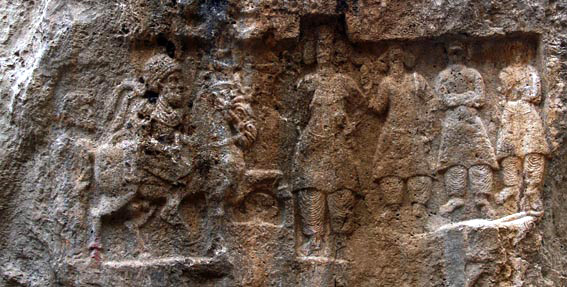
 Well, yes and no. As so often, scholars differ.
 kings, for the mass of rounded, puffy curls on either side of his head also appears on Elymaid coinage at this time (left), before the kingdom is finally and forever vanquished. That would date him to the end of the 2nd or 3rd century AD
 I'm not convinced by the resemblance (although it's possible, of course, that after 300 years his exact image was lost). For example, the sculptor has carefully depicted a heavy necklace (a torc) around the rider's neck, a detail that never appears on Mithradates' coins but sometimes on coins of his successors. Perhaps the sculptor substituted the image of a later Parthian ruler for that of the 'Great King'. But what brings him to Elymais? The bird with a wreath and a palm branch flying towards the horseman (visible on the close-up, below left) is a clue. This is a Roman victory symbol (based on the Roman eagle) which becomes common on Parthian coins from the 1st and 2nd centuries AD. The bird could apply to either Mithradates I or II, both of whom were victorious in Elymais.
 The prancing horse with arched neck and raised foreleg is a Greek image which spread throughout the Near East during the Seleucid period. This stallion (quite clearly male) has the short, clipped mane and high flowing tail of Greek horses. His bridle ornaments and fluttering ribbons, too, are very un-Parthian.
 Enter lasers.
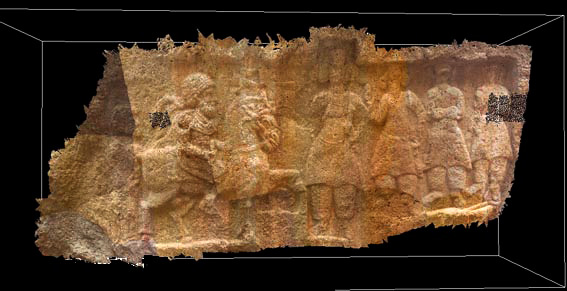
The acquired frames were merged to create a 3D digital model of the rock relief consisting in 7.692.104 points, with an accuracy of 0.2 mm approximately [ I like that approximately!].
A specific software has been created to analyse these data. This software manages all the elaborated files: traces of tools on the sculpted surface, differences in the depth of the carving, and the natural conformation of the rock will be examined in order to verify whether there are also differences in the carving technique and evidence of re-sculpting in the two halves of the relief.
The first results (reported on 5 December 2008) look like this:

It's the best image ever. The contradictions in iconography and style are perfectly clear. Isn't science grand!
-- Do we have our answer?
-- No, not yet.
Tune in for the results of the second season -- coming next month.
* This idea does not hold water (in my opinion) since the attendant on foot behind the mounted figure -- although possibly unfinished -- also has an overly large head. It seems more a stylistic trait than a copying error.
References: I have made much use of T.W. Kawami, Monumental Art of the Parthian Period in Iran, Leiden, 1987.
 While the eyes of the whole world were fixed on Washington D.C., I was also following the Entropa brouhaha in the capital of Europe. In case the drums and trumpets of the American inauguration drowned out the noise of this second installation, let me explain.
 The Czech Republic, which holds the rotating EU presidency for the first six months of 2009, thought it had commissioned a joint work from 27 European artists -- one from each EU country, a cute (if fuzzy) idea.
 Entropa is subtitled Stereotypes are barriers to be demolished, in accord with the Czech EU Presidency motto of "Europe without barriers". The Czechs boasted that the artwork, based on an outline of each country, would speak where words fail.
 The Polish piece recreates the flag-raising at Iwo Jima, with the U.S. Marines and Stars and Stripes replaced by Catholic monks erecting the rainbow flag of the Gay Rights movement. Or are they a gaggle of gay priests? Hard to tell. Still, the public in Poland appears to be largely in favour, with 64% considering it "spot on" and only 13% thinking it "an insult to Polish people", according to an on-line poll.
 But most peeved (if that's the word I want) is Bulgaria. The country's ambassador wrote undiplomatic letters of complaint to the Czech EU presidency and the EU foreign policy chief demanding that the sculpture be taken down before the official launching. The first secretary for the Bulgarian office to the EU, said:
It is one thing portraying, say, France as a country on strike, but quite another to show my homeland as a toilet. That is downright wrong.
 Until they did.

Vatican Museums Director, Antonio Paolucci, who co-organized the project, said that the projected colours were chosen based on traces of paint recovered from the monument in the 1930's, such as red ochre and gold leaf.

Though the colour projections were a temporary holiday event, organizers say they hope to make the demonstration a permanent part of Ara Pacis Museum in December 2009.
 This is all that is left of the body of Queen Sesheshet -- a skull, legs, pelvis, and scattered bones, once carefully wrapped in linen. Sesheshet was the mother of Teti, first pharaoh of the 6th Dynasty (r. 2323 - 2291 BC).
 Inside a spacious burial chamber (22-m [72'] long and 4-m wide), they discovered the queen's granite sarcophagus, some six tons in weight. A team of workers spent five hours lifting its heavy lid. Sadly, her disarray and paltry adornments showed that the robbers had been there first. Only some gold finger wrappings had been left behind. It had been thoroughly ransacked.
 A Queen Mother named Shesh is mentioned in the Ebers medical Papyrus, the most important Egyptian pharmaceutical record to have survived (ca. 1550 BC, although its content is undoubtedly much older). It tells us how to make the very same hair-restorer that Queen Shesh had used herself!
 O Shining one, thou who hovers above!and then swallow a mixture of burned prickles of a hedgehog immersed in oil, fingernail scrappings, and a potporri of honey, alabaster, and red ochre.
O Disk of the Sun!
O Protector of the Divine Neb-Apt
 The thieves entered through a tunnel from the top, because they couldn't get through the main entrance, said Zahi Hawass, secretary general of Egypt's Supreme Council of Antiquities
 Fortunately, Seshseshet's mummy was inside a granite sarcophagus with a six-ton lid,* so the thieves left the body and its decorations of gold jewelry untouched.
They didn't open the sarcophagus; they were using their hands, said Hawass, whose team used heavy machinery to remove the lid.
Here's a close-up of Seshseshet's mummy. It certainly doesn't look 'untouched' -- but I'm more prepared to believe that something horrible happened to her during embalming than that the thieves lifted the lid with their hands ... and then carefully replaced it.
* Surely it's the sarcophagus that weighs 6 tons, not the lid by itself!
My thanks to Talking Pyramids for signalling the update.
 What a great start to the New Year!
An offering which the pharaoh gives Sekhmet, the Great, Lady of Heaven that she may grant power in heaven, strength on earth and a good name for her beloved, the Overseer of Craftsmen and Chief of Goldsmiths, Gerti Bierenbroodspot.For countless generations, artists have freely incorporated elements from distant cultures to create new visual forms. Archaeologists and art historians are always studying (and being stymied by) such 'influences' and artistic interdependence. Bierenbroodspot takes this ‘re-mix’ one step further: she uses a modern Museum’s archaeological treasures as the starting point for her art, creating from the ancient objects a highly personal vision of a modernity grand in theme as well as in manner. To create this ground-breaking show, Bierenbroodspot received the keys of the Museum, free to wander at will -- enter any vault, open any display, sit in the hidden hall of the mummies, rummage through the racks in the basements -- sketching whichever items struck her artist’s eye.
The Muses do not wait; they decide over the Holy Fire, the Divine Inspiration, when and where they want to share it with the artist...But it is not history that interests her: as she paints them, objects become re-newed, the transmutation of art giving them again the power of dreams.
 When Bierenbroodspot saw the bronze horse bits from Luristan or inscribed clay tablets from Sumer, she stopped and had them out of their cases and in her hands. Re-used in her art, these things that are silent and past get a new vision, as in a magic theatre or divine rite. A polished bronze Corinthian-Greek hoplite helmet or the ornate gilded silver face-mask of a Roman knight become eerily like, in feel, twelve bronze helmets from the armoury of Atlantis that Bierenbroodspot cast for her record-breaking show, Atlantis Rising:
Over this image that is sketched on a clean, unused sheet of papyrus with powder of emerald green glaze mixed with myrrh and water. Say, "I am an initiate, void of sins. There is nothing I do not know about Truth."She thinks of the mural scene of the deathbed of Queen Nefertari, carved like a lion’s body, with the goddesses Isis and Nephtys to guard her mummy, as two hovering hawks. Hieroglyphs with birds and animals flutter around her protective tent, magic spells to help the dead as they make the dangerous journey Beyond the Horizon.
 Or not?
the repository of all culture, of all benevolence, of all devotion, of all concern for the living and grief for the dead.
 In short, the first gods were female and women ruled the earth. In this era, women mated promiscuously and "every woman's womb was the mortal image of the Earth Mother". Everyone was sister, brother, uncle, or aunt to everybody else, a world of unimaginable equality or, as Bachofen described it, "the undifferentiated unity of the mass." It sounds as if he pictured Mutterrecht society as a kind of human beehive. A beehive throbbing with inchoate forms of She-worship:
Whirling round and round in dance until "the beasts and all the mountain seemed wild with divinity."Of course, such happy, chaotic times couldn't last. Too bodily-busy, sticky (if not steamy), and oblivious to the individual, the Mother was destined to be replaced by paternal rule. The stars transited from the warm lucent bubble of livingness to the celestial, Olympian right of the father.* Out went the She-god, in came the He-god -- and with him, hierarchical male-dominated religions, and male control of females. This "world historical defeat of the female sex", as Friedrich Engels phrased it, was not only inevitable ... but for women's own good: obscene disorder was suppressed and women came under the protection of individual men.
 Gertrude Rachel Levy's study of Stone Age religion, The Gate of Horn (1948) was strong on the continuity of female religious traditions from Upper Palaeolithic people who "bequeathed to all humanity a foundation of ideas upon which the mind could raise its structures": the cave as the female womb; the mother as a pregnant earth; the magical fertile female as the mother of all animals. Levy assumed that the Venus figurines were
the first step in the establishment of a relationship between the human group and the One [the goddess].Well, maybe. She had an interesting idea, though, about why the early Venuses usually lacked extremities: "the general unimportance among the statues of face, hands, and feet may have originated in fears of magic dangers” -- as seen, for example, in modern voodoo dolls. Having made a potential connection between an anthropomorphic figure of a specific person and the resulting power over that individual, Levy left the idea hanging and took refuge in vague references to their role in a "cult of human fertility".
 You Tarzan, Me Jane
the mystery of the female body is the mystery of birth, which is also the mystery of the unmanifest becoming the manifest in the whole of natureArchaeology definitely takes a back seat. And prehistoric women are transformed into “some kind of super-beings revered by submissive males for their femaleness and their ability to produce children”.
 It is plausible, though not certain, that the first humans were unaware of the exact role of the male in procreation, not having established a causal relationship between coitus and parturition. Thus, their attitude toward the female, apparently weaker than the male, but mysteriously able to produce life, was ambiguous: a profound respect, if not veneration, and, at the same time, a kind of terror in the face of incomprehensible, even magic or divine, powers. The statuettes called ‘Venus callipyges,’ ["of the beautiful bum"] of the well-known Lespugue type, are a decisive argument in favor of this thesis, because, in these representations, a divine maternal power is undeniable [and it is] probable that primitive humanity regarded divinity, whatever that was, as feminine in nature.
 The 1966 "Man the Hunter" conference changed the way anthropologists thought about hunter-gatherer societies. New research showed that such societies were sexually egalitarian, and thus the idea that men and women were once equal finally took root. Studies began to demonstrate women's contributions to subsistence. The he-manly mammoth hunter, beloved of 19th century prehistorians, turned out to be a dud as the main food provider -- though there is an undoubted cultural value in sharing meat and the prestige it bestows upon men with strong hunting skills. Analysis showed that women produced an average of 2/3rds of the calories for the group, a result of their highly-skilled gathering forays. During those forays, incidentally, women also often caught small game, thus producing protein-munchies as well as veg and nuts.
Possibly, it was the women's contributions -- and not the big-game of male hunters -- that assured the survival of the species.
While !Kung people of the Kalahari Desert, Australian desert Aborigines and polar Eskimos, of course, are not carbon copies of our Palaeolithic ancestors, they do share important features in social behaviour and values. Since they have never been in contact with each other, it's very likely that the shared features reflect a common social and environmental situation ... and thus it's reasonable to assume that European Palaeolithic hunter-gatherers had similar social organisation, values, and ways of thinking.A centrality of women, or a special relevance of them or even a state of gender equality, has very probably been an important adaptive factor in the emergence of Homo sapiens out of all the different evolutionary experiments attempted by non-human Hominids. In simple terms, human evolution may well have acted on the gender that most invested in reproduction, nurturing and caring, a concept often [proposed] by female evolution scientists, but stubbornly ignored by their male colleagues and museum directors, who continue to display the evolution of Man the Hunter, with small women squatting in the background.**The Venus figurines may well reflect women's centrality (not political power) in the human adventure. The figurines range from realistic to symbolic representations of women but, regardless of the degree of realism, all or some female attributes are emphasised: breasts, vulva, and the natural female pattern of fat distribution on legs, hips and buttocks. These are clearly the attributes the carvers wished to emphasize.
 Above centre: 3 views of the ceramic Vestonicka Venus, credit Petr Novák, Wikipedia