21 August 2011

Mistress and Commander, Royal Navy


Warship Ahoy!

A woman is to command a frontline warship for the first time in the 500-year history of the Royal Navy.

For most of history, the Royal Navy saw fit to allow women to serve only as carved figureheads or by lending their names to military vessels. But now the navy is set to hand command of a major warship to a female officer.

Lieutenant-Commander Sarah West, 39 (left), is to take control of HMS Portland in April 2012, a 5,000-ton Type 23 frigate that is prepared for 'total warfare'. 
To be selected to drive a front line operational Frigate is an honour for any Officer, and there is no doubt in my mind that Lt-Cdr West both deserves this opportunity and will be the first of many women to take on the challenge (comment of a female ex navy officer).
Her appointment is a remarkable achievement because women were not even allowed to go to sea with the Navy until 1990.  The fact is that all the jibes made in the early Nineties, when women were permitted to sign up for most areas of active service across the Forces, have proved unfounded. There hasn’t been a crisis over women’s loos and it seems they can also find reverse gear.  The Senior Service now has 620 female officers, and Wrens (Women's Royal Naval Service) make up ten per cent of an average warship's company. 

Until now, women naval officers have only taken charge of small ‘non-fighting’ ships. Lt-Cdr West herself has captained four minehunters – including her current ship Pembroke – which only carry weapons for self-defence. Whereas the Portland (below) carries surface-to-surface missiles for tackling ships, surface-to-air missiles for shooting down aircraft and a helicopter for hunting and destroying submarines.  It also carries a 4.5in gun, Stingray anti-submarine torpedoes and is bristling with radar and sonar devices to guide its weapons and help with navigation.


A spokesman for the Royal Navy dismissed suggestions that they had caved in to political correctness by appointing a woman to captain such a powerful ship.
Lt-Cdr West will have responsibility for potentially taking a crew of young sailors in a state-of-the-art warship costing hundreds of  millions of pounds into a warzone, a senior source said. She is hardly going to be entrusted with that purely as a token gesture.
 Sarah West was born in Lincolnshire and studied mathematics (honours) at the University of Hertfordshire before entering Britannia Royal Naval College in 1995.  She joined the Royal Navy as a warfare officer and also took a law degree while on active service in the Middle East. She is an expert in large-scale naval planning, mine clearance, weapons-systems and underwater warfare. Before you ask, Lt-Cdr West is unmarried.  Undoubtedly, she's been occupied elsewhere.  As a woman captain recently described her own experience of leading a ship: "It was like having a lot of brothers who are fun to be around but also can be really annoying at times."

Lt-Cdr West will be promoted Commander at the end of 2011 and will take over the Portland next April -- the first 'Mistress and Commander' of a warship in the Royal Navy's history.

Congratulations, Maam; fair winds and following seas to you!


My thanks to IntLawGrrls for first notice of Lt-Cdr West's appointment (with a warm nod to their foremother, the female pirate, Grace O’Malley) And a reminder of our post in March 2008 celebrating the first female 4-star general in the US Army: 'Thumbs Up for an Uppity Four-Star Woman, Sir!'

Sources for this post: Sarah West, Wikipedia; Martin Wainwright, 'Royal Navy appoints first female warship commander', Guardian.co.uk, 8 Aug. 2011;  Rowan Pelling, 'Women pilots were not just a flight of fancy',  Telegraph, 9 Aug. 2011;  Ian Drury, 'On the bridge, first woman to command one of our warships', MailOnline, 8 Aug. 2011;  John Kay, 'Woman to run a navy warship for 1st time ever', The Sun , 21 Aug. 2011.

Illustrations

Top left: Lt Cdr Sarah West. Photograph: Ben Sutton/PA (via MailOnline, above)

Centre: HMS Portland returning to its home port of Plymouth. BBC Devon 16 Nov. 2010

.
.
.

14 August 2011

The Little Queen at Hadrian's Wall


Once upon a time, a little queen married a man from Palmyra at Hadrian's Wall. 

At Hadrian's Wall?

Well, only a stone's throw away.

To wit, at the Roman fort of Arbeia.  On the North East coast of England, just beyond the end of Hadrian’s Wall, Arbeia was the easternmost garrison fort on the Wall.  Originally built during the reign of Hadrian c. 129 CE, it guarded a small seaport at the mouth of the River Tyne near its outlet into the North Sea (nowadays South Shields)

The Gatehouse Reconstruction
viewed from across the principia
The wooden fort was rebuilt in stone in the 160s. Around the end of that century, it was further transformed into a supply base: all the barracks in the northern half of the fort were pulled down and replaced by granaries. Arbeia could now hold enough grain to supply more than 40,000 men for three months.  A good supply system was one of the foundations of the Roman army's phenomenal success. Bulky stores and equipment would be ferried up the east coast, perhaps from the legionary base at York, and then distributed under military supervision along the Wall line.  In this way, Arbeia became a bustling port.  A small civilian settlement, at least partly inhabited by the wives and families of the soldiers, grew up nearby. 

In 208 CE, the emperor Septimius Severus came to this northern limit of empire to launch a series of campaigns against the troublesome Caledonian tribes in Scotland.  It was his last hurrah: he died at York in 211 CE at a time when he had not only proved victorious but had concluded a perpetual peace.  As part of his military preparations, Severus had embarked on major construction work at two of the forts behind Hadrian's Wall -- Arbeia (South Shields) and Coria (Corbridge)

As it happens, the lives of our little queen and her Palmyran husband were entwined with those very forts at much the same time as Severus came north.

The People of the Wall

Very few of the 'Romans' who lived along Hadrian's Wall were from Rome itself, or even Italy.  The Roman north was a cosmopolitan place with a great mixing of people from all over the empire.  Surviving inscriptions show that, at one time or another, they included Germans, Spaniards, Gauls, Africans, Syrians, Arabians,  and people from Dacia (modern Romania).

In the late second century, among this foreign flock was a man called Barates and his wife, Regina. 

Ladies first.

This is Regina (Latin for 'Queen'; or perhaps, in this case, 'Queenie') -- pictured sitting in a gabled niche on her tombstone.  Her face has been hacked off but the rest of the elaborate monument, carved in the local buff sandstone, is wonderfully preserved. 

Regina sits on a high-backed wicker chair, her distaff and spindle in her lap, a wool basket by her left side.  With her right hand she opens a jewel box and in the box are rings, bracelets and beads.  She wears a long-sleeved robe over her tunic, a necklace with a cable-pattern design and a bracelet on each wrist.  Her hair is pinned up in one of the ornate styles dictated by the fashion of the day.

Her image is typical of a high-status Roman matron and is symbolic of traditional values, with the distaff and spindle suggesting wifely domesticity.  In short, Regina’s tombstone portrays a paragon of female Roman virtue.

What's wrong with this picture?

The Latin Inscription (RIB 1065)


D(is) M(anibus) Regina liberta et coniuge
To the spirits of the departed [and to] Regina, his freedwoman and wife

Barates Palmyrenus natione
Barates of Palmyra [set this up]

Catuallauna an(norum) XXX
[she] a Catuvellaunian by tribe, [died] aged 30

The inscription tells us all that we shall ever know of Regina.  It gives her name, that she was 30 when she died (though not whether she died from disease or in childbirth), and that she was a Catuvellaunian - a member of the largest southern British tribe.  Her homeland covered what is now Hertfordshire -- about as far as it's possible to get from Hadrian's Wall while still being in the province of Britain.  This makes her a native of one of the most civilized Celtic tribes, whose chief town, Verulamium (St Albans) enjoyed the rank of municipium, which allowed its magistrates to become Roman citizens. Presumably she grew up speaking a native British language.  Perhaps her name, Regina, is a translation of the girl's original Celtic name, which might have included the element Rigan, 'queen'

How in the world did our 'queen' become a slave (for she can't have been a freedwoman, without first having been enslaved)? 

Regina, the slave

Despite being against the law, it was, sadly, a common practice -- particularly in Celtic regions -- for families to sell their daughters if they could not afford to raise them.  By this means poor parents reduced the number of mouths to feed.  It is difficult to see how a Catuvellaunian girl of the late second century could be sold into servitude except by a voluntary act on the part of her parents.  

So, it seems that her husband, Barates, bought her, later gave her her freedom and then married her, a not uncommon arrangement. 

But how the devil did he find her? 

Here's how I think it happened.

On Hadrian's Wall, eighty milecastles (or small forts) were placed at intervals of roughly one Roman mile to guard gateways through the Wall.  At milecastle 55 in Cumbria, some 70 km (40 miles) to the west of Arbeia, this building inscription (RIB 1962) was found:

CIVITATE CATVVELLAVNORVM TOSSODIO
The tribesmen of the Catuvellauni, Tossodius.' [T, the native commander of the contingent]

Since these Catuvellauni were involved in the reconstruction of Hadrian's Wall, their presence in the north can probably be dated to the time of Septimius Severus in the early third century. That puts Regina's tribesmen at the Wall at pretty much the right time. Q.E. (not exactly) D. but as credible a source for the girl as we are likely to find.

Barates the husband

Barates, as he told us in Latin, was even more foreign and from a land still farther away than Regina: he is Barates of Palmyra

Palmyra in the Syrian desert is some 4,000 km (2,500 miles) distant, as the falcon flies, from Arbeia.  As if to stress his pride in this exotic origin, under the Latin inscription, his dead wife's epitaph continues in perfectly-formed swirling Palmyrene letters:

The Palmyrene Inscription 


RGYN' BT HRY BR'T' HBL
Regina, the freedwoman of Barates, alas

This is a typical Palmyran formula for the dead: name + descent or description + lament.  Oddly enough, Regina's name has been written as if it were Semitic: RGYN' -- but no such name exists at Palmyra.  Barates (whose name, on the other hand, is common there) seems to have made it up for the occasion.  It's odd that he didn't translate her name -- Palmyran inscriptions often do translate foreign names, sometimes quite literally -- so 'Regina' could have become MLKT' (Palmyrene for 'Queen').  At a guess, MLKT' may only refer to a royal person, as later Zenobia will be given this title; it's not just a pretty name.

The sculptor who carved this inscription was clearly literate in Palmyrene: he's not copying signs but writing them fluidly.  His Palmyrene is perfectly correct; more correct, in fact, than his Latin: the words Regina, liberta, coniuge, and Cataullana, should normally be in the dative (this memorial is dedicated 'to'...) but they are not; the four words are accusatives with final -m omitted.*  So there's good reason to think that the epitaph was the work of a man whose first language was Palmyrene.  The somewhat erratic Latin letters, too, as compared to the confident Palmyrene script, show that it was probably carved by a Syrian sculptor.  In truth, the whole monument is Palmyran in style: its characteristic closely detailed and linear cutting is very similar to that of funerary sculpture from Palmyra itself.**  This distinctive style also helps us date Regina's tombstone to the late second century; that is, at approximately the time of Severus' campaigns.  It seems logical to connect the arrival of Barates at Arbeia either with Severus' army or, possibly, with the Syrian entourage of his wife, Julia Domna -- the first of the Syrian empresses -- who was with the emperor in Britain and at his deathbed. 

Who was Barates?

By an amazing stroke of luck, Barates's own tombstone has also been found (RIB 1171).  He was buried at the Roman fort of Coria, situated beside the lowest fordable point of the river Tyne (modern Corbridge), just 35 km [22 miles]  from Arbeia.
D(is) M(anibus) [Ba]rathes Pal/morenvs vexila vixit an LXVIII
To the spirits of the departed [and to] Barathes the Palmyran, standard-bearer (vexillarius), who lived 68 years
What he meant by calling himself a vexillarius is disputed. This normally refers to a 'standard bearer', a low-ranking officer in the Roman army.  There is no evidence, however, for any Palmyran military unit in Britain.  Still, he could have been (say) a centurion serving in another unit.  It then wouldn't be strange to find him living not too far from Arbeia: upon discharge, many soldiers simply continued to live where they had served.  But if he were a retired soldier -- as at the age of 68 he would have been -- he should be called ex vexila[rio].  So, many think he was not a military man at all but was a trader in vexilla -- flags, standards, and ensigns -- for which there supposedly would have been plenty of customers along the Wall.  That doesn't feel quite right either, I think, as military standards don't wear out quickly enough to make a good living out of the trade.  Certainly, the richness of Regina's tombstone suggests that he was prosperous.  We don't know, of course, if he outlived Regina by many years, or if he was already much older when they married. Yet there was time enough for something to change: his own tombstone was of much poorer quality and written only in Latin.

This could mean that his trade, whatever it was, was flourishing at the time of Regina's death but went downhill after that.  So, for what it's worth (which isn't much) I think that his prosperity was somehow tied to the presence of the emperor and other Syrians in the north -- for why would he have written Regina's epitaph also in Palmyrene if there were no one there to read it?.  When everyone else left after the emperor's death, Barates stayed on -- declining in wealth, perhaps, but living to a ripe old age. 


* It's a little more complicated: the dedicatee in such Latin texts can also be in the nominative or genitive but the forms of Regina's inscription cannot be interpreted as these cases either.  Rather, the four words are accusatives (the object of the implied verb [set up]) -- a characteristic found in the Greek in Greek-Palmyrene honorific texts at Palmyra.  For a full discussion, see J.A. Adams, Bilingualism and the Latin Language, CUP, 2003, 253-255.

**  Martin Henig, 'Roman Sculpture from the Hadrian’s Wall Region'  A second tombstone from the same workshop is that (left) of a Moor named Victor, a 20 year old freedman, surely the boy-lover of the Spanish cavalryman who 'devotedly' dedicated it, Numerianus of the Ala I Asturum.

I am indebted to Jonathan Eaton of the Imperium Sine Fine blog for highlighting Regina's tombstone in a recent post.  In the comments, Dr Eaton also noted that, "According to the CSIR, the form of the final letter of the Palmyrene script did not outlast the third quarter of the 2nd Century AD in Palmyra."  This means that the sculptor had left Syria by that time which possibly fits with my suggestion that Barates and the other Palmyrans who came to northern Britain had some connection with the campaigns of Septimius Severus. See also the discussion of the dating of Victor's tombstone (above) in the comments on the blog post.

Main sources for this post (in addition to Imperium Sine Fine ): M. Henig, 'Roman Sculpture from the Hadrian’s Wall Region', on the Hadrian's Wall Research Project at Durham University; P. Ottaway, M. Cyprien, A Traveller's Guide to Roman Britain, 1987, 66ff; A. Cavla, 'Social Roles and Gender in the Roman World', on the site of The Roman Military Research Society; A.R. Birley, The People of Roman Britain, 1979, 127, 147; J.A. Adams, Bilingualism and the Latin Language, CUP, 2003, 253-255; ICONS: A Portrait of England.

Illustrations

Upper left: Arbeia fort at South Shields from Archaeology.co.uk 

Regina and her inscriptions: from Imperium Sine Fine

Tombstone of Victor the Moor (Arbeia).  Photo credit davidparsonsb at Photobucket
.
.
.

26 July 2011

Zenobia and the Manichean Convert (Part III)

(Click here for Part I & II)

Walk therefore in joy, drawn to the land of light


Whatever the true history of Nafsha, sister of Queen Tadhi (= Zenobia), there can be no doubt that the Manichean missionary, Mar Adda, believed that he had miraculously healed and so converted a high-born lady of Palmyra. As a result,  many other people were confirmed in the faith as well.  But did he really convert the queen herself, as he claimed?
And also Queen Tadhi, Nafsha's sister and the wife of the Caesar (kysr), came before Mar Adda with great ... and from him received the truth.
We needn't take this too seriously: kings and queens seemed remarkably convertible whenever Mani or one of his disciples performed a miracle or two.  It's standard Manichean hyperbole.  What is interesting is that, even by their own accounts, such royal conversions usually followed a missionary's success as healer rather than as proclaimer of a unique revelation. 

Still, healed is healed and it would be surprising if Zenobia had not become a fan of the Manicheans.  That is what seems to have happened.

For the next part of the story, we leave the Sogdian documents and return to the Coptic historical texts (see Part I).

Holy Men on the Move

The Coptic fragment which refers to Queen Thadamor (= Zenobia) makes no mention of Mar Adda.  Perhaps the unfolding events took place after he had left Palmyra to go to 'the great Alexandria' -- the farthest point of his mission, according to Middle Persian sources.  In any case, the scene now shifts to his younger colleague, Abiesou, whom Mani had sent to accompany Mar Adda on his western mission ...  and a previously unknown episode in the history of Palmyra is revealed: 


He (Abiesou) again went in before Queen Thadamor and she looked favourably on him.  Abiesou the teacher had confidence [in her and settled] there with other brothers.  She became a [great protectress] of the church in that place....

The most likely dates, I think, both for Mar Adda's Egyptian mission and Abiesou's meeting with Zenobia,would be 269-272 CE, that is, the years when the queen ruled over Egypt.  In what happens next, it isn't clear whether Abiesou acted at the urging of Thadamor/Zenobia or if it was his own idea:   
... after which Abiesou the teacher sent Sethel, the deacon ... to the fort of Hira [Abiran] so that they might build up the church in that place.  They healed numerous people.  The matter came before AmarĂ³ the king, who was the son of Lahim, so as to enable the brothers to go to his house for a cause of healing.  They befriended him by doing good. He helped us greatly and took care of us.  He became a great protector of the brothers, openly granting us his help and his protection....
Thus, the mission spread out from Palmyra, back across the Euphrates and into the desert areas between the Roman and Persian empires. That region was dominated by the Tanukh, an Arab tribe that had recently migrated into this part of the world.  In the 3rd century CE, they founded the town of al-Hira ('camp') --  7 km/4 miles from what is now the holy city of Najaf in Iraq.  According to Arab legend, AmarĂ³ was the first king of al-Hira and his name in Arabic, Amr ben Lakhm, was taken by his descendants of the Lakhmid dynasty of the city.  The Lakhmids were traditionally allied to the Persians and fought as their main desert allies in Roman-Persian conflicts.  We have every reason to think that they were already close allies of the Sasanians: King AmarĂ³ is mentioned as one of the supporters of Narseh I (r. 293-302 CE) in the Paikuli inscription, written soon after events of 293 to justify Narseh's right to the throne after he had violently deposed the former crown prince.*  So, by crossing back into the territory of a Persian client, the Manichean missionaries were playing a dangerous game.

End Game

During the last years of Mani's life, the new religion experienced ups and downs  inside Persia itself.  The Zoroastrian clergy (led by the high priest Kirdir) were furiously opposed to the upstart religion.  Worse, they regarded the Manicheans as heretics since they had assimilated some Zoroastrian concepts and names of deities into their system.  As the Zoroastrian 'Acts of the Religion' emphasizes: The most dangerous enemy of religion is the heretic who betrays the stronghold from within.  Political reasons, too -- not least, I would think, their missionary activities on both sides of the frontier and in client kingdoms -- made them seem a subversive element at a time when the Sassanians were facing renewed conflict with Rome.

In January 274 (or 276), Persian fury boiled over.  Their implacable opponent,  Kirdir, finally managed to set the King of kings Bahram I against the prophet. A telling encounter between Mani and Bahram is preserved. Mani arrives at the royal palace to be told that he is unwelcome. "What wrong have I done?" he asks the king.

The King said: "I have sworn not to let you come to this country".  And in his anger he spoke thus to the Lord [Mani]. "What are you good for since you go neither fighting nor hunting? But perhaps you are needed for this doctoring and this physicking? and you don't even do that!"

Mani was imprisoned, crucified (or, more likely, impaled), and his corpse flayed. It was said that Kirdir had his skin stuffed with straw and hung outside the city walls.   After his death, the Manicheans faced their bloodiest period of persecution:  

... Manichaeans were struck down, idol temples were destroyed, and the dens of the foreign gods were ruined and turned into thrones and seats for the gods.

Persecution continued until 293 CE ... and then a true miracle happened.

The 'Living Spirit' 

The reverse of the Coptic page that tells us about the Manicheans at Palmyra and at al-Hira preserves a short text that continues the story after the death of Mani:
He told us that the king [AmarĂ³] had arrived in the neighbourhood of our shepherd Innaios, together with the noble Persians who were his assistants.  He spoke to him.... He asked him to go to the king [of kings].  He achieved mercy for us from him and stopped the destruction.
King AmarĂ³ apparently wrote several letters on behalf of the Manicheans to his overlord Narses, seeking an end to the persecution.  The 'shepherd' Innaios, possibly now the leader of the sect, carried the letters to Persia and managed to have an audience with Narses.  The persecution came to an end. 

So, in a way, it was because of Thadamor/Zenobia that they were saved.  The favour she showed to the sect during her lifetime led directly to their mission to the Lakhmids of Hira.  Now, twenty years after her demise, AmarĂ³ still provided the Manicheans with protection and vitally needed shelter from persecution.

If only for a time.

Under the successor of Narses (Hormizd II), the Zoroastrian priests once again clamoured for the extirpation of the sect and persecution was renewed. 

The End of the World

What happened next is entirely a matter of legend.  As legends will, as circumstances change, old stories shift and are turned, twisted, and refined in a poet's mind until little remains but names and dimly-remembered places.  Just so, in Arab legend, Zenobia and AmarĂ³ of al-Hira become deadly enemies.  All else is forgotten as they dual in the desert....  

Those stories are told in 'The Zenobia Romance I' and II: Truth or Fiction, brilliant inventions, true, but not nearly as enlightening as the history revealed by the Manichean fragments.


* § 92: Amru King of the Lahmids

Sources are the same as those listed in Part I and II; in addition, I have used part of my own account of Kirdir's career from Zoroastrian Stuff III

Illustrations

Above: Leaf from a Manichaean Book. Khocho, Temple α. 8th-9th c. Manuscript painting, MIK III 4979. Via Washington.edu

Middle:  Fragment of a Manuscript. Khocho. 8th-9th c. Painting on paper. MIK III 4937. Via Washington.edu

Below: The execution of Mansur al-Hallaj (858-922): Persian mystic, Sufi, and perhaps crypto-Manichean. Via Wikipedia.
.
.
.

12 July 2011

Zenobia and the Manichean Convert (Part II)

(Click here for Part I)

The Elect of the Apostle of the Light 

Manicheism was a self-consciously missionary religion from the very beginning.  The prophet Mani actively sought to deliver his message to a wide range of audiences in every part of the known world.  The uniqueness of his revelation would thus be proved by his spectacular missionary successes.  Mani himself undertook missionary journeys throughout the Sasanian Empire and to lands further east.  He is known to have preached in India and was said to have converted the king of Turan (a country in northeastern Baluchistan).  His disciples followed suit, called to a lifetime of travel and evangelism. 

In the lands of Rome

The rich variety of Manichean texts found by German archaeologists in the Turfan Oasis in Central Asia consisted not only of hymns, psalms, and homilies but also records recounting the history of their founder and their church.  Fragments include an account of the missionary exploits of Mar Adda, the earliest and best known of the Manichean missionaries sent by Mani into the Roman Empire.  Mani gave Adda instructions for this mission to the western region, so that 

.... this goodness should be received in greatness. And be very learned and educated in it, wise and well-spoken in the district where you are going.  And when you act the way that I have commanded you, then the religion will be spread in these districts, and your work and doings will result in [its] furtherance.

Accordingly, Mar Adda traversed the frontier and entered Roman territory. 

First Stop: Palmyra?

For those who travelled to the Roman Empire from southern Mesopotamia in the third century, Palmyra (Tadmor) was the entry point for caravans as they began the last lap at the western branch of the Silk Road.  This location between east and west gave the city huge commercial advantages and great wealth.  Being at the crossroads also had major strategic implications, especially when, in mid-century, Palmyra was forced willy-nilly to be a bulwark against Sasanian Persia.  In 252-253 CE, the King of Kings, Shapur I, crossed the Euphrates and invaded Syria.  The Roman legions stationed to the north were woefully unprepared to defend the province.  As Shapur boasted,
The nation of Syria and whatever nations and plains that were above it, we set on fire and devastated and laid waste.  And in that campaign we took ... a total of 37 cities with their surrounding territories.
Six years later, the Roman emperor Valerian tried to regain lost territory and avenge Rome's defeat.  Valerian crossed into Mesopotamia with an army of 70,000 men.  They met Shapur in battle and the Roman army was annihilated. Valerian himself was taken prisoner -- to spend the rest of his life rotting in Persia.  The Persian king followed up this victory with another invasion of Syria.  This time around, he destroyed 34 cities, including the eastern capital, Antioch. 

No organized Roman forces remained to protect the eastern provinces.  Then,  like a deus ex machina, Odenathus, prince of Palmyra (ras tadmor) leapt into action.  His army pushed the Persians back into Mesopotamia and chased them all the way to their capital, Cteisiphon, even briefly laying siege to the city.  As reward, the Roman Emperor Gallienus (son of Valerian),  granted Odenathus the title 'Restorer of all the East', and raised  him to consular rank.  Odenathus now outranked any other Roman official or general in Syria.  At some point, he also adopted the more grandiose title of 'King of Kings', thus putting himself on a metaphorical par with Shapur I.  The end game came in 266/67: at the height of his powers, Odenathus was murdered -- almost certainly by a cousin, quite possibly at the instigation of Gallienus -- and his wife Zenobia seized the regency on behalf of their young son. 

It was probably while Zenobia ruled Palmyra herself (267-272 CE) that the Manichean missionary Mar Adda arrived in the city.

How important was the Manichean presence in Palmyra?  That's the first thing to establish. Then, I'll  tell you the most amazing story about Mar Adda bringing his 'Hope' to Palmyra.

The Special Manichean Script

The writing and circulation of Manichean scripture played almost as important a part as preachers and teachers in the diffusion of Mani's faith.  Professional scribes and painters were included on the early missionary journeys in order to spread the 'The Living Gospel' among literate and illiterate audiences alike (with such elegant results as above, left).  The scribes adopted an Aramaic script as the official script of their sect and used it to write their literature in Syriac as well as Persian and other central Asian languages as the religion spread eastward over the centuries. There is good reason to think that some early-bird scribes arrived at Palmyra at the very beginning of the Manichean western mission: as it happens, the so-called Manichean script is virtually identical with the Palmyran script (as attested in Palmyrene inscriptions).  It is possible, of course, that the scribes chose a script already known to them from foreign merchants who travelled along the western Silk Road; but it seems to me altogether more likely that it was created by scribes who accompanied Mar Adda on his mission to Palmyra and stayed there long enough to record the history of his evangelical success.**   

Healer and Wonder Worker  
And I have a religion the radiance of which is brighter than the sun.
And I have as provisions divine profit[?], the taste of which is sweeter than honey.
Two recently-published fragments of Manichean history from the Turfan Oasis (written in Sogdian*) tell us about an important convert brought by Mar Adda to the new faith.  This was a woman named Nafsha, sister of the queen of the city.  Nafsha was cured of her illness by invoking the name of Jesus and the laying on of hands by Adda.  Here's what the Manicheans said happened next: 
And right away the lord [Mani], the apostle, descended openly into the presence of Nafsha and laid his hand upon her, and Nafsha was healed at once and was made complete and without pain. And all the people were astounded at the miracle.  And there were many who received the truth anew.  And also Queen Tadhi, Nafsha's sister and the wife of the Caesar (kysr), came before Mar Adda with great ... and from him received the truth.(So 18223, 18222)

Since the word kysr in Sogdian is used invariably to denote a Roman ruler, and the only ruler with such a title in a frontier region in this period was Odenathus, it seems certain that these events took place at Palmyra (though the surviving fragments do not name the city) -- and that Queen Tadhi, the sister of Nafsha, is none other than Odenathus' wife,  our dear Queen Zenobia.

How did Queen Zenobia turn into Queen Tadhi?  Simple, really. First of all, the good book of missionary history was translated from Syriac Aramaic or Parthian into Sogdian hundreds of years after Palmyra/Tadmor had been destroyed by Aurelian (273 CE).  The city itself may well have been forgotten and its name ('Tadhi' in Sogdian) confused with the personal name of the queen.  And so, the Queen of Tadhi was turned into Queen Tadhi.  Much the same had happened, you may remember, in the Coptic Manichean texts from Egypt, with Tadmor translated as Thadamor (Homilies of Mani; see Part I) -- and Zenobia hides there, too, behind the name of 'Queen Thadamor'.  The city and the queen are again conflated in some later Arab legends, where she is simply named as 'Tadmur'; perhaps the Arab poets -- who did remember Tadmor -- imagined that she had founded the city and given it her own name

In short, kysr is Odenathus and Tadhi is Zenobia. 

... but who is Nafsha? And did Zenobia really have a sister?

Graeco-Roman sources do not mention any sister.  That doesn't mean much, to be honest, as they tell us very little about her family (even the name of her father is uncertain).  However, Arab legend, as recorded by the Persian historian al-Tabari (839-923 CE),*** does put a sister in her story -- a rather shrewd tactician named Zabibah (or Zaynab, Zubayba, or Zalubya).  Most Arab histories call Zenobia herself 'al-Zabba', a reasonable approximation of her name in Palmyrene, zby [Tabari's account is told in an earlier post, The Zenobia Romance, so we needn't rehearse it here.] Although not known earlier than Tabari's 6th C source, we can at least point to a regional tradition that gives Zenobia a sister.  

Yet there is no Nafsha at all at Palmyra.

Or, rather, there is no name like 'Nafsha' among the thousands of Palmyrene names known from inscriptions.

Why, I ask myself, is no real woman ever named Nafsha?  Was this really a given name -- or something else entirely?

Let me make a guess.  In the context of the story -- a sickbed conversion -- I naturally wonder if 'Nafsha' is, in fact, a description of the convert: in Palmyrene, naphsa (related to Hebrew nephesh) refers to the 'spirit' or 'soul' (discussed in 'The Secret Language of Palmyra II').  So we may have a personification of a 'soul' that is saved when it accepts the truth taught by Mani,
fear not, righteous soul, but step forward to the Light Paradise and receive joy.
Just as the place-name 'Tadhi' is confused with the name of the queen in this late translation of an old story, I suggest that the soul, the 'nafsha' that is saved, becomes mistakenly the convert's personal name. 

That might be the be-all and end-all of the matter.

But, not so fast!  This may be true but there are yet more Manichean stories connected with Zenobia/Tadhi/Thadamor behind this tale -- the subject of my next post, in Part III.  Sorry to be so long about it but there's a whole lot of forgotten history lurking in the Manichean fragments.


Click here for Part III

* The centre of ancient Sogdiana was around the cities of Samarkand and Bukhara in present-day Uzbekistan. 

**  Mani himself used this script to write his confessions in Middle Persian, a non-Semitic language (M 172 [= MIK III 196]), adding a few letters and diacritical marks necessary to express specifically Iranian sounds not found in Aramaic: see 'The Manichean Script' in the Encyclopaedia Iranica

*** His stated source was the pre-Islamic Christian Arab poet Adi b. Zayd (died ca. 600) from al-Hira.

Sources for this post (in addition to those used in Part I) include: U. Hartmann, Das palmyrenische Teilreich, Stuttgart, 2001, 311-313; Prods Oktor Skjærvø, Manicheism II: Texts, Sept 21, 2006;  I. Gardner-S.N.C.Lieu, Manichaean Texts from the Roman Empire, CUP, 2004,112-114; S.N.C. Lieu, Manichaeism in the later Roman Empire, Manchester UP. 1992, 73-75.


Illustrations

Top left: Manichean priests, 10th/11th c,. Wall painting, Museum fĂ¼r Indische Kunst, Berlin-Dahlem. Photo credit: Gryffindor via Wikipedia.

Upper middle: Cover leaf of a Manichaean hand scroll (detail). Turfan Oasis. 10th c. Paper.  MIK III 4614. Via Washington.edu

Lower middle:  Leaf from a Manichaean Book.  Turfan Oasis (Khocho Temple) 8th-9th c. Manuscript painting. MIK III 4959.  Via Washington.edu

Bottom left: Manichaean Female Elect. Turfan Oasis. 10th c. Painting on silk. MIK III 4815. Via Washington.edu

.
.
.

30 June 2011

Zenobia and the Manichean Convert

Rock Crystal Sasanian Seal: Mani and two of the Elect (priests).
The inscription reads, "Mani, the Apostle of Jesus Christ".

Mani, Apostle of Light

A new religion was founded in Mesopotamia in the third-century by the Persian prophet, Mani (216-277 CE).  Mani deliberately created a universal church that incorporated Christian, Zoroastrian, and Buddhist concepts.    Previously considered by scholars to be a Christian heresy, Manicheism (as named after the 'apostle') is now properly understood as an independent religion in its own right. 
Glory and honour to the Paraclete!*  Victory and blessing to our lord [Mani], the Spirit of truth, this one from the Father.

Mani saw himself not only as the successor of previous prophets (Zoroaster, the Buddha, and Jesus Christ), but also as the incarnation of the saviour -- that is, both as Jesus the saviour and as Buddha Maitreya, the saviour.
Wisdom and deeds have always from time to time been brought to mankind by the messengers of god.  So in one age they were brought by the messenger called Buddha to India, in another by [Zoroaster] to Persia, in another by Jesus to the West.  Thereupon this revelation has come down, this prophecy in this last age, through me, Mani, the messenger of the God of truth. (ShabuhragĂ¢n).
Also in the ShabuhragĂ¢n (a summary of his teachings written for his great patron, the Sasanian King of Kings, Shapur I), Mani declares that he is the very Paraclete* announced by the Messiah and that he is the seal of the prophets.  This means that no further revelations and prophets were necessary, since Mani considered he had taken all precautions to ensure that his religion would not be corrupted and so would endure until the end of the world.

In Mani’s view, the greatest problem with other religions was that the messages of true prophets had become corrupted by later generations because the earlier apostles did not write down their own teachings as he himself did (his seven canonical works included the Treasure of Life, Living Gospel, Book of Giants, Book of Mysteries, Letters, Psalms and Prayers [all in Syriac Aramaic], and the ShabuhragĂ¢n [in Persian]).  Jesus, he said, came to the West, and after his death his disciples wrote down his words. Zoroaster came to  Persia, but he did not write books, though his disciples remembered and wrote down his words after his death. And, when the Buddha came, he preached much wisdom and established churches, but he did not write anything, and, again, it was his disciples who wrote down his words after his death. 

That was one way in which Manicheism was thought to be superior to all the others. Just as important, Mani’s religion did not dismiss other religions as false religions; instead he accepted earlier religions and their prophets as carriers of parts of the truth. So, he incorporated elements of those faiths into his own great scheme of the world and mankind.

According to Mani, his new religion would not simply replace the previous religions, but rather represented the fulfilment of what the previous religions had promised but not been able to live up to. It was the same truth that had been revealed to the earlier prophets and was embedded in their religions, but, for various reasons, this truth had degenerated.  Earlier religions simply did not have the inherent power to withstand the attacks of evil -- and so they degenerated, and the truth they contained was spoilt.
The writings and the wisdom and the apocalypses and the parables and the psalms of all earlier churches were gathered everywhere and came to Mani’s church and were added to the wisdom which he revealed.... “As water will be added to water and becomes much water, so were the ancient books added to my writings and became a great wisdom the like of which was not proclaimed (hitherto) in all ancient generations.” (Kephalaia,** chap. 154)
This is also what Mani believed distinguished his church from all others.  But perhaps what made Manicheism really special (and Mani himself put this at the top of his list) was the fact that "The previous religions were only in one land and in one language, but Mani’s was taught in all lands and in all languages."

During Mani's lifetime, the religion had already moved east towards India and west into the Roman empire.  The gruesome death of the founder (recounted in Sassanian Stuff III) did not prevent the new religion from growing and spreading.  By the time the Sasanian Empire was overthrown by the armies of Islam in the mid-7th century, Manicheism had spread into Egypt and North Africa in the west, and to the borders of China and beyond in the east.  Thus, Manicheism reached from the Atlantic to the Pacific oceans before it was eventually destroyed by the Catholic church in Europe and wiped out in the east by new conquerors.  So, at times, Manicheism was a veritable world religion -- as had been intended from the beginning.

So, one of the first things Mani did was to concern himself with missions. Not only did he send out missionaries, both east and west, as soon as possible, but he himself travelled extensively. From various sources we know that he visited many countries to the east of the Sasanian empire.  The most reliable report is from Ibn al-Nadim’s Fihrist, which tells us that Mani travelled from country to country for 40 years before he met with Shapur I, King of Kings, who granted him the right to teach his religion in the Persian empire.  Then, Mani settled near Ctesiphon, on the western bank of the Tigris and it was there, during 262-63, that he set down the tenets of his faith and organized the missions.  Throughout Shapur’s reign, for over thirty years, Mani and his followers were free to propagate their ideas.  And so it happened that, by 270, Mani’s religion had firm footholds throughout the vast Sasanian empire.

But that was not enough.  "All lands" meant the world outside Persian territory as well.  So Mani sent one of his closest collaborators, Mar Adda, who held the ecclesiastical rank of 'teacher', to carry the new religion to the west, i.e., to the Roman empire.  Several stories about Mar Adda's missionary activities are found in Manichean texts: for example, when Mar Adda was at Kirkuk (in the north-east of modern Iraq), Mani sent him three scribes who brought him the new gospel and instructed him to strive to spread the good word "like a merchant hoards up a treasure."  As the Prologue to the Kephalaia** reveals, Mani exhorted his disciples to record what he taught them, as "everything is explained fully and completely".

The Books of the Mysteries of the Truth

In 1929, a library of seven genuine Manichean Coptic texts were discovered in the ruins of an old house in Medinet Madi, to the south-west of the Fayyum, in central Egypt. The cache was said to have been hidden in a wooden chest found in the cellar by workmen digging for fertilizer.  They sold the papyri, all bound with wooden boards, to an antique dealer for a trifle. And so the books reached the Cairo market.  A German scholar, Carl Schmidt, who was on his way to Palestine to collect manuscripts, was shown a papyrus entitled the Kephalaia of the Teacher.  By sheer coincidence, he had been working on a 4th-century text (Bishop Epiphanius' Panarion) that furiously denounced 80 different 'heresies', which just happened to cite the Kephalaia as a book of detestable Manichean lies. And then, when Schmidt read the characteristic phrase, Once more the Enlightener speaks to his disciples, he knew for certain that the text had originated from the innermost circle of the Manichean sect. As he read on, it became clear that the 2,000 leaves (= 4,000 pages) were a treasure-trove of original Manichean documents:
Glory and honour to our Father, the God of Truth.  Victory and
blessing to his beloved son, Jesus, and his Holy
Spirit, our Lord, the Paraclete, and all his holy Elect.
While the Coptic papyri were probably written down ca. 400 CE, they were undoubtedly translated from Syriac originals that reach back to Mani himself or to the first generations of the church. 

Mar Adda at Palmyra

Included in the Medinet Madi papryi is a fragment of Mani's Homilies, which mentions the Semitic name of Palmyra:(Thadamor).  While this suggests a lost history of Manichean settlements in Palmyra, the reference passed without comment until, almost sixty years later, spectacular new finds allowed scholars to put two and two together: Manichean documents from the Turfan oasis in Xinjiang (northwestern China) included an account of the missionary exploits of Mar Adda, one of the earliest Manichean missionaries sent by Mani to the west.  His first stop in the Roman Empire seems to have been at Palmyra, where, as healer and teacher, he came into contact with Queen Zenobia.

But Mar Adda and Zenobia will have to wait a bit. What was supposed to be a short introduction to the Turfan texts has turned into a post of its own.  My apologies.  I promise that Zenobia and the Manichean Convert II (the whole kit and kaboodle!) will follow very quickly.  


Part II: click here.


* Mani as the Paraclete (comforter) and Holy Spirit incarnate. Cf: ...the Comforter, which is the Holy Ghost, whom the Father will send in my name, he shall teach you all things, and bring all things to your remembrance, whatsoever I have said unto you. (John 14.26)

** Kephalaia, Greek for 'headings, central principles'.  Sacred Manichean text in which Mani discusses the basic tenets of the religion with his students: The whole revelation I have unveiled/and declared to the church. In your presence/I declare this revelation alone.


I am most grateful to Chris Bennett (whose website is a treasure trove, too, on the chronology of the Ptolemaic Dynasty) who brought the documents from Turfan -- and their implications for Zenobia's history -- to my attention.

Main sources for this post: I.M.F. Gardner & F.N.C. Lieu, From Narmouthis to Kellis: Manichean Documents from Roman Egypt, JRS 86 (1996) 146-69;  Prods Oktor Skjærvø, An Introduction to Manicheism, 2006; W. Barnstone & M. Meyer, The Gnostic Bible, Ch. 40: 'The Kephalaia', 598-615.


Illustrations

Upper left: Manichean rock crystal seal engraved with 3 profile busts; inscribed “Mani, the Apostle of Jesus Christ”. Bibliothèque nationale de France, INT 1384BIS. Via Encyclopaedia Iranica

Middle left: Manichaean Middle Persian manuscript (ink on paper). © Depositum der BERLIN-BRANDENBURGISCHEN AKADEMIE DER WISSENSCHAFTEN in der STAATSBIBLIOTHEK ZU BERLIN - Preussischer Kulturbesitz, Orientabteilung.  Via IDP (International Dunhuang Project)

Lower left: pictorial insert in Manichean scroll in the Sogdian language from Turfan oasis in Xinjiang (northwestern China), preserved in the collection of the Turfan Antiquarian Bureau (81 TB 65:01); created between 7th and 9th century CE.  Via  Encyclopaedia Iranica


.
.
.

15 June 2011

The Underground Tomb of the Aureli (Multiple Updates)

However implausible it seems, we should pay attention when the Historiae Augustae tells us that the young emperor Severus Alexander (r. 222-235 CE), always up bright and early, piously went first thing in the morning to 
worship in the sanctuary of his Lares [guardian gods] in which he kept the statues of the deified emperors ... and also of certain holy souls, among them Apollonius of Tyana [Pythagorean philosopher and miracle-worker], and, Christ, Abraham, Orpheus, and others of the same character.... (HA XXIX2)
Jesus Christ!  And Abraham, too!  Next to Orpheus and Apollonius?  Why in heaven's name is a pagan emperor of Rome worshipping such a mixed bag of souls in his private chapel?  Utter nonsense, I would have thought, and typical of the unreliable Historiae Augustae at its most fanciful.

But, then, I had not reckoned with the Underground Tomb of the Aureli.  

For no sooner had Alexander Severus -- and his mother, Julia Mamaea -- been murdered by mutinous soldiers far away in upper Germany (that story ends my series of More Uppity Women) than a freedman named Aurelius Felicissimus began to build an elaborate and ambitious tomb for himself (235-240 CE) in Rome.   

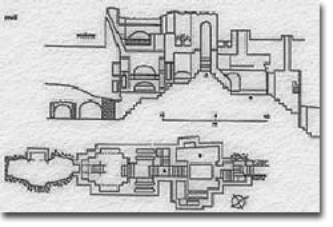
The richly decorated tomb consists of three rooms, two of them underground, which were used for burials. A mosaic inscription in the floor tells us that he built the tomb for his sister Aurelia Prima (described as a virgin), his  two brothers, and for fellow freedmen ... fratris et conlibertis.  This suggests that the space was intended for use by a select group of religious 'brothers', seemingly some kind of alternative cult community.  Scholars have never been able to decide on the identity of this group.  Were they Gnostics, Pythagorian Gnostics, heretical Christians, or even a pagan syncretic burial club?  

Religious Syncretism in Third-century Rome

The thousand political, social, economic and military problems of the century were reflected in philosophic and religious thought combining Roman ideology with the new beliefs and faiths coming from the East.  The cult of Mithra, Judaism, Neo-Platonic philosophy, Orphism, Christianity and Gnosticism co-existed in a multi-ethnic and multi-religious Rome, creating a complex layering of religious expression. The tomb of the Aureli expresses this complexity as the burial place of a family of a high and striving social class, perhaps members of the entourage of freed slaves who became part of the Emperor’s court, and who emulated their betters by creating monumental funeral displays.

The mural decorations in the tomb contained new iconographic images suspended between daily life and the tranquil, blessed world of the beyond, while maintaining elements of Greek culture and Roman tradition.


Two great themes are incorporated into the frescoes: philosophy, which depicts a group of intellectuals holding wands and scrolls of wisdom, and bucolic scenes, represented by a shepherd with his sheep (the Good Shepherd?).  A curious combination of the two themes may seen in a bearded character in the act of reading a scroll while a flock of sheep grazes at his feet, which perhaps refers to one of the Aureli buried in the tomb.  Nearby, we see scenes from the Homeric cycle representing Odysseus returning to Ithaca to find Penelope at the loom being pestered by a row of naked suitors. 

Shifting Scenes 

These are many such pagan scenes ... but are the Aureli pagans?  That depends on how we read the pictures.  For example, one scene that has long been interpreted as  Adam and Eve with the tempting serpent and fatal apples is thrown into doubt because the couple is shown without sexual shame; some scholars now think that it illustrates the pagan theme of Heracles and the apples in the garden of the Hesperides.

The recent restoration of  the frescoes, using a revolutionary laser technique, offers a closer reading of some images. Where, for example, scholars had previously seen (left) the home and the sheep of the father of Odysseus, overcome with grief at the absence of his son, it now seems clear that the fresco actually shows Aurelia Prima untieing her hair in grief at the loss of her two brothers who are lying on the funeral bed within the chamber. 

Under the sorrowful sister, another scene shows the moment when Odysseus  persuades Circe to undo the transformation of his companions, who had been turned into swine, and she witches them back into men. This story from the tenth book of the Odyssey is inserted into a funeral motif because it was Circe who indicated to Odysseus the way to Hades.  The new scenes are thus perfectly in line with the multi-religious system of the time and the elaborate syncretism of the Aureli.

Yet it is hard to imagine the strands of religious symbolism being woven together in this next scene (below).


A mythical hippocampus (a horse with fishy, coiling hindquarters) is seen devouring a small human figure while a naked man looks on, lying relaxed in a bower, a lamp at his side.  Hippocamps are a traditional pagan funerary motif (like the Cupids, birds, and peacocks that appear elsewhere on the walls) but one wonders if this creature is not confused with the sea-monster sent to devour Andromeda, which morphed, in turn, in Christian art, into the sea-monster devouring Jonah and then vomiting him up.  So, could this be Jonah after his miraculous deliverance from the fish's belly, seated in a booth in the shadow outside Nineveh while he waits to see if God will destroy the city (Jonah 4.5)?

That would make it an 'orthodox' painting; wouldn't it?  If so, it was not enough.  The Tomb of the Aureli, like other heretical Christian catacombs, was not listed in medieval pilgrimage guides.  And, still today, we don't really know who was initiated and buried there. Orthodox or not, I guess the medieval church knew better than we who and what had crossed the red line.

From Rome to Palmyra

The paintings in the Tomb of the Aureli depict scenes belonging to the pagan, Jewish, and Christian worlds (both orthodox and heretical).  Even taking into account the diverse multicultural nature of Rome in the 3rd century, the richness and variety of the frescoes are astonishing.  It reminds me of nothing so much as the immensely varied religious visual (and possibly mystic) experiences of Dura-Europos -- see my post Gods at the Crossroads -- before it was destroyed in 256 CE.  With its dozens of temples dedicated to Greek and Roman gods, Mesopotamian deities, Palmyran gods and gads, a Mithraeum, a frescoed synagogue and the earliest Christian house-church anywhere in the world, there was an inevitable and eclectic mixing of images from one religion to another.

Palmyra, too, knew many different forms of worship.  We'll have a look at one new religion that had recently arrived there in my next post, Zenobia and the Manichean Convert

Updated 24 June 2011

Wonderful new images from Rome Reports:


Updated 7 August 2011

See now the comments and excellent photographs on Dorothy King's PhDiva blog: The Aurelii and Third Century Rome


She suggests that the tomb's builder, the freedman Aurelius Felicissimus, might be the same as a Felicissimus who was in charge of the treasury at Rome in Aurelian's reign (mentioned in Historiae Augustae, Aurelianus, 38.2): "it not impossible that he was the same man, holding a high position towards the end of his life (AD 270), or his son."  If so, our tomb-building Felicissimus ended badly: a fantasy letter purportedly written by the emperor tells of the mint-workers revolt in 270-71 or 274, 
a most grievous struggle.  For under the leadership of Felicissimus the lowest of all my slaves, to whom I had committed the care of the privy-purse, the mint-workers have shown the spirit of rebellion.  They have indeed been crushed, but with the loss of 7,000 men.... 
That the tomb continued to be used into the next century makes me a bit sceptical of this identification.  Aurelian, notorious for his cruelty, would have left no heir alive.  It's possible, of course, that the cult community survived his downfall and continued to use the tomb.  But I rather suspect that all of the treasurer's close associates, more than likely also working in the treasury, would have met the same fate.


My thanks to David Meadows'blog (RogueClassicism) for alerting me to the newly restored frescoes from the Hypogeum of the Aurelii.

The main sources are the reports in Italian and English in L'Osservatore Romano, 'New discoveries in the hypogeum of the Aurelians, a funeral monument astride two worlds', 10 June 2011; and S. Swain, et.al. Severan Culture, Cambridge, 2007, 277-289.

Illustrations

Upper left: plan of tomb from Monumenti Antichi website

Upper centre: Dorothy King's PhDiva blog

Lower left:  L'Osservatore Romano

Lowest:Antike Fresken im SĂ¼dosten von Rom freigelegt. Photo: © 2011 by SĂ¼dostschweiz Medien
.
.
.

30 May 2011

Medieval Memorial Day for Cleopatra

Cleopatra as 'The Virtuous Scholar'

Who? Cleopatra? Do you mean our Cleopatra, divine queen of Egypt and lover of Julius Caesar and Mark Antony?  That Cleopatra?

Yes, the very same.

But better known to those who wrote about her scholarly temperament as Qilopatra, Qilpatra, Qalupatri, Qilawfatra, Qulfidar, Qarupa, Kilapatra, Elawpatra, Elawatra, and even Aklaupatr.  Not the ten little dwarfs but the queen's name in medieval Arabic.  All of which mean, or so we are told, 'The Weeping Rock' or 'The Weeping Woman'. 

Which makes a kind of sense, I suppose, if you were a medieval Arab historian looking for meaning in names.  But why should she weep?  According to their memories, she had nothing to cry about.

Memorial Day in Medieval Egypt

It all began with the Coptic Christian bishop, John of Nikiu (a town in the Nile Delta), who lived at the time of the Muslim conquest of Egypt, the very fraught years 639-41 CE.  John wrote a Chronicle of the History of the World (in Greek, perhaps also partially in Coptic; now lost, it was translated into Arabic and survives today only in an Ethiopian translation from 1602 CE).  Though John was an Egyptian, his memory of distant history was foggy, to say the least.  Cleopatra, he tells us, was 'a very beautiful young virgin':
[Julius] Caesar fell in love with her and married her and begat a son by her. And he gave her the kingdom of Egypt. And he named that son Julius Caesar. He was also named Caesarion.
So far, so good (if you ignore her two previous marriages, possibly unconsummated, to her brothers, Ptolemy XIII and P. XIV). But Bishop John soon loses track of Julius Caesar and knows nothing of the Mark Antony episode nor of Octavian's defeat of Antony + Cleopatra.  Rather, the good bishop drifts off into a long aside extolling Cleopatra's courage and her strength, and lauding her building projects in Alexandria, the likes of which had never been seen before.  These, he says, included a magnificent palace built on an island -- with a causeway to reach it across the bay; the draining of a large area of sea which she turned into dry land; a contrary project of digging a canal and diverting a river so that ships could come right up to the city; and yet another water management project that supplied the city with an abundance of fish. 
And she executed all these works in vigilant care for the well-being of the city. And before she died she executed many noble works and (created) important institutions. And this woman, the most illustrious and wise amongst women, died in the fourteenth year of the reign of Caesar Augustus. Thereupon the inhabitants of Alexandria and of (lower) and upper Egypt submitted to the emperors of Rome.
Clearly, and despite centuries of Roman rule, native Egyptians as late as the 7th century continued to cherish Cleopatra's memory.  In fact, we know from a graffito on a temple at Philae that her divine statues were still being cared for at least as late as 373 CE, when Egypt, and indeed the whole of the Roman Empire was officially Christian.  By John of Nikiu's time, nonetheless, her history was grossly 'misremembered', and simply riddled with errors and omissions.  Yet that was the tradition, for better and for worse, that would be further shaped by Arab historians.

"Incomparably Above All Others"

The first Muslim to write about Cleopatra was the native Egyptian Ibn 'Abd Al-Hakam, in the early 9th century* -- about 150 years after the Muslim conquest -- and he got it spectacularly wrong on two counts.  He tells us that the world-famous lighthouse of Alexandria
was built by [Queen] Daluka... It is also said that the builder of the Lighthouse of Alexandria was Qulpatra, the queen who dug the canal into Alexandria and paved its bottom.
No one knows who this Queen Daluka is so we've no idea how she comes into the story (unless she is a doppelganger of Cleopatra).  According to Al-Hakam, the two queens were credited with building the Lighthouse -- although certainly neither did.  Equally, both ladies were supposed to have erected an entirely fictitious Great Wall around Egypt to protect it from invasion.  Real or imagined, Cleopatra's building projects continued to impress medieval Arab writers.  In a way, it's easy to understand: somebody had built the massive monuments that still dominated the landscape -- the pyramids, Sphinx, and ancient temples.  If the Copts and Philo of Alexandria (the Hellenized Jew who described her great Alexandrian temple as "incomparably above all others") agreed on Cleopatra, so be it. 

But what really turned them on was her devotion to alchemy and philosophy.

Yes, you read that right.
She was a sage, a philosopher who elevated the ranks of scholars and enjoyed their company.  She also wrote books on medicine, charms and cosmetics in addition to many other books ascribed to her which are known to those who practice medicine.
Those are the words of Iraqi-born Al Mas'udi (who died in Egypt ca 956 CE).  He was the first to tell us, too, about Cleopatra's interest in the higher and rarefied scholarly spheres, such as alchemy.  He might even have had in his library her reputedly great work on the subject, 'The Book of Queen Cleopatra', in the form of a dialogue between the queen and a group of scholars.  In it, the Muslim alchemists and fellow philosophers invite her to illuminate them with her knowledge on alchemical matters and, perhaps too, on secret symbols and devices that she invented for use in alchemical investigations.  Al Mas'udi called her "the last of the wise Greeks" -- and who would argue?  As time went on, still more learned books were credited to the queen, including one on poisons and antidotes, another on mathematics, and a legal tome entitled 'The Abridged Law of Cleopatra', described as "a simple law that is easy to understand."

Indeed 'A Virtuous Scholar'

Alchemist, accomplished mathematician, medical doctor, able monarch and a scholar who was comfortable among philosophers and men of science: that is the medieval Arab tradition of Cleopatra.  There is nothing of the hedonist, sexy seductress, nor a deceiving and over-ambitious queen.  In short, this is not the Cleopatra of our classical Graeco-Roman sources:
... a frenzied queen plotting ruin against the Capitol and destruction to the empire, with her polluted crew of creatures foul with lust -- a woman mad enough to nurse the wildest hopes and drunk with Fortune's favours  (Horace Odes I 37)
So, who is right?  Does the medieval Arabic memorial 'correct' the lascivious western tradition -- which descends all the way from Horace (sucking up to Augustus) right down to Liz Taylor?

First, it must be said that the contrast between Arabic and Graeco-Roman images of the queen is somewhat overdrawn: they are not entirely on opposite ends of the pole.  Even Horace admits her courage (waxing bolder as she resolved to die... no craven woman she!).  And Plutarch, who has left us the most detailed and relatively balanced story of her reign, declares that her irresistible charm had not so much to do with physical beauty but more with her character and "the persuasiveness of her discourse", and thus with her intelligence (Life of Anthony 27). 

What is Remembered?  What is Historical Memory?

As an Egyptologist put it, "Neither representation says much about the real Cleopatra."**

"It is not unusual for people faced with cultures which they experience as 'exotic', to stereotype these other cultures as either 'dark' (with barbaric bloodthirsty males and loose ensnaring women) or as 'paradisical' (with noble warriors and all-knowing priestesses).... 

"Such models say much of the ones who adopt them and hardly anything of the cultures that they are concerned with. That the Romans, for political reasons, picked a model of the first type (Cleopatra as a shrewd seductress) should not surprise us, nor that the Arabs, for esoteric reasons (alchemists wanting to see Egypt as the land of secret science and hidden wisdom), preferred a model of the second type (Cleopatra as virtuous scholar).

While medieval Arab historians were just as fascinated by Cleopatra as everyone since, their picture of Cleopatra was no more real than that of our Graeco-Roman tradition Alas, their story was not built on original Ptolemaic facts but rather on medieval fantasies that made sense to them. They had no privileged access to genuine ancient knowledge somehow preserved and transmitted to medieval seekers of ancient secrets.  In the end, their vision was no more factual than the  biased version of events spread by the Romans and beloved of Hollywood.  Why the Arabic sources chose to emphasize and exaggerate certain aspects of her 'life' -- already very cloudy and distorted -- is in itself a fascinating study. 

But that is for another post, another time.   My Memorial Day tribute to Cleopatra's memory is done.  R.I.P. Liz Taylor.


*The medieval Arabic image of Cleopatra was brought into scholarly discourse by Okasha El Daly, an Egyptologist at the Petrie Museum of Egyptian Archaeology.  His book, The Missing Millennium, Ancient Egypt in Medieval Arabic Writings," (2005) analysed previously untranslated Arabic texts referring to early Egyptian history.

>** Review of Okasha El Daly's Egyptology: The Missing Millennium submitted to the Egyptologists' Electronic Forum (EEF) by A.K. Eyma, 28 June 2005. The whole review is available here.

Illustrations

Upper left:  A fanciful illustration of an Egyptian-Arab queen and her ladies, unknown source (perhaps lifted from a turn-of-last-century German book, thence let loose on the web); via BarefootSpringNet.  If anyone knows of a proper credit, I'd be glad to hear of it.

Centre left: From an exhibit at the British Museum, Cleopatra: From History to Myth, 12 April - 26 August 2001 (Via BBC News/Reviews, 11 April 2001). Introductory text by the show's curator, Susan Walker at Fathom, The Source for Online Learning

Lower left: Via University of Oregon: 'The Age of Caesar' website.
.
.
.

Blog Archive