18 April 2012

A Million MI-(A)W Mummies


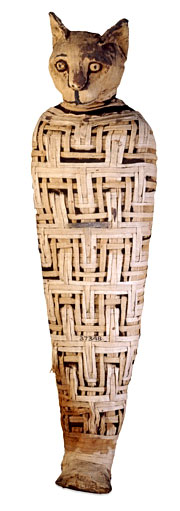
The ancient Egyptians didn't just make mummies of dead people but went hog-wild mummifying all sorts of non-human species too: reptiles, birds, dogs, baboons, bulls, rams, crocodiles, and even an occasional hippopotamus. However, one of the most common animal mummies in Egypt was the cat (left).  

Fully domesticated cats probably became companions to humans in Egypt somewhere around 2000 BCE.  At first, they were captured from the wild as kittens to be domesticated. But they soon became home bodies and bred as pets.  By 1350 BCE, cats were occasionally buried with their owners.  The female cat, especially, was noted for her fecundity and  was associated with fertility and female sexuality. Around 900 BCE., a striking change took place in the Egyptians' religious beliefs: many animals were now thought to be the incarnation of certain gods and goddesses.  Female cats were believed to be the earthly representation of the goddess Bastet who was pictured as a woman with the head of a cat (below left). Consequently, cats were raised in and around temples devoted to Bastet, especially in the city of Bubastis, on the Nile in Lower Egypt.  At least 20 of her cult centres are known and all of them, presumably, were once filled with felines.  When the cats died, they were mummified.

Feline mummification had 6 steps:
1. Remove internal organs.
2. Stuff body with sand or other packing material.
3. Place in sitting position.
4. Wrap tightly.
5. Faces painted on wrappings with black ink.
6. Natural dehydration.*
The cat mummies were buried in huge cemeteries, often in large communal graves.  Cat cemeteries lined the Nile River, while the goddess' main temple at Bubastis alone contained an estimated 300,000 cat mummies.  So many cat mummies were discovered in Egypt that it's a good guess that there had once been millions of them.

That's an awful lot of dead MI-(A)W's. 


In 1888 an Egyptian farmer digging in the sand near the village of Beni Hasan in Middle Egypt uncovered a mass grave. The bodies weren't human. They were feline — ancient cats that had been mummified and buried in pits in staggering numbers.

Bastet (Late Period)
"The plundering of the cemetery was a sight to see, but one had to stand well windward. The village children came [...] and provided themselves with the most attractive mummies they could find. These they took down the river bank to sell for the smallest coin to passing travellers. The path became strewn with mummy cloth and bits of cats' skulls and bones and fur in horrid positions, and the wind blew the fragments about and carried the stink afar"

Two years later, about nine tons of cat mummies from the cemetery were shipped into the port of Liverpool. They were sold off by the ton: bidding started at £3 per ton and gradually advanced to £5 17s 6p.  One company bought 38,000 pounds of cat mummies to pulverize and sell as fertilizer in England; this shipment alone was said to contain 180,000 mummified cats:

Some contractor came along and offered so much a pound for their bones to make into something - soap, or tooth-powder, I dare say, or even paint. So men went systematically to work, peeled cat after cat of its wrappings, stripped off the brittle fur, and piled the bones in black heaps, a yard or more high, looking from the distance like a kind of rotting haycocks scattered on the sandy plain.  The rags and other refuse, it appears, make excellent manure, and donkey loads of them were carried off to the fields to serve that useful, if unromantic, purpose.

This was not the result of people mummifying their beloved pussy pets. The cat mummification industry was big business.

And therein lies the rub. 

From about 332 B.C. to 30 B.C., cats began to be raised for the specific purpose of being turned into mummies. The mummies were sold to people on their way to worship Bastet and left at her temples as offerings. Scientists have uncovered a gruesome fact: many cats died quite premature and unnatural deaths. Two- to four-month-old kittens seemed to have been sacrificed in huge numbers because they were more suited to the mummification process.

Within the elongated oval shape of the cat mummy, the squeezed skeletal body of the cat embedded in wrappings is visible. The thin white arrows indicate the squeezed thorax; white arrow: fractured vertebra of the tail; arrowhead: fracture/hole in the occipital region of the skull. 
Look at what happened to the mummified cat (above) from the National Archaeological Museum of Parma, Italy.  As reported in the April issue of The Journal of Feline Medicine and Surgery, this mummy has just been examined radiographically in order to evaluate and describe how cats were wrapped and mummified in ancient Egypt. 

Wrappings of Cat Mummy, Parma Museum
Radiographs made by Giacomo Gnudi, veterinary radiologist at the University of Parma, show that the cat was bound and wrapped tightly to take up as little space as possible, with the ribs compressed and the front legs placed very close to the chest which forced the skeleton into the 'sitting position'.  A coccygeal vertebra at the bottom of the spine was fractured in order to reposition the tail as close as possible to the body.  A hole in the skull (white arrowhead) also seems to confirm the hypothesis of a very unnatural death.  In other words, the cat was murdered, probably by a spike driven into its head.  Or rather, we can say that this was kitten murder: the long bones and vertebrae of the skeleton and the eruption of definitive canine teeth suggest a cat ranging in age from 4–5 months.  The fact that the cat was so young suggests that it was one of those bred specifically for mummification.  It is likely that it was an offering to the goddess Bastet.**

Owing to the huge demand for mummified cats throughout the Late Period (ca. 1069-30 BCE), different qualities of cat mummies were sold with better or worse  features according to the clients' budget.  It was possible to find 'cheap' cat mummies with just a few bones inside or even an empty 'shell' or to spend much more and get a complete mummified cat body embedded in decorated wrappings. The cat mummy from the museum of Parma is one of the most valuable types.  The cat's skeleton is complete and the arrangement of the mummy’s wrappings, too (above left) is intricate, with painted geometrical patterns.  The eyes are depicted in black ink on small round pieces of linen bandage. 

If This Be Love
How do we square the Egyptians reputation for loving, protecting, and even worshipping cats with the mass slaughter of temple-raised kittens?  Cats were protected by a kind of common law: Diodorus Siculus (writing between 60-30 BCE) is quite explicit:
Whoever kills a cat in Egypt is condemned to death, whether he committed this crime deliberately or not. The people gather and kill him. An unfortunate Roman, who accidentally killed a cat, could not be saved, either by King Ptolemy of Egypt or by the fear which Rome inspired.
And the Greek historian Herodotus (5th C. BCE) tells us that, when a cat died, the household would go into mourning as if for a human relative, and would often shave their eyebrows to signify their loss.

So who was buying dead-kitten mummies in the millions?

Everyone, it seems: 
On the day of her festival, [Bubastis] is said to have attracted some 700,000 visitors  "both men and women who arrived in numerous crowded ships.  The women engaged in music, song and dance on their way to the place, great sacrifices were made and prodigious amounts of wine were drunk, more than was the case throughout the year. [Herodotus 2.60]
Is it fair to complain (as A Thinking Person's Blog does) that, "There is nothing that is cat loving or cat caring about this process. It is all about the human and his insecurities and superstitions. It is simply cat use and abuse."

I'd say like to say MI-(A)W to that but, of course, we cannot impose our contemporary western ideas upon the distant past.  Imagine that you were about to approach Bastet to offer a sacrifice.  After all, you had to take care to placate the goddess.  True, in her docile moods, Bastet gives life, and joy, and protects the household, but she also had an agressive side if provoked!  And that would worry you while you wanted to have a good time at her festival.  Better to offer a pre-wrapped mummy... and relax.  Doesn't it make sense to give her what she most loves?  Perhaps, even in ancient Egypt, each man, each woman, and each mummifying priest kills the thing he loves:
                                 The coward does it with a kiss,
                                 The brave man with a sword!

Or a bloody spike.


* This is unsure.  Possibly chemicals were used, similar to the dehydration treatment of humans: natron, a naturally occurring mixture of sodium carbonate decahydrate, sodium bicarbonate mixed with small quantities of salt and sodium sulphate, and particular herbs to improve artificial dehydration.

**The National Museum of Parma bought this cat mummy in the 18th century from an antiquarian; there is no documentation about which part of the Egypt it came from, but it is certain that it was an offering to the goddess Bastet, possibly from the temple of Bubastis. Sources for this post, in addition to "Radiological investigation of an over 2000-year-old Egyptian mummy of a cat", JFMS, include The Role of Cats in Ancient Egypt, by M.E.; Cats in Ancient Egypt, Wikipedia; News on t he Mummy Cat at Archaeology Museum Parma, Think Archaeology; and A Wuthering Expectations Investigative Report - Were mummified cats actually shipped to England for use as fertilizer?

Illustrations

Above left: Cat mummy in folded shroud, National Museum of Antiquities, Leiden, NL; AMM 16c.  Photo credit: Animal Mummies Online. A list of cat mummies found in various museums, with links to photographs, is available at The Animal Mummy Database.

Upper Centre: The Mi-W  Hieroglyphs (uploaded to YouTube) by on 6 Mar 2010.

Middle left: Bronze Bastet statue, Louvre Museum N 3857. She wears ankle bracelets and a tight, mid calf-length dress with a V-neck and sleeves that cover her shoulders. Photo credit: © 2009 Musée du Louvre/Christian Décamps.

Lower Centre:Giacomo Gnudi et al., "Radiological investigation of an over 2000-year-old Egyptian mummy of a cat", JFMS, Fig. 1.

Lower Left: Outer wrappings of the cat mummy from the National Archaeological Museum at Parma; via Think Archaeology

Bottom left: Cat Mummy wrapped in Meander pattern shroud.  British Museum EA 37348. From Abydos, Roman Period, Acquired 1902 from Egypt Exploration Fund.
.

20 March 2012

Questions On the Queen of Sheba's Gold


The Golden Girl

You may have heard that the Queen of Sheba's gold mines have (or have not) been found in Ethiopia.*  Those who are following the story might object that, regardless of the news report, the gold mines -- if they ever existed -- would not have been in Ethiopia. You'd be right.  If ever there were a Queen of Sheba, she most probably came from the spice lands of Yemen.

Not that it really matters.

Rather, I'm thinking of two other things....

The first is that Sheba is forever linked in our minds with King Solomon, the wisest of kings.  It is the queen's arrival at his court in Jerusalem that is the beating heart of her story. 

An Ethiopian fresco of the Queen of Sheba travelling to King Solomon
As the Good Book says [Kings 10.1-13]:
 When the queen of Sheba heard about the fame of Solomon and his relationship to the LORD, she came to test Solomon with hard questions [or riddles].  Arriving at Jerusalem with a very great caravan—with camels carrying spices, large quantities of gold, and precious stones—she came to Solomon and talked with him about all that she had on her mind.  Solomon answered all her questions; nothing was too hard for the king to explain to her....
She said to the king, “The report I heard in my own country about your achievements and your wisdom is true.  Indeed, not even half was told me; in wisdom and wealth you have far exceeded the report I heard...."
And she gave the king 120 talents of gold [= ca. 4.5 tons/9,000 pounds], large quantities of spices, and precious stones. Never again were so many spices brought in as those the queen of Sheba gave to King Solomon.... 
Then she left and returned with her retinue to her own country. 
And that, in fact, is all we really know about her.  Which, of course, has never stopped speculation.  Storytellers from different times and places, and different ethnic and religious traditions, have imagined and embellished details according to the interests of their own communities.

So, read on (while listening, I suggest, to this wonderful recording of Georg Friedrich Händel's 'Arrival of the Queen of Sheba').


The Queen's Gold Mines

Now, four-and-a-half tons of gold is quite a lot of yellow metal by any standards.  At today's price, it's roughly $213,500,000 (£ 135,000,000) worth of the stuff. What did Sheba get in return for this whopping gift?

Wisdom.  Or, more precisely, answers to her 'hard questions'.

The Bible doesn't actually tell us what 'hard questions' she put to Solomon.  Nor does it report any of the answers that she so much admired. They must have been real brain teasers to impress Sheba, who was reputed to be a pretty smart queen.  If the authors of Kings did know what it was all about, that chapter-and-verse was lost long ago.  More likely, they didn't have any more clues about it than we do.

Later rabbis were keen to fill the void.  In the Targum Sheni Esther (dated 500-1000 CE), the Midrash Misle (9th century CE) and The Alphabet of Ben Sira (ca. 11th century CE), we finally come upon some riddles. These purport to quote the very words of Solomon and Sheba, including some questions that are serious and some seemingly bizarre. A few samples:

Queen of Sheba enthroned, surrounded by attendants and animals
“What are the seven that issue and nine that enter, the two that offer drink, and the one that drinks?” Solomon answered: “The seven that issue are the seven days of menstrual impurity. The nine that enter are the nine months of pregnancy. The two that offer drink are the breasts, and the child is the one who drinks.” 

Smart!  But Sheba had many more such riddles in her quiver.

“How can a woman say to her son: ‘Your father is my father; your grandfather, my husband; you are my son, and I am your sister?’” Solomon replied: “The two daughters of Lot.” 

Correct!  The rabbis didn't ever wonder how this queen from a far-away land knew about Lot's intimate incestuous history, telling how his two daughters became pregnant by their father and bore sons!  This didn't seem to bother Solomon either.  And so the riddling went on, just so:

"What is like unto a wooden well, the contents of which are drawn up, as it were, by a bucket of iron; that thing taken up no more than stones, which forthwith are irrigated by water?"

Solomon answered: "The reed container which carries the black antimony known as stibium, which stone when crushed is used by women in painting their eyelids, and by men as a remedy in eye ailments, and which they apply to themselves by wetting the iron pin with their spittle." If you are missing a little Iron Age lore, it's said that stibium clings to the spittle on the iron pin.  Get it?

When he had solved all these riddles and many more, Sheba changed tack.  She required the king to explain such tricky business as how to perforate a pearl and to string a crooked shell.  Then, she brought before him some children who were of the same height and identically dressed, and asked of the king:
“Distinguish between the males and the females.” He made a sign to his eunuchs, who brought him nuts and roasted ears of corn, which they scattered before the children. The males, who were not bashful, collected them and tied them within the hems of their garments. The girls, however, were bashful (since their bodies would be revealed if they were to tie their undergarments) and therefore tied them within their outer garments. Solomon told the queen: “These are the males, and these are the females.”
Clever, you have to admit.  And the queen was duly impressed.

Which brings me to my second point:  Was there a method in this madness?

Early Christian Riddling

The Jewish Women's Encyclopaedia thinks there is.  But, before we get to that, I'd like to tell you about a brand new document that also purports to record Sheba's riddling with Solomon.  This early-Christian text, preserved only in Armenian and Syriac (recently translated from the latter by the eminent Oxford scholar, Sebastian Brock**), mixes serious and peculiar questions, too -- with some leaning towards the completely loopy.
Question:  How does this [earthly] sphere revolve, to the right or to the left?  And when the whole of it revolves, does it all revolve equally, in the same direction, or part of it one way, part of it another?
  Solution:  The sphere has a double revolution: its firm part revolves westwards, to the right, and turns rapidly, each night and day completing the movement of its course.  But the planets, which ride above it, revolve eastwards, to the left, and each of them completes the revolution of its journey in accordance with the measure of its altitude, ranging from every thirty years to every thirty days
Having briefly dabbled with the cosmos, Sheba again displays astonishing familiarity with the patriarchs of Israel, so much so that Solomon gets a bit tetchy:
Question: A foreign mother of native sons, a murderess who brought up lawless men;  the theft prospered, and in cunning bore as fruit a king.
    Solution:  Solomon said to her: You insult my ancestors with your questions, for Phares son of Judah, by the cunning and the theft of Tamar, who was considered to be the murderer of her husbands, produced the king David in his line. 
I am quite puzzled by this riddle: Sheba must be referring to Genesis 38 but I can make no sense of it.  Happily, she gets right back to basics.  The next two questions are set in the 'land of the Indians':
Question:  How is it possible that a woman who eats pomegranates in the land of the Indians does not become pregnant?
Answer:  Pomegranates are cold and moist, while India is hot and dry, and so, they are eaten there as opposites, women who eat them do not become pregnant because they are of the same composition as a woman.
 Opposites, it seems, do not attract.  This is a late (but far, far from the latest) survival of the ancient Greek theory of the sexes, pitting chilly wet women against superior hot-and-dry men.  As Aristotle argued in the Generation of Animals, the male is characterised by an abundance of the superior element, fire, and the qualities hot and dry, while the female has an abundance of water and is therefore cold and wet.  Rather soggy, in fact.  Since women are cold and moist, eating a cold, moist fruit in a hot, dry climate doubles down the negatives, so to speak, and prevents the happy event.  If there were any doubt, the next questions rubs it in.
Question:  When a man drinks wine in the land of the Indians, how is it that his intercourse does not result in conception?
Answer:  The wine in the land of the Indians induces a heavy sleep, and because it is hot and dry by nature ... it prevents cohabitation, being of the same composition as intercourse, and it causes desire to become confused in a disrupting manner, not allowing nature to flow in accordance with the norm of procreation.
Thus, the hot dry (!?!) wine + the hot dry man = no baby either. According to Aristotle's theory of the sexes, the hotness of the male and the coldness of the female determine their roles in reproduction.  The extra heat that characterises the male lets him turn his food intake into the ultimate residue, namely spurts of white semen.  The female, lacking heat, can achieve only an imperfect concoction, which dribbles out as red menstrual blood.  However unlikely this appears, that may explain the next riddle:

Question: An unclean thing that brings up kings and that is softened; it is honoured in clouds, and is sprinkled with change, and is sent like excrement on the paths of the fields.
Answer: Solomon says:  In the menstruation which becomes milk, in the excretion (‘clouds’) on the breast, are kings and lowly nourished.  This is what you are saying, set out in a delightful way.
Enough!  While I'm glad he was delighted, much more of this will drive me quite mad.

Sheba the Riddler

As the Jewish Women's Encyclopaedia rightly argues, the main shared element in all of Sheba's rabbinic riddles is that they are concerned with gender. The first riddle pertains to the female’s birth cycle: menstruation, pregnancy, birth, and nursing.  The second turns upside down the generational hierarchy within the family, by interchanging father and grandfather, husband and father, mother and sister. Solomon's solution restores the normal order, since it reveals that this is an exceptional case, which held good only for the daughters of Lot. The answer to the third riddle is a tube of eye makeup used differently by men and women.  The fourth indicates the differences between males and females that supposedly are already noticeable in young children, and is connected to the shame felt by girls at publicly exposing parts of their bodies. That, QED, is the 'natural' order of things, a stance obviously endorsed by the Christian riddles, too.

Solomon as riddlee is determined to restore the natural order by winning over this foreign queen of fabulous wealth and wisdom, who is also a dangerous (that is, out of place) female of power in a world ruled by men.  Here we have a monster in the making, a woman who has usurped male prerogatives (on Sheba as demonic monster, see The Zenobia Romance).  How could the queen ever have believed that she could outwit the wisest of kings?  How, indeed, could a woman challenge a man with any expectation of winning?

She must be made 'natural' and put in her place.  Solomon answers all of her riddles quickly and somewhat derisively, thinking them mere child's play.  But Sheba's ability to make riddles out of Solomon's heritage (Lot's daughters, Phares and Tamar, among others) marks her for the boundary-crossing female that she is.  Perhaps that's why Kings 10 doesn't sample her riddles: too aggressive? or too close to the bone? Though Solomon can answer these and all of the others, she has presented herself as a ruler equal in status and wisdom, one capable of keeping her place in her own world.

Then she left and returned with her retinue to her own country.

Wherever that was.


* Shared thanks for the first reports of the new claims to PaleoJudaica and to Past Horizons.  You can read the press releases on those sites or at the Guardian's website: 'Archaeologists strike gold in quest to find Queen of Sheba's wealth.  A British excavation has struck archaeological gold with a discovery that may solve the mystery of where the Queen of Sheba derived her fabled treasures. Louise Schofield, an archaeologist and former British Museum curator, who headed the excavation on the high Gheralta plateau in northern Ethiopia, said: "One of the things I've always loved about archaeology is the way it can tie up with legends and myths. The fact that we might have the Queen of Sheba's mines is extraordinary."'  Personally, I wouldn't count on it.

** I am immensely grateful to Prof. Brock for sending me a pre-publication translation of these early-Christian riddles and granting permission to use them on my blog.  The whole will appear in the first volume of texts edited for the More Old Testament Pseudepigrapha Project at the University of St Andrews. More information on the manuscript: Date and origin unknown; survives in this form only in Syriac and Armenian, but completely different questions are known from Jewish tradition; they could not be any earlier than c.6th century, and must be earlier than the earliest textual witness, in fact in Armenian, ca.13th century CE.

Sources include 'The Queen of Sheba' on Viewzone (translated and annotated by David Ben-Abraham); 'King Solomon and the Queen of Sheba' at King Solomon Legend;  Tamar Kadari, 'Queen of Sheba: Midrash and Aggadah' at Jewish Women Encyclopaedia; and (especially) Carole Fontaine, Smooth Words: Women, Proverbs And Performance In Biblical Wisdom, Continuum Press, 2009 (partly available via Google Books).

Illustrations

Top: Mural from Lalibela, now in the National Museum at Addis Ababa. Supposedly the Queen of Sheba, but more likely to be St George heading for the dragon. Photo credit: unknown, via Wikipedia.

Youtube credit: 


Middle: 14th century Persian manuscript frontispiece depicting Queen Sheba (Bilqīs) enthroned. She is surrounded by attendants and animals, both real and fantastic. Above her is a flying mythical bird (sīmurgh).  Photo Credit: The Walters Art Museum.  Licensed for use under Creative Commons Attribution-NonCommercial-ShareAlike 3.0.

Below:  Betty Blythe in the title role of the Queen of Sheba, December 1921. Reproduced by permission of © The Trustees of the British Museum.  Middle East: Registration number: EPH-ME.471.
.
.
.

07 March 2012

Syrian Army Attacks Palmyra (Multiple Updates)

Reported by Agence France-Presse. Translated by Now Lebanon. Only now making its way into the world news*

Wednesday, March 7, 2012 | 18:16 Beirut

TOP OF THE NEWS
Syria's ancient desert city of Palmyra besieged
February 19, 2012

The Syrian army has been laying siege to the ancient city of Palmyra, a world heritage site, since early February and shooting at anything that moves from a historic citadel, residents say.

"Palmyra is surrounded by the army from all fronts: the Arab citadel, the olive and palm tree groves, the desert, the city," one resident told AFP by telephone, adding that the operation began on February 4.

Security forces have set up camp in the citadel which overlooks the Roman ruins and the city of some 60,000 people, said the resident who asked not to be identified for fear of reprisals.

"Machinegun fire rains down from the citadel at anything that moves in the ruins because they think it is rebels," he added.


Palmyra's pristine Roman ruins set off by dramatic desert sunrises and sunsets have earned it the status of a UNESCO protected world heritage site.

Residents report the army has set up camp in this historic citadel that overlooks the city
It was a key tourist attraction in Syria before unrest against the regime of President Bashar al-Assad erupted 11 months ago. Human rights groups say more than 6,000 people have been killed in the country since mid-March last year.

Other Palmyra residents told AFP said that hundreds of people have fled the city for safety after reports emerged that several local figures have been killed by regime forces.

Adnan al-Kabir, whose family owns the Al-Waha (Oasis) Hotel in the heart of the city, was among three civilians killed by the army, three different sources told AFP.

A YouTube video shows Kabir with a wound to the head apparently caused by gunfire. Friends who knew him identified Kabir in interviews with AFP.

"The majority of the young men have left or are trying to leave, fearing detention. Only elders and state employees stayed behind," said another resident who managed to sneak out of Palmyra.

Women and girls have been spirited off to safer locations for fear they would be raped by "soldiers who hold nothing sacred," he said, speaking from a neighbouring country.

Although communications with Palmyra were severed at the start of the campaign, those residents who have managed to get out spoke of daily machinegun and tank fire.

Hundreds of people have fled from the desert city that carved its place in the history books as a caravan stop on the ancient Silk Road and as the home of legendary Queen Zenobia who defied Rome in the third century AD.

"People related and unrelated to rebels are fleeing because security forces are detaining people at random," said one resident who fled to neighbouring Jordan.

He said he saw tanks and checkpoints all around the city.

Security forces have also set up checkpoints within Palmyra itself, stopping traffic at gunpoint, checking cars and detaining men between the age of 20 and 40, said another resident who escaped from the city.

"Many people have disappeared, we don't know if they are dead or detained," said the 31-year-old who was able to get out after five days of siege.

Tanks were also deployed near the Roman ruins at the entrance to Palmyra - a desert city known as Tadmur in Arabic.

According to residents, regime forces have destroyed and set ablaze several olive, palm and date groves using tank and machinegun fire.

"All our resources are concentrated in the gardens: our olives, our dates," said one resident who fled after security forces stormed and destroyed his garden.

"The gardens near the ruins were hit the hardest. People will have to plant again and wait for 10 years before they see a good season again," another man said.

Anti-regime activists, mostly loosely organised local youths, had been using the gardens as a meeting point, residents said.

Until this month Palmyra had been spared the deadly violence in the Assad regime's crackdown on dissent, according to activists.

"There was an unspoken understanding between authorities and residents that security forces would stay out of Palmyra if the city behaved," one resident said.

Residents say Palmyra's fate was decided after a Sunni general in charge of security in the region was replaced by an Alawite from Assad's community.

-AFP/NOW Lebanon

For live updates on the Syrian uprising, follow @NOW_Syria on Twitter or click here.

* Reported 5 March on the Global Heritage Fund blog (my thanks to Chuck Jones for bringing this dire news to my attention via Facebook).  Photo of citadel credit: Barbara Boranga via Global Heritage Fund. 


Updated 19 April 2012 


According to reports collected by 14 April, the UNESCO World Heritage site of Palmyra is threatened by:

1. The continuous movement of troops on and around the site ("le danger majeur que court le patrimoine mobilier ou immobilier de la cité caravanière de Palmyre, où d’incessants mouvements de troupes ont lieu selon les sources locales.")

2.  Tanks and heavy armour dug in near the funeral towers and troop barracks constructed near the Justinian's Walls.  ("La ville antique de Palmyre, dans les ruines antiques, notamment à proximité des tours funéraires de la nécropole, où des chars et de l'armement lourd ont été positionnés et des casernes construites, notamment près de la grande muraille.")

3.  Tanks and heavy armour deployed on the citadel ("Installation de chars et d'armes lourdes par l'armée syrienne dans des citadelles (position dominante), au fur et à mesure du déploiement des forces de répression.")

For which reasons, Palmyra is now listed as one of the Syrian sites facing serious damage and possible destruction of its monuments. 

Updated 29 May 2012

New Report on Damage to Syria’s Cultural Heritage

GHN member and Durham University PhD student Emma Cunliffe has prepared a comprehensive summary of the known damage to cultural heritage sites in Syria. Entitled Damage to the Soul:  Syria’s Cultural Heritage in Conflict, the report draws from a number of sources to present a picture of the destruction – from looting to shelling – that is afflicting cultural heritage sites as a result of the ongoing conflict in the country.

Extracted from this report:

According to an interview with Hiba al-Sakhel, Director of Museums in Syria (as reported by PAS84), the areas looted and damaged at Palmyra are: 

The Camp of Diocletian

The Valley of the tombs and the tombs of the Southwest and Southeast (passage-graves or underground tombs)

Triumphal arch and decumanus at colonnades

The areas of the defensive walls South and North

The edge of the temple of Bel

It has been suggested that at Palmyra government troops were involved, or at least complicit, as from their base in the ruins, any looting would theoretically have been visible to them, although this cannot be verified. 

Updated 4 August 2012

Soldier’s video reignites fears of looting at World Heritage Site


According to France 24 International News,this video was uploaded by Abdellah al-Tadmoury, the director of the opposition’s communications centre in Palmyra. Abroad.
Al-Tadmoury told us that, last week, a soldier deserting from the army gave him his phone’s memory card just before leaving town with some rebels from the Free Syrian Army. The man, he said, barely had the time to specify that his memory card contained images from his brigade in Palmyra. FRANCE 24 was given several of these videos. On one of these, a brigade from the regular army is shown patrolling the Palmyra archaeological site. Another video features the same group of armed soldiers breaking into a house. And then there was this video, where uniformed men manhandle what appear to be rare archaeological artefacts.
After analysing these images, a FRANCE 24 journalist from Syria concluded that these men are probably soldiers from the regular Syrian army, as they repeatedly use the term of respect “Sidi.” This is used in the Syrian army to address one’s superiors. In contrast, in the Free Syrian Army, the combatants call each other “brother” or “comrade.”

See the full report on France24 in EnglishFrench, or Arabic.
.
.
.

Blog Archive