27 April 2013

The Curse of Artemisia

He was her man, and he done her wrong!

That's more or less what a woman named Artemisia, daughter of Amasis, said to her erstwhile lover, and so she made a curse.  She didn't exactly sing it and there wasn't any jazz band in the land, but the sentiment is one that resonates through the ages:
This story has no moral,
This story has no end,
This story just goes to show
That there ain't no good in men,
He was her man, And he done her wrong.
The Artemisia of the curse left one of the earliest surviving Greek documents written on papyrus, dated to the middle of the 4th century BCE, probably written even before the arrival of Alexander the Great in Egypt (332 BCE).  It comes from the Ionian community in Memphis -- that is, from the Greeks who originally lived in central coastal Anatolia and who settled at that time in a merchant colony on the Nile just south of modern Cairo. 

The Curse of Artemisia Papyrus (P. Vindob. G 1)

Who is Artemisia?

The woman is named after the famous female ruler of Caria who, Herodotus tells us in his Histories , personally commanded five ships at the naval battle of Salamis in 480 BCE.  She was a Persian ally and fought audaciously, to put it mildly.  But the Persians lost and their king, who had watched the battle, is supposed to have said, "My men have become women and my women, men."  So when Amasis named his daughter after this queen, he was making quite a statement.  Curiously, however, Amasis himself bore the name of the last native pharaoh (died 526 BCE) who ruled Egypt just before it was conquered and incorporated into the Persian Empire. It may be that our Artemisia was the child of a mixed Ionian-Egyptian family.  We know nothing else about her ... except, of course, that she wrote this text.

And that her man had done her wrong.  He fathered a daughter on her but when the little girl died, he refused to pay for the funeral and her burial goods.  A proper burial is everywhere  important but nowhere more so than in Egypt.  So Artemisia cursed him bitterly: 
O lord [Sarapis] and the gods who sit with [Sarapis], Artemisia the daughter of Amasis [appeals] to you against the father of her daughter, who has deprived her of her funeral rights and burial.  So ... he has not treated me and his children rightly, indeed he has treated me and his children wrongly....
She begs the god to deny this man, tit for tat, the solace of being buried by his children in turn, and for good measure that he fails to bury his own parents.  She then curses the man who mistreated her roundly: may he and what is his be destroyed evilly on land and on sea by [Serapis] and the gods who sit in the House of [Serapis].  To ensure that the god hears her plea, she sensibly deposits the papyrus in the god's house, the Serapeum which existed at Memphis (and where it was found almost two millennia later), along with a final angry demand: While the appeal lies here, may the father of the young girl receive no favours at all from the gods

Neglecting the Curse of Artemisia

Discovered in 1826, this papyrus should have been received with jubilation by the scholarly community.  After all, it was one of the first Greek papyri ever to come to light and it is, to this day, still one of the oldest papyri bearing Greek writing.  Far from being acclaimed, however, it was entirely neglected until 1899 when it was republished in Palaeography of Greek Papyri.  It was then damned with no praise, the scholar noting that the letters of the script were a bit clumsy and imitate those of stone inscriptions (for example, the theta with middle dot). Rather crude, in fact.  Clearly, the papyrus was not up to snuff:   
[It] is not the work of a professional scribe, but the writing of an uneducated woman who uses uncial letters [i.e., written entirely in capital letters] because she can form no others.  Artemisia used letters like those employed in inscriptions for the same reason that an illiterate person always uses capitals, because such letters were commonly before her eyes in public places, while she had probably seldom seen a book.
Snob!  

For professors entirely accustomed to studying the literary texts written by the 1-2% of the Greek writing elite -- the poets, philosophers, politicians, historians, and buddy scholars -- the mostly anonymous lower social classes for all intents and purposes remained unknown ... and unwanted.  Who cared about the ideas, thoughts, hopes and fears of artisans, shopkeepers, merchants, homemakers and whores, farmers, soldiers and sailors?  Oracles, dreams, magic spells and curses alike were  low-brow, barbaric, disgusting!  Only a few of these people were able to write anything better than scrawls.*  

But what the Artemisia papyrus demonstrates is that there was very little difference between literary and non-literary scripts in the 4th century BCE -- and certainly not in the Greek colony of Memphis on the Nile. In other words, Greek handwriting, both for literature and more ephemeral documents, was all originally in 'epigraphic' form, which resembled the lettering on monumental inscriptions: 
In the beginnings of writing on papyrus it cannot be doubted that, in formally and carefully written [manuscripts], the shapes of the letters were nearly identical with those in contemporaneous use in inscriptions; and the greater or less occurrence of epigraphic forms, in a [manuscript] written, not by an uneducated person (as in the case of the Artemisia papyrus), but by a trained scribe, may be taken as evidence for a relatively early date.
 If, at this early date, trained scribes wrote in much the same way as Artemisia, it may be concluded that she could write tolerably well and must have been educated to better than a basic level.  The fact that one of the first Greeks in Egypt to put pen (or stylus) to papyrus was a woman obviously rankled with gentlemen scholars.  It made the curse seem even worse.  Much better to ignore it.  

For some it seems, There ain't no good in women.

Many more scrawls and scratches coming up, with new posts planned on graffiti at Dura Europos.


* Greek literary culture was largely oral up to the fourth century BCE, but reading became widespread at least a century earlier. Up to 10% of the Athenian population was able to read (and write), and this figure was no doubt more than double among the male citizens.  In pharaonic Egypt -- probably the most literate society of its time-- an estimated 1-5% of the population was literate. However, generalisations covering the whole country, even within any one period, mask differences between urban and rural populations. This may seriously underestimate the proportion of the population able to read and write in towns; the estimate of literacy for some Egyptian urban populations may have reached ca. 15%: see Digital Egypt for Universities, UCL.

Sources: My thanks to the blog of Brice C. Jones for recently highlighting the Curse of Artemisia. Other sources include W. M. Brashear, 'Out of the Closet: Recent Corpora of Magical Texts', Classical Philology 91 (Oct., 1996), 372-383; (J. Rowlandson & R. S. Bagnall, eds.) Women and Society in Greek and Roman Egypt: A Sourcebook, CUP, 1998, No. 37;  A. Mugridge, Writing and Writers in Antiquity: Two "Spectra" in Greek Handwriting, American Studies in Papyrology (Ann Arbor 2010) 573–580
.

Illustration

The papyrus fragment (35.5 x 8.5 cm). P. Vindob. G 1. Photograph: World Digital Library


27 March 2013

Diadems Are Forever (Part II)

Do as the Romans Do.  But what did they do in Palmyra?

How strong was the cultural impact of Rome on far-away Palmyra, a city in Syrian desert -- closer to the Euphrates River than to any other part of the Roman Empire?

Nowadays, historians have a fairly nuanced view of  cultural identity. It is seen as a kind of layer-cake, with overlapping hard and soft zones which are constantly changing as the one bumps up against another.  In fact, having multiple cultural identities was a remarkable feature of the Roman world: people constantly added layers to the cake instead of just absorbing Roman flavourings. Thus, the elite of Palmyra (and those are the only people of this rich city that we really know anything about) continued to display  local pride, traditions, and ideals rather than aspire to being, in any real sense, solely Roman.

Proof of the Pudding

In a Master's thesis, recently completed at Leiden University (Diadems: a girl’s best friend? Jewellery finds and sculptural representations of jewellery from Rome and Palmyra in the first two centuries AD), Ms Andrea Raat explored the relationship between a provincial society (= Palmyra) and the core of the Empire (= Rome) by focusing on precious metals and gems: what jewellery was found in burials compared with what was being carved on statues of men and women in each place? 

Part I of 'Diadems Are Forever' considered the jewellery (as it happened, mostly of gold) found buried in graves excavated near Rome.  She then looked at statues of men and women from roughly the same time and place: what bijouterie was -- and was not -- pictured on their statues?  It turned out that both in reality (burials) and image (sculpture), jewellery was only associated with the female sex.  Roman men did not do bling.

In Palmyra, Do as Palmyrans Do

Now we turn to one of the farthest frontiers of Empire to compare the cultural value of jewellery at the centre with that of the periphery. 
The procedure is the same: how does real jewellery found in tombs stack up against the ornaments sculpted on funerary portraits?  Are we seeing the same the norms when it comes to jewellery, or are the Palmyrans going their own way in matters of bling?

From Towers and Underground Tombs


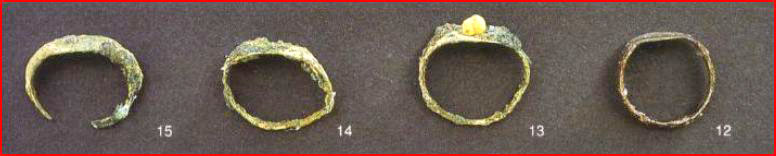
A total of 84 pieces of real jewellery were collected from six tombs of mainly second-century CE date.  The haul included bracelets, a brooch, earrings, finger-rings (such as pictured above), a loose gem, one necklace, and several pendants.  Most objects were made of copper or silver and very few of gold.  Of course, the big problem at Palmyra is that nearly every tomb was thoroughly looted long ago, so thieves probably beat the archaeologists to most of the good stuff.

That may not be the whole story, however.

Classier finds did come from the relatively undisturbed Tomb F, excavated in the 1990's --  built by two brothers with the impossible names of BWRP and BWLHThis tomb yielded a total of 30 pieces of jewellery, including lots of beads, finger-rings (one of gold), copper earrings, and two gold-and-glass pendants (left) ... and a strange human-shaped amulet, resembling a clothed female-like figure (13.3 cm tall; top of post).

Who had goodies in their graves?

We are obviously missing lots of jewellery and assume there would have been more glittery gold if the tombs had not been so extensively robbed.  Still, we must make do with what we have.


We have bones.

The bones of 22 skeletons in graves with jewellery could be sexed and/or age estimated: three were adult males, six adult females, and twelve were children; one burial held two adult males and a child.*  Though fewer males than females were buried with jewellery, there was clearly no prohibition on the practice (contrast the Roman study which found no  males buried with bijoux).  On the contrary, the average number of pieces buried with each sex was much the same: 3.5 pieces per adult woman vs 3.0 per adult man; the kids had less: just 1.4 pieces each.

Nonetheless, there was a distinction in the types of jewellery that men and women took with them to the grave.  Men had predominantly pendants, often of amuletic character (such as the figurine at the top of this post). Adult females were mostly buried with earrings and finger-rings, and children mostly with beads.

Reality versus Image

So that's the real deal.  But reality never interferes with how people choose to picture the dead.  It's always idealized.

In order to make a fair comparison with the Roman statues, Ms Raat sought a published Palmyran tomb that held at least 15 well-preserved female portrait busts (that is, the same number as Roman female statues), and mainly from the second century CE. Only the underground tomb of Sassan qualified: 42 individual limestone busts come from this tomb and 16 of them (38%) are femaleWorking back from an inscription written in Palmyrene (a dialect of Aramaic) on the bust of two men which is dated to the year 181/182 AD, Sassan's family genealogy was established by linking up  inscriptions on funerary portraits (I am X, son of Y, son of Z -- that sort of thing). This gives the time range during which the tomb was used as ca. 80-200 CE.

Sassan's Daughters

We know something about 15 of the 16 women whose images were sculpted on the limestone busts because inscriptions give their name plus their father's name and often his father's name, and such useful patriarchal data.  Only one inscription names both parents.

The women must all have been part of the Sassan family for which the tomb was constructed. How they are exactly related is not always apparent. In one case, we can point to two women who were sisters.  We can be certain, however, that all these women belonged to the higher class: the family was affluent and important enough to found and sustain this quite large tomb.

So, how were these well-to-do fathers' daughters portrayed?  And who was meant to see them?  Ms Raat sets the scene: 
... I would call the context of the [tomb] semi-private or semi-public. In Palmyra, family members of the deceased had access to the tombs, so the busts were visible for generations to come. Only relatives or others associated with the deceased would be able to open the locks on the entrance doors of the tombs....

We thus can identify the location, the viewing context (deliberate visits to mourn, pray and perhaps worship), as well as the viewers (relatives of the deceased) of these sculptures. This must be taken into account in the interpretation of the busts....With all this in mind the deceased will have been represented in a certain way, conveying messages on his or her identity and role in society. The sculptures will have evoked a certain response from the family members.
 Now, what did these ladies look like?

Amtâ, daughter of Malkû, wife of Belšûrî, son of Sassan
Let's start with a woman named Amta, who died between 100-130 CE.  She wears a headband and a knotted turban underneath a cloak that is draped as a veil. Covering the head with a veil was fashionable in different areas of the ancient east as well as the west. She gazes straight forward, holding her veil with her right hand and, with her left hand, a spindle and distaff as proof of perfect domesticity.  As for jewellery, other than the headband, she wears a brooch, earrings shaped like a bunch of grapes, and two necklaces, both consisting of chains of round stones.

Tammâ, daughter of Sîgâ (and), daughter of Belšûrî
Tamma was buried between 100-120 CE.  She was the only woman in Sassan's tomb whose father and mother were both named on her funerary stone. She touches her chin with her right index finger. Her other hand holds spindle and distaff. She wears a broad, rather plain headband and a twisted turban below a veil.  Her ornaments are a brooch  and bunch-of-grapes earrings.

Amtâ, daughter of Malkâl, (son of) Moqîmû
Amta was a popular name in Palmyra.  Another lady of this name died between 170-200 CE. She holds her veil with her right hand, raising it to collarbone level. Raising a hand to chin or collarbone was known in Rome as the pudicitia gesture (pointing to modesty and fidelity) and is commonly made by women in Palmyran funerary portraits -- though it might not have had the same meaning here.**  She wears a headband with floral design, a head-chain made of round stones and a knotted turban underneath a veil. As for other jewellery, she boasts a large, richly-decorated brooch, dumbbell earrings, two rings on her little finger, and two necklaces, the first a simple choker with a flower-like pendant, and the second a chain of stones.


Malkat, daugther of Oggâ, son of Sassan
Malkat died between 150-170 CE.  She holds her veil with her right hand, raising it to collarbone level, and in her left hand loosely grasps a spindle and distaff. She wears a floral-design headband, a head-chain made of round stones and a knotted turban underneath a veil.  The jewellery displayed includes a brooch, dumbbell earrings, and a necklace of stones with an oval pendant, which itself has three smaller pendants.

Bîlat, daughter of Elahbel
Big-eyed Bilat was buried between 140-170 CE.  She holds her veil with her right hand, raising it to collarbone level, and holds in the other a spindle and distaff. She wears a headband with floral design and a knotted and twisted turban below a veil.  Her jewels are an animal-headed brooch, earrings shaped like a bunch of grapes, and a ring on the little finger of her left hand.

We needn't go on.  You get the idea. 

If you've got it, flaunt it.

Female jewellery is meant to be seen and its reproduction on funerary portraits is clearly considered seemly. The total amount of separate pieces of jewellery pictured on the 16 busts (earrings counted per pair) adds up to 75 objects. On average 4.7 pieces of jewellery are displayed per portrait and ranges from two to ten pieces per bust.  No woman wore less than two items (the minimum was a brooch and headband).  In short, all of the ladies wore jewellery. 

It is difficult to determine the kind of material the sculpted jewellery was intended to represent. A necklace made up of a chain of stones is often described as a ‘pearl necklace’, but most sculptures in Palmyra were painted, though few traces of colours survive.

Those colours would have told whoever was looking at them what the jewellery was meant to be: gold would be shown by yellow paint, silver by white paint, gems by their 'natural' colours. We can be sure that yellow paint imitated gold because the 'Beauty of Palmyra' (below), for example, retains both traces of gold leaf as well as yellow paint. Recent microscopic photography has revealed red paint invisible to the naked eye (above, left) on the bust of Haliphat, daughter of Oglata, son of Harimai, now in the Smithsonian -- that might have indicated rubies along with some kind of red inlay.

But boys will be boys

Male funerary busts, whether in Sassan's tomb or anywhere else in Palmyra tombs are never pictured wearing any jewellery except occasional finger-rings or cloak fasteners (fibulae). Thus, the difference between men and women regarding jewellery representations is a strict matter of gender.  Which is interesting when you think that some men were nonetheless buried with jewellery -- even if the limestone portraits that closed their graves did not show it!

In the Roman part of this study, all graves with jewellery were female graves, and, as it turned out, only with a specific category of deceased: young unmarried women.  Even so, in both regions, it was uncommon to bury the dead with jewellery.  Just a quarter of the graves in the unlooted Tomb C held any jewellery at all . Moreover, in the grave of the founder of the Tomb (YRHY, son of LSMS, son of MLKW -- if you must know) no jewellery or grave goods of any kind were found, even though his tomb was undisturbed.
This is an important outcome, because it points to jewellery not being a general status marker of the deceased person. Not even in wealthier circles of society there was a habit to give jewellery with the deceased into the grave, neither as a remembrance of the status and wealth of the persons during life, nor as an act of conspicuous consumption by rich families during burial rituals.
When in Palmyra....

The 'Beauty of Palmyra'
And yet, not a single dead woman was pictured without at least two pieces of jewellery -- and some wore lots more.  In some tombs, the jewellery displays were simply dazzling (left).  

This adornment with jewellery, combined with feminine gestures and attributes (e.g. spindle and distaff),  expressed what was considered the Palmyran female ideal.  Differences in the amount of jewellery displayed on female portrait busts surely reflected the social status of the city's elite as well as the actual wealth of the women and their families during life.

When in Rome...

The enormous display of jewellery visible on the Palmyran busts was unimaginable in Rome: there, the general absence of jewellery on statues of women counts. Displaying jewellery contradicted the feminine virtues and challenged the prevailing female ideals. In Roman society, sculptures without jewellery were representations of that feminine ideal.  Opulent displays like those in Palmyra would have been shocking, an indication of loose morals -- or worse!  Only diadems (and earrings) were allowed on Roman female statues: since diadems were connected with the religious sphere, this must have made it an acceptable adornment.

A Girl's Best Friend

The results on the jewellery finds and how jewellery was pictured on statues from Rome and Palmyra show that we are not dealing with a dominant centre that set the standards to which all the provinces conformed.  The relationship is not that direct: there is more an overlap in the material visible, pointing to a layer-cake-like process taking place.  When it comes to the way they handled jewellery, Rome and Palmyra followed their own traditions and practices.

In short, as Ms Raad concludes, "The sculptures demonstrate that different ideals prevailed in Rome and Palmyra."


*  Two of the males were aged between 20-39 years old, two between 40-59 years old, and one was older than 60 years.  One female was between 40-59 years old when she died, one around eighteen years old, and two could only be classified as 'middle-aged' and another one as 'young'.  For the children, gender could not be determined but two were under a year and two were 5-7 years old.

** On the pudicitia and other female gestures, see Zenobia's post on  The Secret Language of Palmyra

Illustrations

All are taken from Andrea Raat's Master's thesis with the exception of the 'Beauty of Palmyra' (ca. 190-210 CE) from Ny Carlsberg Glyptotek and the microscopic photograph made by the Smithsonian of the necklace worn by Haliphat, daughter of Oglata, son of Harimai (died 231 CE).
.
.

24 February 2013

Diadems Are Forever


Just like a woman...

... elegance of appearance, adornment, apparel – these are the woman's badges of honour; in these they rejoice and take delight; these our ancestors called the woman's world.

That what Livy (34.7.8-9), perhaps the greatest of Roman historians, said ... and he knew what he was talking about.  At least, he knew what was what when the subject was about men: their offices, priesthoods, triumphs, decorations, gifts, and spoils of war.  About the women's world, well, not so much.  Although, in one basic matter, he was right: women had no equivalent public honours.  Accordingly, he assumed that their obsession with bodily appearances was compensation for their lack of civic repute.*  So, what mattered most to them was how they looked ... gussied up with silks and jewels and other female frippery. This was the only public statement that a woman could make, the only way she could boost her status and command respect outside the home.

Let women have gold in their bracelets and covering their fingers and on their neck, ears and tresses, let gold chains run at random round their waists; and let little bags of pearls hang invisible suspended by gold chains from their lady owners' neck, so that even in their sleep they may retain the consciousness of possessing gems : but are even their feet to be shod with gold, and shall gold create this female Order of Knighthood, intermediate between the matron's robe and the common people? (Pliny, N.H. 33.40)

Needless to say, any opulent public display of gold and pearls and gems was also taken as a sign of dubious morals, bringing out the worst qualities in women (greediness, extravagance, and vice).

Just like a woman, really. 

Higher in bling, she was inevitably lower on the moral scale than men and accordingly a creature of lesser virtue.  Both figuratively and, as some would say, literally:
There is nothing that a woman will not permit herself to do, nothing that she deems shameful, when she encircles her neck with green emeralds, and fastens huge pearls to her elongated ears....(Juvenal, Satire 6)
But did the Roman woman really conform to this pattern?

Of course, the feminine virtues admired in Roman society were chastity, modesty, fertility, beauty, and fidelity -- all virtues in favour of a woman's husband and family.  Those are the virtues reflected in representations of women. Wearing too much jewellery was believed to contradict feminine virtues and could be seen as suggesting loose morals -- which means that the absence of jewellery in itself could be meaningful. On the other hand, jewellery could also demonstrate a woman's status and her husband’s and his family’s wealth. And it must be said, some kinds of jewellery positively supported female virtues, such as green gemstones favouring fertility, pearls rewarding motherhood (only to be worn by women with three or more children) and engagement rings pointing to marital status.  

So, what was an elite Roman woman to do?  To bling or not to bling?

It's time to find out.

In her Master's thesis, just completed at Leiden University (Diadems: a girl’s best friend? Jewellery finds and sculptural representations of jewellery from Rome and Palmyra in the first two centuries AD), Ms Andrea Raat delved into this perennial conflict from two different viewpoints: 

First, she set out to discover what kind(s) of real jewellery has been buried with men or women in the area of Rome, and the social position of the owner(s).  The precious metals and gems she studied come from sarcophagi and tombs in ten identified burials, found around and on the bodies.** All date from the first century CE to the end of the second century CE.  

Then, she asked about what kind(s) of jewellery are pictured on statues of Roman women of roughly the same dates. 

What jewels do they wear and what kind of woman is wearing them? Sculptural representations express both a person's identity and a social role forever fixed in a specific pose, gesture, attributes, dress and adornment. So Ms Raat went to the Musei Capitolini in Rome and studied the statues of women there shown wearing jewellery of any kind, from the first two centuries CE: of 145 female statues from this period, only 15 meet these criteria. That is to say, ca. 10% wear jewellery; 90% not.

Next, she asked what are the similarities and differences between the buried jewellery and that depicted on sculpture?

Reality versus image, really.

As if that isn't a big enough subject, she then went on to visit Palmyra, home of Queen Zenobia (but a little earlier than her reign)....

From Rome to Palmyra

The procedure was the same: looking at real jewellery from tombs and then the ornaments pictured on sculpted grave monuments.  Did she find the same patterns there as at Rome?  And would these indicate the similar aspirations of elites living at the centre of empire and those living far away on its eastern frontier in Syria?  Were the Palmyrans bijoux copy-cats, or did they go their own way in matters of personal adornment?

So, what did Ms Raat discover?

The Imperial Capital First

In the nitty-gritty of the Roman tombs, 49 pieces of jewellery were found -- from bracelets to brooches, from hairpins and hairnets (below, left), to necklaces and very popular finger-rings, too. 


Most objects are of gold or gold combined with a precious stone.  In nine of the ten burials, the skeleton could be sexed and all were female.  So, it seems pretty clear that jewellery in such Roman burials is linked to the female gender. When the age at death could be estimated (three cases) as well, they turned out to be under 20 years of age. That leads to the hypothesis that all of these female burials are of young, unmarried women:
Normally jewellery was not placed in graves, but formed part of a dowry and was passed on from one generation to the next. When a girl died before she had arrived [at] marriage and motherhood, this chain of traditions was broken, making it an accepted practice to let the girl take her jewellery to the grave.
As for the social status of these young women, the richness of jewellery finds and other grave goods in the burials suggest that they belong to affluent and socially significant families.

That's how these young women looked in death.  What does the sculpture say?

First, remember that of the 145 sculptures in our sample, just 15 (ca. 10%) are pictured wearing any kind of jewellery. Five of them had real metal jewellery attached (earrings fastened to the pierced earlobes; as above, third image down) or had holes in their ears where it once real earrings had been attached.  And ten statues had jewellery in sculptured form but only, remarkably, of one single type: diadems!


Here is Livia, wife of the Emperor Augustus (above).  The decoration of her elaborate diadem includes relief ears of wheat, which alludes to her identification with the divine goddess of agriculture, CeresFive more imperial women also wore diadems (one representing Venus and one Artemis), but no one managed to out-diadem Livia.  Sabina, wife of Hadrian (below), didn't even try.


Two women with diadems are of unclear status and one was definitely not an imperial lady but she had herself sculpted as the goddess Fortuna.  One more was a priestess (below), who also wore a richly decorated diadem: 


So, what does this say about the type of women who were portrayed wearing diadems? 

While the diadem can refer to the imperial sphere, that is not always the case. In fact, it seems more strongly connected with the religious sphere. Besides the priestess with the diadem, three diademed imperial women and one certain non-imperial woman with a diadem are represented as goddesses. The diadem can therefore be associated with the divine, as if this type of jewellery were a divine attribute. 

The fact that the diadems on Roman female statues were connected with the religious sphere apparently made it an accepted piece of public adornment. Obviously, these women would have possessed an awful lot of jewellery in real life, but they wouldn't have wanted to show off their riches on their statues (at least nothing more than occasional  earrings or a diadem). Most probably, the 90% of women pictured without any jewellery at all were praised as representing female virtues. More jewellery than earrings or a pious kind of diadem would probably have warranted the same criticism as showing off their jewels in public, namely an accusation of female vice.

So, when in Rome, elite ladies were commemorated in public, they would wear only the most limited and stereotyped forms of jewellery -- or none at all -- and so they presented the female ideal.

In the next post, we'll move on to Palmyra -- where things could not have been more different. 


* Commonly ornamenta referred to the status, title, honours and costume (including decorations) granted to a specific rank. For men these were ‘badges of honour’  operating in the public political or military sphere (e.g. ornamenta consularia or ornamenta triumphalia). Ornamenta muliebra or feminarum (‘female ornaments’), on the other hand, are confined to personal items of decoration.

** The jewellery finds for this study consist of the collection of jewellery on display in the `Luxury in Rome´ section of the Palazzo Massimo alle Terme, part of the Museo Nazionale Romano. It comprises well conserved valuables mostly found in a grave context with known excavation records.

My thanks to the blog History of the Ancient World for signalling this fascinating Master's thesis from Leiden.

Illustrations

All are taken from Andrea Raat's Master's thesis.

1.  Plotina (aka Pompeia Plotina Claudia Phoebe Piso), wife of the emperor Trajan (r 98-117). The marble bust of a woman (Plotina?) with a diadem sculpted from hair; Trajan period (Musei Capitolini).

2. A woman is helped getting dressed. Fresco, first century AD, Pompeii (Museo Archeologico Nazionale di Napoli). Wealthy women made use of a special ornatrix, a female slave responsible for making her mistress’ toilet, with hairdressing as main task.

3. Bronze statuette head of a divinity with a gold and pearl earring (Museo Nazionale Romano).

4. Detail of a marble statuette of Venus with painted golden jewellery and bikini from Pompeii (Museo Archeologico Nazionale di Napoli).

5. Marble portrait head of Livia; Museo Capitolino, Stanza degli Imperatori 9. Inv. 144.

6.  Marble portrait of Sabina; Museo Capitolino, Salone 44. Inv. 338.

7. Marble portrait of a priestess (from a relief); Palazzo dei Conservatori, Braccio Nuovo III 16. Inv. 2688 (2539.158).  Discovered in 1938 during excavations at the Mercati Traianei (Trajan’s markets).
.
.
.

06 February 2013

Once Upon A Time in Palmyra


This simple film shows a camel caravan passing through Palmyra and moving on to Baalbek some time in the 1930s.* I'd hate to be thought an Orientalist by calling such images timeless, but it comes pretty close to that:

 
But time has moved on.  Al-Jazeera had this news report today.   

Suicide bombings hit central Syria town of Palmyra. 

The official Syrian news agency said the attack took place in a residential area in Palmyra. An activist group claimed that a military intelligence headquarters was targeted and that at least 12 members of the security forces had died. Video footage showed a large cloud of thick smoke rising in the city.
  

It looks to me to be in a part of the new town to the north of the Roman-era ruins.  The buildings are surrounded by a protective wall (visible in the foreground).

The attack occurred at about 06:00 local time (08:00 GMT), according to local activists:
The first bomber reportedly blew up his explosives-laden car next to a back wall of the military intelligence compound. The second assailant is said to have then driven through the hole, detonating the bomb inside his vehicle and destroying parts of the facility. 
The Syrian Observatory for Human Rights (SOHR), a UK-based activist group, said at least 12 members of the security services had been killed and more than 20 others injured.

Retaliatory Shelling

Abu al-Hassan, one of the local activists, reported that tanks stationed inside the intelligence compound had fired shells into an adjacent residential district following the attack, killing several civilians.  Eight civilians have been injured, some severely, by heavy gunfire that followed the bombings.  Rebel fighters were said to have attacked the buildings soon after the double blasts.  Roadblocks across the city also came under attack.  There were claims of "huge material damage".

Protests broke out in Palmyra at the start of the uprising against President Bashar al-Assad in 2011, but the army has since tightened control of the town, which is situated near a major oil pipeline junction.

Zenobia has been reporting throughout 2012 on violence and looting in the town (designated as a world heritage site by UNESCO).  See Syrian Army Attacks Palmyra -- with multiple updates.  More news on the latest fighting as I get it....


 * The film begins at Palmyra, and then (at 3.30'), when a gang of children run down the stairs, you have been suddenly transported to Baalbek. The sound track is inaudible: I'm even unsure of the language (any ideas?). The film clip was generously made available on YouTube (8 Nov. 2012) by Huntley Film Archives, one of the largest independent film libraries in the UK. 

.
.
.

20 January 2013

How Hatshepsut Helped Build The Good Ship Min

Min of the Desert takes to the sea


Just as almost four-thousand years ago...


That's when the female pharaoh Hatshepsut sent five ships sailing south to the far-away 'God's Land' of Punt and then pictured them returning to Egypt with the products of Punt on the walls of her mortuary temple at Deir el-BahriAs she herself tells us in a lengthy inscription  "the ships were laden with the costly products of the Land of Punt and with its many valuable woods, with very much sweet-smelling resin and frankincense, with quantities of ebony and ivory..." 

Egyptologists have long have argued about whether, when, how and in what sort of ships the ancient Egyptians went to sea.  How did they ever dare to leave the shallow waters of the river NileNo one ever thinks of the Egyptians as real seagoing sailors: textual references to seafaring are scarce and often provide few detailsIn the last few years, however, new discoveries have dramatically changed that picture.  Extensive remains of seagoing ships at the port of Saww/Wadi Gawasis on the Red Sea coast --  in ancient times a sheltered bay, lush with mangroves and deep enough for launching large ships to sail the sea -- provided the first physical evidence of massively built cedar-wood ships that were used to conduct the business of the Egyptian empire on the briny deep.

We now know that this port was the jumping-off point for deep-sea voyages to Punt, some 1,200-1,300 km (800 miles) away to the south.  Punt itself has only been recently located in what is now Eritrea.  [Zenobia has written all about both discoveries: the location of Punt at Eti, the Eritrean Queen of Punt; and the astonishing finds from Saww/Wadi Gawasis  at Hatshepsut and the Turin Papyrus Map].

Even before exploring the site, however, there was evidence that Egyptian sailors were putting out to sea from that harbour in their quest for the fabulous goods to be found at Punt -- myrrh, ebony, gold, ivory, live baboons, and exotic animal skins.  An inscribed stela from the time of Senusret I (ca 1956-1911 BCE), second king of the 12th Dynasty, found in a shrine there described ships built on the Nile at Coptos in Upper Egypt for a voyage to Bia-Punt ('the mines of Punt') involving more than 3,200 men.  Those sea-going ships were then dismantled for transport and carried by men and donkeys more than 150 km (95 miles) along the wadi routes of the eastern desert to be reassembled at the port.

Navigating the dangerous waters of the Red Sea to the very edge of the known world must have seemed to them as daunting as a mission to the Moon to us.  Myrrh made it worthwhile. It was not just a sweet-smelling perfume (though it was that too: Hatshepsut rubbed it on her legs to impart a divine fragrance*), but an incense that was essential to the proper worship of gods and for the after-life.

Myrrh (Commiphora myrrha) was burned in vast quantities during the daily temple rituals, and used in embalming the bodies of pharaohs and for the mummification of lesser folk, too. As early as the Fifth Dynasty, a single expedition had brought back to Egypt no less than 80,000 measures of myrrh. Demand, however, was insatiable. Therefore, besides having orders to import the desired incense from Punt, Hatshepsut's expedition also would collect complete trees and bring them back to Egypt as well (left).

A conundrum

You can't sail to Punt without a proper sea-going ship.  River craft (used to sailing upstream with the wind in a southerly direction, and moving with oars and the current downstream to the north) would be quickly overwhelmed on the deep tidal waters of the Red SeaYet, despite Egypt's perfect conditions for preserving wood, no such craft had ever been found: remains of seagoing ships were limited to a few plank ends dating to the Middle Kingdom at Saww/Wadi Gawasis.

And so, for a great many years, the representation of five ships on a voyage to Punt commemorated in reliefs on the walls of Hatshepsut's mortuary temple was the only real evidence showing that the ancient Egyptian ever took to the high seas. That remained the case until the 2004-2010 excavations at Saww/Wadi Gawasis uncovered a vast complex for staging round-trip voyages to Punt.

Archaeologists unearthed substantial ship parts ranging from complete planks to short pieces of oar looms, as well as anchors, and ropes still tied in original knots, dating from the Fifth Dynasty (c. 2500 BCE) to the time of pharaoh Hatshepsut (c. 1475 BCE).  But, sometimes, the tiniest clues turn out to be the code-breaker: this picture of a fragment of cedar planking (left) shows where shipworms had tunnelled into wood immersed in the sea -- irrefutable biological proof that the ship had sailed on the Red Sea.

Those discoveries provided a scientific foundation for the design, building, and rigging of ancient Egyptian deep-sea ships. They also changed the basic question from ‘did the Egyptians go to sea?’ to ‘how often and how far did the Egyptians sail at sea?".

Putting together all the new and old information was enough for Dr Cheryl Ward (Director of the Center for Archaeology and Anthropology at Coastal Carolina University) to get a team together to build a full-scale reconstruction of an Egyptian seagoing ship and then test its seaworthiness by sailing it across the Red Sea: 
Although we do not have an entire ship—or the ability to identify which vessel a particular timber came from or whether any of the timbers came from the same vessels—the assembly-line mentality of common dimensions, shapes and proportions made me confident that the ... data could be used as the basis for a theoretical reconstruction. From 2006 to 2008, I led a team that designed, built and sailed a full-scale reconstruction of an ancient Egyptian ship.
This theoretical study was measured against the rare full-sized Nile ships that have been found in monumental royal burials, as at Abydos (14 boats in mud-brick boat graves from the reign of Aha, Dynasty 1), at Giza (two 43m-long disassembled ceremonial ships outside Khufu’s pyramid), and at Dashur (four 10m-long boats outside the pyramid of Senwosret III).  It is those vessels and timbers that constitute the main physical evidence for the indigenous and unique methods of Egyptian boat and ship construction for the Nile as well as for seagoing ships Almost all these vessels exhibit similarities and a consistent approach to creating a shell of thick and sturdy planks, fastened along their edges, with beams across the hull at deck level but few frames.

The results of Dr Ward's work has just been published in the latest British Museum Studies, with a full report on how she and her team of researchers and volunteers came to ply the waters of the Red Sea: Building pharaoh’s ships: Cedar, incense and sailing the Great Green

Min of the Desert

The ship was christened Min of the Desert in honour of Min, the ancient god of Coptos, who was also worshipped at the site of Saww/Mersa Gawasis. 

The good ship Min is 20-m (66') long, 5 m (16') wide and displaces 30 tonnes of water with a cargo capacity of about 17 tonnes.  It is based primarily on ship components from Saww/Gawasis as compared with similar features illustrated in the Punt reliefs (left): these are constant across several dimensions and tests, showing consistency in proportions for steering rudder blades, beam spacing and dimensions, oar looms diameters and crutch height.

They also correspond well to components illustrated in the Dashur boats, if the scale of the Dashur boats were doubled. That consistency, and similarities between the profiles of Hatshepsut’s ships and those of the Middle Kingdom Dashur boats provided the foundation for the vessel design.

The Cedars of Lebanon

The timbers found at Saww/Gawasis resemble boat planks from the Dashur boats, and like them, were carved from cedar of Lebanon (Cedrus libani), a conifer that produces long, straight timber. This lightweight, durable and strongly scented resinous wood was valued for ships, furniture, statues, coffins and other finely crafted objects in the ancient world. Cedar only grows above 1,700m in elevation and was harvested from forests on mountains near the sea and transported as trimmed, roughly squared logs. Transported on ships to Egypt, cedar intended for ship construction was converted to ceremonial craft like those at Dashur and Giza, or perhaps was sent to a royal shipyard.

The few remaining cedars in Lebanon are thankfully protected and cannot be cut down.  Cheryl Ward had to find a substitute:
Our effort uses 120-year-old, Douglas fir timber with physical characteristics and features comparable to cedar of Lebanon. We depend on ancient techniques, assisted in some cases by modern technologies such as electrical band saws for the rough cutting of plank shapes. Most work is done with hand tools made to specifications comparable to ancient examples, but of iron rather than hammered copper.
But what kind of sailing could be done with these vessels? 
We made short trips on the Nile at first, and then in the Red Sea, before attempting the longer trial voyage south towards Sudan from Safaga along the route used by the Egyptians. The square sail is high above the deck and quite large at 14.25 x 5 m, and it has no brailing lines (an innovation of the late 13th/early 12th century BCE). Day sails and practice in rowing prepared the crew for the longer trip in the Red Sea.
All Hands to the Bilge Pump!

Because archaeologists had found no trace of any caulking materials at Saww/Wadi Gawasis, it was hoped that the ship would be watertight because of the precisely cut hull planking alone. It took just one trip on the Nile to be rudely disabused of this notion: the hull quickly filled with water and almost sank. The researchers turned to linen fibres and beeswax, two natural products used by the ancient Egyptians for wooden furniture and coffins. No one knows if the ancient shipwrights used this or another formula ... but they certainly used some kind of natural products to caulk their ships.

We're off! 

Ward and a crew of two dozen students, engineers, and sailors embarked on an 18-day voyage on the Red Sea aboard the reconstructed ship.


Min of the Desert outperformed all expectations, logging an average speed just above 6 knots over six days, with speeds of up to 9 knots. During the voyage, wind speed reached 25 knots, and the swells climbed to 2.5–3.0m, but the ship easily kept to its course and suffered no adverse effects.

The trip indicated that the Egyptians were much more proficient shipwrights than previously thought. "When the wind picked up and filled our sail, we just took off," she says, about twice as fast as she'd expected. "My hope was that we would be able to have a nice, solid voyage in which we could test the capability of the ship. I had no idea it would be so exhilarating, so easy to operate, and such a direct reflection of what we see in the ancient reliefs." 

Thank you, Hatshepsut!


* Read about one of Hatshepsut's perfume flasks on my blog post at Hatshepsut Smells as Sweet.


Explore different parts of the ship in this interactive Anatomy of the Punt Ship.

Sources (in addition to Cheryl Ward's report  in BMSAES) include her abbreviated research report 'Ancient Egyptian Boats and Ships: Building Min of the Desert'; Eti Bonn-Muller, Diving into History: Min of the Desert, Archaeology Archive; Min of the Desert, on the Red Sea Pages; Rachel vanCott, Anatomy of the Punt Ship, on Nova beta

Illustrations

All from Cheryl Ward's reportin BMSAES except for the following:

First left:  Relief from Hatshepsut's mortuary temple of men carrying myrrh trees with roots in pots (AboveTopSecret).

Portrait of Dr Cheryl Ward from her Home Page at Coastal Carolina University.

Lowest left: The Min in full sail . Photo credit: Stéphane Bégoin (via Archaeology Archive)
.
.
.


Blog Archive