26 June 2013

The Ultimate Palmyran Identity Crisis


Roman Palmyra: Identity, Community, and State Formation


I'm late, I'm late, I'm late for a very important date:

My review of Roman Palmyra by Andrew M. Smith II appeared almost two weeks ago in the Times Higher Education, but I didn't want to interrupt the flow of posts on Graffiti in Dura Europos, so it only goes up today. 
 
Here's what I wrote:


13 June 2013

Judith Weingarten on an island emporium in the midst of a sea of sand
When, before AD77, Pliny the Elder remarked that Palmyra “had its own fate” between the Roman and Parthian empires, what had been a remote oasis in the Syrian desert a century earlier was becoming a world-beating marketplace. The city’s strategic location between empires was, of course, one reason for its success. A natural stop for caravans trekking from the Euphrates to the Syrian coast, it was well placed to profit from the trade between Rome and the East. As Pliny grumbled: “By the lowest reckoning, India, Seres [China], and the Arabian peninsula take from our Empire 100 millions of sesterces every year: that is how much our luxuries and women cost us.”

The vast circuit of desert that surrounds Palmyra kept it just beyond the tight control of either side, an island emporium in the midst of a sea of sand. It was last attacked in 41BC, when Mark Antony crossed the desert greedy for plunder. But it is as if both empires tacitly agreed to let it live in remarkable peace - within the general orbit of Rome, to be sure, but enjoying excellent relations with Rome’s enemies nonetheless. And so, a Graeco-Roman city blossomed in the desert. Who built it, and how, is the story told by Andrew Smith in this latest attempt to explain Palmyra’s rise.

A unique Palmyran cultural identity - at once Greek, Roman, Parthian and, above all, native - grew out of the interplay between (semi-)nomadic tribes in the vast Palmyran hinterland and the city’s Arameans and Arabs. Both desert tribes and urbanites profited from the caravans, whether as cameleers and guards or financiers and merchants. Palmyrans maintained their cultural distinctiveness and language despite the ups and downs of life on a volatile political frontier.

With increasing Roman encroachment in the 3rd century, some of their distinctiveness faded. Roman soldiers were in the city by the close of the 2nd century and Palmyra became a Roman colonia and its citizens Romans after AD212. By then, most of the monumental building was done: temples, a theatre, colonnaded streets, an agora and cemeteries of elaborately decorated tombs. Until the end, the structure of personal and group identity in the city remained essentially tribal. While most temples had specific tribal links, Smith stresses that the Temple of Bel was more civic in nature. Appropriately, the first record for the monumentalisation of Palmyra (AD19) honours a man of the Bene Mattabol tribe for contributing to this temple. In AD24 and AD25, the “treasurers and the people of Palmyra” twice honoured a man of the Bene Komare for his donations. In the 2nd century, one of the Bene Gaddibol paid for a gate and doors. Maddeningly, Smith does not vocalise the Aramaic tribal names (referring to bny mtbwl, bny kmr’, bny gdybwl and 96 other tribes and familial units). This makes reading about “Tribes and Tribalism” difficult for non-specialists. A New York friend of mine brings the Bene Mattabol to mind as “Bene Matzo-balls”; perhaps unscholarly, but it helps.

Smith describes how the status quo crumbled in the 3rd century, provoked in part by Septimius Severus’ successful invasion of Parthia in AD198. In AD228 the Persian vassal king overthrew his master and proclaimed an aggressive new Sassanian Empire. In April AD239, the Persians first assaulted Dura-Europos. This must have sent shock waves across the desert: if Dura were taken, could Palmyra be far behind? Dura finally fell in AD256. The great warrior prince Odenathus rode to the rescue, chasing the Persians from Roman lands and to their capital at Ctesiphon; does Smith really believe that his forces consisted of “an army of Palmyrenes, peasants, and dispossessed soldiers” (repeated twice)? Smith leaves others (among them Pat Southern, author of Empress Zenobia: Palmyra’s Rebel Queen) to tell of events between Zenobia’s rise to power and the sack of Palmyra by Aurelian in AD272.

This is not an easy book, but it is worth tackling the early chapters because the arguments become stronger and the writing tighter as Smith proceeds. But why do we call both the people and language “Palmyrene”? After all, Arabs are not “Arabics”. Peeves aside, even the strictest historian who adds Smith to Southern will know all there is to know about Palmyra’s “fate”.


Roman Palmyra: Identity, Community, and State Formation
By Andrew M. Smith II
Oxford University Press, 336pp, £55.00
ISBN 9780199861101
Published 21 February 2013
.
.
.

20 June 2013

"I AM HIYA!" Part 4 (Updated)

Much More Graffiti in Dura Europos (3rd century CE)

Part I, Kilroy Was Here!
Part 2, Azzanathkona is coming!
Part 3, Temple of Palmyran Gods 

Home Sweet Home 

Imagine!  You are sitting on a bench in the entrance hall of a grand mansion in Dura Europos one fine day, waiting for an audience with its noble owner, a man by the name of Lysias.  Lysias traces his ancestry back to the time of the Seleucid kings who had ruled over Syria and eastwards in Hellenistic times.  Even after the Parthians took control of the city (ca. 113 BCE), the family remained great landowners.  An ancestor, Seleucus son of Lysias, had held the office of strategos (General of the City) in 33 CE, and a grandson of the same name was both strategos and epistates (chief magistrate) in 50 CE, both under Parthian rule, and his grandson -- conveniently named Lysias son of Lysias -- held the same positions in 136 CE, at the very time of the Roman conquest; and so on.  As late as 200 CE, another offspring, Septimius Lysias (who had very recently become a Roman citizen) was also in office as the strategos of Dura.  Well, empires come and go, but the family still rejoiced in the exhalted title of 'First and Most Honoured Friends and Bodyguards' of the King, a title dating back to the time of the Seleucids.  

You get the picture.  Wealth.  Lineage.  Class. 

South facade, House of Lysias (Block D1)

And a house as big as a city block.  Even if it's not much to look at now, you can still feel the size.

So, there you are, sitting in the hall of this home, waiting.  Instead of twiddling your thumbs, you idly pick up a stylus or your knife, and -- what can be more natural? -- scratch your name into the wall of your host's house.  Perhaps adding the words, 'Remember me!' (in Greek, the mnēsthē formula).  That's what Addaios, Aisaos, and Areaios did,  presumably while waiting to be admitted, and a fellow named Herakles, too.  In all, eight different persons scrawled their names with 'Remember Me' on the walls of the entrance hall.  Some visitors were perhaps more circumspect, writing Lysias' own name instead of their own: twice 'Lysias.  Remember me!', once naming him in connection with an embassy, and another time recording the death of Lysias (or a family member of the same name).  One uncharacteristic graffiti seems to give the prices of wine.

Why in the world would you deface the house of your powerful host in that way?  Well, of course you wouldn't.  And Dr Jennifer Baird, lecturer in archaeology at Birkbeck College (University of London), tells us why the scribblers didn't:
The scripts clustered in the entranceway ...would have been so unremarkable both in presence and formulation that the guest had no doubt that their actions would not be considered a defacement.... [T]hey were in visible places, and from the dated examples in other houses, it is clear some were allowed to remain as part of the fabric of the building for many years.
Note, first of all, that in this super-rich household, no servant came along to scrub graffiti off or whitewash over them. Not in the grandest houses of Dura, like that of Lysias, nor in the meanest with just a few rooms.

Second, many names with 'Remember me!" were also found at Dura in the synagogue, the Temple of Azzanathkona, the Temple of the Palmyran Gods, and in other buildings, both sacred and secular, public and private. In sanctuaries, graffiti “frequently and appropriately appeared in places of intensified holiness”.  There is no reason to assume that when the same formulations occurred in houses they meant anything different.  Far from being casual, off-hand, or the result of boredom, such graffiti played a part in each building's social fibre.

[M]emorialising an individual on a house wall also –literally- cements that person into a relationship with that social group, a relationship that could further be recalled if the graffito was read aloud. 
 The Writing on the Walls

At Dura, 22% of all graffiti (and there was an awful lot of it) was found in private houses.  Put another way, archaeologists recorded graffiti on the walls of 36% of the 130 houses that they excavated.

House. Room 23 (Block E4)
While a tenth of this home-grown graffiti consisted of the "Remember me!" formula, graffiti-artists had many more arrows in their quivers: they scratched or painted horoscopes, calendars (left), alphabets (abecedaria), lists of all kinds of products, bookkeeping accounts, and many more-or-less naturalistic drawings including hunting scenes and ships.

These marks are part of the biography of the building.... 

The House of the Archives, aka House of Nebuchelus

Another very large, but not so grand house, practically covered in graffiti, is the House of Nebuchelus, named after its owner as identified by the graffiti itself.  Almost 100 graffiti were recorded in the house, many clustered near the entrance (especially the 'Remember me!' texts) and in rooms opening off the main courtyard.  The house, which was located in the old agora, had two attached shops which led into the building and four rooms with benches, perhaps indicating that it wasn't strictly private but also had a commercial use.


Graffiti included horoscopes, accounts, receipts and inventories, as well as drawings of a boat, a winged victory, and what looks almost like a child's drawing of the walls of the city (above).
Again in this house, the number and range of graffiti shows that graffiti were not just a casual scratch, nor an act of defacement, but one way the walls of the houses were active in the lives of their occupants, whether being used to invoke a god or to recall how much Aurelios owed you for those two jugs of wine.
Neatly written on the walls, too (with script a centimetre or two high), was an inventory of textile items, records of shipments of grain and wool, and various calculations.
House walls were an available surface, one which could archive the information for easy use and reference, as well as displaying them, and even editing them, scratching off items that had been paid or dealt with.  Parchments or papyri were expensive ... but house walls were ubiquitous and available for mark making.
Given the size of his house, I wouldn't have thought that Nebuchelus was short of a bob or two.  But we mustn't forget that he was a money-lender as well as a merchant: 'take care of the pence and the pounds will take care of themselves' might have been his motto.  I wonder if this part of the house was considered private in a family sense -- or, rather, private in a way that we would today understand and share with Mr & Mrs Nebuchelus?  Such private-public shifting boundaries make it all the odder that horoscopes appeared on the same walls where calculations, inventories, and receipts were scribbled too. 

A number of horoscopes were found scratched into the walls of this house, in the form of a circle divided into four quarters with diagrams of the horoscope, constellations and planets. These, in addition to providing dates for the texts and birthdates for some of those whose horoscope was read, show both people’s interest in divination, and function to place the individual whose horoscope is recorded and their life span in relation to the cosmos....

It also makes the persons who have their horoscopes scrawled on the wall a subject of conversation, and undoubtedly gossip.  I would have thought you'd want to keep this information as private as possible -- lest your enemies learn your secret self and future; but, it seems, not at Dura.  Horoscopes are relatively common, and some appear in (semi-)public  places.  Perhaps, Durenes had a different idea of public and private matters.  It may be so.  As Dr Baird describes it,

House A, Room 1 (Block N8)
At Dura there are many ... banal texts, recording the price paid for a container of wine, or a little scratched drawing of a deer, but many of the graffiti, I think, are special. The medium may not be the carefully carved letters of lapidary inscriptions, but ... they are placed in visible locations, made often by named authors, and have a sacred meaning for them.  Even the seemingly mundane graffiti have something to tell us, about how people used spaces, how they lingered while waiting. The amount of religious graffiti is perhaps also special at Dura, and goes beyond these textual forms, to drawings of gods, scenes of sacrifice, and altars.

But what deserves a special drum-roll is this graffiti from the house of Nebuchelus:
On the 30th day of the month of Xandikus of the year 550 (20 April 239), the Persians descended upon us.
Perhaps it was only a spring raid, but it was the first inkling of the troubles to come and a fearful harbinger of the Persian attack that destroyed Dura-Europos just 17 years later.

Not all the horoscopes in Dura could have helped them then. 


Sources:  I would again happily thank Dr J. Baird for her help in pointing me to useful publications and photographic resources, as well as for getting me started on this fascinating topic.  My warmest thanks, too, to Dr. Agnes Korn, Empirische Sprachwissenschaft, Universitaet Frankfurt a.M. and to Chris Bennett for their help on horoscopes, and to those who wrote in from Parthia-L@yahoogroups.com.  In addition to sources mentioned in previous posts, I would cite the Cambridge History of Iran, on the Parthian period (pp. 716-718); and An Ancient Horoscope .

Illustrations

Top: Graffiti Sketch of a man (possibly armed with sword), scratched in plaster. Yale-French Excavations at Dura-Europos, 1929.441.  Photo credit: Yale University Art Gallery. 

Centre: Façade sud de la résidence de Lysias, en fouille ©MFSED; photo via AOROC.

Top left: Calendar illustrating (top row) seven planets or days of the week; (bottom row) the gods.  Photo via B. Goldman, Pictorial Graffiti, D-1. House, Room 21.  South wall. Block E4.

Middle left: City wall and gate.  Photo via B. Goldman, Pictorial Graffiti, G-1.  Block B-8, House 17:  House of Nebuchelus.  Shop on Main Street.

Lower left: Horoscope discovered by Jotham Johnson on a courtyard wall of a small house.  Photo credit: Ancient Horoscope.

Bottom left: Forequarters of horse with heavy mane (surely not a lion), frontal face; beneath the animal, inscriptions, loose scratchings, feather designs and two inscribed tabulae ansatae.  Photo via B. Goldman, Pictorial Graffiti, E-4.  House A, Room 1 (Block N-8).
.
.
Updated 15 July 2013

Archaeologists have just reported discovering an immense quantity of Greek graffiti scrawled on walls in the agora of Izmir (formerly Smyrna) on the Aegean coast of Turkey.

Two gladiators (provocatores?); small boy urinating on street
The graffiti is estimated to date back to the 2nd and 4th centuries A.D. Experts have said the graffiti was the richest Greek graffiti collection in the world. Besides writing and paintings done with paint, there are also dozens of carvings on the wall.... 


There are many different figures in the graffiti, from trade ships to gladiators. There are also confessions; one read, “I love someone who does not love me.” One inscription read, “The gods healed my eyes, this is why I dedicate an oil lamp to the gods.” Another piece of graffiti read, “The one who ensouls,” which symbolized Jesus Christ in early Christianity. There are also riddles that have not yet been solved....

More news as I hear of it!

13 July 2013
credit: for the report and illustration
.
.
.

12 June 2013

"I AM HIYA!: Part 3


Still More Graffiti in Dura Europos (3rd century CE) 

Part I, Kilroy Was Here!
Part 2, Azzanathkona is coming!
 
In The Temple of the Palmyran Gods 


This famous fresco from the north wall of the front room (pronaos) of the Temple of the Palmyran Gods was painted ca. 239 CE.  It shows Julius Terentius, the tribune of the XXth Palmyrans, a cohort of mounted archers, offering incense to the statues of three Palmyran gods, all dressed in Roman military costumes -- Aglibol, Iarhibol, and Arsu (upper left); and to the gads, the protective goddesses of the cities of Palmyra and Dura-Europos (seated, lower left).  Red flames  rise from the golden incense burner. A standard bearer, facing Terentius,  holds the regiment's colours: the banner is red, with a yellow border and fringes below; on top of the pole is a golden ring or crown. Behind Terentius stand some of his troops raising their right hands in prayer, their left hands on the hilts of their swords.

Although  almost always shown alone -- as if it were a modern, framed painting in a museum -- this wonderful fresco was not alone on the north wall.  Much the larger portion of the wall, in fact, was filled with other paintings and graffiti -- making up a strange, mixed bag of images and texts, both formal and informal.  Early in the twentieth century, the excavators somehow lost track of most of the other frescos from the north wall -- and all the graffiti; the originals went walkabout and no one knows what happened to them  (the Terentius fresco survived, having been sent to Yale University).  Happily, a drawing of the wall still exists -- which gives a radically diverse impression of daily worship among those natives and foreigners, soldiers and civilians, who lived, traded, and fought in Dura.

But, first, where are we exactly?

Upper left circle: Temple of Palmyran Gods
The Temple of the Palmyran Gods  was built in the northwest corner of the city (red circle, upper left) early in the first half of the first century CE, when the Parthians still ruled Dura-Europos.  The Romans took over in 165/6 CE but, although control of the city changed hands, Dura was never converted into a Roman city. Documents continued to indicate a polyglot mix of people living in this frontier town, including local families descending from the original Macedonian settlers, all sorts of Greeks, Syrians, Iranians, Mesopotamians, Christians and Jews (perhaps from Babylonia), with the later addition of Roman army veterans to boot.  Around 210 CE, the Roman army walled off the whole north-west sector of Dura and turned it into a military camp (roughly the area shown on the map, above).  It's unclear if civilians still had access to the temple after this time or if it was now visited only by soldiers, such as Terentius and his lot. 


The temple's plan (left) is typical of temples in the region, with rooms built around a courtyard. The inner sanctum (naos - room B on the plan, left) and front room (pronaos - room A) -- were built against the western ramparts of the city wall.  The other rooms around the courtyard were used for worship, as banqueting halls, or to house the priests of the temple. Judging from a graffiti on the east wall of the pronaos, these  priests came from local families. These same local families worshipped in the temple and paid for much of its adornment with wall paintings through the second century CE.  

Terentius in Context 

Drawing of scenes on the north wall of the pronaos
Recently, Professor Maura Heyn, who teaches at the University of North Carolina at Greensboro, set out to understand the bigger picture of gods and worshippers in the temple by studying all the differents pieces and parts of the north wall and its surroundings in the pronaos.  The result of her work is 'The Terentius Frieze in Context'*  (and that study is the basis of this post).  As the drawing, above, makes clear, the soldiers, gods, and gads of the Terentius panel fill only about one-third of the wall.

So it's time to examine the whole wall.

The scene closest to Terentius and his troops shows a young lad carrying a platter with food to an over-large goddess, with the halo of divinity, who reclines on a thick couch of plump cushions.  To her left is a completely separate scene, only partially preserved, with four men making offerings on altars and incense burners.   Below the four men is a row of separate pictures (from left to right): a man dressed very like Terentius, so perhaps he's another Roman officer, and a gowned woman thought to be the goddess Atargatis; next, a bearded man dressed in a cloak and a goddess (halo!); then, some animals -- a sheep or goat and a gazelle; and more figures, one of whom is the god Herakles with his club and lion skin.  Although a bit crowded and uneven in their frames, the wall boasts a panorama of professionally-painted images, most probably of gods and goddesses worshipped in this part of the temple.  So far, so normal.

The surprises are below, above, and even superimposed right on top of the paintings.  First, as Prof. Heyn tells us:
Underneath these diverse scenes were painted the letters of the Greek alphabet. This seemingly random addition probably had religious connotations and may have been apotropaic [that is, to ward off evil].  Abecedaria, or alphabet inscriptions, are surprisingly numerous in Dura-Europos. Both Greek and Latin abecedaria have been found in houses, public structures, and in other sanctuaries in the city, most notably the Christian House Church and the Temple of Azzanathkona....
Scribble, scribble, scribble

And so we return, willy nilly, to our subject of graffiti.  The temple walls were literally covered with a multitude of scratched inscriptions and amateur drawings. Particularly thick on the western portion of the north wall, there are also many graffiti on the other walls of the front room and even within the inner sanctum.  Most are written in Greek, and a few in Aramaic.

A long  Aramaic graffiti (left), scrawled just to the left of the fresco was probably written by two different Palmyrans serving in the Roman army.  More graffiti continues down and around this text with many other names and remembrance inscriptions, really rather like an early version of Facebook: 

 May Maliku the son of Wahballat be remembered before Iarhibol and [Aglibol] and Resu ...

... and made this good memorial and reward for them in fixing the painting

...the son of Baba, the son of ....

Wahballat before [the god] Iarhibol 

May Ayeb be remembered

Someone also thanked the gods for having answered his prayers for more animals (could he have written it while gazing at the sheep/goat and gazelle on the fresco?).  Still others scrawled their names within the paintings: on top of the panel of the four sacrificing men in the upper register, Taimarsu, engraver(?), the son of Taime wrote his name and trade; and Konon Nikostratou was there, leaving his name in Greek near the head of the soldier in the lower left-hand corner, repeating it twice to make sure everyone saw it.

I don't mean to sound facetious. It is hard for us today to take such scribblings seriously.  In fact, the excavators originally assumed that the graffiti meant that the temple was derelict and almost abandoned at this time.  But it wasn't.  Several more graffiti scratched on the panels to the left of the Terentius painting give the dates 158 CE and 165/66 CE, so it's quite clear that, when the Terentius fresco was painted (ca. 239 CE), the adjacent scenes were already covered with graffiti.

Why place the scene of a very important officer in the corner of a wall covered in graffiti?  If the location had bothered Terentius, he could have chosen a completely empty wall (there were several available).  But he didn't: he was honoured in the corner of a wall that was filled with scenes in different sizes, and of different subjects, as well covered with an awful lot of graffiti.  

He doesn't seem to have minded graffiti. 

In fact, his fresco went right over some earlier graffiti (left).  The artist-in-charge didn't even bother to smooth away the human figure (of a fighter?) scratched into the plaster of the wall: it still underlies the image of the very gad or Fortune of Dura!  It seems certain that Terentius (and his men) did not view the graffiti as we do -- as disfigurement, even as vandalism -- but rather as a different kind of contribution to the life of temple walls.  In short, as Dr Heyn concludes,

The adornment of the walls does not conform to the conventional idea of what is aesthetically pleasing; it results from a system in which all types of mural markings could function as votive offerings. 

'Terentius in Context' leaves no doubt that those who scrawled graffiti in this temple,  --  like those who wrote on the walls of the synagogue (Part I) and in Azzanathkona's temple (Part 2) -- were also active worshippers.  No less than the individuals painted in the Terentius fresco, they shared in a continual presence within the sacred space. The decoration of the walls was changing and changeable.  Professionally painted scenes, such as that of Terentius and his troops, were placed next to scenes covered with graffiti, even scratched on top of and underneath the paintings themselves. Paintings were not ornamental; they were votive, and so too were the graffiti:
It is more than likely that the graffiti functioned in the same way as the paintings, particularly those graffiti that recorded the name of the worshipper or the name of a god or both.  The graffiti scratched throughout the painted decoration were not disfiguring and did not detract from the desirability of location, because they were also votive.
Graffiti was everywhere at Dura-Europos ... in every part of the town, in public and in private places,  in sanctuaries, in the fortifications, on gates, in shops, and houses.  

Next post: leaving your mark in private homes.


* In (L.R. Brody and G. L. Hoffman, eds.) Dura Europos: Crossroads of Antiquity, Boston, 2011, 55-67. I am most grateful to the author for sending me a copy of her paper.

Sources are those listed in Parts 1 and 2.

Illustrations

Top:  Julius Terentius fresco.  Photo credit: University of Leicester.

Upper left:  Magnetometry survey superimposed on the plan of the military base.  After 'The Roman Military at Dura'; website of University of Leicester.

Middle left: Plan showing location of naos (A), pronaos (B), Temple of the Palmyrene Gods. After Downey, Mesopotamian Religious Architecture. Via M. Heyn, 'Terrentius in Context', Fig. 13.1 .

Centre:  Drawing of scenes on the north wall of the pronaos.  After Franz Cumont, Fouilles de Doura-
Europos (Paris: Librairie Orientaliste Paul Geuthner, 1926), plate XLIX. 
Via M. Heyn, 'Terrentius in Context', Fig. 13.5. 

Below left: Aramaic graffiti.  From  L. Dirven, The Palmyrenes of Dura-Europos, 1999, 307-8.

Bottom left: Graffito underlying the wall painting of Julius Terentius performing a sacrifice (detail, pl. 1931.386). (photograph by Jessica Smolinski, Documentation Photographer, Yale University Art Gallery).  Via  M. Heyn, 'Terrentius in Context', Fig. 13.9.
.
.
.

17 May 2013

"I AM HIYA!" Part 2


More Graffiti in Dura Europos (3rd century CE)

Azzanathkona is coming! 

Who on earth has ever even heard of Azzanathkona? Few of us, I admit, but I did warn you (in Part I of "I am Hiya") that she was coming into the picture.

So, here she is (left) as shown on an altar, seated on her throne and flanked by two guardian lions.  A man (presumably the chap who dedicated the altar) makes an offering -- almost dropping the plate on her head -- while a son or servant leads the cow that will be sacrificed.

This is the only certain portrayal of the goddess Azzanathkona.  Her image is so utterly rare because no other temple dedicated to her has ever been found .  Scholars think that the goddess originally hailed from the island of Anatha (Azzanathkona) in the Euphrates river, very far away to the south.  Another theory locates her home in the middle of the vast Nejd desert in Arabia, where a city named Azzanathkona was said to lie south of the Petra-Ctesiphon trade route.  That mysterious place was last spotted by a sergeant in the Long Range Desert Group, the sole survivor of unit lost in the Nejd in 1942: he told of squat round towers emerging from the sand, of his vehicle's wheels breaking through the ground into an ossuary, and of an obligatory Biblical plague of scorpions.

He was clearly raving.

Centre: T. Azzanathkona; E8: Roman garrison HQ
Wherever she came from, her temple (left, central circle) was one of the oldest in Dura, having been built before 12/13 CE.  While its chapels and shrines were constructed by ethnic Syrians, the goddess was also worshipped by Durenes of Greek extraction, most especially among the women.  Ladies of well-to-do families, both Semitic and Greek,  possessed seats in the front room of the temple (the pronaos) which were passed down from mother to daughter(s).  There, they carried out rites from which men were excluded.  By the time the Romans occupied the city (165 CE), Azzanathkona had become identified with Artemis -- another goddess who often didn't like men poking their noses in.  

It's possible that a more informal portrait of Azzanathkona also exists.  This graffiti (left) comes from a blocked-up doorway in her temple, so it should date from before the  final phase, when the temple may no longer have been religiously functional.  It shows a female figure with an elaborate headdress and what looks like a halo around her head dropping incense onto a burning altar.

Graffiti of all kinds was as common in the Temple of Azzanathkona as in the synagogue ("I am Hiya!",Part I): almost 100 name and remembrance scribbles have been recorded, many of them also clustered around doors and in sacred spaces.  Pictorial graffiti, however, such as this red-painted image, is very much more common in the Azzanathkona complex.  
 

Boy-Talk

Around 210 CE, the Roman army walled off the whole north-west sector of Dura-Europos and turned it into a military camp (roughly the area shown on the map at the top).  The temple of Azzanathkona was taken over primarily by the XXth Palmyrenes, a unit of mounted Palmyran archers based in Dura.  The soldiers installed themselves in a suite of small rooms located against the north city wall and which was cut off from the temple courtyard by cross-walls. It is not clear if civilians continued to worship in the main temple but the many military papyri and parchments found in this area  show that these rooms had become a clerical office staffed by military scribes.

Kilroy was here, too.
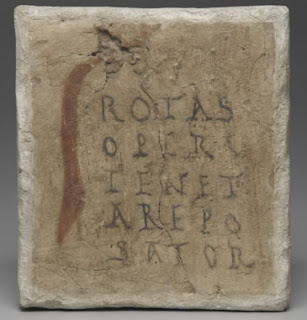
Painted Rotas/Sator square: T. Azzanathkona
Most of the pictorial graffiti dates from after the military remodelling of the temple. It seems very likely that the military scribes were responsible for most if not all of the names and drawings scrawled on the walls here.  Especially interesting are three so-called Rotas/Sator squares, a palindrome -- that is, read the same forwards or backwards -- formed by the words: rotas/opera/tenet/arepo/sator.  This formula, known from elsewhere in the empire, including centuries earlier at Pompeii, has been interpreted (or misinterpreted) as a magical formula, a hidden Christian text with the letters spelling out pater noster, a Mithraic text, or, inevitably, as a mysterious Egyptian incantation.  Whatever it means, these are among the very rare graffiti at Dura written in Latin: less than 3% compared to about 80% in Greek, and 20% bilingual, Semitic, or pictorial without text. 

When they were not playing with Rotas/Sator squares, the scribes who had taken over these quarters -- and who were meant to be writing up cavalry rosters -- tried their hands at more ambitious drawings.  


A mounted hunter draws his bow on a charging wild boar in an ink drawing on the wall of a small room in the temple.   The bearded hunter wears a long-sleeve tunic over wide trousers tucked into ankle boots.  The hilt of his sword and  scabbard are visible on his hip and a quiver full of arrows hangs on the horse's flank.  The horse is pictured in flying gallop (all four hooves off the ground) confronting the boar which leaps out of a bed of reeds.*  

When the soldiers in the records office were not dreaming of boar-hunting, they set off after gigantic lions such as still lived at the time in the marshes of the Euphrates valley.

On the opposite wall of the same room, a clean-shaven mounted archer aims his bow at an attacking lion.  His horse has a small head and short legs.  The excavators weren't clear if he (or his mates) had never finished the other horse graffiti or if they were just not well preserved. 

The Semitic name written in Greek letters ZABAO YC [= Zabdous] inscribed above the horseman could be the man who made the drawings, or just someone who came along later and put his name on the wall.  VICTOR, I assume, means that the horseman got his lion.  This Latin word was probably added later.

Rites of Spring

When not thinking of hunting or horses, the soldiers unsurprisingly turned their minds to women.

This well-coiffed lady has her curly hair parted in the middle and drawn up into a knot on top.  She wears a gem or metal circlet as a forehead ornament and a necklace of five strands with a tiny gem or medallion on the lowest strand.  She may have been holding a wreath or tambourine in her left hand.

It is possible, of course (as her discoverers would have it), that she is a mythic figure but, having a low mind, I think it more likely that the scribbling soldier was musing about some female musician or entertainer, such as we know were present at Dura. 

In which case, the presence of a naked, winged youth (identified as Amor-Eros) elsewhere on the same wall would make a certain sense.**  

Quite naturally, too, in springtime, a young man's fancy  turns to sport.  Given the roughness of the times, that doesn't mean football but gladiators.

This gladiator from the same room as the above graffiti is provided with Thracian equipment: a beaked helmet with vizor, rectangular shield with convex rim, curved dagger, greaves, and high-laced boots.  This is a pretty accurate picture which suggests that the soldiers of the XXth Palmyrenes had recently cheered gladiatorial combats.  That would not have been at Palmyra (which lacked an amphitheatre), but at Dura, where an amphitheatre was dedicated in 216 CE on behalf of the Legio IV Scythica and Legio III Cyrenaica (located southeast of the Temple of Azzanathkona on the map above).

Worship post-Azzanathkona

The elaborate scene below was drawn in ink on the wall of the clerical department, surely by Palmyran military scribes even though their names are translated into Greek.  The central figure on the pedestal is the Palmyran sun god, Iarhibol (who is named on the base), dressed in formal Roman military attire.


Iarhibol is crowned with solar rays and a halo, and holds a staff in his raised right hand.  The goddess of Victory flies in from his left, holding out a ribboned wreath and a palm frond; from the other side, an eagle flies towards the god with a wreath in its beak.

Below the Victory, a man drawn in a cruder style (most probably a later addition) offers incense.  A painted inscription identifies the intruder as 'Artemidorus, the standard-bearer'; under his feet, by another later hand, is the name (in Latin) SALVIANUS.  The original offerant stands on the god's right: a man dressed in the uniform of a Roman officer who burns incense on an altar.  His name is Heliodorus but someone later scratched the word 'Victor' (in Greek) over his name, probably referring to the god rather than the officer. Behind Heliodorus, a small boy raises a palm frond.  The lad is almost under the hooves of an approaching horse ridden by a Palmyran nobleman.  The horseman wears an Eastern tunic, trousers, and soft boots.  His heavy-bodied horse is fully harnessed, with decorative trappings behind a large quiver, a partly wrapped tail, and two large hair tassels. Was this major figure part of the intended original composition; or not?

Graffiti never stands still. Not only did the standard-bearer Artemidorus elbow his way in, but there is a bull's head with incurving horns to the left of Iarhibol's statue, and some small circles (meant as gold coins?) strewn below the horse.  

So even this ritual scene, so carefully drawn as to suggest veneration, was subject to casual changes.   Presumably, the officer Heliodorus who sponsored the graffiti (or had it offered him by a sycophantic scribe?) did not complain.  After all, graffiti is informal, unplanned, and unpredictable.  Yet, Heliodorus is strikingly similar in appearance and pose to the tribune Julius Terrentius in the fresco of the Temple of the Palmyran Gods, just down the road from Azzanathkona's temple.

That's where we are going in the next post (Part 3).   The graffiti there is even more surprising.


* The inked inscription behind the hunter reads (in Greek) ROUBATHIL leus.  It's not a name or text that I know: if anyone can interpret this for me, I'd be most grateful!

** Sorry, I have no picture of the male nude (not that I'm prudish but no drawing was published). 


Sources (in addition to those listed in Part I) include John Stathatos' post on Azzanathkona, N.J. Andrade, "Imitation Greeks": Being Syrian in the Greco-Roman World (175 BCE-275 CE), 313-15;  J.A. Baird, 'The Graffiti of Dura Europos: A Contextual Approach' in (J.A. Baird & C. Taylor (eds.,) Ancient Graffiti in Context, 59-60; L. Dirven, The Palmyrenes of Dura-Europos, 1999; N. Pollard, Soldiers, Cities, & Civilians in Roman Syria, 2000, 44-58;  P.M. Edwell, Between Rome and Persia, 2008, Ch. 4.


Illustrations

Top left:  Altar for Azzanathkona, #600094: Damascus National Museum (50-150 CE).  Via Arachne.

Below left 1: Magnetometry survey superimposed on the plan of the military base.  After 'The Roman Military at Dura'; website of University of Leicester.

Below left 2: Standing Woman or Goddess with Incense Burner, Block E 7 , East Wall, blocked-up doorway in Room W14. Red paint.  B. Goldman, 'Pictorial Graffiti of Dura Europos' (Parthica 1, 1999,19-106; 50, Fig. D2). 

Below left 3: Acrostic Rotas/Sator square from the Temple of Azzanathkona. Paint on plaster.  Photo Credit: Yale University Art Gallery.

Below centre: Mounted Boar Hunter, Block E7, Room W14. Ink on plaster. B. Goldman, 'Pictorial Graffiti of Dura Europos' (Parthica 1, 1999,19-106; 35, Fig. B1b).

Below left 4: Mounted Lion Hunter and Horse, Block E 7, Room W14. Ink on plaster. B. Goldman, 'Pictorial Graffiti of Dura Europos' (Parthica 1, 1999,19-106; 35, Fig. B2b).

Below left 5:  Standing Woman or Goddess, Block E 7, Room W 14. B. Ink on plaster.  Goldman, 'Pictorial Graffiti of Dura Europos' (Parthica 1, 1999,19-106; Fig.52, Fig. D4)

Below left 6: Gladiator, Block E7. B. Goldman, 'Pictorial Graffiti of Dura Europos' (Parthica 1, 1999,19-106; 61, Fig. D21).

Below:  Celebration of the solar god Iarhibol. Ink on plaster or gypsum. Photo credit:  Yale University Art Gallery.  Cf.: B. Goldman, 'Pictorial Graffiti of Dura Europos' (Parthica 1, 1999,19-106; 68-69, Fig. F2).
.
.
.

12 May 2013

Zenobia, last ibis in Syria

 
From 'red-list endangered' to extinct.

We interrupt our series on graffiti at Dura Europos to bring you a special announcement.  
 
In the midst of our sadness and grief at events in Syria, comes one wretched extra ill omen (as if more were needed):  the tiny breeding population of the Northern Bald Ibis in Palmyra has collapsed.  This year, only Zenobia (left) returned to the breeding grounds in the Syrian desert not far from Palmyra after the winter's migration to the Ethiopian highlands.

We have been following Zenobia's story from March 2007 (Zenobia's Triumphant Return to Palmyra) with further hopeful updates with the Latest News in 2011 and 2012. 


And then there was one.

This sad report came in this morning from SEO/Bird Life
Only one of the Northern Bald Ibis has returned to the breeding site at Palmyra this spring. Unfortunately, there are no signs of any more birds so far returning from their migration to Ethiopia. The returning female Zenobia was last year paired to Odeinat, the last male, which was fitted with a small satellite tag that stopped transmitting in southern Saudi Arabia in July 2012....

This looks ominously like it may be the end for the relict eastern population of the species, having been rediscovered in 2002 when there were 3 breeding pairs. Despite huge efforts the colony dwindled to just one pair in the past two years and now it seems to just the one bird. 
The Palmyran ibis colony discovered in 2002 never rose above 13 birds. They were the last of a Middle Eastern population that once numbered several thousand; and the bird was classified as critically endangered – the highest level of threat there is.

The northern bald ibis, Geronticus eremita, is a large bird with black plumage that flashes irridescent purple and green when the light strikes it, with a bald red face, red bill and legs, and a strange crest of long feathers on the back of its head, which makes it look as though it is wearing a feather wig. It is usually silent but hisses and grunts (like an angry queen) when at its nest and in display.

Zenobia is now alone; and soon there are none. 


Illustrations

Top: Zenobia the ibis, during satellite tagging at Palmyra in 2006. Photo courtesy of G. Serra (via NATGEO News Watch).

Middle:  Last Syrian ibis among bedouin tents.  Photo credit:  M.S. Abdallah (via SEO/BirdLife).

Below: Northern Bald Ibis.  Photo credit: Brian Stone (via SEO/BirdLife).
.
.
.

06 May 2013

"I AM HIYA!"

Graffiti in Dura Europos (3rd-century CE)

Who was Mr. Hiya that he dared to scrawl his name at least three times on the door posts and walls of the synagogue in Dura Europos?  A blasphemer?  Or just a little schmuck like men who wrote 'Kilroy was here!', whose fools' names and fools' faces always appeared in public places...?

Kilroy Was Here!

Kilroy first showed up on graffiti left by a mysterious American soldier during the landing in Normandy in 1944 -- or so it was said: no one really knows how the meme began. But thousands of 'Kilroy was here' drawings were scratched and sketched everywhere in Europe during the last years of World War II, especially in newly captured areas or landings, often in the most risky places, and so the phrase became connected with the presence of US troops.  The big Kilroy graffiti fad ended in the 1950s, but today people all over the world still scribble that bald-headed character and 'Kilroy was here' in schools, trains, and other similar public areas.

In short, Kilroy is a pain. 

Graffiti often is. 

Vandalism!

Graffiti is defined as any writing or drawings scribbled, scratched, or sprayed on a wall or other surface in a place where it didn't originally belong.*  It's never part of the intended decoration.  Graffiti ranges from simple written words, especially names, to elaborate wall paintings, and it has existed for millennia -- with countless examples dating back to ancient Egypt, Greece, and all over the Roman empire.


The mountain of ash that covered Pompeii in 79 CE preserved hundreds, if not thousands of such scrawls (like the section of wall pictured above).  There is even an early  meta-reference in the form of an epigram found on a graffiti-covered wall:
I wonder, O wall, that you have not fallen
in ruins from supporting the stupidities 
of so many scribblers
Pompeiian graffiti runs the gamut of personal names and public inanities (such as declarations of love), but some are more ambitious -- or at least more intriguing -- including scribbled curses, magic spells, alphabets, political slogans, and literary quotations.** One inscription gives the address of a woman named Novellia Primigenia of Nuceria, a prostitute reputed to be of great beauty, whose services were much in demand. Another shows a penis accompanied by the text, 'mansueta tene': Handle with care.

Graffiti needn't be quite so rude, but whatever it may be saying, it is -- in and of itself -- always subversive. Looking back from the remove of two thousand years, however, makes the heart grow fonder: such long-ago scribbles display both an individual identity and the kind of intended social interaction that is seldom visible in the distant past.

The Social Hubbub at Dura Europos

Three separate studies have recently taken up the subject of graffiti at Dura, a much lesser known time and place than Pompeii [some background at Zenobia's Gods at the Crossroads].  Now, what's really interesting is that the three historians approach the Durene graffiti from different angles and yet agree in their conclusions: Maura Heyn sets the scene, studying graffiti in the pagan Temple of the Palmyran Gods, while Karen Stern was looking at the scrawls in the Jewish synagogue just down the road from the Palmyran Gods, and at much the same time Jennifer Baird examined graffiti scribbled by visitors on the walls of private houses.  They agree that such graffiti wasn't meant as desecration: it wasn't even illicit or subversive, but rather, it "...show[s] that the presence of scratching text or pictures into walls was, actually, normal at the site."

It seems it was fairly commonplace to leave your own mark on the walls -- even within a god's temple, or a synagogue, or in someone else's home that you happened to be visiting!

So, let's get down to the nitty-gritty.

The synagogue

Torah Shrine and West Wall of synagogue
 In 1932, excavators discovered the walls of a synagogue's assembly hall, largely intact and adorned with over 70 narrative paintings that included labelled images of Moses, Aaron, and other Biblical figures. Although some figures, such as Moses, Ezra, and Abraham are slightly Hellenistic Greek in style, the rest wear Persian garments, displaying little that is reminiscent of Greco-Roman art.

The surviving graffiti didn't make quite such a publicity splash as the paintings did but they were preserved in the same extraordinary way.  During the last days of the city (see Zenobia on The Death of Dura Europos), as they fought off a fierce attack by the Sassanian Persians, the Durenes dumped a huge mass of sand and earth over all the buildings near the vulnerable western wall, thus burying everything along the inside of the wall.  The result was an extended rampart roughly 20 m (60') wide, with an easy gradient to permit troops to run up to any point on the battlements.  It wasn't quite enough: after a gruelling siege, the Persians took the city in 256/7 CE.  Long after Dura's destruction, the buildings incorporated into the defensive embankment continued to resist collapse. The city's population did not survive the Persian attack, but portions of buildings, such as the inscribed and painted walls of the Temple of the Palmyran Gods and the synagogue walls, did. 

So, who was Hiya?

Top: I am Hiya .Below: I am Hanani son of Samuel
Hiya's first message consisted of two simple words, "I [am] Hiya", scratched into a doorpost of the synagogue (underneath, a second man added his own moniker).  According to Karen Stern,
[t]he Aramaic letters of the text are carved irregularly and largely enough to have been visible from the building's elaborately decorated assembly hall. But unlike other elegantly painted inscriptions from the synagogue that clearly announce the names and donations of esteemed benefactors, the presence of this terse graffito, limited to a pronoun and a personal name, initially appears inexplicable. How, if at all, can we make sense of this crudely carved text, placed so ostentatiously in this sacred setting?
It's hard for us to imagine today that anyone would set his name so blatantly within a place of worship unless he intended an act of impiety or scorn.  Hiya certainly wasn't shy:  two more inscriptions can be attributed to him (I am Hiya, son of ..., and I Hiya, son of ... . (am) their father/chief).  If synagogue patrons or visitors had found these markings intolerable, why didn't they just scratch them out or paint over them?  The fact that they didn't (and no graffiti bear any signs of attempted defacement or erasure) must mean that graffiti represent acceptable acts within the sacred space of the synagogue.  In fact, Hiya was not exceptional: at least 47 examples of such graffiti in Greek and Aramaic survive on portions of the synagogue walls and on fragments of door-jambs and door-frames, often with many different names crowded onto the surviving fragments.   These inscriptions may have been considered unremarkable because they were so common.

Remember Me For Good!

Another common type of graffiti in the synagogue are the remembrance inscriptions. These name individuals who should "be remembered" (dkyr/zkyr lw, or the equivalent formula in Greek mnēsthē: "remember").  One such Aramaic graffito is six lines long (left) and reads:

Aliyah son of ... of the sons of Levi. May he be remembered for good before the Lord of Heaven. Amen. This is a memorial for good. 

A male torso with a circle on the left breast appears beneath the text. Perhaps this is an image of Aliyah, thus doubly ensuring that he will be remembered.

What's the point of all this scribbling?

The synagogue graffiti, cut into the hard-to-carve and friable plaster with a stylus or other sharp tool, do not look very pretty but they are legible at close range.  Anyway, aesthetics are not the point.  As Professor Stern says, "The seemingly slapdash writing,  whether in Aramaic or Greek, should not fool us into thinking that these texts were casual or unimportant." The letters are written large and they were meant to be read by visitors.

In fact, as she reminds us, the underlying hope is that passersby will remember -- or read out loud -- such names that appear in the holy placeIf so, the graffiti are remarkable in a good way, because they let individuals  communicate with the deity and with like-minded devotees at the same time.   In short, they will have served as a type of prayer offered up to the divine:  "I am Hiya! Remember me!" Not for him John Donne's prayer:
That thou remember them, some claim as debt;

I think it mercy, if thou wilt forget.
This, then, is what the synagogue graffiti might mean: the act of inscribing one's name and/or requesting remembrance for good is a prayer to the deity in its own right.  At the same time, the audience's response plays an additional role in boosting the efficacy of text or image. 

Perhaps the graffiti artists expected visitors to the building to read the messages out loud in the specific location where they viewed them.  The thick clustering of graffiti around doors and on door-jambs would then make good sense: if a man (and they are all men; no female graffiti have been found) wanted his name to be recited by visitors to give it that extra punch, putting it near the assembly-hall door seems like a smart move.  Engraved, painted or recited names and remembrance requests should be seen, then, as another kind of devotional practice, or prayer, once conducted inside the synagogue -- leaving the surviving graffiti as the only witness to these vanished activities. 

Part II of this post will look at what visitors to the temples of the Palmyran Gods, Aphlad, Azzanathkona, Mithras, and even the Christian church left in the way of graffiti.  Who in Dura's diverse polyglot population scratched their names and remembrance requests in their own sacred spaces?

Kilroy was everywhere.


* Oxford On-line Dictionaries .   While graffito is the correct singular form of graffiti, in practice graffiti may be treated as either singular or plural. 

 **  More history and examples at Wikipedia.  However, their article errs in stating that the earliest graffiti appeared at Ephesus: ancient graffiti begins at least with the Egyptians: it already appeared in the pyramid of Khufu (ca. 2560 BCE); for a more scholarly discussion, especially of Egyptian New Kingdom graffiti, see'An Introduction to Visitors' Graffiti' (The Visitors' Graffiti of Dynasties XVIII and XIX in Abusir and Saqqara by Hana Navratilov).  A fuller discussion of graffiti at Pompeii, 'Reading the Writing on Pompeii's Walls' and some choice examples at Graffiti from Pompeii.  On modern graffiti, see the Graffiti Archaeology Project .  Not least, a new blog devoted to early graffiti is Chloe Ragazzoli's 'Scribbling Through History'.  

Sources.  My sincere thanks to the authors of the three key papers, who so kindly made their articles available: Maura K. Heyn, ('The Terentius Scene in Context', in [L.R. Brody and G. L. Hoffman, eds.] Dura Europos: Crossroads of Antiquity, Boston, 2011, 55-67), Karen B. Stern ('Tagging Sacred Space in the Dura Europos Synagogue', JRA 25/1, 2012, 171-194), and warmest thanks to Jennifer A. Baird for helpful links as well as an advance copy of her forthcoming 'Private Graffiti? Scratching the Walls of Houses at Dura Europos' (in [R. Benefiel and P. Keegan, eds.] Inscriptions in Private Places, Leiden).  I have also made much use of Bernard Goldman's 'Pictorial Graffiti of Dura Europos' (Parthica 1, 1999,19-106)  -- with special thanks to Chuck Jones for his help.  

Illustrations  

Top: 'Kilroy was here!' Credit: J.-N. L., re-drawn in July 2006 via Wikipedia.  

Centre: Graffiti on a wall in Pompeii.  From Goldman, Pictorial Graffiti, Fig. 17. 

Top left: Graffiti from Dura Europos.  Yale e-catalogue no. 1938.5999.190.  Photo credit: Yale University Art Gallery.

Middle left: Graffiti on doorpost of synagogue: K. Stern (reference above), Fig. 2.

Lower left: Torah Shrine and West Wall of Synagogue installed at the National Museum of Damascus.  Photo credit:  Yale University Art Gallery.

Lowest left: Alayah, remembrance graffito: K. Stern (reference above), Fig. 6 
.
.
.

Blog Archive