06 October 2013

How a Prince Became a Princess


Quick Sex Change in Etruria

Just last month, Italian archaeologists discovered a remarkable, intact Etruscan burial at Tarquinia in the heartland of Tuscany.  On 21 September, Alessandro Mandolesi, Professor of Etruscology and Italic Antiquity at the University of Torino, and his team removed a perfectly sealed stone slab door to enter the newly discovered rock-cut tomb.

This is what they saw.

The skeleton on the left platform with the spear beside the body (marked by arrow)
Within the burial chamber was the complete skeleton of an individual resting on a stone platform with an iron spear lying alongside the body.  Brooches on the chest indicated that the man (for, presumably, the spear makes the man) had been dressed for his funeral in a cloak fastened by those brooches.  Gold jewellery and engraved sealstones were found, while a still unopened jewellery box on the opposite narrower platform hints at more treasures to come.  On that platform, too, were the incinerated remains of a second person, presumably his wife.

Cleaned up a bit, her pile of ash and burnt bones looked like this:


The tomb and its contents date to ca. 610-600 BCE.  The fact that the burial chamber lies on the very flank of the giant tumulus of the so-called Queen’s Tomb, dated a little earlier to mid-7th century BCE, indicates that it belonged to one of the princes of Tarquinia,  who would have been closely related to the founders of the Queen’s Tomb.*  It was tempting (and who can resist the temptation?) to connect this new-found prince with Tarquinius Priscus, the legendary fifth king of Rome from 616 to 579 BCE.

Imported Corinthian vases confirm late-7th c. BCE date
In an interview with the Italian newspaper Corriere della Sera,  Prof. Mandolesi said that the last time a comparable tomb had been discovered intact was more than 30 years ago, but that it collapsed before it could be excavated. “It’s a unique discovery, as it is extremely rare to find an inviolate Etruscan tomb of an upper-class individual." And he added, "This one is completely intact and may well reveal further surprises."

A rare find indeed.

World media reacted swiftly:

Italian archaeologists hail discovery of Etruscan warrior prince's tomb (Daily Telegraph)

Etruscan Prince's Tomb Found Intact In Italy After 2,600 Years (Huffington Post)

Tomb of Etruscan Prince Hints at Ancient Society's Secrets (Discover Magazine)

Ancient Etruscan Prince Emerges From Tomb (Discovery)

The story had everything: royalty, rarity, and mysterious Etruscans.  It lacks only one thing.  There is no prince. 

Or, at least, it's not his skeleton.

Now you see him, now you don't.

“There are two [stone] platforms," Prof. Mandolesi said, "one bigger and the other narrower. It was probably for a couple, especially if you consider the objects. The point of an iron spear is male...while other objects such as a jewellery box are female."

Not necessarily, my good sir. 

Surprise!

While jewellery boxes are indeed gendered female (although Etruscan men wore jewellery, too), all that means is that there was a woman in the tomb.  Since Etruscan tombs are family tombs, that's no surprise.  What is a surprise, however, is that the skeleton with the lance is female.  Osteological analysis (reported on 26 September) indicates that the body on the bigger platform was that of a woman who was 35 - 40 years old when she died.  And the incinerated corpse on the narrower platform belonged to a male.  In other words, gendering the grave goods got it backwards.

"It's not usual to find the body of a woman with a lance," explained Mandolesi.  "After having had the results of the anthropological analysis of the skeleton, and having found the [ashes of] the male, we have a clearer picture of the situation.  The lance, in all probability, was deposited as a symbol of the union between the two deceased." (my translation and my italics).

So the newly-identified lady still doesn't get credited with her own lance.  The thought doesn't even arise that it might be a symbol of her power and authority rather than the weapon of a warrior.  Downplayed like this, this major revision of the original story dropped like a stone into the media pool without leaving so much as a bubble behind.** 

Why is it so difficult to understand that the ruling class of Etruscan society was made up of both men AND women? 
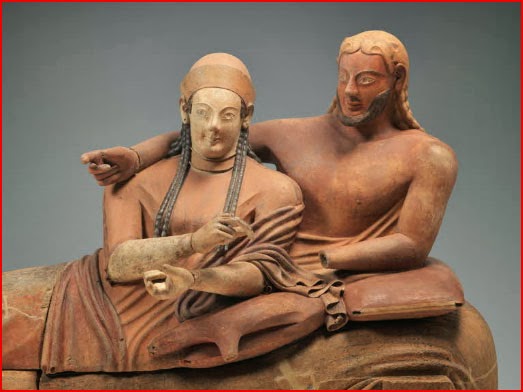

And that some Etruscan women were tough as old boots?

Their exceptionally emancipated status is perfectly clear from the surviving stories that harp on their scandalous behaviour.  The Greeks and Romans, who wrote everything that has survived, were enemies of the Etruscans and despised them for their way of life.  And they certainly did not like what they saw of Etruscan women's relatively free and easy-going habits. Take Theopompus, for example, a Greek historian of the 4th c. BCE:
Sharing wives is an established Etruscan custom. Etruscan women take particular care of their bodies and exercise often, sometimes along with the men, and sometimes by themselves. It is not a disgrace for them to be seen naked. They do not share their couches [when dining] with their husbands but with the other men who happen to be present, and they propose toasts to anyone they choose. They are expert drinkers and very attractive. 
The Etruscans raise all the children that are born, without knowing who their fathers are. The children live the way their parents live, often attending drinking parties and having sexual relations with all the women. It is no disgrace for them to do anything in the open, or to be seen having it done to them, for they consider it a native custom.
Lust, luxury, nudity, and indiscriminate whoopie-making.  How unlike our dear Greek women, who know their place and stay in the women's quarters.  The famous story of the Rape of Lucretia (told by Livy, writing at the turn of the 1st c. BCE/CE) starts off, too, with those notorious drinking parties.  Livy contrasts the licentious Etruscan women -- whooping it up with young male guests -- with the virtuous Roman matron who spends her evenings with her maidservants spinning wool.
While [the men] were drinking at Sextus Tarquinius' house, where Tarquinius Collatinus was also dining, the conversation happened to turn to their wives. Each one praised his own, and the discussion heated up. Collatinus said there was no need for all the talk as only a few hours were needed to prove beyond a doubt that his wife was the most virtuous. 'We are young and strong. Why don't we get on our horses and make a surprise visit. Then we'll see with our own eyes how our wives behave when we're not around.'  The wine had got them fired up. 

'Let's go!' they cried and flew off towards Rome, which they reached as twilight was falling. There they found the daughters-in-law of the king [= Etruscan princesses] in feasting and luxury with their friends. They continued on ... to check on Lucretia [wife of Collatinus], whom they found, not at dinner like the others, but in the atrium of the house, with only her maidservants, working at her wool by lamplight.

There was no question who won the contest.


Paintings from Tarquinia provide ample evidence of elegant Etruscan ladies reclining with men on banquet couches amid festivities, with musicians, dancers, and youthful naked servants bringing food and drink. In contrast to the male world of the Greeks and the Roman paterfamilias, the Etruscans included the women of the ruling noble families in their public life.  Such mingling of the sexes seemed, in their eyes, to be a serious breach of decorum which could only lead to gross indecency ... and worse; much worse.  

According to Livy, the wives of the Tarquins played a major role in acquiring royal power for their husbands.  Tanaquil, wife of the first Tarquin, could foresee the future and so urged her husband to leave Tarquinia and seek his fortune in Rome: they worked together to get him chosen as king.  Her prophetic ability helped, but she  could also plan and plot with the best of them: later, by covering up the violent death of her husband, pretending he was still alive and issued orders, she bypassed the true heirs and raised her son-in-law Servius Tullius to the throne.  The deeds of his younger daughter, Tullia, in turn, show off Etruscan muliebris audacia ("the daring proper to a woman") in the most dramatic ways possible. Our Lady Macbeth could take lessons from Tullia.  Tullia  murdered her sister and then her own husband in order to marry her brother-in-law, Lucius Tarquinius, whom she pushed into taking over the throne. To accomplish this, she went so far as to drive her chariot over the body of her father, King Servius Tullius, spattering herself with his blood.  This was going a bit far, and eventually led, in 509 BCE, to the overthrow of the monarchy.  Her husband is thus the last king of Rome.  He, his murderous wife, and their sons were sent into exile to the Etruscan city of Caere, not far from Tarquinia, where they continued to make mischief for the new Roman Republic. 

I can well imagine Tanaquil or Tullia being buried with a spear by her side.  Or any other of their female kin, for that matter, who displayed a lively dose of muliebris audacia. 

As inspired by the image of the Etruscan goddess Menarva (Minerva/Athena), perhaps.

Well, that's how the Prince from Tarquinia became a Princess.  And not just another pile of ashes.

Ancient women are so confusing!


Part II of this post continues with What's Up With Etruscan Gender?


* The designation of the largest tomb in Tarquinia as the "Queen's Tomb" is entirely conventional.  No human remains, male or female, have yet been discovered.  The tumulus covering the tomb is 40 meters in diameter, similar to that of another monumental tomb, 200 meters/yards away, the so-called King’s Tomb. Hence, the conceit of King and Queen.  A staircase descends about 7 m (left) into a room built from large limestone blocks. Some of the walls were covered in a  gypsum plaster that has close parallels in Cyprus; the crypt's design resembles the royal tombs of Salamis on Cyprus. A horizontal band of red paint once ran around the walls, a treatment that also appears in the new tomb from Tarquinia.  On recent excavations in the Queen's Tomb, see 'Etruscan Necropolis Yields Fresh Discoveries', 05 August 2010.

** Despite intense searching, the only notice I've come across appeared in Roman Bioarchaeology Carnival 33 on Kristina Killgrove's blog, Powered by Osteons, on 30 September -- which linked to the Italian report in Viterbo News 24, with Prof. Mandolesi's response.  I warmly thank Dr Killgrove for the reference, which certainly got my attention.

Sources.  In addition to those cited in the post, I have made much use of L. Bonfante, 'Daily Life and Afterlife', Ch. VII, in Etruscan Life and Afterlife: A Handbook of Etruscan Studies (Detroit, 1986), 232-254; V. Izzet, 'Etruscan Women: Towards a reappraisal', in (S.L. James, S. Dillon, eds.) A Companion to Women in the Ancient World (Blackwell, 2012), 66-78. I also happily credit two posts from Rosemary Joyce's blog, Ancient Bodies/Ancient Lives for their inspiration: Ancient Women Are Confusing and Powerful Women Existed in Moche Society: Now Move On.

Illustrations

Top: The complete skeleton of an individual resting on a stone bed on the left (

Upper left: Grave goods, including large Greek Corinthian vases and precious ornaments, on the floor of the tomb (

Lower Centre: Le Sarcophage des épouxPainted clay sarcophagus from Caere (Cerveteri), ca. 520-510 BCE.   Photo credit: Louvre Museum, dist. RMN/Phillpe Fuzeau.


Bottom centre:  Banqueting men and women, Tomb of the Triclinium, near Tarquinia, ca. 470 BCE.  As preserved in a watercolour made in 1895 by Gregorio Mariani.

Bottom left: Bronze mirror engraved and inscribed with Menrva (Athena) holding the child Maris Husrnana, from Bolsena, 330-300 BCE. British Museum 1868,0606.1, AN256892. Photo credit: Courtesy of the British Museum.

Footnote: Current excavations in the Queen's Tomb at the Doganacci necropolis, Tarquinia.  Etruscan Necropolis Yields Fresh Discoveries, 05 August 2010.  Photo Credit: © Copyright ANSA

27 September 2013

Wild Land Ahoy!


In the Oostvaardersplassen.

Oostvaardersplassen?  A pithy way of saying, more or less, "The place through which ships sail on the way from Amsterdam to the East Indies".

As ships once did.  When the land was a sea. 

But the Dutch never saw a sea that they didn't want to dehydrate. Especially when it washed the shores of Holland, the most heavily populated part of a very crowded country. So, in the 1930s,the Dutch began to dyke off and dry out four massive areas of land to the east of Amsterdam, at the southerly end of the Zuiderzee.  However, even the best laid plans of Dutch hydro-engineering can go astray.

And inadvertently become the subject of the most amazing film I've seen in years. 


Water-logged

By 1968 three great polders were created, with all of the reclaimed land earmarked for industry, agriculture, and sparkling new towns such as Almere (now pop. 200,000) and Lelystad (76,000).  That wave of development crashed in 1973 thanks to the oil crisis and economic recession.

One large area covering about 56 square km (22 sq mi.), the Oostvaardersplassen (where the arrow points on the map above) -- which had never been fully drained -- was left behind and became home to egrets instead of factories.

Sensing opportunity, a determined group of conservationists set out to "strategize, proselytize and wheedle" the Oostvaardersplassen into being as a nature reserve unlike any other: a tract of re-wild land in the heart of one of the world's most densely populated nations.

Today, the Oostvaardersplassen is the world’s most visible example of rewilding, the idea of reintroducing the megafauna that man wiped out as he spread across the globe.

The New Wilderness

The idea of reintroducing the large fauna that lived there thousands of years ago came from Frans Vera, a government biologist working for the state forestry service, an organization charged with managing the nation's nature reserves. Unfortunately, most of the needed species are now extinct, killed off by humans as they moved in and cultivated European lands.  So Vera stocked the new wilderness with their nearest modern equivalents: Heck cattle, a German attempt to recreate aurochs, the original wild cattle of Europe, and Konik ponies from Poland, said to be descended from tarpans, the last of Europe’s wild horses. He shipped in red deer, which were among Europe’s original inhabitants.


These large grazing animals are kept out in the open all year round without supplemental feeding, and are allowed to behave as wild animals (without, for example, castrating males, or vaccinating or tagging animals).  The ecosystem developing under their influence is thought to resemble those that would have existed on European river banks and deltas before human disturbance -- vast, grassy plains where wild horses, cattle and red deer move in massive herds.

The Real Twitter

Vast numbers of birds flew in, including 29 endangered species:
Marsh harriers flapped and cruised overhead.  Red-headed smews paddled, dipped. A flotilla of coots chelped companionably as they cruised down-dyke. White butterflies settled on scat. The landscape felt riotous with life.
...Overhead, a goshawk—the first wild one I had ever seen—lifted from the grass and glided away, scattering smaller birds as it flew. A sea eagle took flight from a willow, leaving the tree-top shivering, dipping off on its vast wings, its primary feathers stretched out like a swimmer's fingers. 
Sea eagles came here of their own accord five years ago, moving down into the area from Scandinavia. They were charismatic proof of the conservation ethic of the Oostvaardersplassen: increase scale, reduce management inputs, resist species farming, avoid deliverables and goals, and let wild nature take its course as far as possible.*
 The world before humans

EMS FILMS had exclusive access to the Oostvaardersplassen in all seasons, and they worked there for three years. Their new feature film, De Nieuwe Wildernis (The New Wilderness) has just been released. It is magic.  I was lucky enough to attend the première -- with the Metropole Orchestra playing the powerful theme music, live** -- in the Concertgebouw in Amsterdam on Monday evening!

Open the trailer now. 


Great Nature in a Small Country

For once, there's not too much hyperbole about it: this spectacular film enters into the soul of an extraordinary experiment:
We simply need…wild country available to us, even if we never do more than drive to its edge and look in.  For it can be a means of reassuring ourselves of our sanity as creatures—a part of the geography of hope.  (Wallace Stegner, Wilderness Letter,1960)
The beauty of nature in the Oostvaartsplassen is overwhelming yet the film makes no bones about the struggle of animals left to their own devices.  Nature's 'circle of life' (for better and for worse) is red in tooth and claw, and dazzling, in De Nieuwe Wildernis.  

Yesterday, the film opened in 90 theatres in The Netherlands and Belgium.  Text is minimal and dialogue non-existent so you don't have to wait for translation into your native language before begging or buying (or, if need be, stealing) a DVD of this unforgettable film.


* Robert Macfarlane, 'And there's another continent', writing in The Economist's Intelligent Life magazine, November/December 2012.  He erred, however, in ascribing the death of the trees to 'dehydration' (in The Netherlands, of all places!?!); rather it was a consequence of overgrazing.

** Now released as a single by Don Diablo:


Sources: In addition to the website of De Nieuwe Wildernis, I have used 'Amsterdam's Wild Side' in The Economist, 14 Sept. 2013; Robert Macfarlane, 'And there's another continent', Intelligent Life magazine, November/December 2012; Emma Marris, Conservation Biology: 'Reflecting the Past, Nature 462, 30-32 (2009); Elizabeth Kolbert, 'Recall of the Wild', The New Yorker, 24 December 2012; and Wikipedia's on the Oostvaardersplassen .

Illustrations

Modified Google map via Wolfstad.com (Our Visit to Oosvaarderplassen).

Common Kingfisher (in Dutch, IJsvogel), one of a pair, possibly the first specimens to be spotted in The Netherlands in our lifetime. Photo credit: Wolfstad.com (Our First Dutch Kingfishers): Every few minutes they dove in the water and picked up a small fish. If the fish was still moving the bird would hit it really hard against the branch until it stopped and then swallow it. This was a lot of fun to see, and the tiny birds ate an exceptionally large amount of fish.

Other illustrations from the website of De Nieuwe Wildernis

08 September 2013

The Zenobia Scandal

Will not -- shall not -- every American look with pride -- an honest, noble pride -- on this marble effigy of Zenobia, because it is the ideal, the production, of an American, and that American a woman.*

Zenobia-in-Chains, an over-life size (7 foot, 208 cm) marble statue made by the American artist living and working in Rome, Harriet Hosmer (1830-1908), was one of the most famous — and controversial — objects produced during the golden age of American classical sculpture in the mid-19th century.**  It was long assumed to be lost or destroyed, but after 123 years, it is again on public display at the Huntington Library in Pasadena, California. 

In contrast to typical classical sculptures of captive women -- naked, in shackles, and with downcast eyes (as, for example, Hiram Powers' titillating Greek Slave) -- Zenobia is dignified, fully dressed and holding the chains in her hands, as if she has ownership over her captivity.

It was a bold statement for any woman artist of the time to make. While many Neoclassical artists depicted mythological figures, Hosmer was chiefly drawn to female characters whose stories could be viewed as allegories for her strongly held feminist beliefs.  As she said,
Every woman should have the opportunity of cultivating her talents to the fullest extent, for they were not given her for nothing.
She began working on the monumental statue in 1858, taking new studio space to match the statue's size.  That December, she wrote to an American friend:

I wish you could raise your eyes from this paper to see what at this particular moment of writing I can see.  It would be a huge, magnificent room ... with a monstrous lump of clay, which will be ... Zenobia.

Harriet Hosmer ca. 1855
Soon afterwards, the American novelist Nathaniel Hawthorne (author of, among other books,  The Scarlet Letter) was in Rome and visited Hosmer in her new studio:
Zenobia stood in the centre of the room, as yet unfinished in the clay, but a very noble and remarkable statue indeed, full of dignity and beauty.... I have seldom or never been more impressed by a piece of modern sculpture.
The visit a year later of Sir Henry Layard -- English explorer, archaeologist, and trustee of the British Musum (an institution today loaded with treasures from Layard's excavations at Nimrud) -- was to bear spectacular fruit in the promotion of her career:  "I want to hear about your Zenobia", Layard wrote to her afterwards.  "Is she yet turned into a pillar of marble, for the admiration of posterity, or does she still stand in her frail mortal clay?"  He continues:
You have probably heard that there is to be a great universal exhibition in England in 1862....  I hope you will be induced to send something, that the women and men of England may know what a young lady of genius, with the estimable qualities of perseverance and determination, can effect. 
Success!

And so the statue travelled to the world fair in London to be set alongside the work of John Gibson -- the Welsh sculptor in whose Roman studio she had trained and where she had until recently worked -- in a place of high honour, thanks to Layard's influence.  With characteristic pride and modesty, Hosmer wrote to an American friend and patron (March 1862):
You don't know what a grand place they have assigned the Zenobia in the English exhibition.  A small octagonal temple is to be erected, with niches on four sides, to be lined with Pompeian red.  Into three of these go Mr Gibson's  colored statues, and into the fourth my own unworthy one.  This structure is to be just in the centre of the Exhibition.
That location also put Harriet Hosmer herself at centre stage in the most important international exhibition of the decade.  Her work was well received.  In three weeks, over 15,000 people paid to view the statues in their little temple.  Critics described Zenobia as "a figure of command", "a noble figure of Queenlike dignity" (no little praise when Victoria was on the British throne), and more poetically as "a high, heroic ode". 

Hosmer was on the verge of claiming a very high rank among the sculptors of the day.  

Harriet Hosmer 1857
But what if she hadn't actually made this giant statue? 

What if Zenobia was, in fact, carved by another hand?

On September 1, 1863, The Art Journal published an anonymous letter which complained about the meretricious charms of Zenobia -- said to be by Miss Hosmer but really executed by an Italian workman at Rome. Soon after, the prestigious British fashion and style magazine The Queen repeated this claim in a widely-read article.  

Scandal!

Are these her assistants or take-over artists?
Hosmer with her Italian workmen (1861), posing before her 'Fountain of the Sirens'.
When she produced the towering Zenobia, the work was quickly met with disbelief that a woman created it.   Some critics questioned whether a work of such sublime expression, on such a scale, and requiring such power of hand and arm in the carving could have been done by a woman.  In a way, The Art Journal and The Queen were pushing at an open door.

We won!  The enemy queen is our war trophy.

Harriet Hosmer saw it quite differently:
When [my brother artists in Rome] declared that I did not do my own work, I felt that I must have made some progress in my art; otherwise they would not have been so ready to attribute that work to one of their own sex.

Zenobia-Unchained

That Roman rumpus is the subject of a new book, The Zenobia Scandal: A Meditation on Male Jealousy by New York artist Patricia Cronin.**  Cronin explores Hosmer's life in Rome leading up to the events as they played out after the Great Exhibition.  In the Zenobia Scandal,  Cronin lets everyone speak in their own voices: "Since all the characters involved, whether it was Henry James or Nathaniel Hawthorne or Elizabeth Barrett Browning, were major figures in the arts, I realized [that] I didn’t need to write this narrative.  I just let them speak in their own words, friends and foes alike.  So I sequenced their quotes to chronicle this event and Hosmer’s clever response that also really resonated with me."

So, early on, we hear Hosmer's lament: 
I had not been long in Rome before I was informed that an artist, with whom I was upon the most friendly terms, had engaged in spreading a report that the work which I claimed as my own was in reality the production of a paid workman.
As Cronin reflects, "While I was trying to figure out how and why Harriet Hosmer got erased from history, I learned ... exactly how people try to wipe you out: destroy your reputation, damage you financially so you just disappear."

Harriet Hosmer, however, was not about to disappear.
I hope and trust I may soon be involved in a law suit,  For seven years it has been whispered about that I do not do my own work but employ a man to do it for me.  This scandal has now reached the point when I am accused of being a hypocrite and a humbug.... 
The appearance of this damaging slander in print finally gave her the ammunition to initiate a libel action against the man responsible for starting the hare running and The Queen which had run with it.


The matter was put into the hands of a London lawyer, with Hosmer claiming damages of 1000 pounds -- a small fortune at the time.  The editor of The Queen quickly folded: if she withdrew her suit, he would print a fulsome apology and pay all costs.  She accepted his offer on the further condition that the grovelling apology also be inserted in The Times of London and the Galignani Messenger, (an English-language newspaper published in Paris, which circulated among the English-speaking community on the Continent -- rather like today's International Herald Tribune).

So Hosmer won, hands down. 

Zenobia was Hosmer's personal statement.  She chose Zenobia as a subject when all the men were choosing sexy suicidal Cleopatra – that’s how they saw women.  But Hosmer, as Patricia Cronin sees it, chose to depict a strong woman ruler at a moment of potential humiliation who, through her own agency persists, perseveres and prospers. This subject choice, as she says, is intentional.

The last word, of course, belongs to Harriet Hosmer:

I honor every woman who has strength enough to step off of the beaten path when she feels that her walk lies in another; strength enough to stand up to be laughed at, if necessary. That is a bitter pill we must all swallow in the beginning....[I]n a few more years it will not be thought strange that women should be preachers and sculptors, and every one who comes after us will have to bear fewer and fewer blows."

"I would love that," says Patricia Cronin. "Nothing would make me happier."

I entirely share her sentiment.


* Anonymous author, The Saturday Evening Gazette, March 26, 1865, Harriet Hosmer Papers, Watertown Public Library, Watertown, MA.

** On Harriet Hosmer and Zenobia-in-Chains, see my blog posts Zenobia Lost and Found (10/07/09), The Huntington Makes Space -- for Zenobia (06/06/09).

*** Published by the book division of Zingmagazine, the SoHo-based art magazine  for contemporary/alternative  art projects.  Cronin will be having a solo museum exhibition in Rome (Italy) at  the Musei Capitolini, Centrale Montemartini Museo, opening October 2013.

The primary source is, of course, Patricia Cronin's The Zenobia Scandal, with most of the quotations in italics coming from that book. In addition to the blog posts listed in note **, sources include Alison Yarrington, "'Made in Italy': Sculpture and the staging of National Identities of the International Exhibition of 1862." In (M. Pfister - R. Hertel, eds.) Performing National Identity: Anglo-Italian Cultural Transactions. Amsterdam-New York (2008) 75-99.

Illustrations

Top: Zenobia-in-Chains, marble, 6 ft 10 in (208 cm).  Photo credit: The Huntington Library, Art Collections, and Botanical Gardens. Purchased with the Virginia Steele Scott Acquisition fund for American Art.  Object Number: 2007.26.

Upper left: Photograph (salted paper print; photographer unknown) of Harriet Hosmer (ca. 1855).  Photo credit: National Portrait Gallery, Smithsonian Institution. Object number: NPG.84.150.

Next left: Portrait (oil on canvas) of Harriet Hosmer dressed in riding clothes (1857) by Sir William Boxall. Photo credit: National Portrait Gallery, Smithsonian Institution. Object number: NPG.95.6

Centre: Hosmer with her Italian workmen (1861).  Photo credit: The Schlesinger Library, Radcliffe Institute, Harvard University

Below left: Cover of The Zenobia Scandal: A Meditation on Male Jealousy by Patricia Cronin (2013). Publisher zingmagazine.

Below centre: Close-up of legend on the pedestal of ZenobiaHarriet Hosmer carved me in Rome 

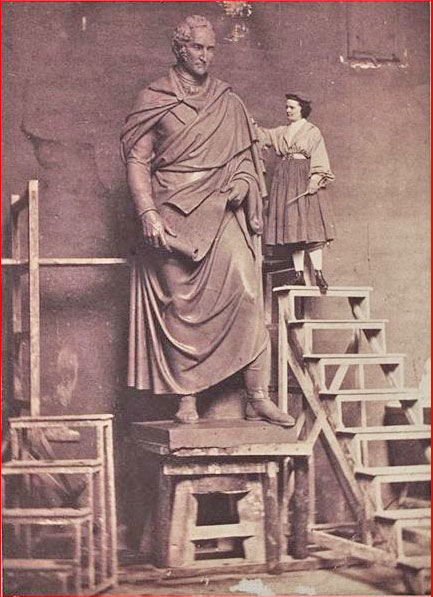
Below left: Hosmer on ladder in her Rome studio with commissioned statue of Thomas Hart Benton (ca. 1860-1862); statue erected in St. Louis in 1868.  Photographer:  Mariannecci.  Photo credit: The Schlesinger Library, Radcliffe Institute, Harvard University

28 August 2013

A Literate Lady in Vindolanda


A dour garrison

On the early frontier between the province of Britain and the unruly Scots (Caledonii) stood the Roman fort of Vindolanda.  By the late 80s CE, it was a permanent turf and timber fort, with a stone headquarters building, an officer's house, and a small bathhouse.

The weather there was terrible.  Tacitus (56-c.120 CE) said, the climate in Britain was "pretty foul, with frequent rain and fog...." It hasn't changed since.  Today's weather report: it's raining now, it's raining tomorrow, and it will alternate rain and low clouds all the rest of the week.  The temperature right now (in late summer) might reach a high of 16° C (about 60° F) during the day.  Winter doesn't bear thinking about.

Still, the troops up there were hardy types.  The fort was manned at the time by cohorts of Tungrians (from Belgic Gaul, now Belgium ) and Batavians (neighbouring Netherlanders). These were auxiliary units made up of non-citizen recruits who served for up to 25 years in return for Roman citizenship.  Previously stationed within their homelands, the same units had revolted against Rome in 69 CE.  It had taken five legions, commanded by Petilius Cerialis,  to put down the mutiny.  Cerialis had taken the subdued auxiliaries with him on his next tour of duty, to Britain, where they stayed on. 

A hell of a life

The fort on the Stanegate frontier, (pre-Hadrian's Wall)
Now, they were stuck on the very edge of empire in cold, wet Northumberland -- to this day the most sparsely populated county in all England -- where the climate and desolation were even more dismal than in their soggy homelands.  The frozen mud, however, had one surprising virtue: being anaerobic (airless), the muck preserved a remarkable treasure trove of wooden documents with ink-writing in Latin.  At a corner of the commander's house (praetorium) within the early fort (ca. 95-115 CE), excavators dug a waterlogged rubbish heap which produced over 400 thin tablets made from slivers of oak, alder, and birch, between one and three mm thick (about the size of a modern postcard).

Great Garbage

Thrown out on this garbage dump were personal letters,  official letters, copies of reports, old duty rosters, cash accounts, and lists of commodities from the commander's own household as well as some lists concerning the garrison as a whole.  One letter (above) addressed to an unnamed soldier, refers to a care package sent from his far-away home containing socks, sandals and underpants (surely woollies), along with greetings to his comrades:
... I have sent (?) you ... pairs of socks, from Sattua [a family member?] two pairs of sandals and two pairs of underpants, two pairs of sandals [from?]... Greet ...ndes, Elpis, Iu..., ...enus, Tetricus and all your messmates with whom I pray that you live in the greatest good fortune. 
The documents, now totalling more than 1,000 items as new finds continue to be made, were not written primarily by a corps of scribes, nor even by an educated elite of Romans or Italians, but by soldiers of non-Roman auxiliary units -- higher-rank officers, to be sure, but also lower ranking centurions and decurions (who themselves would have risen through the ranks), none of whom would have had Latin as their original native language. Since almost all the tablets are in individually-distinct handwriting, we can say they were written by several hundred different persons.

And one of them was female.

Party Time
Front: (1st hand) Claudia Severa to her Lepidina greetings. On 11 September, sister, for the day of the celebration of my birthday, I give you a warm invitation to make sure that you come to us, to make the day more enjoyable for me by your arrival, if you are present (?). Give my greetings to your Cerialis. My Aelius and my little son send him (?) their greetings.*
 (2nd hand) I shall expect you sister. Farewell, sister my dearest soul, as I hope to prosper, and hail.
Back: (1st hand) To Sulpicia Lepidina, wife of Cerialis, from Severa.
The recipient of this invitation,  Sulpicia Lepidina, was the wife of Flavius Cerealis, prefect (commander) of the Ninth Cohort of Batavians stationed at Vindolanda.  And the birthday-girl, Claudia Severa, was wife of Aelius Brocchus, the commander of a neighbouring garrison called Briga (Celtic for 'hill'), a place which is still unidentified. As a commander's wife, Severa of course had an official scribe (perhaps a slave) to write even her private letters; most of the letter was written in such a trained hand.  Yet she was fully literate herself: the second hand (see the lower right corner of the tablet, above; translation in bold) is in her own handwriting.  While less elegant than the scribe's, it was nonetheless written in fluent cursive Latin and clearly practised.**  

It is also the earliest known example of writing in Latin by a woman.

Who's Who?

Women's names took the feminine form of their father's family name: thus, Claudia Severa came from the family of the Claudii, while her friend Sulpicia Lepidina was from the Sulpicii.  So, the women were not really 'sisters' but expressed sisterhood as a term of endearment. When non-citizens were made citizens, they often took the names of the reigning emperor, a patron or benefactor.  The family name Sulpicia suggests that one of her forebears was granted citizenship during the reign of emperor Sulpicius Galba (AD 68-69).

Her bosom-friend Lepidina was married to Flavius Cerialis, one of the commanders at the Vindolanda fort.  The nomen Flavius suggests that he came from a family that gained the citizenship under the first Flavian emperor, Vespasian (ruled 69-79 CE).  Perhaps Cerialis' father had remained loyal to Rome when the Batavian troops revolted in the late 60s.  His cognomen, Cerialis, is the same as that of Petillius Cerialis, the Roman general who ended the Batavian revolt and who governed Britain in the early 70s. Possibly, Petillius Cerialis had acted as patron when he became a Roman citizen.  At the time this letter was written (ca. 100 CE), Flavius Cerialis would have had to be of equestrian rank which means that his family had amassed a fortune of over 100,000 denarii, the property qualification for entry into the equestrian order, as well being of free birth.  Both Cerialis and his wife, despite their Roman names, were surely nobles of Batavian blood.  

Claudia Severa's name suggests that her family acquired citizenship in the reign of Claudius, a generation before that of Cerialis and his wife. 

Her husband, Aelius Brocchus, was a friend of Cerialis (they write to each other as 'brother', paralleling their wives' intimacy).  He is one of the diners recorded at a feast held at Vindolanda fort, where guests included the imperial governor of Britain, Neratius Marcellus -- a Roman of the highest rank, a senator and consul.  Brocchus may have finished his career at the other end of the Roman Empire: he is perhaps the same person as a C. (Gaius) Aelius Brocchus recorded on an inscription in Pannonia (now Hungary) who commanded the prestigious cavalry unit, Ala Contariorum.

Still in Britain, however, we get a hint that Brocchus was an easy-going character and an amenable husband.  Another letter from his wife, Severa, to Sulpicia Lepidina explains that Brocchus will always let her come to Vindolanda to visit:

Front (hand of scribe)
Back (hand of Severa)
 (Front)  ... greetings. Just as I had spoken with you, sister, and promised that I would ask Brocchus and would come to you, I asked him and he gave me the following reply, that it was always readily (?) permitted to me, together with .... to come to you in whatever way I can.
For there are certain essential things which .... you will receive my letters by which you will know what I am going to do .... I was ... and will remain at Briga. Greet your Cerialis from me. 

(Back, 2nd hand) Farewell my sister, my dearest and most longed-for soul. 

This letter tells us more about the close relations between Severa and Lepidina: unlike the birthday invitation, it clearly shows that they kept up a regular correspondence. Both were surely comfortable with reading and writing in Latin. We also learn that they were planning regular social visits from fort to fort.   Most intriguingly, there is the hint of secrets kept to themselves and away from the inquisitive eye of a scribe (albeit a different scribe this time): there was something  that Severa needed to discuss with Lepidina face-to-face rather than entrust to correspondence: For there are certain essential things which .... you will receive my letters by which you will know what I am going to do.

What was she going to do?  We shall never know.


* The reference to Severa's son in the birthday invitation indicates that their children would live with them in Briga fort, wherever that was.

** Her handwriting is seen again in Vindol. II 292 and on a small fragment of a third letter with the start of a greeting in her hand (Vindol. III 635, Vindol. III 747).


I am grateful to Artifact Archaeology Magazine of 12 August 2013 for reminding me of the  famous birthday invitation and giving me the impetus to write this post.

Sources: First and foremost, the superb site Vindolanda Tablets Online, a treasure trove of information on a par with the tablets themselves (created by the Centre for the Study of Ancient Documents and the Academic Computing Development Team at Oxford University); and the British Museum who have published almost all tablets and fragments on line and generously allow their free reproduction for non-commercial purposes.   I have made use, too, of the website of the Vindolanda Trust; the BBC History page, Vindolanda by Mike Ibeji; and the BBC Home, The Vindolanda Tablets - 'Send More Socks'; R. Cribiori, Gymnastics of the Mind: Greek Education in Hellenistic and Roman Egypt (Princeton, 2001) Chapter III: Women and Education; J. Wilkes, 'The pen behind the sword: power, literacy, and the Roman Army ', Archaeology International 5: 32-35 (2001).

Illustrations

Top left: Reconstruction of the wooden wall and gatehouse of the early Vindolanda fort .  Photo credit: BBC History: Hadrian's Wall Gallery 

Second left:  The location of Vindolanda in relation to the Stanegate frontier and the later Hadrian's Wall. Nearby forts and milecastles are indicated.  Photo credit: Vindolanda Trust (via Vindolanda Tablets Online).

Top Centre: Tablet Vindol. II 346 (= BM 1980,0303.35), via Vindolanda Tablets Online.

Below Centre: Writing-tablet with a letter inviting Sulpicia Lepidina, the commander's wife, to a birthday party. Tablet Vindol. II 291. Photo credit: © Trustees of the British Museum.

Lower left:  Sculptured gravestone from Murrell Hill, Carlisle, showing a lady (c AD250) holding a large round fan with radiating ribs. Photo credit: Tullie House, Carlisle.

Lowest left: Right side of a relief depicting a sacrifice scene on the Bridgeness slab (from the Antonine Wall, Scotland). In the foreground are the victims (a boar, ram and bull), with a servant and flute player. Behind them the celebrant pours a libation on the altar. Photo credit: © The Trustees of the National Museums of Scotland (Via Vindolanda Tablets Online)

Lowest Centre: Writing tablet with a letter from Claudia Severa to Sulpicia Lepidina.  Tablet Vindol. II 292.  Photo credit: © Trustees of the British Museum.

26 June 2013

The Ultimate Palmyran Identity Crisis


Roman Palmyra: Identity, Community, and State Formation


I'm late, I'm late, I'm late for a very important date:

My review of Roman Palmyra by Andrew M. Smith II appeared almost two weeks ago in the Times Higher Education, but I didn't want to interrupt the flow of posts on Graffiti in Dura Europos, so it only goes up today. 
 
Here's what I wrote:


13 June 2013

Judith Weingarten on an island emporium in the midst of a sea of sand
When, before AD77, Pliny the Elder remarked that Palmyra “had its own fate” between the Roman and Parthian empires, what had been a remote oasis in the Syrian desert a century earlier was becoming a world-beating marketplace. The city’s strategic location between empires was, of course, one reason for its success. A natural stop for caravans trekking from the Euphrates to the Syrian coast, it was well placed to profit from the trade between Rome and the East. As Pliny grumbled: “By the lowest reckoning, India, Seres [China], and the Arabian peninsula take from our Empire 100 millions of sesterces every year: that is how much our luxuries and women cost us.”

The vast circuit of desert that surrounds Palmyra kept it just beyond the tight control of either side, an island emporium in the midst of a sea of sand. It was last attacked in 41BC, when Mark Antony crossed the desert greedy for plunder. But it is as if both empires tacitly agreed to let it live in remarkable peace - within the general orbit of Rome, to be sure, but enjoying excellent relations with Rome’s enemies nonetheless. And so, a Graeco-Roman city blossomed in the desert. Who built it, and how, is the story told by Andrew Smith in this latest attempt to explain Palmyra’s rise.

A unique Palmyran cultural identity - at once Greek, Roman, Parthian and, above all, native - grew out of the interplay between (semi-)nomadic tribes in the vast Palmyran hinterland and the city’s Arameans and Arabs. Both desert tribes and urbanites profited from the caravans, whether as cameleers and guards or financiers and merchants. Palmyrans maintained their cultural distinctiveness and language despite the ups and downs of life on a volatile political frontier.

With increasing Roman encroachment in the 3rd century, some of their distinctiveness faded. Roman soldiers were in the city by the close of the 2nd century and Palmyra became a Roman colonia and its citizens Romans after AD212. By then, most of the monumental building was done: temples, a theatre, colonnaded streets, an agora and cemeteries of elaborately decorated tombs. Until the end, the structure of personal and group identity in the city remained essentially tribal. While most temples had specific tribal links, Smith stresses that the Temple of Bel was more civic in nature. Appropriately, the first record for the monumentalisation of Palmyra (AD19) honours a man of the Bene Mattabol tribe for contributing to this temple. In AD24 and AD25, the “treasurers and the people of Palmyra” twice honoured a man of the Bene Komare for his donations. In the 2nd century, one of the Bene Gaddibol paid for a gate and doors. Maddeningly, Smith does not vocalise the Aramaic tribal names (referring to bny mtbwl, bny kmr’, bny gdybwl and 96 other tribes and familial units). This makes reading about “Tribes and Tribalism” difficult for non-specialists. A New York friend of mine brings the Bene Mattabol to mind as “Bene Matzo-balls”; perhaps unscholarly, but it helps.

Smith describes how the status quo crumbled in the 3rd century, provoked in part by Septimius Severus’ successful invasion of Parthia in AD198. In AD228 the Persian vassal king overthrew his master and proclaimed an aggressive new Sassanian Empire. In April AD239, the Persians first assaulted Dura-Europos. This must have sent shock waves across the desert: if Dura were taken, could Palmyra be far behind? Dura finally fell in AD256. The great warrior prince Odenathus rode to the rescue, chasing the Persians from Roman lands and to their capital at Ctesiphon; does Smith really believe that his forces consisted of “an army of Palmyrenes, peasants, and dispossessed soldiers” (repeated twice)? Smith leaves others (among them Pat Southern, author of Empress Zenobia: Palmyra’s Rebel Queen) to tell of events between Zenobia’s rise to power and the sack of Palmyra by Aurelian in AD272.

This is not an easy book, but it is worth tackling the early chapters because the arguments become stronger and the writing tighter as Smith proceeds. But why do we call both the people and language “Palmyrene”? After all, Arabs are not “Arabics”. Peeves aside, even the strictest historian who adds Smith to Southern will know all there is to know about Palmyra’s “fate”.


Roman Palmyra: Identity, Community, and State Formation
By Andrew M. Smith II
Oxford University Press, 336pp, £55.00
ISBN 9780199861101
Published 21 February 2013
.
.
.

20 June 2013

"I AM HIYA!" Part 4 (Updated)

Much More Graffiti in Dura Europos (3rd century CE)

Part I, Kilroy Was Here!
Part 2, Azzanathkona is coming!
Part 3, Temple of Palmyran Gods 

Home Sweet Home 

Imagine!  You are sitting on a bench in the entrance hall of a grand mansion in Dura Europos one fine day, waiting for an audience with its noble owner, a man by the name of Lysias.  Lysias traces his ancestry back to the time of the Seleucid kings who had ruled over Syria and eastwards in Hellenistic times.  Even after the Parthians took control of the city (ca. 113 BCE), the family remained great landowners.  An ancestor, Seleucus son of Lysias, had held the office of strategos (General of the City) in 33 CE, and a grandson of the same name was both strategos and epistates (chief magistrate) in 50 CE, both under Parthian rule, and his grandson -- conveniently named Lysias son of Lysias -- held the same positions in 136 CE, at the very time of the Roman conquest; and so on.  As late as 200 CE, another offspring, Septimius Lysias (who had very recently become a Roman citizen) was also in office as the strategos of Dura.  Well, empires come and go, but the family still rejoiced in the exhalted title of 'First and Most Honoured Friends and Bodyguards' of the King, a title dating back to the time of the Seleucids.  

You get the picture.  Wealth.  Lineage.  Class. 

South facade, House of Lysias (Block D1)

And a house as big as a city block.  Even if it's not much to look at now, you can still feel the size.

So, there you are, sitting in the hall of this home, waiting.  Instead of twiddling your thumbs, you idly pick up a stylus or your knife, and -- what can be more natural? -- scratch your name into the wall of your host's house.  Perhaps adding the words, 'Remember me!' (in Greek, the mnēsthē formula).  That's what Addaios, Aisaos, and Areaios did,  presumably while waiting to be admitted, and a fellow named Herakles, too.  In all, eight different persons scrawled their names with 'Remember Me' on the walls of the entrance hall.  Some visitors were perhaps more circumspect, writing Lysias' own name instead of their own: twice 'Lysias.  Remember me!', once naming him in connection with an embassy, and another time recording the death of Lysias (or a family member of the same name).  One uncharacteristic graffiti seems to give the prices of wine.

Why in the world would you deface the house of your powerful host in that way?  Well, of course you wouldn't.  And Dr Jennifer Baird, lecturer in archaeology at Birkbeck College (University of London), tells us why the scribblers didn't:
The scripts clustered in the entranceway ...would have been so unremarkable both in presence and formulation that the guest had no doubt that their actions would not be considered a defacement.... [T]hey were in visible places, and from the dated examples in other houses, it is clear some were allowed to remain as part of the fabric of the building for many years.
Note, first of all, that in this super-rich household, no servant came along to scrub graffiti off or whitewash over them. Not in the grandest houses of Dura, like that of Lysias, nor in the meanest with just a few rooms.

Second, many names with 'Remember me!" were also found at Dura in the synagogue, the Temple of Azzanathkona, the Temple of the Palmyran Gods, and in other buildings, both sacred and secular, public and private. In sanctuaries, graffiti “frequently and appropriately appeared in places of intensified holiness”.  There is no reason to assume that when the same formulations occurred in houses they meant anything different.  Far from being casual, off-hand, or the result of boredom, such graffiti played a part in each building's social fibre.

[M]emorialising an individual on a house wall also –literally- cements that person into a relationship with that social group, a relationship that could further be recalled if the graffito was read aloud. 
 The Writing on the Walls

At Dura, 22% of all graffiti (and there was an awful lot of it) was found in private houses.  Put another way, archaeologists recorded graffiti on the walls of 36% of the 130 houses that they excavated.

House. Room 23 (Block E4)
While a tenth of this home-grown graffiti consisted of the "Remember me!" formula, graffiti-artists had many more arrows in their quivers: they scratched or painted horoscopes, calendars (left), alphabets (abecedaria), lists of all kinds of products, bookkeeping accounts, and many more-or-less naturalistic drawings including hunting scenes and ships.

These marks are part of the biography of the building.... 

The House of the Archives, aka House of Nebuchelus

Another very large, but not so grand house, practically covered in graffiti, is the House of Nebuchelus, named after its owner as identified by the graffiti itself.  Almost 100 graffiti were recorded in the house, many clustered near the entrance (especially the 'Remember me!' texts) and in rooms opening off the main courtyard.  The house, which was located in the old agora, had two attached shops which led into the building and four rooms with benches, perhaps indicating that it wasn't strictly private but also had a commercial use.


Graffiti included horoscopes, accounts, receipts and inventories, as well as drawings of a boat, a winged victory, and what looks almost like a child's drawing of the walls of the city (above).
Again in this house, the number and range of graffiti shows that graffiti were not just a casual scratch, nor an act of defacement, but one way the walls of the houses were active in the lives of their occupants, whether being used to invoke a god or to recall how much Aurelios owed you for those two jugs of wine.
Neatly written on the walls, too (with script a centimetre or two high), was an inventory of textile items, records of shipments of grain and wool, and various calculations.
House walls were an available surface, one which could archive the information for easy use and reference, as well as displaying them, and even editing them, scratching off items that had been paid or dealt with.  Parchments or papyri were expensive ... but house walls were ubiquitous and available for mark making.
Given the size of his house, I wouldn't have thought that Nebuchelus was short of a bob or two.  But we mustn't forget that he was a money-lender as well as a merchant: 'take care of the pence and the pounds will take care of themselves' might have been his motto.  I wonder if this part of the house was considered private in a family sense -- or, rather, private in a way that we would today understand and share with Mr & Mrs Nebuchelus?  Such private-public shifting boundaries make it all the odder that horoscopes appeared on the same walls where calculations, inventories, and receipts were scribbled too. 

A number of horoscopes were found scratched into the walls of this house, in the form of a circle divided into four quarters with diagrams of the horoscope, constellations and planets. These, in addition to providing dates for the texts and birthdates for some of those whose horoscope was read, show both people’s interest in divination, and function to place the individual whose horoscope is recorded and their life span in relation to the cosmos....

It also makes the persons who have their horoscopes scrawled on the wall a subject of conversation, and undoubtedly gossip.  I would have thought you'd want to keep this information as private as possible -- lest your enemies learn your secret self and future; but, it seems, not at Dura.  Horoscopes are relatively common, and some appear in (semi-)public  places.  Perhaps, Durenes had a different idea of public and private matters.  It may be so.  As Dr Baird describes it,

House A, Room 1 (Block N8)
At Dura there are many ... banal texts, recording the price paid for a container of wine, or a little scratched drawing of a deer, but many of the graffiti, I think, are special. The medium may not be the carefully carved letters of lapidary inscriptions, but ... they are placed in visible locations, made often by named authors, and have a sacred meaning for them.  Even the seemingly mundane graffiti have something to tell us, about how people used spaces, how they lingered while waiting. The amount of religious graffiti is perhaps also special at Dura, and goes beyond these textual forms, to drawings of gods, scenes of sacrifice, and altars.

But what deserves a special drum-roll is this graffiti from the house of Nebuchelus:
On the 30th day of the month of Xandikus of the year 550 (20 April 239), the Persians descended upon us.
Perhaps it was only a spring raid, but it was the first inkling of the troubles to come and a fearful harbinger of the Persian attack that destroyed Dura-Europos just 17 years later.

Not all the horoscopes in Dura could have helped them then. 


Sources:  I would again happily thank Dr J. Baird for her help in pointing me to useful publications and photographic resources, as well as for getting me started on this fascinating topic.  My warmest thanks, too, to Dr. Agnes Korn, Empirische Sprachwissenschaft, Universitaet Frankfurt a.M. and to Chris Bennett for their help on horoscopes, and to those who wrote in from Parthia-L@yahoogroups.com.  In addition to sources mentioned in previous posts, I would cite the Cambridge History of Iran, on the Parthian period (pp. 716-718); and An Ancient Horoscope .

Illustrations

Top: Graffiti Sketch of a man (possibly armed with sword), scratched in plaster. Yale-French Excavations at Dura-Europos, 1929.441.  Photo credit: Yale University Art Gallery. 

Centre: Façade sud de la résidence de Lysias, en fouille ©MFSED; photo via AOROC.

Top left: Calendar illustrating (top row) seven planets or days of the week; (bottom row) the gods.  Photo via B. Goldman, Pictorial Graffiti, D-1. House, Room 21.  South wall. Block E4.

Middle left: City wall and gate.  Photo via B. Goldman, Pictorial Graffiti, G-1.  Block B-8, House 17:  House of Nebuchelus.  Shop on Main Street.

Lower left: Horoscope discovered by Jotham Johnson on a courtyard wall of a small house.  Photo credit: Ancient Horoscope.

Bottom left: Forequarters of horse with heavy mane (surely not a lion), frontal face; beneath the animal, inscriptions, loose scratchings, feather designs and two inscribed tabulae ansatae.  Photo via B. Goldman, Pictorial Graffiti, E-4.  House A, Room 1 (Block N-8).
.
.
Updated 15 July 2013

Archaeologists have just reported discovering an immense quantity of Greek graffiti scrawled on walls in the agora of Izmir (formerly Smyrna) on the Aegean coast of Turkey.

Two gladiators (provocatores?); small boy urinating on street
The graffiti is estimated to date back to the 2nd and 4th centuries A.D. Experts have said the graffiti was the richest Greek graffiti collection in the world. Besides writing and paintings done with paint, there are also dozens of carvings on the wall.... 


There are many different figures in the graffiti, from trade ships to gladiators. There are also confessions; one read, “I love someone who does not love me.” One inscription read, “The gods healed my eyes, this is why I dedicate an oil lamp to the gods.” Another piece of graffiti read, “The one who ensouls,” which symbolized Jesus Christ in early Christianity. There are also riddles that have not yet been solved....

More news as I hear of it!

13 July 2013
credit: for the report and illustration
.
.
.

Blog Archive