09 July 2008

A Short Tribute to Giovanni Battista Borra

An Artist and Architect at Palmyra

I was somewhat saddened at the treatment received by Giovanni Battista Borra at the elitist hands of Dawkins and Wood after their travels to Palmyra (where Borra did all the measuring and the exquisite drawings, as noted in the the previous post, Lure of the East). While, even today, archaeological architects play second fiddle to the dig director, they do at least get pictured in the inevitable team photograph; not so Borra who is nowhere to be seen in Hamilton's giant painting, James Dawkins and Robert Wood Discovering the Ruins of Palmyra.

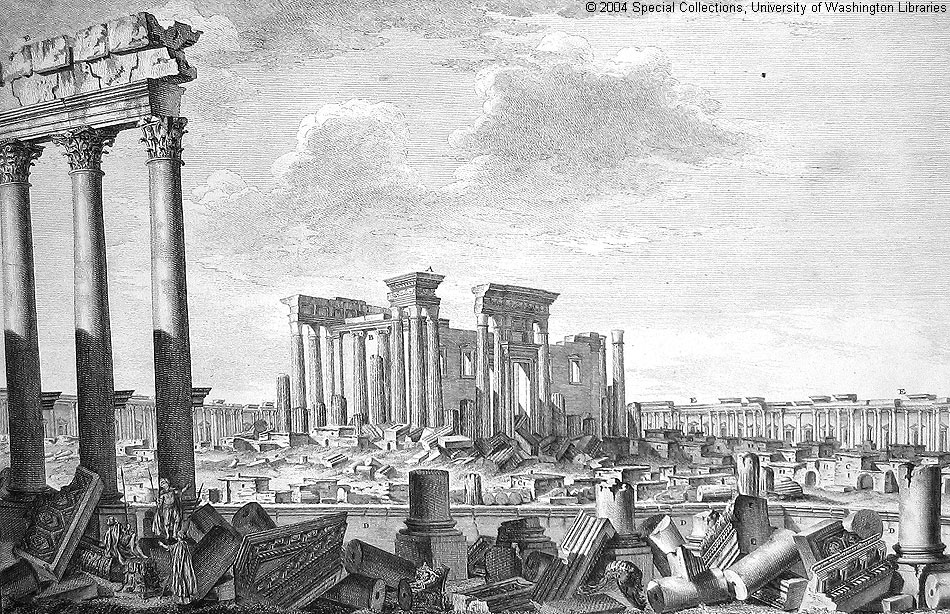
So, I was especially delighted to find a webpage filled with Borra's engravings from The Ruins of Palmyra.*

I'll make it up to him, I thought.

Left: View of the Triumphal Triple Arch from the West, with the Great Colonnade, rubble, and columns.

The Colonnnade -- c. 1000 m (3,000') in length -- bisects the centre of Palmyra from the north-west to south-east. Shops and trading stations lined both sides of the street -- an early souk, really. Built during the course of the second century AD, it got its finishing touch with the addition of the lavishly decorated arch in c. 220 AD.

The arch may have commemorated the victory of Septimius Severus over the Parthians when the Emperor established the Roman province of Mesopotamia (taking the title Parthicus Maximus in January 198) .

One expects that Palmyran troops would have fought in this war -- and been rewarded with a share in the rich booty. For Severus had sacked and plundered the Parthian capital, Cteisiphon. As Cassius Dio tells us, vast numbers were killed and 100,000 prisoners taken. That's 100,000 slaves to be sold and turned into cash. Plus, as Herodian adds, the royal treasury was captured and all the king's jewels and valuables.

Quite when the Roman army reached Cteisiphon is unclear, but I like to think that this is the Severan triumph still celebrated over thirty years later by the Palmyran garrison at Dura Europos each year on 21st May.

So I propose that a victory toast was first drunk on 21 May 197, while Parthian blood was still wet on Palmyran swords. And then the rich merchants raised the money to build this elaborate triumphal arch.

(Left): View of the Triple Arch and the beginning of the Great Colonnade, with the North-West Wall of the Temple of Bel in the distance.

Wood called Bel's temple 'the Temple of the Sun', a reasonable error: Bel and the Sun were already confounded by the 5th C Byzantine historian, Zosimus, who tells that Aurelian placed the statues of Helios and 'Belos', patron god of Palmyra, in the Temple of the Sun which he founded at Rome. This would have looked right to Wood (who knew his ancient sources), while the carved bas-reliefs of Bel they might have seen were certain to have muddled the issue further.

For Bel was worshipped here as one of a trinity of gods, and is usually pictured along with Yarhibol, the Sun god, and Aglibol, Moon god. Both Yarhibol and Aglibol wear a radiate nimbus about the head (as on the relief below**), like a halo with sun rays. Confusion is easy, to say the least.

Although Bel is the supreme cosmic deity -- the one, sole, and merciful god -- nothing in the many inscriptions ascribes a subordinate rank to Yarhibol (who is also the patron of the life-giving waters of the spring of Efqa, as well as the divine judge) -- and perhaps not even to Aglibol, whose own sanctuary at Palmyra was called 'the Holy Garden', and which must have been one of the earliest temples in the city.

We know that these three gods were already being worshipped as a group in this temple in the very year 32 AD, when the sanctuary was dedicated. An inscription on the pedestal of a statue found in the temple grounds reads:

This is the statue of Lishamsh son of Taibbol son of Shokaibel ... who dedicated the temple of Bel, Yarhibol, and Aglibol, the gods, on the day of their feast, the sixth day of Nisan, in the year 342 (= 6 April 32 AD).


Right: Exterior View of Temple Cella from NW.

When Dawkins & Wood & Borra arrived at Palmyra, the entire courtyard and the temple of Bel itself were built over with the little houses of the Arab village (click here for a larger image).

Borra scrupulously drew all the one- and two-story Arab dwellings that then filled the god's precinct. So, to return for a moment to the theme of the Lure of the East (and charges of Orientalism flung about in recent times), these Occidentals -- at least as a general rule -- faithfully respected the landscape as they found it and did not try to erase signs of later accretions. It was the French who demolished the Arab habitations in the 1930's when they began excavating the +2 m (6') of dirt and rubble that had accumulated over the centuries within the temple grounds.

You Win Some, You Lose Some...

On the other hand, the plans Borra drew of the temple interior did not show the small mosque which was inside the building and only removed (by the dastardly colonialist archaeologists) in 1929.


When in London, Do As The Romans Do


After their travels in the Middle East, Borra went with Wood to London to prepare the engraving for The Ruins of Palmyra.

He stayed in England for eight years, busy with commissions for noble patrons. First came the Music Room (left) in the London house of the 9th Duke and Duchess of Norfolk, unveiled to rapturous acclaim in 1756.

There is no evidence that the room was used as a setting for music, but the Duchess of Norfolk certainly received her guests here during the reception in February 1756, when Horace Walpole remarked on the 'scene of magnificence and taste. The tapestry, the embroidered bed, the illumination, the glasses, the lightness and novelty, of the ornaments and the ceilings are delightful'.

On Borra's recommendation, Jean Antoine Cuenot was hired to make the extreme fine Carvings, the Arts and Sciences all Gilt , being paid 2643 pounds sterling 3s 8 1/2 d -- quite a lot of money -- for work undertaken at Norfolk House between 5 March 1753 and 24 February 1756. His carved woodwork caused a sensation when the interiors were first shown in 1756 (and again when the refurbished music room was installed in the British Galleries at the V&A in 2001). Bills indicate that he worked from preparatory drawings by Borra. It is not known how much Borra was paid but one cannot help but feel that Borra was again short-changed, at least in matters of fame.

To be fair, the white and gold interiors had a Parisian ambience, reflecting the latest French fashions -- which might well be due to Cuenot. It is certainly impossible to spot any trace of Palmyran ideas in these designs.

That is not the case with his second great commission.

Stowe House, 'the largest and most completely realised private neoclassical building in the world'.

Sir Richard Temple’s original seventeenth-century house was enlarged significantly by his son Viscount Cobham in the early eighteenth century -- with input from architects such as John Vanbrugh, James Gibbs, Robert Adam, and Sir John Soane. One of the finest neoclassical buildings in Europe, Stowe is set within an Arcadian classical landscape designed by Capability Brown and William Kent.

Roman Grandeur

But it was our hero Giovanni Battista Borra who designed the awesome Marble Saloon at the heart of the building, and for this commission he pulled out all the stops. The room takes its name from the marble floor, made of over 72 squares of veined white Carrara marble

Recalling the Pantheon of Rome, it contains 16 great imitation stone (scagliola) columns, supporting an entablature surmounted by a spectacular plaster frieze showing a procession of triumphant soldiers in high relief.

It's jaw-dropping stuff.

Containing 280 human figures as well as horses and lions, the frieze supports a huge elliptical coffered dome which reaches a height of over seventeen metres (50') at its (also elliptical) central skylight.

The plasterwork of the dome is spectacular, and nearly every single one of the 160 coffers is different in shape and size due to the elliptical design.

Am I the only one reminded of the ceilings of the South and North Shrines in the Temple of Bel (below left)?

Although these ceilings are made from monolithic sandstone slabs, one could easily imagine the designs transferred to a Roman dome

Networks of descending lozenges had again decorated ceiling vaults in Italy from the 16th C (in erudite reference to the apse of the classical Temple of Venus and Roma), but High Renaissance artists filled the panels with elaborate figures of man, animals, and emblems, rather than repetitive -- if highly decorated -- rosettes as in Borra's design.

In fact, his rosettes (below right) are rather sun-like, a conceit conceivably borrowed from the mis-named 'Temple of the Sun'.


But I don't insist on it.


* The properly eclectic Cabinet of Wonders alerted me to the Borra engravings at the website of the University of Washington Libraries, Special Collection (with thanks again to David Derrick of The Toynbee convector for the tip). Not to look a gift-horse in the mouth, but I do wonder why the University puts a copyright sign on the images! Surely, copying engravings from an 18th-century book to the web does not give you rights of copyright; or so I think.

** Monument aux dieux Bêl, Ba’alsâmin, Yarhibôl et ’Aglibôl, now in the MBA Lyon, dated January 121 AD

01 July 2008

The Lure of the East


James Dawkins and Robert Wood Discovering the Ruins of Palmyra
by Gavin Hamilton, 1758 (Oil on canvas, 3.1 x 3.9 m [12'x 16'])

I had not intended to write about the exhibition, The Lure of the East now on at Tate Britain. I confess to having no special insight into how British painters represented the people and places of the disintegrating Ottoman empire in the late 18th and 19th centuries. But David Derrick of The Toynbee convector directly challenged me to say something about this extraordinary huge painting (left)* and I'll try to rise to the occasion.

I shall be frank. I have not seen The Lure of the East nor have I ever seen this painting by Gavin Hamilton in the flesh.* To comment on art you haven't seen is rather like reviewing a book you haven't read.

Although -- come to think of it -- Oscar Wilde (the patron saint of non-readers) recommended six minutes as the proper time to spend reading a book for review. Having examined this reproduction for rather more than six minutes, I expect that I'm now well qualified to comment on it.

Lurid Orientalism

The burning question in 'Lure of the East' is whether the painters who were lured east faithfully represented the people, cities and landscapes they encountered -- or reflected, as Edward Said argued in his influential work Orientalism, a quest for Western superiority and control over them:
Orientalism is a political vision of reality whose structure promoted the difference between the familiar (Europe, West, "us") and the strange (the Orient, the East, "them").
A colonialist mind views the East as 'mysterious'. Presumably, despite new railroads and steamships, artists should have stayed at home, portraying the 'unspeakable in pursuit of the inedible' at English fox hunts. Or, if they did travel east, painted the people with sympathy, as if they were British under the skin. Fascination = phooey! On the other hand, it does not do to be too faithful to the subject: an essay in the catalogue roundly condemns the Brits as "content to paint a static world of exquisite surface" (Rana Kabbani). I suspect it's the word static that convicts them of Orientalism.

Yet I find it hard to find much in the way of imperial disdain in these detailed, dreamy, lazy, hazy,and colourful portrayals of mosques, markets, domestic life, and bustling coffee houses.

Certainly, even the most offensive British Orientalists were never as base as their French counterparts. Some of the French painters really did turn the East into 'the Other'. The first and greatest age of Orientalism in art began around the time of Napoleon's invasion of Egypt and peaked as the Romantic Movement swept through Europe. Full-blooded French painters, needless to say, often depicted the East as a place given to sexual excess, wanton cruelty, mass murder and unbridled sensuality.

Tut tut. British Orientalist Painting was very different.

You won't find a single British painting at Tate Britain showing a massacre, a beheading or a naked slave girl.

There are many reviews of the Lure of the East on the web.** Almost none, however, noticed the oddity of placing the Neoclassical artist Gavin Hamilton (1723-1798) -- and his painting of the 'discovery' of Palmyra -- within a show essentially dedicated to Orientalism. Decidedly earlier in date, he was entirely uninterested in the Ottoman Empire, the Bible lands or Egypt.

La Dolce Vita

He spent most of his life in Rome and never seemed tempted to venture eastwards. He visited the main sites of Italy, especially Pompeii and Herculaneum, and did a lot of deplorable digging up of antiquities in and around Rome, the results of which inspired the Neoclassical movement.
As an art dealer and archaeologist he undertook excavations at Hadrian's Villa in 1771, at first occasioned by the need of marble for his sculptor to restore sculptures. His excavators reopened the outlet of a low-lying swampy area and "after some weeks' work by lamp-light and up to the knees in muddy water" retrieved sculptures from the where they had been thrown with timber when the sacred grove was levelled.
Hamilton was permitted to excavate (or loot, if you prefer) by the Vatican -- which claimed one-third of the excavated works -- and lived well by selling many of his discovered statues, busts, and bas reliefs to British collectors.

Whether his own art brought the ancient world to life, or killed it dead, is a matter of taste. But there's no doubt about how he painted:
being perfectly familiar with the works of the great masters of Grecian and Roman literature, he displayed a highly classic taste in the choice of his subjects; and the style at which he always and successfully aimed, made him at least equal to his most celebrated contemporaries.

Hamilton's paintings provided patrons with illustrations of Homeric subjects treated in a stern and moral manner. For example, his Andromache Mourning the Death of Hector (click for a better image),the first of his large Homeric canvases (1761) of scenes taken from the Illiad, is built up of ranks of figures strictly parallel to the picture plane. The figures, overly eloquent in their restraint and absurdly noble in their form (in some cases derived directly from antique statues), gather round the bed of the dead hero rather as you would expect on a Roman sarcophagus. The subject is Greek, but the source of its style is seventeenth-century classicism. It is an interesting sidelight on Neoclassicism that an artist who had so much opportunity for examining newly found Greek and Roman antiquities tried in no way to break away from it.

His portraits, however, were a good deal fresher. And they certainly made a change from the oppressively hieratic, classical frieze composition of his history paintings. He painted the notorious, delicious Emma Hamilton (her husband, the English consul in Naples, perhaps a distant relative)^ as the goddess Hebe in a new 3/4 pose. This caused a craze in England where the goddess of youth and beauty and cup-bearer to the gods became the ultimate disguise for fashionable society portraits. Although Hebe is the personification of domesticity, there are erotic possibilities in the menacing eagle (Jupiter). That may explain why he painted her scandalously bare-breasted.

So we may add a grain of salt to the life of Hamilton, as told by Significant Scots , the paragon painter who
studied the chaste models of antiquity with more attention than the living figures around him; which has given his paintings of ancient histories that propriety with regard to costume, which distinguished them, at the time from most modern compositions.

Palmyra Ho!

In 1750-1753, Robert Wood and his friends James Dawkins and John Bouverie travelled to Syria:
A ship had been commissioned from London and met them at Naples. It was well stocked with a library of classical authors and historians, the relevant travel books, treatises of antiquities, and mathematical instruments; and they were accompanied by their own draughtsman.
The 'draughtsman' was the Italian artist and architect Giovanni Battista Borra, whose task was to measure and draw the ancient ruins. Gentlemen did not draw columns but copied inscriptions instead.

They arrived at Palmyra in 1751. Though not the first Europeans to reach the city, their timing was perfect: artistic style and refined taste was increasingly influenced by the classical ideal. The publication of their magnificent folio volume in 1753, The Ruins of Palmyra, contained templates for a new classicism in architecture that resulted in buildings in many parts of Europe being adorned with antique decorative motifs copied from Palmyra. The engravings became valuable sources for the emerging neoclassicism of the late 18th century and cemented the notion of ‘Palmyra' in Western minds.

From Wood's Preface:

THE RUINS OF PALMYRA, OTHERWISE TEDMOR, IN THE DESART

We visited most of the island of the Archipelago, part of the Asiatick and European coasts of the Hellespont, Propontis, and Bosphorus, as far as the Black-sea, most of the inland parts of Asia Minor, Syria, Phoenecia, Palestine and Egypt.

The various countries we went through, furnish, no doubt, much entertainment of different sorts. But however we might each of us have some favourite curiosity to indulge, what engaged our greatest attention was rather their antient than present state. It is impossible to consider with indifference those countries which gave birth to letters and arts, where soldiers, orators, philosophers, poets, and artists have shewn the boldest and happiest flights of genius, and done the greatest honour to human nature.

Circumstances of climate and situation, otherwise trivial, become interesting from that connection with great men, and great actions, which history and poetry have given them: The life of Miltiades or Leonidas could never be read with so much pleasure, as on the banks of Marathon or at the streights of Thermopylae; the Iliad has new beauties on the banks of the Scamander, and the Odyssey is the most pleasing in the countries where Ulysses travelled and Homer sung.

John Bouverie, who had funded the trip, died on the voyage. Dawkins, who was also very wealthy, paid for the folio volume but was too much the gentleman to put his name on it. So Robert Wood alone published Palmyra , becoming famous as 'Palmyra Wood': at about 36 years of age, his reputation was
high and praise was unanimous.

Much less fuss was made about Giovanni Battista Borra (1712-1786) who actually drew the monuments and prepared the engravings for publication, So, rather than condemn Wood & Dawkins as proto-Orientalists, I see them as snobby elitists who didn't give proper credit to the hired help. Nor did Hamilton: Borra is left out of his painting entirely.

What did Wood think of Palmyra?

Although it's all the rage today to view people of earlier times according to our own modern, enlightened constructs, I cannot help but wonder what Robert 'Palmyra' Wood thought he was doing. Why did he go to Palmyra? What did he learn from it?

Wood, though not a professional scholar, was a student of ancient history, sharing with his more famous contemporary Edward Gibbon an interest in the rise and fall of great nations. For Wood, it was the traveller's duty to analyse the forces which led to the rise and fall of past civilizations, rather than simply describe the splendour of their monuments. Despite its splendid engravings, therefore, Wood's book is less significant for its description of Palmyra's ruins than for its prophecies with regard to Great Britain.^^

Palmyra as a portent of the future of Britain.

According to Wood, Palmyra achieved a high level of civilization as a result of its own unaided efforts -- as did England--- rather than through contact with supposedly superior cultures. There were many parallels, he wrote. Just as the sea contributed to Britain's "riches and defence," so the desert had contributed to Palmyra's: both states profited from their strategic position in terms of commerce and their ability to ward off potential invaders.


Palmyra had prospered as a result of its independence from surrounding nations and only declined after it had become a tributary of Rome. This dependence sapped their morale and weakened their resolve. There was a lesson here for his own country.

Like Palmyra, too, during the time of its greatness, Britain was blessed with a form of government that was essentially sound [Wood later became a politician,
serving as under-secretary to Prime Minister William Pitt from 1756 until 1763 and was secretary to the Treasury during the administration of Lord Bute, 1762-1763]. Nevertheless, Wood argued, if Britain fell victim to the dissensions of the age, it might suffer the fate of Palmyra, and he warned his fellow countrymen that they should not allow the pressure of the moment to pervert the noble simplicity of their constitution.

Wood believed that once a great civilization had established itself, it was unlikely to die. Palmyra, he imagined, could still regain its past glory, since the basic conditions that had promoted its rise to power were still present: the caravan trade and the desert.

That was a little too optimistic: today most of the traffic flowing toward Palmyra is composed of bus loads of tourists who come to view its ruins. Wood would not have been amused. He took his ancient ruins seriously.

Modern historians wouldn't judge his analysis an alpha effort, but Wood was an 18th-century gentleman of modest birth and varied talents, whose Palmyra nonetheless made a profound impression on his contemporaries.

He does not appear to have had a hidden imperial agenda.

No more did Gavin Hamilton.

In 1758, Henry Dawkins (James' father?) of Standlynch, Wiltshire and Overnoxton Park, Oxon, commissioned a painting from Hamilton to commemorate the discovery of Palmyra. The work remained in the Dawkins family until 1954, when it was given to the National Gallery of Scotland partially in lieu of taxes.

The line between moralizing and sentimentality is always a thin one in Neoclassicism and seldom thinner than in Dawkins and Wood Discovering the Ruins of Palmyra. However striking the rosy background ruins, the overall effect is decidedly silly.

I'll give the last word to Brian Sewell, the trenchant art critic of the Evening Standard, from his headline review, Lost in the East at the Tate Britain:

The biggest picture in the exhibition is Gavin Hamilton's James Dawkins and Robert Wood discovering the Ruins of Palmyra, of 1758 — 12 square metres of inflated nonsense, the discoverers dressed in togas of a kind that no ancient Roman ever wore, flanked by sub-Van Dyckian servants in a far from Dyckian disorder, clad in costumes borrowed from an Adoration of the Magi, the classical and baroque references confused, the ancestral composition fractured, the whole monstrosity irrelevant to the history of Orientalism.


* I am most grateful to Tate Britain for providing me with this excellent reproduction.

** An excellent review by Rachel Aspden in the New Statesman and another by Brian Sewell [cited above].

^ The story of Lady Hamilton, her antiquity-loving husband, and her passionate affair with Admiral Lord Nelson, is superbly told in Susan Sontag's historical novel, The Volcano Lover: a romance. Another portrait of Emma Hamilton by Gavin Hamilton, can be found here.


^^I am indebted to John Munro (American University of Beirut) for this discussion of the moral lessons that Wood sought at Palmyra.

22 June 2008

The Zenobia Romance II (Truth or Fiction?)

Continuing The Zenobia Romance (please click and read that first)

Tabari's life of Zebba (= Zenobia) is so deeply imbued with folklore that it is hardly possible to take the story seriously on any level. Besides, he makes her a member of a mythical tribe, the Amlaqi, and gives her a nomadic lifestyle so unsuited to the city of Palmyra that it's easy to dismiss his tale as a hotchpotch of epic proportions.

Once we clear away the fantastical and obviously legendary elements, what -- if anything -- is left in this Arabic version of her history?

Quite a bit, actually.

And there are inscriptions to prove it.

As an Arab proverb has it, A thousand friends are few, one enemy is many.

Zenobia's enemy in Tabari's story is undoubtedly the Tanukh tribe. This is a real tribe, originally from the northeastern Arabian peninsula -- not far from where Ptolemy's Geography had placed them in mid-second century. By the end of the Parthian period (before 220), or a little later -- after purportedly being attacked either by Ardashir I or Shapur I (ca. 240) -- some groups split off, leaving their homeland, and moved north into Iraq.

Inscription # 1

Tabari's report of their origins is confirmed by an inscription from Yemen (ca. 275) in the Himyaritic script, which describes the country as containing 'two royal provinces of Persia and the land of the Tanukh.' This may have marked the Sassanian encroachment into Arabia which caused some of the Tanukh to emigrate.

Tabari further says that they settled around al-Hira in Iraq (about 7 km [4 miles] south-east of the modern Shia holy city of Najaf), joining Arabs already established there. We hear from another historian that, on the advice of a female soothsayer, many Tanukh pushed on yet further north into the desert regions west of the Euphrates. There, according to Tabari, they were joined by Jadhima and his followers. When Jadhima appears in the story, we are in the time of Zenobia and he is ruling the Tanukh.

Inscription # 2

An extraordinary bilingual inscription in not-wholly-literate Nabataean and Greek from Um al-Jimal (which means "Mother of Camels", in northern Jordan near the Syrian border, a town still famous for its handsome white camels; right) is dated to mid-third century: it commemorates a man called Fihr (Pheros in Greek), who was the teacher of Jadhima -- who is explicitly named and described as 'king of the Tanukh':
This is the grave-monument of Pheros son of Solleos, tutor of Gadimathos, king of [the Tanukh]
Several scholars argue that this inscription proves that the Tanukh and their king were in Roman Arabia -- and probably in Syria as well -- by mid-century, well in time to confront the power of Palmyra.* But, no, it doesn't prove their presence in the region, or anywhere near it; all we know for certain is that Fihr was buried there. He may not even have been a native of the country where he died. For it is curious that the carver of his tombstone knew little Nabataean and less Greek. I would have thought that the family of a local, well-educated man would have ensured that at least one of the languages was correct! In short, there seems little reason to conclude from this document that Jadhima ever came into Nabataean territory, or into Syria for that matter.

What the inscription does show is that Jadhima is an historical figure, who was king of the Tanukh in the mid-third century (though even that date needs a question mark). Beyond that, the literary traditions about him are so encrusted with folkloric and mythical elements that they are of little historical value. They show Jadhima as founder of pagan cults in al-Hira, and the originator of many Arabic proverbs -- few of which sound properly proverbial when put into English:
Feeble thought and sheer treachery.

I see a matter that is neither odd nor even.

A minor occurrence in a major affair.
Since he was said to be a founder (or re-founder) of Al-Hira, we may credit him with the cultivation of proverbs that are such a feature in poetry at the later royal court of that city. For example, a 6th-C king of al-Hira supposedly quipped: Man's worth is in his two smaller [organs]; that is, the heart and the tongue.

It probably sounds better in Arabic. But you get the idea.

Another old Arab proverb: The man who accepts the word of his enemy is doomed.

Perhaps it wasn't yet proverbial at al-Hira, so Jadhima foolishly took Zenobia/Zebba at her word and got his wrists cut in return: after he bleeds to death, his nephew, Amr ibn Adi, becomes king of the Tanukh. Amr had been abducted by jinn in his youth but was rescued and returned to the bosom of his tribe. Now grown to manhood, we are told, he was
the first Arab king to settle in al-Hira, and the first of the Arab kings in Iraq whom the people of al-Hira glorified in their writings.
Despite having been maltreated by the jinn, he lived to the ripe age of 120 -- a good life, full of raiding, rape and murder, and booty.

In Tabari's History, he is succeeded by his son, Imru'l-qais.

Inscription # 3

A funerary inscription from Namara -- a small Roman frontier fort, about 120 km [90 miles] southeast of Damascus -- is in unequivocal Arabic though also written in the Nabataean script (below right); it can be precisely dated to the 7th of the month Kislev in the year 328/329 (that's about a year or so before the Emperor Constantine founded Constantinople). The stone commemorates Imru'l-qais, the very man we believe to be the son of our long-lived Amr ibn Adi.

This is the funerary monument of Imru'l-qais, son of Amr, king of the Arabs....

As for the rest of the text, little is certain except that he ruled over an extensive area and had subdued, overwhelmed and put to flight a number of enemy tribes; there is also a not quite comprehensible but seemingly friendly reference to the Romans. Finally, he boasts of himself:
And no king has equalled his achievements...
Oh the good fortune of those who were his friends!
So, the Namara inscription seemingly confirms the succession of rulers reported by Tabari -- Jadhima > Amr ibn Adi > Imru'l-qais.

You will not be surprised to learn that nothing is so simple.

How many kings were named Imru'l-qais?

Tabari tells us that Imru'l-qais ruled for 114 years and was a Sassanian vassal under a succession of Persian kings (from Shapur I [240-272] to Bahram II? [276-293]). Needless to say, this does not fit the explicit date of the Namara gravestone (328/9, when Imru'l-qais presumably died). Nor does it make any sense to have two inscriptions from Roman Arabia (both Namara and Um al-Jimal) if these kings owed their loyalty to Persia rather than Rome.

So, while there were two rulers, father and son, named Amr and Imru'l-qais, a closer look at the at the succession of kings of al-Hira after Amr ibn Adi shows great confusion. For there were several named Imru'l-qais, not all in a row but interspersed with the names of other kings.** That's bad enough but, even the shortest king list gives us two kings, both named Imru'l-qais the First. Finally, there is also a tradition Amr ibn Adi was not succeeded by his son Imru'l-qais but by his brother al-Harith. All we can be sure of is that at least the first part of the list of kings of al-Hira is legendary.

Here's why. Around 400 CE, a new dynasty came to power al-Hira and needed to establish their legitimacy by means of links to the heroic past. It appears that they knew of two different main lines of descent: one connected with South Arabia, the other with Amr ibn Adi. It is doubtful that either line is historical. What seems to have happened is that, at a fairly early stage, the two are fused into a single line -- with all the duplication and muddle you would expect. Though the new reigning kings had no connection with Amr ibn Adi in the third century, this line of descent -- as well as their ultimate origin from Jahima -- was spun by the poets and chroniclers of al-Hira in the fifth and sixth centuries and does not reflect any direct historical links.

The story of Jadhima's death, too, is pure legend, and may reflect the activities of these many later story-tellers.

All that seems factual is that the real Amr ibn Adi was in Syria in the 290's and established himself as the ruler of several tribes in the desert on both sides of the Euphrates. He -- or his son Imru'l-qais -- became a close ally of Rome, possibly after the treaty of Nisibis between the Romans and Sassanians in 298 , when the Sassanian king Narseh was forced to cede Mesopotamia back to Rome. Was Amr involved in the fall of Palmyra in 272? It's possible, but we just don't know.***

We can be pretty sure, however, that the romance about Amr and his revenge on Zebba/Zenobia is from a different epic cycle tacked on to the legendary origins of the kings of al-Hira. Indeed, it is told as a separate tale in fragments left by other historians. One of Tabari's sources is the pre-Islamic Christian Arab poet Adi b. Zayd from al-Hira. He is a fascinating figure, the most famous Arab poet of the time (d. ca. 600). He had been educated at the Sassanian court in the Imperial capital,Ctesiphon, and was for long a secretary and a translator between Persian and Arabic for the Sassanian King of Kings. Who better to have put together an epic Persian tale of Queen Zenobia of Palmyra with the Arab saga of the wanderings of the Tanukh and the legends about Jadhima to create a story glorifying the origins of the great kings of al-Hira in the sixth century CE?

It could well represent the official version of the founding of the royal house of al-Hira.

With no more credence than that.


* Most importantly, G.W. Bowersock, Roman Arabia, 133, 136.

** This reconstruction is my attempt to synthesize the very complicated, contradictory sources, masterfully disentangled by Jan Retso, The Arabs in Antiquity: their history from the Assyrians to the Umayyads (2003) 476-485.

*** Everything told about Amr, albeit legendary, locates him in the middle Euphrates region (map). Al-Hira is really very far from Palmyra [Ctesiphon is near modern Baghdad]:

Illustrations

Top of post: An entirely fanciful Orientalist picture of the timeless East :-)

Middle left: Construction of the castle at Khawarnaq, Al-Hira, 1494-1495, by Behzād, most famous of Persian miniature painters (British Museum).

Above right: a Himyarite inscription from Ma'rib (modern Yemen), Encyclopaedia of the Orient.

Middle right: the white camels of Um al-Jimal before the ruins of the town's grim basalt walls (© Zohrab) .

Below right: the Namara inscription

Phoenix Touches Martian Ice (with Two Updates)

I know it's off topic, but I'm awestruck.

This week on Mars:

White bits in this trench vaporized during four martian days (15 - 19 June 2008), proving that they were water ice.

In the lower left corner of the left image, a group of lumps is visible. In the right image, the lumps disappear, similar to the process of evaporation.

"It is with great joy that I report we have found the proof that this material really is water ice," Phoenix principal investigator Peter Smith of the University of Arizona, Tucson, said.

NASA's "follow the water" approach to finding life--or evidence of past life--on Mars has finally hit pay dirt. Three weeks into its 90-day mission, the Phoenix lander has scraped a few centimetres down to an irrefutable layer of water ice in the martian arctic. Phoenix's first digging exposed a thin layer of white material, but team members couldn't tell whether it was ice or perhaps salts. So they waited and watched the trench. In 4 days, at least eight crouton-sized white chunks formed by the digging disappeared, vaporized into the cold, dry air. "Salt does not behave like that," said Smith, "so we are confident now that this is ice."

NASA sent Phoenix to a safe-looking spot where, if past climates were warm enough, that ice might have melted to form a cosy zone for life between the ice and the soil surface. The first robotic contact with water on Mars promises a score of chemical analyses in the next few months that could reveal whether this ice ever melted to liquid water that could have supported living organisms.

Not little green men but possibly Martian creatures like this multicoloured phoenix.*

Pliny (Nat. Hist. 10, 2):
The phoenix, of which there is only one in the world, is the size of an eagle. It is gold around the neck, its body is purple, and its tail is blue with some rose-colored feathers. It has a feathered crest on its head. No one has ever seen the Phoenix feeding. In Arabia it is sacred to the sun god. It lives 540 years; when it is old it builds a nest from wild cinnamon and frankincense, fills the nest with scents, and lies down on it until it dies. From the bones and marrow of the dead phoenix there grows a sort of maggot, which grows into a bird the size of a chicken. This bird performs funeral rites for its predecessor, then carries the whole nest to the City of the Sun near Panchaia and places it on an alter there.**

Panchaia is a country or island in Arabia, its name derived from the Egyptian word Pa’-anch, which came to mean an island paradise brimming with spices. Euhemerus of Messene (ca. 300 BC) described a spectacular temple to Zeus Triphilus on Panchaia -- which, needless to say, he had never visited -- built by Zeus himself: it sat on “an exceedingly high hill” and contained a stela of gold inscribed with the deeds of the gods.

A friend of mine once told me that the last practical use of the Classics is for people to give clever names to their pets (two of my three cats, for example). Not so, Prof. John Younger! It's to name places in outer space. For, to come full circle, there is, of course, a spot on Mars called Panchaia, an albedo (radiation reflecting) feature in the northern polar region of Mars -- perhaps not all that far from where the Phoenix lander is industriously digging.

Wouldn't it be fun if that turns out to be the home of the phoenix after all. And well worth telling on a stela of gold.


* From the Fitzwilliam parchment MS 254; dated 1220-1230.

** For more on the phoenix (and other legendary beasties), see the invaluable pages of the Medieval Bestiary.

Update (12 November 2008): Farewell to Phoenix.

As Phoenix nears the end of its prime mission, it has found water ice under the surface, seasonal frost on the surface, water ice clouds in the sky and even falling water ice crystals. Yes, snow falling from ice clouds. You can see it 'snowing' on Mars on the Gizmodo blog.

The Phoenix last conducted science on October 27th, when a perfect storm converged. A combination of ice clouds and a dust storm darkened the sky, causing a dramatic drop in sunlight reaching its solar panels. Power levels reached a critical point. To make matters worse, temperatures dropped to the lowest point of any time in the mission, and the heaters kicked in for the very first time. With that, the last bit of power drained away.

Its systems are built automatically to attempt to jump-start again should the batteries begin to receive power again. On a few days since the storm, when sunlight hit the solar panels, it gave enough energy to send a beep to an orbiter before losing power again.

Its scientific work is done. All its instruments -- including a miniature chemistry lab, an oven to bake samples and analyze their vapors, an optical and an atomic force microscope, a laser (which discovered the snow), and a weather station -- worked valiantly throughout the mission and sent back enough data to keep the scientists busy for months, if not years, to come.

On Monday 10 November, mission control announced they lost contact with Phoenix.

They tell a story of what this bird does, which does not seem to me to be credible: that he comes all the way from Arabia, and brings [its dead] parent bird, all plastered over with myrrh, to the temple of the Sun, and there buries the body. In order to bring him, they say, he first forms a ball of myrrh as big as he finds that he can carry; then he hollows out the ball, and puts his parent inside, after which he covers over the opening with fresh myrrh ...; so he brings it to Egypt, plastered over as I have said, and deposits it in the temple of the Sun. Such is the story they tell of the doings of this bird. [Herodotus Book 2]

Not in a ball of myrrh (as Egyptian priests told Herodotus) but, when temperatures reach -199F (-128C) on Mars this winter, Phoenix will be enveloped in a tomb of carbon dioxide ice. It's hardly credible -- even to us. Farewell Phoenix.


Update (7 July 2008):

Still off-topic but we now have more amazing news of water on Mercury too! From The Planetary Society (via The Greenbelt):

MESSENGER Scientists 'Astonished' to Find Water in Mercury's Thin Atmosphere

As MESSENGER flew past the night side of Mercury in January, its Fast Imaging Plasma Spectrometer (FIPS) scooped up ions from an atmosphere so tenuous that it's usually called an "exosphere." FIPS measured the expected amounts of ions like sodium, potassium, and calcium that had previously been detected in Mercury's exosphere, but to the science team's great surprise, there was also water present, and in large amounts. . "Nobody expected that. I don't know a single person that did. We were astonished, just astonished," said MESSENGER science team member Thomas Zurbuchen.

MESSENGER's journey to Mercury

MESSENGER's trip to Mercury requires a total of six gravity assists (one of Earth, two of Venus, and three of Mercury) to permit it to enter orbit at the small planet close to the Sun. This fabulous animation (above: for the animated version, click on link) shows that journey and the motions of Venus and Mercury using a frame of reference that holds the Earth-Sun line fixed.

13 June 2008

The Zenobia Romance

The Persian historian and commentator on the Koran , al-Tabari (839-923 CE), seen left among his disciples, wrote a History of Prophets and Kings, ten thick volumes in Arabic recounting the history of the world from the Creation up to the events of his own day. When he reached the time of Zenobia, he told about the queen -- but it was an entirely different story from the one given in the Historiae Augustae -- or in any other Greek or Roman source -- and at least as fabulous.

At the Amsterdam All-Zenobia Day, it was Tabari's turn. Johan Weststeijn, who is writing his dissertation on the role of dreams in the History of Prophets and Kings, gave us Tabari's version of the life and loves of Queen Zenobia, a blood-curdling saga of Blood Revenge, Deceit, and Royal Murder.

In Tabari's tale, there are no Romans at all. There is no Roman empire, no legions and no Emperor Aurelian. Even the Persians and the King of Kings are hardly mentioned. It is rather an almost timeless world with Arab tribes battling each other -- a pot-boiler of war and intrigue -- in the desert.


The Arab Queen Zenobia

Unlike the historical Zenobia, Tabari's Zenobia is undoubtedly an Arab. Her father was Amr Ibn Zarib, shaikh of the nomadic Amlaqi tribe,* "ruler of the Arabs in the Jazirah and the fringes of Syria." He was killed fighting against a Shaikh Jadhima for control of the two banks of the Euphrates. Jadhima was ruler of part of central Arabia and king of their tribal rivals, the Tanukh. Amr's death -- in Arab society then, as now -- demanded blood revenge, and so it sets Tabiri's story moving.

'Amr had two daughters, Zebba (= Zenobia) and Zabibah. After his death, Zenobia became head of the tribe and continued a nomadic lifestyle, leading the tribe between summer and winter pastures. At some point, she marries Udaynath (Odenathus) of a more settled Palmyran branch of the same tribe,* and presumably spent some time with him in the city -- but the story is about her, not him, and he fades out. In any event, she is too busy plotting revenge to bother about a husband.
When her power was well established and she was well entrenched in her reign she wanted to avenge her father's death.
She builds a castle beyond the Euphrates with a tunnel under the river to link the two banks. For her forthcoming joust with Jadhima, her sister Zabibah advises her against battle and recommends cunning instead. So Zenobia sends a message to Jadhima suggesting that they unite their two realms by marriage. Come visit me, she tempts him. Zenobia's sister, it seems, was smarter than Jadhima's generals. Although one general, Qasir by name, bridled at the idea, arguing that Zenobia should come to him at his camp, others won the day and decided that Jadhima would go to meet her.

This was a bad mistake. One should never, never, forget blood revenge in the Middle East.

As they crossed the Euphrates, Jadhima asked Qasir what prudence would advise him to do now. 'Prudence!' replied Qasir, in a phrase that became proverbial, 'You left your prudence behind at [our camp].' How true! But before reality strikes, there's a curious interlude. Here's what happens when Jadhima and Zenobia meet somewhere in the desert to discuss the marriage proposal.

When Jadhima assents to the marriage, Zenobia lifts her skirts to reveal her private parts. The length and quantity of her pubic hair (her name in Arabic means 'with beautiful long hair') astonishes him. Zenobia remarks that a woman with such an appearance is not a suitable bride.

At this point, I'd like to insert some thoughts (marked in blue) on the folkloric themes that appear in this and other parts of the story.

This scene strongly recalls the meeting between King Solomon and the queen of Sheba in both Jewish and Islamic traditions. In the collection of homilies known as the Targum Sheni (perhaps late 7th/early 8th C. CE), when the queen of Sheba finally reaches Jerusalem, Solomon receives her at the royal baths. This unusual welcome disconcerts the queen, who lifts the hem of her dress just enough to prevent it from getting wet. Solomon catches sight of her hairy legs and says, with a certain lack of courtesy, "Madam, your beauty is feminine but the hair on your legs is masculine. Hairy legs are fine for a man but revolting on a woman." The queen's pride was hurt and she reacted by putting a long series of riddles to Solomon only to discover, to her astonishment, that he was cleverer than she for he solved them without difficulty. So she praised both him and the One God and, receiving gifts, took her leave. Whether or not she depilated is not stated.


The earliest Islamic version of this story comes from the 11th century writer, al-Tha'labi. Solomon receives the queen of Sheba in a glass building or a palace with crystal paving. The queen is tricked by the reflection (thinking it water) into lifting her skirt and thus reveals her hairy legs. Solomon, no longer the biblical king but owner of a magic ring, angrily summons demons and orders them to find a depilatory. They promptly produced a mixture of arsenic and quicklime and, thanks to that, the Queen of Sheba's attractiveness became proverbial (the Prophet Muhammed was supposed to have said that the queen was 'one of the women with the most gorgeous legs').

It seems that the only really important aspect of the meeting between the two sovereigns was the fact of the queen's excessively hairy legs. There can be little doubt that she is almost assimilated into a female demon (later tradition gives her donkey-hooves as well) because she is not prepared to accept the typical role of a female. Despite her beauty, she refused to serve any man. It was up to Solomon, who had mastery over the evil spirits, to put this dangerous woman in her place and restore the natural order. On this gender issue of setting things straight, both Judaism and Islam agree.** As for Zenobia
, it was probably not she, with her supposedly hairy pubes, who inspired these legends, but on the contrary, the same widely-spread folklore marked her dangerous attempt to subvert time-honoured rules of gender.

Meanwhile back in the desert, a squadron of Zenobia's cavalry surrounds Jadhima, unhorses him, and brings him to Zenobia. ' How do you wish to die?' she asked. And he replied, 'Like a king." He was served a last meal, with plenty of wine to make him drowsy. As he began to snooze, she cut the veins of his wrists and collected the blood in a suitably royal golden basin.

Naturally, this murder, too, demands blood revenge.

Qasir is the man who avenges Jadhima. But first he must get into Palmyra. How? He mutilates himself, cutting off his nose and scarring his back. In this pitiful state he goes to Zenobia, presenting himself as a fugitive from his tribe which had treated him so cruelly. Zenobia, seeing the general all but streaming with blood, was sure that he was speaking the truth and had deserted the Tanukh and come over to her side.

This trick recalls the famous story in Herodotus (3 153-160) when Darius the Great was besieging the rebellious city of Babylon without success. A Persian nobleman, Zopyrus, gets into the city by a similar ruse.

Zopyrus could not conceive of any other way of taking the city except to mutilate himself and then desert to the Babylonians.... He cut off his nose and ears and shaved his hair to disfigure himself and laid lashes on himself.

He then pretended to flee to the Babylonians. When they saw the most notable man in Persia in this state, they believed he had deserted and had come to be their ally and so gave him an army. As he had schemed with Darius, Zopyrus now encircled and killed a thousand Persian troops, then 2,000 troops, then 4,000 troops. Impressed, the Babylonians made him commander-in-chief. And soon enough he threw open the gates -- and it was bye-bye Babylon.


Zenobia should have read her Herodotus. And never, never, have let herself forget blood revenge in the Middle East.

Once accepted as a friend, Qasir gained her confidence by another trick. He announced that a train of a thousand camels, heavily laden with treasure of all kinds, was on its way to her. Each camel carried two large sacks, and the greedy queen admitted the caravan in delicious anticipation. Each sack proved to conceal an armed warrior. Once within the city, they emerged and massacred the garrison.

This, of course, reminds us of the tale of Ali Baba and the 40 Thieves as told by Shahrazade in The 1001 Nights, when armed thieves were smuggled into Ali Baba's house within empty oil jars loaded on mules.

Very similar, too, is a story told by Tabari himself, which supposedly took place in the time of king Kawad I of Persia (488-531). There was an effete king of Samarkand whose intelligent daughter ruled in his place and "decided the affairs of the city". An Arab prince Shamir sent her gifts with an offer of marriage. To sweeten the deal, he promised her 4,000 chests full of gold and silver. She accepted -- but instead of treasure, two men were hidden within each chest. When the caravan got inside the city, "they sprang out and seized control of the gates. Shamir led a frontal attack with his troops and entered the city, killing its populace and seizing as plunder everything within it." Which is why, to this day, the city is called Samarkand (in Persian popular etymology, 'Shamir destroyed it').


The End of Zenobia

After the fall of her city, Jadhima's sister's son, Amr ibn Adi, pursues Zenobia, who attempts to flee via her tunnel under the Euphrates. But Qasir was inside the tunnel waiting for her. She evaded capture by swallowing poison. Because of her suicide, neither Amr nor Qasir are guilty of her death and the cycle of vengeance ceases. Her kingdom passed to Amr.

Truth and Fiction

Only a few points connect this story to the Graeco-Roman accounts:

1. The Arabic form of her name al-zabba is a reasonable approximation of Zenobia's name in Palmyrene, bt zby.

2.
She is ruler of Palmyra.

3. In the Hist. Aug. Zenobia is captured on the Euphrates; in Tabari, she is trapped and kills herself in a tunnel under the Euphrates (but now see Johan Weststeijn's comment below, and my reply).

Though it is hard for us to disconnect Zenobia from Rome, Tabari's tale at least preserves what must have been an important Arab dimension to the struggle that was going on in the mid-third century in the Roman provinces of Syria and Arabia. We'll come back to discuss the importance of this -- and such evidence as there is -- in the next post.


* It is odd that the reality of the Amlaqi tribe is widely accepted: Warwick Ball (" probably one of the original four tribes of Palmyra", Rome in the East, 78); and becomes an underlying assumption with Irfan Shahid, (e.g., "the more recognizably Arab Odenathus and Zenobia. Their military operations were [conducted] from the Arab city of Palmyra ... with Arab troops...." Rome and the Arabs, 151). The Amlaqi are a mythical tribe of Arabs, their name derived from the biblical Amalek, to which many further legends and stories were added by Arab story-tellers (M. Perlmann, History of al-Tabari, Vol. 4: The Ancient Kingdoms, 131 fn 335). It can certainly not be taken as good evidence to identify any of the Palmyran tribes.

** On this fascinating subject, see Jacob Lassner, Demonizing the Queen of Sheba: Boundaries of Gender and Culture in Postbiblical Judaism and Medieval Islam, and Fabrizio Pennacchietti, Three Mirrors for Two Biblical Ladies. The Queen of Sheba and Susanna in the Eyes of Jews, Christians, and Muslims.

Illustrations

At top of post: Cover of Bal'ami's 14th century Persian version of Universal History by Tabari (Smithsonian Institute).

Above right: Arabian archers fighting from a dromedary, Assyrian relief , ca. 650 BCE (British Museum), via Livius.org.

Centre: Queen of Sheba facing the hoopoe, Solomon's messenger; from Persia, Safaid c. 1590-1600 (British Museum).

Below left: Terracotta figure of a Persian nobleman (Persepolis), via Livius.org.

Bottom left: Shahrazade, engraving by Thomas Dalziel (1823-1906).

09 June 2008

Giraffe Milk is OK Kosher

Just in time for the Jewish festival of Shavuot, giraffe's milk has been pronounced as kosher.* Milk from a non-kosher animal is widely held not to coagulate or curdle. Earlier this week, veterinarians treating a giraffe at the Ramat Gan safari park near Tel Aviv took a milk sample which formed curds, as required by religious law. Since giraffes also chew the cud and have cloven hooves, there was nothing to stop religious Jews from nibbling a bit of roast spotted haunch except doubts about the milk.

Now a rabbi has weighed in with a judgment: "The giraffe has all the signs of a ritually pure animal, and the milk that forms curds strengthened that."

Shavuot, or the festival of the first fruits, which begins today, is traditionally a time for consuming milk products, especially cheese. One explanation for the consumption of dairy foods is that the Israelites had not yet received the Torah, with its laws of shechita (ritual slaughtering of animals). As the food they had prepared beforehand was not in accordance with these laws, they opted to eat simple dairy meals to honour the holiday. Another theory holds that in spring calves and kids would be weaned from their mothers and milk would be plentiful. Still another points to verses in The Song of Songs that stand metaphorically for acceptance of the Torah: "Honey and milk on your tongue (4:11)." Yet another theory holds that because the Jewish people were at Sinai for so long, their milk turned into cheese.

In other words, no one has a clue.

Since food is an important aspect of every Jewish holiday (and every other day, for that matter) the cooks have been busy nevertheless. Among the most famous Shavuot dishes are blintzes, cheese knishes, butter cakes, cheese cakes, cheese kreplach, salads of bread and cheese, soups with bread and cheese, and lasagne.

Lasagne?

Yes, according to the childhood memories of Rabbi Kahn-Troster,

Growing up, Shavuot for me meant lasagna - a delicious, cheesy creation that my mother would make for the one Jewish holiday on which we did not eat meat. (Actually, I was an adult before I realized that non-kosher lasagna was made with meat). I loved the lasagna, and Shavuot wasn’t bad either. Special food, staying up late the first night with my friends- Shavuot was a hit, and I didn’t think about it more than that.

The good rabbi then gives us the recipe.

At which point Italian blogger Antonio Lombatti explodes.

First of all, he thunders, lasagne is always written with an 'e', not an 'a' (since it's always plural: you can't eat one lasagna any more than you can one spaghetto). But the real issue is the recipe. "If your mother really cooked lasagne that way, well, that was blasphemous."

Worse , it's "heresy!"

To drive the point home, Antonio slapped a slab of proper lasagne over the Israeli flag (I'm not sure why, since the good rabbi is North American).

Ever devoted to la cucina, I investigated.

Marcella Hazan, in her Classic Italian Cookbook, is uncompromising: " It is extremely important to avoid overcooking lasagne." Using biblical language, she warns, "Mushy lasagne is an abomination." But Rabbi Kahn-Troster mama's lasagne doesn't look mushy. So that can't be the reason.

"Do not use commercial ready-made lasagne", Hazan insists. "Lasagne is never, but simply never, made with anything but home-made pasta dough." The rabbi's mother certainly slipped up here: her recipe called for a "12 oz package of lasagna noodles". A grave error undoubtedly, but one committed by so many busy mama's in Italy today that I can't imagine that it would raise a cry of 'heresy!' on that score.

Hazan's Second Italian Cookbook brings up another issue: "... the light, precious texture of the pasta is never buried by a haphazard pile-up of ingredients. The pasta, in lasagne, becomes a dainty mounting for the tasteful display of either a fully integrated filling or a single ingredient." Well, mama Kahn-Troster certainly fails in this regard. Her lasagne is over-full, even haphazard. An overly-mighty mouthful, for sure, but that's the American way. Still, with the exception of the canned/tinned tomato sauce topped up with Tabasco and Worcestershire sauces, most of her ingredients are found in Hazan's own recipe for Le lasagne coi funghi e prosciutto (but skip the ham!).

Having given far too much thought to the problem, I think I've got the answer.

Where's the béchamel sauce?

Hazan's recipe quite rightly includes a Salsa Balsamella (a fact of northern Italian life long before the French christened it 'béchamel') -- a smooth, luxuriantly creamy white sauce made of milk, butter, flour, and a pinch of salt. "It is essential to many of its pastas," she affirms, "and such an unquestionably native dish as lasagne could not exist without it."

Its omission is probably what raised Antonio's ire.

So, get your silky milk sauces ready for Shavuot. But not using giraffe milk, I think. Despite its new kosher credentials, it is hard to milk a giraffe. On the right, a nursing mother lopes along the veld.

Those legs are made for kicking.


(Next, I return to my reports on the Amsterdam All-Zenobia Day)


* Thanks to WIIIAI for tipping me off to this breaking news.

01 June 2008

Now All Shame is Exhausted...

for in the weakened state of the commonwealth things came to such a pass that ... even women ruled most excellently. For, in fact, even a foreigner, Zenobia by name, proceeded to cast about her shoulders the imperial mantle, [and was] ruling longer than could be endured from one of the female sex.

Thus begins the biography of Zenobia, queen of Palmyra, in the unreliable and fantastical Historiae Augustae , written near the end of the 4th C. She is one of thirty-two usurpers described in the section The Thirty Pretenders (why we get two extra pretenders for our money is a mystery). And what we read here is really almost all we know about Zenobia. There are no contemporary historical texts and the short, later reports are just as dubious as Hist. Aug. when it comes to sources.

So who better to take us through this thicket of anachronisms, false letters, fictitious speeches, suspect anecdotes, and imaginary evidence than Diederik Burgersdijk, who is writing his doctoral thesis on the Hist. Aug? Diederik was one of the organisers of the Amsterdam All-Zenobia Day and he began the Day with a triumphant 'The Triumph of Zenobia'.*

First, What we Need to Know.

Zenobia's story does not follow the normal rules of Roman biography --
which require some remarks about birth and ancestry, youth and education, deeds, and death, including age. The absence of these items may simply be explained by the author’s lack of information. If he didn't know much about her, he may have had little choice but to write a partly fictional piece. Fair enough, but you need a model even for writing fiction. Where did he find it? Portrayals of women from antiquity lie at two extremes: at one end, idealized nurturing figures; at the other, devouring hypersexualized monsters. There weren't many portraits of heroic women for him to follow (at least, very very few have come down to us). On the other hand, there are quite a lot of ancient misogynous portraits of wicked women.

Especially, the ever-popular Sixth Satire of Juvenal (d. 130 AD) The Ways of Women -- a brilliant and bitter mockery of the whole female sex. Juvenal is amazed at the decision of his friend named Postumus:


What! Postumus, are you who once had your wits, taking to yourself a wife? Tell me what snakes are driving you mad? Can you submit to a she-tyrant when there is so much rope to be had, so many dizzy heights of windows standing open, and when the Aemilian bridge offers itself to your hand?

Naturally, Juvenal takes him aside to offer some advice.

Or if none of all these modes of exit hit your fancy, how much better to take some boy-bedfellow, who would never wrangle with you of nights, never ask presents of you when in bed, and never complain that you took your ease and were indifferent to his solicitations!

Quite rightly, he backs this up by ripping to shreds the behaviour and pretensions of women, lambasting their loose sexual morals, clothing, pride in ancestry, vaunted skills in language and literature, and (when all shame was exhausted) their masculine activities like fighting and even preparing to show off their gladiatorial skills in the arena.

Was the author of The Thirty Pretenders thinking of the Sixth Satire, one of the most conspicuous portraits of women in Latin literature, when he sat down to write (what may nowadays be called) his herstory? If so, he would deserve credit for ingeniously turning its misogyny into a positive portrait of a successful warrior-queen. I am not convinced, but Diederik makes some strong points.

Juvenal topsy-turvy?


Of all Juvenal's charges against women -- and they are many -- two stand out heads and shoulders above the others.

Chastity: The central theme in Juvenal’s Sixth Satire is the deteriorated morals of his time, especially the almost complete disappearance of pudicitia (“chastity”). He's not talking about male chastity, of course -- if there is such a thing-- but about degenerate wives and indecent women. At quite the opposite pole, Zenobia is astoundingly chaste:
Such was her continence, it is said, that she would not know even her own husband save for the purpose of conception. Even when once she had lain with him, she would refrain until the time of menstruation to see if she were pregnant; if not, she would again grant him an opportunity of begetting children.
But chastity was a hot item by the 4th century, partly perhaps under the influence of Christianity. All the surviving Greek novels had amazingly chaste heroines (Think of that most popular tale of Leukippe and Kleitophon, celebrated for The acid taste of love combined with chastity). It was in the air.

Man-like Women: Needless to say, what we would today regard as healthy exercise, Juvenal finds despicable.
Why need I tell of the [coarse woollen cloak] and the wrestling-oils used by women? Who has not seen one of them smiting a stump, piercing it through and through with a foil, lunging at it with a shield...? Unless indeed, she is nursing some further ambition in her bosom, and is practising for the arena. What modesty can you expect in a woman who wears a helmet (galeata), abjures her own sex, and delights in feats of strength?
Pause a moment at that word for helmet': galeata is the rare female form which otherwise describes the helmet of the armed goddess Minerva. Juvenal uses the word to sneer at man-like women who might have gladiatorial longings. The same word appears in the description of Zenobia who approaches her troops “in the manner of a Roman emperor that she came forth to public assemblies, wearing a helmet (galeata).…

Evidence that he was reading Juvenal? I'm not sure. Since so few females (besides Minerva) wear helmets, it's hard to know; it might have been borrowed from some description of the goddess or her statues instead. It's true, though, that Hist. Aug. sees Zenobia as a fighter: She "fears like a woman, and fights like a man...." And again, "She hunted with the eagerness of a Spaniard." Not just that Spaniards were reputedly very keen hunters but the ancient hunt wasn't simply sport: it was training for military service as well.

Zenobia has several other masculine traits. She rarely rides in a woman's coach but goes about on horseback. She "conserved her treasures beyond the wont of women." "Her voice was clear and like that of a man." She was as stern as any tyrant. She attended public gatherings "in the fashion of a man." This last is something that Juvenal excoriates in Roman women:
rushing boldly about the entire city, attending men's meetings, talking with unflinching face and hard breasts to Generals in their military cloaks.
We don't know if Zenobia flinched or the state of her breasts, but she certainly talked to generals, and then went one better:
She often drank with her generals, though at other times she refrained, and she drank, too, with the Persians and the Armenians, but only for the purpose of getting the better of them.
Why, even a man might do that! So she holds her wine like a man -- unlike the rest of the female sex: What decency does Venus observe when she is drunk? None! for women other than Zenobia, wine = drunkenness = lewdness.

Roman women cannot hold their drink. Juvenal memorably depicts a lady who comes home from the baths
with thirst enough to drink off the vessel containing full three gallons [12 litres] ... and from which she tosses off a couple of pints [half-litres] before her dinner to create a raging appetite: then she brings it all up again and souses the floor with the washings of her inside. The stream runs over the marble pavement; the gilt basin reeks of Falernian [wine], for she drinks and vomits like a big snake that has tumbled into a vat.
Did the pseudonymous author of The Thirty Pretenders really read that and decide that his Zenobia was the flip side of the coin?

The Other Zenobia

When, after a mighty effort, Aurelian conquered that most powerful woman, Zenobia, our author almost certainly finally conflates her story with that of The Other Zenobia of Tacitus to come up with a happy ending. He describes in great detail Aurelian's triumph, with Zenobia paraded in golden chains, and then tells us (in the most repeated version of her fate, but not the only one!) that the Emperor granted her life:
and they say that thereafter she lived with her children in the manner of a Roman matron on an estate that had been presented to her at Tibur, which even this day is called Zenobia, not far from the palace of Hadrian...
The 'Other Zenobia', too, as we told in our post, was taken to a hostile king who received her kindly and granted her life and living: "she was escorted to Tiridates, and, after a kind reception, was treated with royal honours."

That two queens named Zenobia share a common fate seems more than coincidence. As may also be, as Diederik suggests, the author's little joke when he places our Zenobia's estate near Juvenal's own Tiburtine farm (Eleventh Satire, 65).

What is left of Zenobia?

In history, she is 'a blaze of colour against the rather bleak background of the mid-third century.' ** We can be sure that Zenobia lacked neither courage nor conviction but the woman herself is now largely shrouded in legend. This process probably began in her lifetime; it was taken to all sorts of lengths by the Hist. Aug. and, largely under the influence of this source, has continued down to the present day.

In more ways than one, Zenobia is 'one of the most romantic figures of history'.


(I'll continue my reports on the Amsterdam All-Zenobia Day as soon as other work allows).

* For this post, I also make use of Diederik Burgersdijk's article, 'Zenobia's Biography in the Historia Augusta', Talanta 36-37 (2004-2005) 139-152.

** A. Watson, Aurelian and the Third Century, 87.

Illustrations

At top of post, left: fragment of an arch carved with the figure of Victory, Palmyra, mid-third C (Palmyra Museum).

Above, right: cover of manuscript of Hist. Aug. made for Lorenzo de’ Medici in 1479 , by Mariano del Buono di Jacopo (1433-1504). The scribe, Neri di Filippo Rinuccini, signed the fine script with his customary motto from Terence: omnium rerum vicissitudo est ('how all things do change'). State Library of Victoria.

Above, left: Messalina by Aubrey Beardsley, 1896, intended to illustrate Juvenal's 6th Satire.

Blog Archive