01 September 2008

Zeus Rains on Pagan Protest (Updated)


LATEST UPDATE (20 April 2017): 

GREEK STATE RECOGNIZES PAGANISM AS RELIGION


Greek Pagans are granted legal status as polytheism is officially a religion in Greece, according to the Supreme Council of Ethnikoi Hellenes (YSEE).
YSEE is a religious organization claiming they work to restore the indigenous religion of Hellas. The organization put out a statement saying that Greek polytheism has received legal status in Greece.
Until now, Greek Pagans did not enjoy religious freedoms such as the right to buy land in order to build houses of worship nor could Pagan priests perform marriage ceremonies.
Now the Greek State, through a decision of the Greek Ministry of Education, Research and Religious Affairs, recognizes the Hellenic Religion as a “Known Religion,” according to paragraph 17, the only form of recognition for a religion in Greece. The paragraph includes the permission to build a temple as well as the right of public liturgies of any recognized religion.
- See more at: http://greece.greekreporter.com/2017/04/20/greek-state-recognizes-paganism-as-religion/#sthash.xcJpICgt.dpuf
Greek Pagans are granted legal status as polytheism is officially a religion in Greece.

Until now, Greek Pagans did not enjoy religious freedoms such as the right to buy land in order to build houses of worship nor could Pagan priests perform marriage ceremonies.

Now the Greek State, through a decision of the Greek Ministry of Education, Research and Religious Affairs, recognizes the Hellenic Religion as a “Known Religion,” according to paragraph 17, the only form of recognition for a religion in Greece. The paragraph includes the permission to build a temple as well as the right of public liturgies of any recognized religion.
 

The Greek Reporter has more....

And the background to this breakthrough.
Greek Pagans are granted legal status as polytheism is officially a religion in Greece, according to the Supreme Council of Ethnikoi Hellenes (YSEE).
YSEE is a religious organization claiming they work to restore the indigenous religion of Hellas. The organization put out a statement saying that Greek polytheism has received legal status in Greece.
Until now, Greek Pagans did not enjoy religious freedoms such as the right to buy land in order to build houses of worship nor could Pagan priests perform marriage ceremonies.
Now the Greek State, through a decision of the Greek Ministry of Education, Research and Religious Affairs, recognizes the Hellenic Religion as a “Known Religion,” according to paragraph 17, the only form of recognition for a religion in Greece. The paragraph includes the permission to build a temple as well as the right of public liturgies of any recognized religion.
- See more at: http://greece.greekreporter.com/2017/04/20/greek-state-recognizes-paganism-as-religion/#sthash.xcJpICgt.dpuf
Greek Pagans are granted legal status as polytheism is officially a religion in Greece, according to the Supreme Council of Ethnikoi Hellenes (YSEE).
YSEE is a religious organization claiming they work to restore the indigenous religion of Hellas. The organization put out a statement saying that Greek polytheism has received legal status in Greece.
Until now, Greek Pagans did not enjoy religious freedoms such as the right to buy land in order to build houses of worship nor could Pagan priests perform marriage ceremonies.
Now the Greek State, through a decision of the Greek Ministry of Education, Research and Religious Affairs, recognizes the Hellenic Religion as a “Known Religion,” according to paragraph 17, the only form of recognition for a religion in Greece. The paragraph includes the permission to build a temple as well as the right of public liturgies of any recognized religion.
- See more at: http://greece.greekreporter.com/2017/04/20/greek-state-recognizes-paganism-as-religion/#sthash.xcJpICgt.dpuf
Greek Pagans are granted legal status as polytheism is officially a religion in Greece, according to the Supreme Council of Ethnikoi Hellenes (YSEE).
YSEE is a religious organization claiming they work to restore the indigenous religion of Hellas. The organization put out a statement saying that Greek polytheism has received legal status in Greece.
Until now, Greek Pagans did not enjoy religious freedoms such as the right to buy land in order to build houses of worship nor could Pagan priests perform marriage ceremonies.
Now the Greek State, through a decision of the Greek Ministry of Education, Research and Religious Affairs, recognizes the Hellenic Religion as a “Known Religion,” according to paragraph 17, the only form of recognition for a religion in Greece. The paragraph includes the permission to build a temple as well as the right of public liturgies of any recognized religion.
- See more at: http://greece.greekreporter.com/2017/04/20/greek-state-recognizes-paganism-as-religion/#sthash.xcJpICgt.dpuf


Greek Pagans are granted legal status as polytheism is officially a religion in Greece, according to the Supreme Council of Ethnikoi Hellenes (YSEE).
YSEE is a religious organization claiming they work to restore the indigenous religion of Hellas. The organization put out a statement saying that Greek polytheism has received legal status in Greece.
- See more at: http://greece.greekreporter.com/2017/04/20/greek-state-recognizes-paganism-as-religion/#sthash.xcJpICgt.dpuf
Greek Pagans are granted legal status as polytheism is officially a religion in Greece, according to the Supreme Council of Ethnikoi Hellenes (YSEE).
YSEE is a religious organization claiming they work to restore the indigenous religion of Hellas. The organization put out a statement saying that Greek polytheism has received legal status in Greece.
- See more at: http://greece.greekreporter.com/2017/04/20/greek-state-recognizes-paganism-as-religion/#sthash.xcJpICgt.dpuf
 
'Just as Zeus sends rain so as to grow the crops', (Aristotle, Phys. 2.8 198b), the ancient gods sent a much-needed downpour to Athens yesterday. That's the high priestess of the Olympians, Doretta Peppa (below) raising a fist perhaps in response to this mark of divine favour.


“This was the first [pagan] prayer ceremony on the Acropolis since the Parthenon was converted into a church,” [in the 5th C AD] Peppa said. "Is it a coincidence that rain started falling when the ceremony started and ended at the same time as the ceremony? I think not."

Pagans Pray at Parthenon

Thrusting their arms skywards and chanting Orphic hymns, about 200 Greek pagans made a comeback at the Acropolis yesterday. The Guardian reports

After a break of 16 centuries, Greek pagans are worshipping the ancient gods again - despite furious opposition from the Orthodox church.

Yesterday's ceremony represented a major coup for Greek polytheists whose faith, which is described by the powerful Orthodox church as a "miserable resuscitation of a degenerate dead religion", has long been banned in the country that gave birth to the gods of Mount Olympus.


This is the second public prayer meeting of the Greek pagans (who call themselves Ellenais*) in a little more than a year. I've been following the movement since last January (The Gods Revived, Pagan Revival II, More on the Pagan Revival) when they first appeared among the giant Corinthian columns of the Sanctuary of Olympian Zeus in Athens to pray for world peace (and for rain as well!). Since then, Greek Orthodox priests have redirected the venom they usually reserve for homosexuals, Catholics, Jews, Jehovah's Witnesses, masons and the barbaric Turks at these "satanic" New Ageists and fulminated against their idols.

Peppa said officials have also harassed believers in the Olympian gods. Despite this, the pagan revivalists recently won a court battle for state recognition of the ancient religion. Now, flexing their muscles, the devotees gathered yesterday at Greece's most sacred site on the Acropolis. Although the Culture Ministry forbids ceremonies of any sort at archaeological sites, the small band entered the Acropolis’s heavily guarded grounds as tourists and then persuaded guards to allow the 20-minute rite. Before the east wing of the Parthenon, they prayed to Athena, goddess of wisdom and patron of Athens:

Oh, goddess,” high priestess Peppa said over an offering of water and olive oil, “we are ready to defend your grounds.”

Defend the Acropolis, that is, from the cultural barbarity of the New Acropolis Museum.

Last year, the government moved hundreds of sculptures from a tiny museum on the Acropolis to a Euro 129 million (US$190 m; £94m) new museum below the citadel. The building is where Greece hopes one day to display the Elgin Marbles alongside the other Parthenon sculptures. Greek officials have said the new museum will open next month, displaying some 4,000 artifacts.

"Neither the Romans nor the Ottomans or any other occupational force ever took anything from this holy site," said Yannis Kontopidis, one of the high priests who officiated over the affair.  "It's scandalous that antiquities of such value, carved in honour of Athena, should be wrested from their natural environment and moved to a new locale."

The glass and concrete edifice, designed by the Swiss-American architect Bernard Tschumi in collaboration with Greece's Michalis Photiadis, has divided Greeks.

Supporters praise its cavernous space and have claimed the building will offer better protection of the antiquities and a superior viewing space for spectators, who previously had to negotiate the confines of a tiny museum atop the hill.

However, opponents, including architectural purists, have argued that the new museum is in the wrong location and far too big in grandeur and scale.

Ellenais described the new glass and concrete structure as "an incredible architectural monstrosity that insults [Greece's] cultural heritage," and thus he adds the strength of the polytheists to protests against the imminent inauguration of the new Museum.

Perhaps the nationality, too, of the architect sticks in the craw of worshippers of ancient Greek gods.
Although he himself is denounced by the state church, high-priest Kontopidis declares, "Moving these sculptures to a museum that is foreign and hostile to the Greek environment is like breaking up a family.'' 

And high-priestess Peppa frets, "We believe that the structural elements of a temple should not be moved and we worry about the consequences."

What, I wondered, could those consequences possibly be?

The Delphic Oracle

Being a Classical Archaeologist, I immediately consulted the Delphic Oracle.

I asked: Has the fated time of Athens' destruction come upon it?

And the goodly Pythia responded: They should not be too much troubled in spirit; a wineskin floats on the sea.**

You can't say fairer than that!


* an acronym in Greek for "Sacred Society of Greek Ancient Religionists".

** Q247 from Joseph Fontenrose, The Delphic Oracle, 1978.

Photograph of Doretta Peppa (top of post) via AP News

Photographs of the New Acropolis Museum from its website: above, Looking at the Acropolis with the cranes removing sculptures and pieces of temples through the glass walls of the Parthenon Gallery; middle, Architect's Conception of the Museum floating on a pilotis over the archaeological excavations; below, Architect's conception of the future Archaic Gallery.


Updated 28 September 2008 : I should have guessed that even a society dedicated to reviving the ancient religion would have a website ... and so it does: DODECATHEON (with information in Greek, English, French, and German). Interesting features on the Society, Hellenic religion, its journal Pantheon (in Greek only) and Greek rites -- including useful tips on how to have an Hellenic Wedding: it seems necessary to veil the bride and have a handy temple on the hill behind, which may make it hard to replicate in the diaspora.

28 August 2008

Zenobia Survives!

Collateral Damage takes out Queen of Sweden instead.

British readers of this blog may well have already heard the news but, for those located elsewhere, the casualties in the Royal Academy of Art might come as a shock.

Last month, a ceramic sculpture -- one of five by Costa Rican artist Tatiana Echeverri Fernandez on display at the “Summer Exhibition 2008″ (left) -- collided with an unsteady visitor. The 9-foot/3 m.-tall piece named Christina toppled over and smashed into hundreds of pieces.

Before the fall, there were five little Frauleins Christina, Panthea, Zenobia, Semiramis and Guinevere.

We'll come back to these names in a moment, but first an eye-witness report.

Claire San Martin watched it happen and tells us, "It was an enormous crash, like pottery smashing.

"Everyone was just standing around not knowing what to do at all, and one woman in a white top, who I assume had knocked it over, was standing with her hand on her head."

The lady in white thus joins the friendly-fire brigade along with an Englishman who, in 2006, tripped over his shoelaces at the Fitzwilliam museum in Cambridge and smashed a hefty 99lb (45kg) Qing dynasty vase. The 113 pieces of the Chinese porcelain vase have been reassembled. Christina's future fate remains unknown.

But the best (or worst) is yet to come.

The staff reacted with the stiffest of upper lips in the expected, unhurried manner: "After a while," says our star witness, "a person who was in charge of the room ran off to get help and someone came in with a dustpan and brush to clean it up."

Meanwhile, while the dust was still settling, other patrons -- who had heard the loud crash and saw the scattering pieces -- thought it was all part of the show: "They were taking pictures, " Claire continues. " I think they thought it was meant to be like that. It was quite funny."

Well, yes. This was a contemporary art exhibition. How would one know?

The Five Queens

It took me a little while to find the common denominator between Christina, Panthea, Zenobia, Semiramis and Guinevere because I think of Panthea as the beautiful mistress of Lucius Verus (about whom I've written in the 'All-Divine' Girl and Emperor Lucius Verus, I, and a second part as well). But no, the artist didn't have in mind the emperor's mistress; when the penny finally dropped, it had to be the 'Other Panthea', wife of Abradates, king of Susa.

Thus, Tatiana Echeverri Fernandez had created five ceramic totems of queens: three ancient (Panthea, Zenobia, and Semiramis), one medieval (Guinevere) and one early modern (Christina of Sweden).

But not five Frauleins.

Frauleins in German means 'young ladies' or 'unmarried women' -- and that wasn't the case.

What then was the connecting thread?

Faithfulness and Chastity?

Certainly the 'Other Panthea' gets top marks in the Chastity stakes.

"Reportedly the most beautiful woman in Asia" (Xenophon, Cyropaedia 4.6), Panthea had been taken prisoner by the Persian king, Cyrus the Great. Despite attempted pimping by his vassal, Araspas, whom she virtuously rebuffed, Cyrus respected her honour and kept her inviolate. That's Cyrus in blue on the left, telling Arapas that he won't be tempted by lust but will keep his mind on his army. Hence, he's pointing to his soldiers and not looking at Panthea's bare breasts.

The great king sends Panthea back to her husband as chaste as ever. In return for this favour, Abradates surrenders himself and his troops to the conqueror. He swears loyalty to Cyrus and goes off to fight against the Egyptians on his behalf (c. 401 B.C.). When he is killed in the very first battle, Panthea stabs herself and mingles her blood with his before she dies. This was so emotional that three of her eunuchs immediately killed themselves over her body.

As dedicated readers of this blog will know, Zenobia , too, was extremely chaste:

Such was her continence, it is said, that she would not know even her own husband save for the purpose of conception. For when once she had lain with him, she would refrain until the time of menstruation to see if she were pregnant; if not, she would again grant him an opportunity of begetting children. [Hist. Aug. TT XXX 12]

However unlikely and stereotypical this story, a statement by five queens in favour of chastity would be a refreshing antidote to postmodern licentiousness; wouldn't it? Especially in a show curated by the artist Tracey Emin. My favourite Emin artwork is Everyone I Have Ever Slept With (1995), a tent containing the embroidered names of the various persons within this privileged category. But, hold on. Curator Emin said she was searching for works that would make her feel "excited and feverish". There was even a sign outside the gallery warning visitors that some of the exhibits “may cause offence”. The may is optimistic.

That's Emin (right) standing between the five queens -- which she called the 'star of the show' . The exhibit, when intactus, must have had, in her eyes, something titillating.

What can that be?

We must look elsewhere for the connecting thread.

Cuckolded?

The story of the legendary Guinevere, wife of King Arthur, and her love affair with Lancelot is too well known to need retelling. Guinevere, naturally, is also surpassingly beautiful and desirable, but, alas, morally lax. Whether she is forced into or conceives and engineers her extra-marital relationship with Lancelot, her faithlessness triggers the fall of Arthur and the end of the Golden Age of Camelot.

Silly cow.

But at least she didn't murder her husband.

Murder?

Semiramis, a semi-legendary Assyrian queen, is probably a dim reflection of the historical queen Shammuramat (ruled 811-808 BC), the Babylonian wife of Shamshi-Adad V. After her husband's death, she appears to have served as regent for several years for her son.

In most stories, she is the wife of King Ninus of Babylon. He became captivated by her beauty (of course!) and after her first husband conveniently committed suicide, he married her.

As they say, "Love's a bitch", so that was the first of his two biggest mistakes. The second came when Semiramis, now Queen of Babylon, convinced Ninus to make her "Regent for a Day." He did so - and on that day, she had him executed, and she seized the throne.

Clever, really.

This, of course, is only one small part of her story. On the left, Edgar Degas paints her as she dreamily builds the city of Babylon. She is often remembered as a founder of cities: the characteristic tells in the Near East were even known as 'mounds of Semiramis' and said to cover the ruins of one or another of her mighty works.

There are so many different tales told of her -- and I shall certainly write about Semiramis one day, for she is the archetypal eastern queen; and Zenobia is often compared to her. But little seems relevant to Tatiana Echeverri Fernandez's ceramic totem. Unless the artist is thinking of the inevitable rumours of Semiramis' sexual misconduct -- a long string of one-night-stands with handsome soldiers. To ensure that her power would not be threatened by any man presuming on their relationship, she had each lover killed after a night of passion.

Chastity, if I may say so, is not in the offing here.

Gutsiness?

When she abdicated the throne of Sweden, Queen Christina explained one of her reasons:*

... it is impossible for me to marry. That is the way it is for me....My temper is a mortal enemy to this horrible yoke [marriage], which I would not accept, even if I thus would become the ruler of the world. Which crime has the female sex committed to be sentenced to the harsh necessity which consists of being locked up all life either as a prisoner or a slave? I call the nuns prisoners and the married women slaves.


Although still only 29 years of age, she had occupied the throne for 23years. She had excuse enough to call it a day. Her heroic father, Gustav Adolph, had died when she was only six. Her mother, Maria Eleonora, consumed by grief, "mourned day and night, relieved only by her troupe of dwarves and hunchbacks, dancing in the candlelight".

When Christina put down her sceptre, she also abandoned the religion of her powerful father, the northern champion of Protestantism, and converted to Catholicism. Her subsequent lax observance of Catholic rituals, however, suggests this was not an overpowering preoccupation. Perhaps she just got bored of her cold and constricted homeland and hankered for the brighter lights and wider cultures of Rome. So, in 1654, disguised as a man, she left Sweden on horseback with several of her male supporters.

Her life in exile, even more than her years on the throne, showed that she was a formidable figure ... extravagant, quarrelsome, petulant, usually indiscreet and sometimes scandalous in her words and behaviour, she was an infernal nuisance to the countries she honoured by her presence. "I love the storm and fear the calm," she told France's Cardinal Mazarin ....

Yet usually she was accepted at her own valuation and fĂȘted lavishly. When she arrived in Paris, 22,000 men paraded to greet her - "130 companies of knights and gentlemen, bedecked with swords and feathers, and mounted on gleaming horses". Two hundred thousand people lined the streets.

Typically, she rejected the elaborate dais on which she was supposed to be carried and elected to enter Paris on horseback. When she moved on to Rome, even though her reputation had been badly tarnished by the brutal execution of her erring servant, Monaldeschi, 24 cardinals assembled to greet her and the Pope sent a mountain of flowers to show his pleasure at her arrival.**

Christina entered Rome through the Porta del Popolo on horseback and dressed in the costume of an Amazon to boot. Needless to say, her arrival created a sensation. She spent most of the remaining 34 years of her life in the Eternal City occupied with court intrigues and the cultivation of mathematics and the sciences, as well as literature and the fine arts, for all of which her unisex education had given her a taste. She gathered poets, essayists, and philosophers of both sexes in her salon for "scientific discourse on all useful and agreeable, erudite and celestial subjects."

If you've got it, flaunt it

She undoubtedly had a taste for cross-dressing. When still sovereign of Sweden, she had Justus van Egmont paint her clad in full armour (1654). A champagne glass commemorating her visit to the Low Countries with two engravings cut by a diamond shows two busts of Christina, one dressed as a woman, the other as a man. The Duc de Guise described her thus:
She wears men's shoes and her voice and nearly all her actions are masculine. She loves to show off her mastery of horses, and she glories in it....
And Madame de Motteville:
She's completely extraordinary....Nearly all her action are in some way extravagant...in no way does she resemble a woman, she hasn't even the necessary modesty. She seems rough, brusque...and libertine in all she says.

This might just be one of the reasons (mightn't it?) that she remained a Fraulein -- the only Fraulein, in fact, among the Five Queens. So, what holds this diverse group of royal ladies together? Not much, I'm afraid. Artists are always doing this, mixing their periods, and picking and choosing subjects by whim, or the sound of their names.

At least, I'm sure of one thing: goodness had nothing to do it with it.

But it isn't really surprising that it was Christina that got smashed.


* A wonderful website on the life of Queen Christina is kept by Tracy Marks at Windweaver; quotations about and by Christina are from the same source, including, in her own words: the wise observation, "The soul has no gender."

** From Philip Ziegler's review of Christina, Queen of Sweden by Veronica Buckley.

Illustrations

Top Photograph RA: Peter Macdiarmid/Getty.

Emin among the Fernandez sculptures, Photograph: Toby Melville/Reuters

Guinevere and Lancelot Together for the Last Time [book illustration of Tennyson's Idylls of the King, 1911, by Eleanor Fortescue-Brickdale, (1872-1945)

Panthea, Cyrus and Araspas, [painting by Laurent de la Hyre (1606-1656), Art Institute of Chicago]

Semiramis Building Babylon [painting by Edgar Degas, 1861; Paris, MusĂ©e d'Orsay, © photo RMN, HervĂ© Lewandowski]

Bottom right: Greta Garbo as Christina in the 1933 MGM film, Queen Christina (adapted from Faith Compton MacKenzie's Sybil of the North).

27 August 2008

The Other Story of Abelard and Heloise

I don't generally link to blogs outside Zenobia's time or place, but I'll just dip my toe in Medieval Europe, if I may, and ring the bell for this book review by Natalie Bennett at Philobiblon:
Abelard and Heloise is normally told as a great love story, a sort of medieval Romeo and Juliet. But there was much more to the story - Abelard was a rebel, and perhaps surprisingly a proponent of women’s ordination, at least in some forms.

This story is told in Gary Macy’s The Hidden History of Women’s Ordination: Female Clergy in the Medieval West.

... Abelard was far from alone in this in his time, but by the end of the 12th century, the memory of women’s ordination was being written out of church history.
Read the rest at The Other Story of Abelard and Heloise.


Slow blogging at the moment, not only because of summer lethargy, but I've been busy at the Third International Colloquium of Egyptology at Montepulciano, "Artists and Painting in Ancient Egypt". The colloquium began, of course, with a tasting of local products and the famed Vino Nobile di Montepulciano, but then it was serious stuff with wonderful lectures organized by Francesco Tiradritti, native son of that Tuscan hill town. Well worth noting on the international calendar! Tomorrow, back to Zenobia.

13 August 2008

New Italian Explorations at Palmyra

Not a very great distance from the Temple of Bel lies a huge blank unexcavated area on the map of Palmyra (coloured reddish-brown on the aerial photograph, left). Now, archaeologists from the University of Milan have started exploring this almost empty quarter on the south-east side of the city.

Until recently, Palmyra was treated like a vast treasure trove. Archaeologists dug up the glory monuments: temples, the theatre, agora, senate, and baths -- not to mention their immense task of reconstructing the 1,000 metre/3,000'-long Great Colonnade; and they concentrated, too, on the magnificent tombs, often stuffed full of funerary goods and effigies of the dead. Now, La Professoressa Maria Teresa Grassi, team leader of the Archaeological Mission to Syria, intends to change that: as her team fills in the blank, we're almost certain to see rising one of the human-scale residential quarters of the city.

It's a huge area to excavate -- 114,000 square metres/345,000 sq. feet. And it all looks quite desolate. But there are riches below the bleak surface. That's not just a guess any more: the first phase of the Italian project looked under the earth, using the most modern electronic imaging instruments: CAD, GIS, and 3D Photogrammers.

These brought to light the graphic bones of a town -- blocks of stone buildings with columns, pediments, thresholds, and door jambs still in situ. Most of the buildings seem to be modest residences separated by small open areas but one structure is larger and boasts a peristyle courtyard with six columns on each side. Still, there's nothing as grand as the patrician houses behind the Temple of Bel (just visible on the lower side of the photograph).

Two small streets run through the neighbourhood, one north/south, another east/west. And we also now see a diagonal row of deep circular depressions (such as the one, I think, that I've marked outside the area with a yellow arrow), part of a system of canals or aqueducts that may date back to pre-Roman times. That would explain a great deal about the development of Palmyra from an oasis town into a city-state.

There's a lot to learn. And years of excavating ahead. But it will be wonderful, one day, to walk down the streets of this quarter of Palmyra and feel that we are getting closer to some of the people whose poignant portraits have become so familiar to us.

And then we should also know a great deal more about how the Palmyrans -- not just the aristocrats but the middle classes, the more modest merchants and their wives-- actually lived.


Report on the first year's results here (in Italian, thanks to Antonio Lombatti). The aerial photograph is from the University of Milan news page. Much more information on the Italian campaign will be given at a special session 'Palmira tra Oriente e Occidente' at the 17th International Congress of Classical Archaeology, MEETINGS BETWEEN CULTURES IN THE ANCIENT MEDITERRANEAN, to be held in Rome 22-26 September 2008. Session Organizer: Maria Teresa Grassi ( UniversitĂ  di Milano) , Speakers: Maria Teresa Grassi & Marianna Castracane, Lilia Palmieri, Gioia Zenoni, Francesca Ossorio, Andrea Baudini, Alberto Bacchetta & Ivan Bonardi.
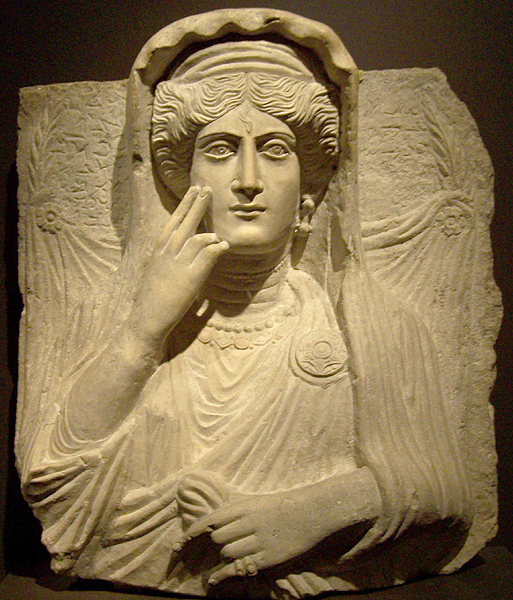
Palmyran woman's portrait bust in the Smithsonian, Freer-Sackler Gallery, Credits: Ann Raia, 2006
; man's portrait bust © 2006 David Monniaux (via Wikipedia Commons).

03 August 2008

EXCELLENT BLOG AWARD

Tucked in between the life stories of two Scandalous Women -- Elizabeth Bentley (Soviet spymaster) and Camilla, Duchess of Cornwall (no introduction needed) -- was the announcement that the titillating Scandalous Women had received an Excellent Blog Award.

And had duly passed the prize on to other centres of bloggy excellence,* among which Zenobia, Empress of the East. I love the idea of Scandalous Women -- where murderesses rub shoulders, so to speak, with les grandes horizontales -- giving an award to Zenobia, whose own impropriety still resonates:
boasting herself to be of the family of the Cleopatras and the Ptolemies, [she] proceeded upon the death of her husband Odenathus to cast about her shoulders the imperial mantle; and arrayed in the robes of Dido and even assuming the diadem, she held the imperial power ... ruling longer than could be endured from one of the female sex.
I thank SW on behalf of Zenobia, and all our uppity readers.

* A condition of the award is to pass it on, but I just tagged six unprotesting blogs a week or so ago and shouldn't make a habit of it. So I'll hold this power in reserve. And, if anyone reproaches me, let those whom nothing pleases keep the venom of their own tongues to themselves. (Aurelian, Hist. Aug. TT XXX ; a little after the quote above)

26 July 2008

Zenobia and the Marxist Gramscians (Updated)

Here we are again at the Amsterdam All-Zenobia Day -- and it's now Robbert Woltering's turn to strut the blogging stage. Robbert (that's Dutch, with two b's) teaches Arabic and Islamic studies at the University of Amsterdam. He is also editor of ZemZem, a journal about the Middle-East, North Africa, and Islam.

And what, I asked myself, is a ZemZem? Undoubtedly you, too, would like to know.

ZemZem, as some clever readers of my previous post were quick to spot, is the name of the sacred well at Mecca. It surges close to the Ka'ba, which houses the renowned Black Stone -- the holiest site of Islam. ZemZem may be an onomatopoeic word mimicking the bubbling sound of the waters, or perhaps it comes from the root z-m-z-m, which, I'm told, means 'swallowing in small drops' or, I suppose, sipping.

Naturally, an abundant source of water in the middle of the semi-arid Saudi desert is a miracle waiting for a legend to attach. Wait no more. Hagar and her son (by Abraham), Ishmael, were wandering thereabouts:

[ZemZem] sprung when Hagar left her infant Ishmael crying for water and shuttled between Safa and Marwa trying to see if people are coming up to provide water for the thirsty infant. Ishmael was kicking the ground when this well sprung out and she came on telling the water "zimi zimi "meaning 'come close together'. She was trying to get the water in one place to be able to give her son a drink.
Long before Islam, Arab storytellers were telling tales such as this about how things began. Poets streamlined the many contradictory traditions as tribes moved about, and created heroic origins for peripheral places and local events. Just so, Arab and Persian chroniclers, as preserved by Tabari, blended elements of folklore and fiction into a barely remembered history of Zenobia and Palmyra. Many of Tabari's tales rely on pre-Islamic sources and, together, they tell a story entirely different from that familiar to us from the late 4th C Latin Historiae Augustae (we've written about Tabari twice, so go first, if you will, to The Zenobia Romance I and II).
In Tabari's tale, there are no Romans at all. There is no Roman empire, no legions and no Emperor Aurelian. Even the Persians and the King of Kings are hardly mentioned. It is rather an almost timeless world with Arab tribes battling each other -- a pot-boiler of war and intrigue -- in the desert.

Zenobia Lives: the modern Arab reception of al-Zabba

By the time that Arab intellectuals began to revive interest in the Palmryan queen, a millennium or so after Tabari, it came about as part of the cult of Westernization that swept the Arab world in the late 19th/early 20th century.

Alexandria 1927

A good example is the Egyptian romantic poet Ahmad Zaky AbĂ» ShĂądy. AbĂ» ShĂądy composed an historical opera in 4 acts, Al-ZabbĂą or Zenobia, Queen of Tadmor. It was published (in Alexandria?) by the Free Masons.

The Free Masons, I think, says it all.

AbĂ» ShĂądy, a Coptic Christian,* was a member of the liberal Egyptian bourgeoisie, that small elite in the process of Westernization in the early 20th century. Egypt was in the vanguard of this movement, which was often expressed by the transformation of Arabic literature through the Western forms of the novel and drama. AbĂ» ShĂądy was the founder of the Apollo Society, which aimed to introduce a fresh atmosphere in poetry especially romanticism, and establish modern aesthetics. It must have been quite difficult to produce modernized fictional work which would not enrage the Muslim conservative element but would, at the same time, not dissatisfy the modernists. Although non-political, he was constantly under attack and finally emigrated to America where he died in 1955.

Given AbĂ» ShĂądy's background, his time and place, you will not be surprised to learn that his opera follows the Historiae Augustae version of events -- a conflict between Rome and Palmyra and between Aurelian and Zenobia -- and not at all Tabari's Arab story of war between desert tribes. His Zenobia opera, as far as I know, was never performed.

Beirut 1969
Adnan Mardam Bey's Queen Zenobia (left), a play in 4 acts, also depends on the Historiae Augustae; and there is no trace of Tabari's folkloric tales nor of the Arab heroes, Jadhima or Amr ibn Adi.

While searching on-line for information on Mardan Bey (a hopeless task: I think he may be a son of the famous poet Khalil Mardam Bey , an assumption based on the fact that he edited that poet's diplomatic papers), I stumbled across a most serendipitous discovery.

I'm sure Robbert knows about it, but quite unknown to me was Zanûbyù Malikat Tadmur (1871) by Salim al-Bustani (1846-1884) of Beirut.

Zenobia, Queen of Tadmur is the first-ever Arabic historical novel -- and the second novel written by this almost forgotten 'father of the modern Arabic novel'.** Before al-Bustani (and, in truth, until the 1950's), poetry remained the leading Arabic literary genre; the novel was perceived as a lower form.

Even the new Beiruti bourgeois reading public was still used to the oral techniques of the hakawati (storyteller) and the sira sha'biyya (popular tales). Al-Bustani had to adopt a style suitable for this readership.

He wrote three historical novels, all with fiery, patriotic Syrian heroines at the centre of the action. While his Zanûbyù also follows the outline of the Historiae Augustae (and not Tabari), he is not so much interested in historical facts as in inculcating moral virtues. He admits to leaving out the depressing bits of her story in order not to sadden his readers.

Zenobia and her (non-existent) daughter Julia are captured by Aurelian and taken to Rome. That's sad, so the story concentrates instead on the Palmyran conquest of Egypt, a love affair between Julia and Pisa, a Roman prince, and Zenobia's war with the Romans. Al-Bustani often interrupts the narrative to criticize indirectly the customs, morals, and actions of the Ottoman rulers of Egypt. To avoid the Ottoman censors, criticism is implicit: contrast, he seems to say, today's governors with Zenobia, a model of beauty, courage, and political wisdom. Most of his characters are rather flat and pale, mere mouthpieces for the author's opinions and values. In fact, he emphasizes the fictitiousness of the novel to show that fiction is a vehicle for a worthy purpose. So, the only nail-biting part of the story is what will happen between Julia and Pisa, the classic story of lovers belonging to two hostile camps.

Beirut 1975

This Zenûbyù emerges from a series of books on Arab heroes (Vol. 14: cover at the top of this post) as an Arab freedom fighter. Her hair is modestly covered to the very last curl. Hadn't the anonymous author ever seen Palmyran statues of women? They wore loose veils over the hair, rather like Benazir Bhutto. No matter.

The purpose of the book is educational and it is going to update Zenobia entirely. At one point in the story, Zenobia turns to her Greek philosopher friend, Longinus ( who may, or may not, be the author of On The Sublime), and says,

We have forty gods and they all do nothing. Find me one god, Longinus, in your wisdom.

Well, yes. Just a trifle anachronistic. But not nearly as anachronistic as her devotion to Marxist Gramscianism:

(Above, left) With her army mustered behind her, she is telling her broken-nosed commanding general, Zabda,

Yes, the empire needs to have a strong army, but we also need knowledge ... provided this knowledge is related to work (or labour).
In other words, as Robbert put it, the book is meant to project the Gramscian concept of the organic intellectual, a quite common ingredient in the Arab leftist ideologies of the time. "Leftist" in this context, designates both the Marxist and Arab Socialist/Nationalist trends in Arab political thought. Gramsci's political theory, and in particular his version of civil society, would, it was hoped, provide a vision to bridge the gap between leftist intellectuals and the people they claimed to represent.

Gramsci is a Marxist: that's why the bad guys in this book are not so much the Romans as the Palmyran sheikhs and merchants who refused to give Zenobia horses, and thus are to blame for making her rebellion a hopeless endeavour; but he is an alternative kind of Marxist -- who adapts the ideas of Marx to his own situation. For Gramsci, that was southern Italy, but, surely, it might equally apply to the backwardness of the Arab masses.

At the end of the book, the Roman Senators insist that Aurelian put Zenobia to death so that Roman women will not be corrupted by her uppity example. Aurelian is cleverer: "No," he says, "it's better to make her marry and be a proper woman -- wife, mother, and cook!"

So much for Marxist equality of the sexes ....

As far back as 1847, in Lebanon, Butrus al-Bustani (the father of Salim) had called for the education of women. He launched a fierce diatribe against the prevailing notion that education of women was dangerous and would lead to atheism and to madness. He stressed women's inalienable right to become men's equals in feeling, opinions, and work.

Hoorah! But let's not get carried away. Here's how he ended his famous speech:

Before concluding this discussion, I would like to say a word to the cultured woman: being such a useful and important member in the world and society does not need to let woman fall into the plight of vanity and pride or lead her to feel superior to her huband even if she is more knowledgeable than he, since nonessentials do not nullify the intrinsic.***
Quite So.

Dubai 2007

For a perfect finish, don't miss The Best Yet Mansour Rabani Zenobia Video (with English subtitles) shown by Robbert at the Amsterdam All-Zenobia Day; and my comments on that epic production, Zenobia Receives Royal Patronage and Zenobia's Terrible Curved Sword.

And still not a hint of Tabari and his Arabic tales!

Has the whole world outgrown the hakawati and the sira sha'biyya?

Save this date:

On September 11th, Johan Weststeijn and Robbert Woltering will give their lectures once again, in an expanded version at the Klein Zenobia Congres voor Arabisten (Little Zenobia Congress for Arabists).

I trust the 'Little' refers to the size of the congress and not to our dear Queen.


*  His granddaughter, Joy Garnett, wrote in (see comment below) to correct this information.  AbĂ» ShĂądy was Muslim.  My apologies.

** His first novel and the very first Arabic novel was al-Huyam fi jinan al-Sham (Love in a Damascene Garden, 1870). Massi Moosa, The Origins of Modern Arabic Fiction, Ch. 7, stresses al-Bustani's belief that the goal of fiction is to reform and regenerate society. While his themes pertain to the Arab world, he often uses a European setting to speak of Western ideology (socialism), "or to convey to his readers that the West can and must be learned from." (183); a summary of Zanûbyù and al-Bustani's other historical novel appears in Ch. 8.

*** Quoted from Joseph T. Zeidan, Juzif Zaydan, Arab Women Novelists: The Formative Years and Beyond (24).


Update: 29 July 2008:

Kung Fu at Palmyra


In his comment on this post, Robbert Woltering points out that both of my images of Zenobia from the Beiruti Arab Hero series (1975) show the queen dressed "in her fighting gear. (In the book, Zenobia constantly engages in physical combat herself.)".

I hadn't realized that the anonymous author had put Zenobia so literally into battle.

Like this Kung Fu lady of modern imagination (below, right).*

So I was wrong to give the impression that Zenobia with her hair tucked away was a model of Muslim modesty. Not at all!

Robbert kindly sent me another picture from this book (left) of Zenobia wearing her crown, and with flowing locks of hair. While this hairstyle, too, is non-canonical for a Palmyran woman, it's AOK for late 20th C Beirut. In fact, she looks a little like the 2007 beauty queen, Miss Lebanon (below, left), with a similar sort of tinsel crown.

And the Arabic text on the same page could not be more politically correct (translation, needless to say, due to Robbert, too):

Zenobia, the warrior who battled against the enemies of the Arabs before the coming of Islam, and who demonstrated that a woman is capable of nobly engaging in combat, and of taking up position in the centre of power with firmness and the strength of her resolve and self-discipline.
I have just one quibble (I'm a great quibbler).

No, not about her battling "the enemies of the Arabs", though she didn't do any such thing.

But rather that she looks about 17 years old -- even Miss Lebanon 2007 looks older; and she was nineteen at the time.

We don't know when Zenobia was born, or how old she was when she died; but she certainly wasn't an adolescent when she became Empress of the East. In Zenobia: The Rebel Queen, she was in her late thirties; but I could be wrong.

It would not be the first time.


* Kung Fu Female Fighter © James E. Porter at Elfwood.com

24 July 2008

I've been tagged!

I've been tagged by a delicious blog, foodvox, just when I was in the middle of writing about Marxist Gramscians and ZemZem.

Puzzled? So was I. I've never been tagged before.

Now you'll have to wait to find out what a zemzem is, as I postpone my serious stuff and play tag instead. (There's an impatient editor, too, thrumming his fingers on the desk, waiting for a chapter from me, but I'm used to that ... and can tough it out.) It's summer, after all.

The tag descended in a purely foodie line until it reached me. How does foodvox know that I'm a foodie at heart? Vibrations through the ether, perhaps. But tagged is tagged, and I'm a game old girl.

The rules:

1. Link to the person who tagged you. Done.

2. Post the rules on the blog. Doing.

3. Write six random things about yourself. Attempting.

4. Tag six people at the end of your post. Dare I tag a total stranger?

5. Let each person know they have been tagged by leaving a comment on their blog. They'll hate me.

6. Let the tagger know when your entry is up. Risky. What if they retaliate with a meme?


Six Random Things About Me

1. I'm a terrible procrastinator and a time-waster (but you already knew that).

2. In a previous existence, I was one-half of Weingarten & Chaplin b.v., an international direct marketing agency.

3. I had an unexpected encounter in a helicopter once and was fool enough to talk about it.

4. French provincial and Tuscan cooking mix very well and I bastardize frequently. As Sopater, the writer of a play called Lentil Soup, said, "I can carve meat for myself, and I know how to take Tuscan wines with any party of eight."

5. Speaking of wines, I am not named Weingarten for nothing. Old wine, but the flowers of new songs, as Pindar says.

6. I have never won anything in any lottery. I'm sure that tells something about me; but what?

These random remarks are not (to quote Plato) the light jests of a young and noble Socrates, but the serious thoughts of a tagger.

Now the moving finger moves on, as I tag another six unfortunates.

David Derrick at The Toynbee convector, who often provokes me into saying something sensible.

Gabriele C at The Lost Fort, whose blog is an engaging mix of history, fiction, and ruins I've never seen before.

Ridger at The Greenbelt, whose Monday Science Links keeps me on my toes.

David Powell at Studenda Mira, who should blog more, much more.

Debra Hamel at Blogographos, not so much a blog as an open posting place.

Carla Nayland at Historical Fiction, who just reviewed my Zenobia: the rebel queen, and doesn't deserve this in return.

Well, that's another day's work. Not.


* The wonderful photo of a cat burglar (at the top of this post) is shamelessly stolen from I-know-not-who: sent to me by a friend, without any credits, I've not been able to find out who photographed (and photoshopped) it. If anyone knows the creator, please send me the name so credit may be given.

19 July 2008

Cleopatra: Kill Or Be Killed

Crystal Theatre Presents CLEOPATRA - A LIFE UNPARALLELED

An Untold Musical Story of the Most Bewitching and Powerful Woman of All Time: Part Epic, Part Soap Opera, Part Tragedy, Part Historical Fact and Part of the Midtown International Theatre Festival.

Cleopatra as a rock opera star

Belting out sensual romantic melodies, blues-rock rhythms, Latin and reggae, CLEOPATRA transports the audience to a time where the major form of news was gossip and innuendo; where centers of power were hotbeds of jealousy and death; where marriages were often mere things of convenience; and where nations made war against their neighbor simply because they could.

What else is new?

Whether thought of as a beloved Queen or disparagingly referred to as "that woman", Cleopatra wanted only one thing - a strong Egypt. But while she made great strides to that end, she could never win over her detractors, always having to deal with gossip, second-guessing (as portrayed here in the classic Greek chorus manner), and predictions of doom which foreshadowed her final downfall.

It sounds like Hillary Clinton.

Crystal Theatre presents the sensual and wondrous story of Cleopatra, who loved and owned the hearts of two of the most powerful men in the world and ruled Egypt with the strength and passion that only the true "Queen of the Nile" could possess.

Crystal Theatre is an independent, non-profit performing arts school. Cheryl E. Kemeny (book music and lyrics, musical director & co-director of CLEOPATRA) is author and composer of over 30 musicals. Founder of the Crystal Opera in 1993, she is also the co-founder and artistic director of Crystal Theatre. I think that is Cheryl on the right, doing a nip and tuck on a very Hollywood-looking Egyptian.

The show will begin performances on July 16th at the June Havoc Theatre at the Abington Arts Complex, located at 312 West 36th Street in New York City -- and runs until August 3rd.

Every year, the Midtown International Theatre Festival likes to introduce something new for audiences and participants. I wouldn't have thought Cleopatra very new, but I see what they mean and it rocks. And it's all there for you to enjoy, so come out and enjoy the festival!


[My thanks to Kat Newkirk via EEF News]

* Press report: "'A Life Unparalleled',
Woman's rock musical about Cleopatra to be staged in New York:
http://www.greenwichtime.com/ci_9847148

09 July 2008

A Short Tribute to Giovanni Battista Borra

An Artist and Architect at Palmyra

I was somewhat saddened at the treatment received by Giovanni Battista Borra at the elitist hands of Dawkins and Wood after their travels to Palmyra (where Borra did all the measuring and the exquisite drawings, as noted in the the previous post, Lure of the East). While, even today, archaeological architects play second fiddle to the dig director, they do at least get pictured in the inevitable team photograph; not so Borra who is nowhere to be seen in Hamilton's giant painting, James Dawkins and Robert Wood Discovering the Ruins of Palmyra.

So, I was especially delighted to find a webpage filled with Borra's engravings from The Ruins of Palmyra.*

I'll make it up to him, I thought.

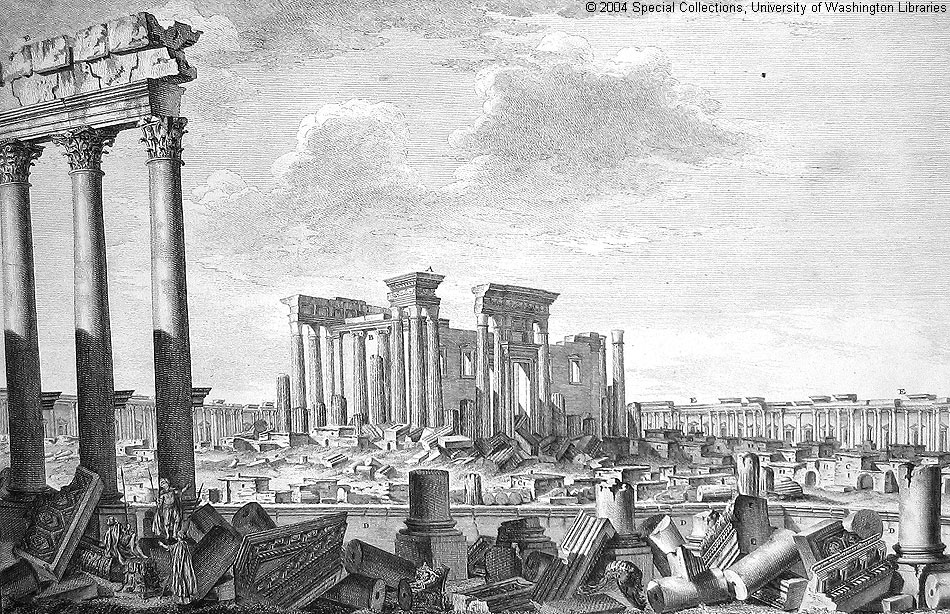
Left: View of the Triumphal Triple Arch from the West, with the Great Colonnade, rubble, and columns.

The Colonnnade -- c. 1000 m (3,000') in length -- bisects the centre of Palmyra from the north-west to south-east. Shops and trading stations lined both sides of the street -- an early souk, really. Built during the course of the second century AD, it got its finishing touch with the addition of the lavishly decorated arch in c. 220 AD.

The arch may have commemorated the victory of Septimius Severus over the Parthians when the Emperor established the Roman province of Mesopotamia (taking the title Parthicus Maximus in January 198) .

One expects that Palmyran troops would have fought in this war -- and been rewarded with a share in the rich booty. For Severus had sacked and plundered the Parthian capital, Cteisiphon. As Cassius Dio tells us, vast numbers were killed and 100,000 prisoners taken. That's 100,000 slaves to be sold and turned into cash. Plus, as Herodian adds, the royal treasury was captured and all the king's jewels and valuables.

Quite when the Roman army reached Cteisiphon is unclear, but I like to think that this is the Severan triumph still celebrated over thirty years later by the Palmyran garrison at Dura Europos each year on 21st May.

So I propose that a victory toast was first drunk on 21 May 197, while Parthian blood was still wet on Palmyran swords. And then the rich merchants raised the money to build this elaborate triumphal arch.

(Left): View of the Triple Arch and the beginning of the Great Colonnade, with the North-West Wall of the Temple of Bel in the distance.

Wood called Bel's temple 'the Temple of the Sun', a reasonable error: Bel and the Sun were already confounded by the 5th C Byzantine historian, Zosimus, who tells that Aurelian placed the statues of Helios and 'Belos', patron god of Palmyra, in the Temple of the Sun which he founded at Rome. This would have looked right to Wood (who knew his ancient sources), while the carved bas-reliefs of Bel they might have seen were certain to have muddled the issue further.

For Bel was worshipped here as one of a trinity of gods, and is usually pictured along with Yarhibol, the Sun god, and Aglibol, Moon god. Both Yarhibol and Aglibol wear a radiate nimbus about the head (as on the relief below**), like a halo with sun rays. Confusion is easy, to say the least.

Although Bel is the supreme cosmic deity -- the one, sole, and merciful god -- nothing in the many inscriptions ascribes a subordinate rank to Yarhibol (who is also the patron of the life-giving waters of the spring of Efqa, as well as the divine judge) -- and perhaps not even to Aglibol, whose own sanctuary at Palmyra was called 'the Holy Garden', and which must have been one of the earliest temples in the city.

We know that these three gods were already being worshipped as a group in this temple in the very year 32 AD, when the sanctuary was dedicated. An inscription on the pedestal of a statue found in the temple grounds reads:

This is the statue of Lishamsh son of Taibbol son of Shokaibel ... who dedicated the temple of Bel, Yarhibol, and Aglibol, the gods, on the day of their feast, the sixth day of Nisan, in the year 342 (= 6 April 32 AD).


Right: Exterior View of Temple Cella from NW.

When Dawkins & Wood & Borra arrived at Palmyra, the entire courtyard and the temple of Bel itself were built over with the little houses of the Arab village (click here for a larger image).

Borra scrupulously drew all the one- and two-story Arab dwellings that then filled the god's precinct. So, to return for a moment to the theme of the Lure of the East (and charges of Orientalism flung about in recent times), these Occidentals -- at least as a general rule -- faithfully respected the landscape as they found it and did not try to erase signs of later accretions. It was the French who demolished the Arab habitations in the 1930's when they began excavating the +2 m (6') of dirt and rubble that had accumulated over the centuries within the temple grounds.

You Win Some, You Lose Some...

On the other hand, the plans Borra drew of the temple interior did not show the small mosque which was inside the building and only removed (by the dastardly colonialist archaeologists) in 1929.


When in London, Do As The Romans Do


After their travels in the Middle East, Borra went with Wood to London to prepare the engraving for The Ruins of Palmyra.

He stayed in England for eight years, busy with commissions for noble patrons. First came the Music Room (left) in the London house of the 9th Duke and Duchess of Norfolk, unveiled to rapturous acclaim in 1756.

There is no evidence that the room was used as a setting for music, but the Duchess of Norfolk certainly received her guests here during the reception in February 1756, when Horace Walpole remarked on the 'scene of magnificence and taste. The tapestry, the embroidered bed, the illumination, the glasses, the lightness and novelty, of the ornaments and the ceilings are delightful'.

On Borra's recommendation, Jean Antoine Cuenot was hired to make the extreme fine Carvings, the Arts and Sciences all Gilt , being paid 2643 pounds sterling 3s 8 1/2 d -- quite a lot of money -- for work undertaken at Norfolk House between 5 March 1753 and 24 February 1756. His carved woodwork caused a sensation when the interiors were first shown in 1756 (and again when the refurbished music room was installed in the British Galleries at the V&A in 2001). Bills indicate that he worked from preparatory drawings by Borra. It is not known how much Borra was paid but one cannot help but feel that Borra was again short-changed, at least in matters of fame.

To be fair, the white and gold interiors had a Parisian ambience, reflecting the latest French fashions -- which might well be due to Cuenot. It is certainly impossible to spot any trace of Palmyran ideas in these designs.

That is not the case with his second great commission.

Stowe House, 'the largest and most completely realised private neoclassical building in the world'.

Sir Richard Temple’s original seventeenth-century house was enlarged significantly by his son Viscount Cobham in the early eighteenth century -- with input from architects such as John Vanbrugh, James Gibbs, Robert Adam, and Sir John Soane. One of the finest neoclassical buildings in Europe, Stowe is set within an Arcadian classical landscape designed by Capability Brown and William Kent.

Roman Grandeur

But it was our hero Giovanni Battista Borra who designed the awesome Marble Saloon at the heart of the building, and for this commission he pulled out all the stops. The room takes its name from the marble floor, made of over 72 squares of veined white Carrara marble

Recalling the Pantheon of Rome, it contains 16 great imitation stone (scagliola) columns, supporting an entablature surmounted by a spectacular plaster frieze showing a procession of triumphant soldiers in high relief.

It's jaw-dropping stuff.

Containing 280 human figures as well as horses and lions, the frieze supports a huge elliptical coffered dome which reaches a height of over seventeen metres (50') at its (also elliptical) central skylight.

The plasterwork of the dome is spectacular, and nearly every single one of the 160 coffers is different in shape and size due to the elliptical design.

Am I the only one reminded of the ceilings of the South and North Shrines in the Temple of Bel (below left)?

Although these ceilings are made from monolithic sandstone slabs, one could easily imagine the designs transferred to a Roman dome

Networks of descending lozenges had again decorated ceiling vaults in Italy from the 16th C (in erudite reference to the apse of the classical Temple of Venus and Roma), but High Renaissance artists filled the panels with elaborate figures of man, animals, and emblems, rather than repetitive -- if highly decorated -- rosettes as in Borra's design.

In fact, his rosettes (below right) are rather sun-like, a conceit conceivably borrowed from the mis-named 'Temple of the Sun'.


But I don't insist on it.


* The properly eclectic Cabinet of Wonders alerted me to the Borra engravings at the website of the University of Washington Libraries, Special Collection (with thanks again to David Derrick of The Toynbee convector for the tip). Not to look a gift-horse in the mouth, but I do wonder why the University puts a copyright sign on the images! Surely, copying engravings from an 18th-century book to the web does not give you rights of copyright; or so I think.

** Monument aux dieux BĂȘl, Ba’alsĂąmin, YarhibĂŽl et ’AglibĂŽl, now in the MBA Lyon, dated January 121 AD

Blog Archive