01 November 2012

Lady Sale and the Buddhas of Bamiyan

Just this morning, as I sat down to write a review of a splendid new book on The Buddhas of Bamiyan by Llewelyn Morgan, I saw this headline in the New York Times, Taliban Hits Region Seen as 'Safest' for Afghans -- a grim report on what's up in Bamiyan today. So I decided not to write a formal review after all, but rather to recount the gist of Morgan's remarkable history which turns out to be, alas, only too timely.


The colossal Buddhas (pictured above) are, of course, no longer in their niches, having been dynamited to bits by the Taliban in 2001. But, first, let me tell you what came before -- it's a long story: the Buddhas 'lived' for over 1,400 years -- and then to the extraordinary true tale of Lady Sale. 

Bamiyan is an oasis town in the centre of a long valley that separates the mountain chains of Hindu Kush and Koh-i-Baba --some 140 miles/230 km northwest of Kabul. In the late-6th and early-7th century CE, first the smaller (38 meters/120 feet) and then the larger (55 meters/175 feet) Buddhas were cut at unmeasurable cost into the tall, sandstone cliffs surrounding Bamiyan.  The taller of the two statues is thought to represent Vairocana, the “Light Shining throughout the Universe Buddha”. The shorter one probably represents Buddha Sakyamuni, although the local Hazara people believe it depicts a woman (Muslims generally interpreted the two Buddhas as man and wife).


The two colossi must once have been a truly awesome sight, visible for miles, with copper masks for faces and copper-covered hands.  The outer robes (or sangati) were painted dark blue on the inside and pink, and later bright orange, on top.  In their latest phase, the larger Buddha was painted red and the smaller white.  Travellers as far back as the 11th century speak of one red Buddha and one moon-white. 

Even an early Muslim visitor was impressed:

The people of India [i.e. non-Muslims] go on pilgrimages to these two idols, bearing with them offerings, incense and fragrant woods.  If the eye should fall upon them from a distance, a man would be obliged to lower his eyes, overawed by them.
Besides the huge Buddhas, there were numerous caves carved out of the ochre-coloured sandstone cliffs.  When the Chinese pilgrim monk Xuanzang visited Bamiyan in 630-631 CE, some 2,000 monks were worshipping and meditating in these caves. One must imagine hundreds of stone and wooden staircases running along the hill face, linking caves that are now inaccessible, their entrances carved and painted and festooned with fabrics.  

On The Silk Road

Behind the cliffs rise the high peaks of the Hindu Kush, perpetually under snow.  Bamiyan, itself about 2500 m (7500') above sea level, is at the heart of this formidable barrier between India and Central Asia and the valley provides comparatively easy passage through it.  So whoever held Bamiyan effectively controlled traffic along a major branch of the fabled Silk Road.  In the Buddhist period (most of the first millennium CE), this strategic position made Bamiyan both a lucrative halt for caravans carrying goods across the vast reaches between China and points west, and a bone of contention for powers on either side of the Hindu Kush.  Rich convoys and predatory armies have been regular features of Bamiyan's history.

Arabian Nights

Despite folk stories of instant conversion, Islamisation was a gradual, uneven process along the Hindu KushAlmost a century after the first Arab soldiers reached Afghanistan, another Buddhist monk, Hyecho, visited Bamiyan in 727 CE on his travels from China to India and still found there 'many monasteries and monks'.   The northern plains of Afghanistan were conquered by Arab armies by the end of that century but it took another three or even four hundred years for the eastern parts of the country to embrace Islam.  Bamiyan was said to have been converted at least three times: in 754-75; or again in 775-85; then, in 870, an Arab strongman captured the city and sent as loot 'fifty idols of gold and silver' to Baghdad, so obviously the monks were still rich and thriving; finally, almost another century later, the founder of the Ghaznavid Empire was said to have done the deed.  Whatever actually happened, Buddhists must have lived alongside Muslims in the valley for some time: as late as 1078, a local official still boasts the title of 'monastery keeper'.  

But it was all for nought.

In 1221 Genghis Khan arrived with his Mongol hoards.  Bamiyan tried to resist -- never a good idea with Genghis -- and the town was taken by force:

Genghis gave orders that every living creature, from mankind down to the brute beasts, should be killed, that no prisoner should be taken, that not even the child in its mother's womb should be spared, and that henceforth no living creature should dwell therein. 
In time the valley was repopulated by the people who now live there, the Hazaras.  They believe that they are direct descendants of Mongol troops and their families who settled there, and they are quite possibly right: recent DNA tests seem to confirm their Mongol origin.  In time, these new inhabitants, too, were Islamised but, for unknown reasons, they became Shi'a -- another cause of tension with the Sunni Pashtun majority and that underlies some of their deadly confrontation with the Taliban in our own times.

If any fool this high samootch [cave] explores,
Know Charles Masson has been here before.


Visitors of an entirely different kind arrived in Bamiyan in the 19th century, adventurers and spies heading to or from British India.  The antiquarian Charles Masson (actually a deserter from the British army) arrived in 1832.  An early excavator of Buddhist sites, he also worked surreptitiously for the British as their 'Agent in Cabul for communicating intelligence of the state of affairs in that quarter on a salary of Rs. 250 per annum.'  It didn't take long for Afghan authorities to realize -- correctly -- that English archaeologists was just another way of saying English spies.

Europe's Favourite Psychopath

What these early adventurers shared was a classical British education and one figure above all inspired their interest: Alexander the Great.  As the British progressed further into the north-west of India, the more they encountered territory familiar to them from the stirring accounts of Alexander's campaigns in the 4th century BCE:

To look for the first time upon the [Indus River] that had borne upon its surface the world's victor two thousand years ago.  To gaze upon the landscape he had viewed.... 
Thrilling stuff!  Another Englishman, Alexander Burnes, author of the bestselling Travels into Bokhara, and something of a sex symbol in his day, travelled to the Indus in 1831 to deliver a gift of five shire horses to the ruler of Punjab.  Needless to say, he was also there to spy out the lay of the land.  He had a particularly bad case of Alexander-itis:
 [Alexander] has reaped the immortality which he so much desired, and transmitted the history of his conquests, allied with his name, to posterity.... And, while we gaze on the Indus, we connect ourselves, at least in association, with the ages of distant glory.
A year later, Burnes was at Bamiyan writing about 'the gigantic idols of Bameean', quite convinced that this was the city founded by Alexander the Great, Alexandria ad Caucasum.  Burnes would soon return to Afghanistan, this time as part of an invading army as the British played out their fantasies of regime change in Kabul.  They wanted to make Afghanistan a friendly buffer state between British India and the Russians on the other side of the Hindu Kush. And so began the First Anglo-Afghan War (1839-1841).

So easy to get in, so hard to get out.

British and Indian troops occupied the country.  Alas, poor Alexander Burnes -- unlike his hero, this Alexander was ripped apart by a mob in Kabul on 2 November 1841, one of the events that led to an infamous massacre of British troops as they retreated from Kabul two months later.

Another visitor to Bamiyan was Lieut. John Sturt of the Bengal Engineers, who had been sent to survey the all-important passes over the Hindu Kush.  He stopped at Bamiyam on his route back.  The officer, suffering from 'Koondooz  Fever' (malaria) camped below Zohak, the fortress perched on the red cliffs at the eastern end of the Bamiyan valley.  That's where he made the charming drawing of the ruins (above, dated 1840).  A little over a year later, Sturt, too, would be dead, mortally wounded during the chaotic and bloody retreat of the British forces from Kabul.

Catastrophe
 
Lulled into a false sense of security, the British had reduced the number of their troops in Afghanistan and brought their wives and families to join them. They went hunting, horse-racing and held amateur theatricals in Kabul.  But it was not a safe place for European interlopers. The country rose against them, and the outnumbered British and Indian soldiers tried to retreat back to India.  As they withdrew through the narrow passes from Kabul to Jalalabad in freezing conditions in January 1842, the British column was attacked from all sidesFew survived. 

Lieut. John Sturt, who had made that tranquil drawing of Zohak at the entrance to Bamiyan, died in agony of an abdominal wound, leaving his pregnant wife Alexandrina and his mother-in-law Florentia, Lady Sale, to be taken prisoner on the very day he died By a strange quirk of fate, their captors would take them to Bamiyan, then at the very edge of Afghan territory.  They marched there along with their fellow captives, including Lieut. Vincent Eyre, who had been seriously wounded in the disastrous retreat, and his wife and young son.

Lieut. Eyre kept an illustrated diary of their ordeal.  But I fear this post is already over long and so we must postpone the saga of the CABUL PRISONERS (as they were famously known in England) to another day.

[Part II: click here]


The Buddhas of Bamiyan
by Llewelyn Morgan

 
Published in the U.K. by Profile Books

In the U.S.A. by Harvard University Press

HARDCOVER
$19.95 • £14.95 • €18.00
ISBN 9780674057883
Publication June 2012

Also Available As
EBOOK
$19.95
ISBN 9780674065383


* Mass spectrometer tests have determined the age of the organic material in the clay layers. The construction of the smaller Buddha is dated to between 544 and 595 and the larger Buddha between 591 and 644.


Sources include the website
Azaranica, a news aggregator on Hazaras and Hazarajat; Hans van Roon on The Silk Road Blog;

Illustrations


Top:
Buddhas of Bamiyan, from Iwan Lawrowitsch Jaworski: Reise der russischen Gesandtschaft in Afghanistan und Buchara in den Jahren 1878-79, Jena : 1885; photo credit: Andreas Praefcke via Wikipedia.
Middle: Reconstruction of colours of the Buddhas robes at the end of the 10th century.  Technische Universitaet Munchen via The Silk Road Blog.


Below: The fortress guarding the entrance to the Bamiyan valley, a lithograph of Shahr-i Zohak, based on a drawing by Lieut. John Sturt, Bengal Engineers (23 August 1840). Photo credit:
Leicester Galleries.


16 October 2012

Kaloomte, the 'Supreme Warrior' Queen

Meet Lady K'abel, Snake of Snakes.

Sometime in the 7th century CE, in the city of el-Peru, -- a Maya kingdom in the northernmost province of today's Guatamala --  there ruled a Supreme Warrior Queen, and this is what she looked like.


Centipedes and Snakes

During the 7th century, the kings who ruled el-Peru* belonged to the Centipede Dynasty (the Wak) and they were loyal vassals to the Snake kings (Kan) who had their seat at Calakmul*, far away to the northeast in what is now Mexico.  After 638 CE, a powerful king of the Snakes conquered towns and turf around the lands of el-Peru and established an empire in the Maya lowlands.  The Centipede king of the time, K'inich Bahlam II, had allied himself with the Snakes, and won as his reward a wife from the royal Snake Dynasty, most likely the king's own daughter, the princess K'abel.  

K'abel and her husband ruled for at least 20 years (672-692), and she very likely continued to govern for some time after his death.  These were golden years for el-Peru.  King K'inich Bahlam commissioned monument after royal monument, and K'abel, too, was regularly portrayed on great stone stele -- not least on that masterpiece pictured above, which boasted the signatures of nearly a dozen carvers, the work of an entire community of artists. 

More than just a pretty face

And more than just a queen, K'abel held the mighty rank of Kaloomte, meaning 'Supreme Warrior' -- a title connected with the paramount storm god 'Chahk with the axe' -- which made her higher in authority and gave her greater status than her husband, the king.  Maya epigrapher Stanley Guenter comments:
This is a title that references the bellicose storm god , and “warlord”, I think, is an appropriate, if rough, gloss. (I think the title would have fit somewhere between our own titles warlord and emperor ...). That said, I don’t think this is a title that should be translated as “warrior” as I see little reason to believe that the person holding the title actually was directly axing people and/or places.
Whether K'abel ever strode into battle and axed a living enemy is unknown.  The title is certainly military but it might mean no more (and no less) than Queen Elizabeth II's rank of "Commander-in-Chief of the British Armed Forces".  It's likely, though, that as Kaloomte, she served as military governor of the el-Peru kingdom under the auspices of the House of the Snake King, to which she belonged.

In the portrait above, K'abel holds a military shield in one hand and  ritual regalia in the other hand, exactly as we see on a similar portrait of the ruling kingAccording to Prof. Olivia Navarro-Farr, one of the directors of the excavation at el-Peru, what is certain is this:
She had a long life, and she was a powerful woman who was depicted as such. That's important, because history remembers her as a formidable figure with a supreme title.
Formidable.  Yes indeed.  Figuratively ... and now literally.  She was a big woman.

Welcome to her tomb! 

The news broke last week that the queen's tomb almost certainly has been found.  And, blessedly, its contents were intact.

Here's the story.

Earlier excavations in the main temple of the city centre at el-Peru (circled, left) discovered that, long after the fall of the last royal dynasty, worshippers still used this sacred place and continued to do so into the early 9th century CE.  These post-royal city dwellers placed layers of offerings over the ruined temple. They also dragged heavy fragments of royal stone slabs and arranged these along the front of the building.  In 2012, excavators decided to dig into the temple to define its architecture and determine why it remained so revered after the fall of the last dynasty.

A shrine over a shrine over a shrine ...

In the post-royal period of the site's history, a masonry shrine had been placed on the main staircase of the temple.  Underneath this, in its last phase (after 750 CE) was a monumental fire altar which had been dedicated by the sacrifice of a mature woman buried below it.  Beneath that, they found another shrine, this one much earlier, and underneath that was a tomb containing the skeletal remains of a person who was buried with a vast wealth of grave goods. 

This is a royal tomb

The tomb contained the remains of a single mature individual who was buried with many rich offerings, including a number of ceramic vessels datable to 700-750 CE, as well as considerable amounts of  jewellery and figurines made from jade -- a material so highly prized by the Maya that it was equal only to the feathers of the Resplendent Quetzal bird in value.

(Left) You can see the skeleton's skull just above the broken plate, which probably represents a round shield.  

The burial turns out to be that of Queen K'abel.  And this is how we know....

It contained a small alabaster jar carved into the form of a conch shell (left): in Classic Maya religion, the conch shell is the dwelling place of royal ancestors and gods.  Conch shell trumpets would be blown during religious rituals to invoke the royals and deities.

The head and arm of a woman emerges out of the shell. She has the woman's characteristic strand of hair in front of her ear.  Her lined face indicates an advanced age.   All these factors strongly suggest that the vessel depicts a royal woman well past her youth who is buried in the tomb.


Jackpot!

On the other side of the jar is a brief text of four hieroglyphic signs (right).  These name the jar's owner as "Lady Waterlily Hand" (an alternative spelling of the name Lady K'abel: the glyph for K’abel is hands holding waterlilies) and "Lady Snake Lord", which identifies her as a princess of the Kan Dynasty of Calakmul.  Matching the names given to queen K'abel in other inscriptions, the hieroglyphs leaves no question it's the same woman.

So, what did she look like in death?

Studying the skeleton showed that the queen was a mature individual (which accords with what we know of her in history), with more robust than gracile facial features and a sturdy frame -- traits consistent with the forceful portrait of Lady K’abel on the stela at the top of this post.

So, the archaeologists who set out to discover why there was so much ritual activity surrounding this particular temple at the site, got a very decisive answer: these worshippers were venerating a warrior queen: 

Such a burial would be unusual for most Mayan women, but it seems perfectly appropriate for the interment of a woman afforded the rare title of Supreme Warrior.

"She's an exceptional kind of woman, from a historical standpoint," says Prof. Navarro-Farr, who discovered the tomb. "She was a strong, politically savvy and important person, and I think her tomb does provide new kinds of evidence that shed light on the key role of women in dynastic rulership."

And as Prof. Rosemary Joyce reminds us (on her blog Ancient Bodies/Ancient Lives), the high rank and status of Lady K'abel was far from being so very singular:
Dynastic marriage patterns, in which powerful families sealed alliances by marrying off young women to less powerful ruling families at other sites, virtually demand that we expect many sites to yield evidence of noble or ruling women whose status might be higher than that of their local spouse.
And indeed they do. An elite circle, to be sure, but a well-peopled one.  By now, we should get used to it: "The fact that there were women powerful enough to be buried with the greatest degree of celebration possible in the Classic Maya world should no longer come as a surprise."

Welcome, Lady K'abel, to the Kaloomte club.


*  These are the modern names of the sites: the Maya names were Waka (el-Peru) and Ox Te' Tuun (Calakmul).

Sources include the report from the excavation team at Washington University in St. Louis website; James Owens for National Geographic News; Mesoweb Encylopaedia (el-Peru); Faine Greenwood interviews Olivia Navarro Farr for the Global Post; The History Blog; and David Stuart's Maya Decipherment blog, including the comments by Karen Bassie, Stanley Guenter, and of course the blog-owner himself; and Rosemary Joyce at Ancient Bodies/Ancient Lives.

Illustrations

Top:  Stele 34, portraying Lady K'abel (dedicated in 692 CE) looted from the site of el-Peru/Waka in the sixties and bought regardless by the Cleveland Art Museum, where it is now on display.  Her name appears in the text panel below her round shield.  Photograph: Cleveland Art Museum via Maya Decipherment blog.

Top left:  The main temple in the city centre of el-Peru/Waka, at Washington University , Fig. 2.

Middle left:  Burial 61 from the west. The queen's skull is above the plate fragments, at Washington University , Fig. 8.

Below left and right: The small conch-effigy alabaster vessel, and drawing of the Glyphs on the back of the vessel (drawing by Stanley Guenter), at Washington University , Fig. 10.

Bottom left: Carved jade head from the tomb, much like the one Lady K'abel wears around her neck on the stela at the top of this post, from The History Blog, Tomb of Maya queen, 'Lady Snake Lord' Found.
.
.
.


23 September 2012

BRAVO CARNIVALESQUE # 89

The 89th Carnival of Ancient and Medieval History Blogging.

Despite Zenobia's devotion to the women of the ancient world, I'm going to kick off this 89th Carnival by celebrating two male figures: two ancient Greeks to be exact, one quite luscious, the other just a wee bit odd. 


Oh to be in London now that the Motya Charioteer is there. 

This gorgeous marble sculpture (above) -- found on the tiny island of Motya off the west coast of Sicily -- was on loan to London for the length of the Olympic and Paralympic Games. 

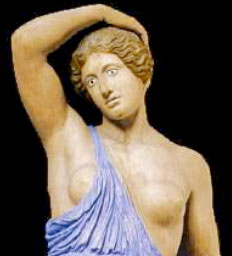
Undoubtedly carved in Greece (Athens?) ca. 460 BCE, the young man is identified as a charioteer because he wears what is taken to be a 'regulation' charioteer's sleeveless chiton ... but -- dearie me -- I don't think his outfit looks designed for driving a 4-horse chariot at breakneck speed around eight miles of oval dirt track: not a chiton so see-through skin-tight, clinging to his bulges in so many homoerotic ripples (left). 

Having been muttering about this since I had the pleasure of viewing the guy and his gear up-close some years ago, I finally found someone who agrees with me.

David Lee writing at The Jackdaw: If this fellow is a charioteer, he can only be at the post-race press conference having slipped into something a little more comfortable, and flashy. 

Read his spot-on analysis (and pointed remarks on the chap’s superb buttocks) and drool over the in-your-face photos. 


Not done yet with drooling?  Reverse circumcision should calm you down.

Ancient History Boy's blog, He has a wife, you know, starts off a post on Greek medical practices with a survey of anaesthetics (largely opium), moves to saw-bones stuff and some astonishingly advanced prothetics (check out that sophisticated fake leg), before settling in for a good long natter about circumcision..

Now, Greeks (and Romans) weren’t fans of circumcision.  More to the point the Greeks weren’t keen on seeing the glans at the end of the male member -- that's the bulbous bit at the tip -- that can be covered by the foreskin on an uncircumcised penis.  To keep the glans concealed, athletes or simply those exercising naked in the public gym would use kynodesme (dog ties) -- small leather strips used to tie a knot at the end of the foreskin so it wouldn’t retract.

But what if you were a Syrian or Jew who had just arrived in Rome and wanted to conduct business in the baths, stripped to the buff as usual?  The way was open to reverse circumcision.  There were two options. Ancient History Boy tells you what they were... 

... and one might well need a dose of opium after that Full Monty.

High and mighty Amazons 

Speaking of regulated substances, how did saddle-sore Amazons relax and tend to their bodies after a hard day's galloping over the hot and dusty Scythian plains? 

According to Herodotus (whom you may or may not believe), Scythians didn't bathe very often: only in the spring, and only before getting toned up for a nice funeral.  But, then, they made up for lost time with mind-blowing steam-baths that made them "shout for joy".  Adrienne Mayor spills the beans on the blog Wonders & Marvels.  


Back on the straight and narrow, now for a dose of Biblical blogging.

Israeli scholars claim to have uncovered archaeological evidence of Samson.

Umm, no they didn't: and to their credit, they didn't claim any such thing -- but that didn't stop the media from headlining SAMSON AND THE LION.

Then went Samson down ... to the vineyards of Timnath and, behold, a young lion roared against him.  And the Spirit of the Lord came mightily upon him, and he rent him as he would have rent a kid....(Judges 14, 5-6)

With his bare hands, needless to say! 

What the archaeologists actually found was a small stone seal (left; measuring 1.5 cm [0.6"] across) at Tel Beit Shemesh, which depicts a large animal next to a small human figure. The seal has been dated to the 11th century BCE, i.e. the period of the legendary biblical judges - including Samson.  In Judges, Samson fights a lion. So, abracadabra, the seal 'proves' the biblical story.


The blogs PaleoJudaica and God And The Machine bring the media hype down to earth and it's worth looking at Samson chapter-and-verse through their expert eyes.  As for the seal, even if that crude quadruped is a lion (it has a curled tail), I wouldn't put money on that little man coming out on top. 

So, sad to say, there may never have been a Samson but, scarcely pausing for breath, the media circus moved on to the sensation of Jesus' wife.

"Jesus said to them, my wife...." 

A provocative scrap of papyrus from the 4th century makes a direct reference to Jesus having a wife, says Professor Karen L. King, a historian of early Christianity at Harvard Divinity School.

This tiny fragment, measuring 4 x 8 cm (1.5" x 3") may thus  cast new light on the history of early Christianity.  The text, written in Coptic (probably translated from a 2nd-century Greek text), contains a dialogue in which Jesus refers to "my wife," whom he identifies as Mary, and a woman who "will be able to be my disciple".

Naturally, what everyone wants to know is: was Dan Brown's thriller, the Da Vinci Code -- making Jesus and Mary Magdalene husband-and-wife -- true to life after all?  Not so fast!

Find out what the fragment does and does not say at some super learned blogs: 

(1) "A Coptic gospel that mentions Jesus' wife?" at PaleoJudaica -- and note that question mark! Is the fragment too good to be true?  Colour him sceptical. 

(2) "The Gospel of Jesus' Wife", reminding us of the Gnostic Gospel of Philip 59, which speaks about Jesus' relationship with his mother, his sister and his companion, all of whom were called Mary, over at NT Blog.

(3) a sharp analysis and slightly variant translation at The Forbidden Gospels.

(4) when a 'wife' is just a 'woman': what the Coptic word means by Craig Evans at Near Emmaus.

(5) and, wait for it ... Is it Real?: is the fragment genuine or (gasp!) a forgery? Follow the discussion in French and English on the Nag Hammadi Seminar Facebook page.

Stop Press: for the very latest take on the papyrus:  The Gospel of Jesus' Wife: The Story is Moving Fast!

And the Carnival is moving fast too, but, before leaving Roman times behind, I can't resist Raising the roof (and not the dead) at Herculaneum.

The extravagant decorations of the House of the Telephus Relief made it one of Herculaneum's most prestigious houses and a superb beach-side property (with cold and hot tub amenities and all mod cons) --  and spectacular views across the Bay of Naples. The roof went flying off in 79 CE, carried away by the force of the eruption of Vesuvius, and it settled on the beach below in 250 or so pieces.  Now, the multicoloured and gilded wooden ceiling has been reassembled and restored to something like its former glory.  Have a look at the grandiose results at World Archaeology.


Giant Roman Milk Pot

This pot would not even have got storage room in the elegant House of the Telephus Relief but, dirt common though it was, its Romano-British owner thought it well worth repairing when the darn thing broke.  They stapled the cracks together with horizontal lead strips laid outside and inside the pot.  And went on using it, perhaps for centuries: pre-break, it tested for containing milk, post-break probably for grain.  The History Blog has all the news of this seriously big great British pot 24" tall and 18" wide (61 x 46 cm).


A little pot of Gladiator Sweat instead? 

In the steamy hot room of the Roman baths, a slave scrapes the sweat, oil and dirt from a muscular gladiator's skin. The slave uses a strigil, a curved metal tool that performs the same task as the modern loofah.

But the strigil (left) is designed to collect the gladiator's gluey mixture of sweat and oil called gloios (γλοίος) in Greek and strigmentum in Latin. Why? Because ‘gladiator sweat’ was worth a lot of money.

Caroline Lawrence explains why it was worth its weight in gold in 'Love Potion Number IX' at  Wonders & Marvels.


Save this date: 19 August 14 CE

Science currently holds that time travel is impossible so I'm afraid you may have to miss that date.  Make do, instead, with its bimillennium celebration in 2014 -- 2000 years to the day after Augustus, first emperor of Rome, kicked the bucket.

We do love to celebrate round dates even though the  roundness of 60, 100, 200 years, whatever, is completely arbitrary.  Somehow, the apparent similarity between two dates separated by a perfect round number -- like 2000 -- has a strong psychological effect. 

Prepare to be psyched.

The way in which such an anniversary is commemorated speaks volumes about the interests, priorities, social structures and political relations in the society which celebrates it.  Mussolini went hog-wild with the bimillennium of Augustus’ birth on 23rd September 1938.  What a great chance for Il duce to signal the perfect parallels between himself and Augustus!  The event was celebrated on a grand scale, including a monster 'Mostra' (that is, exhibition: whence the poster, left) and the reconstruction of the Ara Pacis in Rome. 

Penelope Goodman tells us all about Mussolini's big-time party on her blog, Weavings and Unpickings, and now of her plans for a conference around the bimillennium of his death. A modern obituary, in fact.  I wonder what that will tell about ourselves, and our contemporary society.

Speaking of contemporary concerns and the alarms of our age, how about a a little murder and mayhem? 

Hostage-taking, anyone?

When we think of hostages we tend to think of men with pistols using some innocent as a human shield.  In a grislier mood, we might picture terrorists slitting a hostage's throat from ear to ear when they don't get what they want.  But in the ancient and medieval world hostage-taking was formalised and certainly not criminal. Conquered territories would give up their under-age princes who would be conveyed to an enemy capital or castle, there to be brought up in the winner's ways. A son of a Persian Emperor or a British tribal chief might, for example, find himself in Rome being educated among senator’s sons.  The idea was that, when he went home, he'd be a subservient bridge between top dog and underdog.

It didn't always work like that, especially not in the Middle Ages.  Sometimes, an errant dad got his son's head back instead.  Beachcombing tells us about the ups and downs of Hostage Taking in Ancient and Medieval Times

Now that we've entered the Dark Ages, we search for little beacons of light, such as Chris Cevasco (Author)'s blog which flashes red on 'Lady Godiva - the Naked Truth'.

Mention Lady Godiva and, Chris tells us, the first thing most people think of is the line of chocolates bearing her name. 

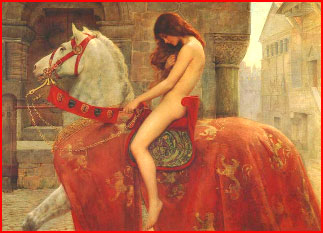
Tchah!  Surely, Chris, readers of Zenobia recall higher things than confectionary -- something, for example, about her riding naked on the back of a horse.  Exactly as sprang to the mind, too, of the Pre-Raphaelite artist, John Collier (left). 

But who was Godiva, and why do we remember her at all?  

In truth, very little is known about her.  A mid-11th-century Anglo-Saxon countess, wealthy and pious, whose granddaughter Ealdgyth was Harold Godwineson’s queen when Harold fell at Hastings in 1066.  Godiva lived through the arrival of the Normans, dying less than a year after William the Conqueror took Harold’s throne.

So far, so goodly.

But hardly a reason to baptise any chocolates.  No, it took a cloistered monk to make her famous. The earliest account of her legendary naked ride appeared in Flores Historiarum (Flowers of History; 1326?), written by a monk of St. Albans Abbey.  Read what he had to say, and the later embellishments at Chris' blog

About the time that Godiva was allegedly mounting her horse, anyway in 1042, Edward the Confessor ascended to the throne of England, ending nearly three decades of rule by conquering Danish kings.

1066 and All That

Edward was the last Anglo-Saxon king (genuflect, please, before his image; left).  The great-great-great-great grandson of Alfred the Great, he died childless, leaving England open to conquest from overseas. 

To put it mildly, Edward had a turbulent childhood (well, who wouldn't if your father was Aethelred the Unready, the hapless king besieged by Vikings on all coasts and  Danish kinglets anywhere left undefended?).  When Edward was about ten, his father was deposed and the whole family went into exile under the protection of Edward’s uncle in Normandy. 

The snakes and ladders that followed were worthy of a French farce had the consequences not been so bloody serious.  When, for a brief time, there were more ups than downs, Edward was crowned King of England (April 3, 1042).  That didn't stop invasions, usurpations, and power struggles for a minute.  In 1051, it’s possible that young William, Duke of Normandy visited England and Edward may have promised him the throne at this time....

The whole nine yards at 'Edward the Confessor, King of England' on The Freelance History Writer blog.

Who would have imagined that Edward's promise was to cost Godiva's granddaughter (and her husband) the throne?  Edward didn't become a chocolate but, next best thing, he was canonized as a saint and confessor in 1161.

After the conquest, what did it mean when a writer used French or English?

As time went on, being English was increasingly being defined against being French, but records of government and law long remained multilingual.

The Bavardess blog considers the changes taking place in the 'public sphere' in England in Interpreting Medieval Sources: Orality, Aurality, and Textuality

That may sound daunting but it simply means that texts initially created as written documents also circulated orally whereupon they were read out and listened to in public.  So, it could happen that a French text was proclaimed in English, and then it might go through yet another round of translation and circulation as, for example, being copied into Latin chronicles. 

In those dark days, documents were rarely drawn up in English.  But such  happened in 1405 when some northern nobles agitated for good governance (a 'Northern Spring'?), drafting a set of articles demanding that King Henry IV take steps to reform the system.  The monastic chronicler Thomas Walsingham recorded their complaints, ending with this declaration:
These were the articles that were written in English, whose sense I have translated almost word for word, and have inserted them here as they were expressed, without any bias. [In other words, he has translated them from English into Latin] This seemed necessary to me because of the plainness and inelegance of the language.... 
England was still multilingual at the time although there were a growing number of literary works being written in English (Chaucer, Gower, and, most dangerous of all, Wycliffe's Bible).  Elegant or not, here we came!  

Chaucer was praised as "The first finder of our fair language." And this below may be its terminator:

“Wield the Skillet, Forge the Family Dinner,”

A recent ad campaign for Velveeta stars a manly, quasi-medieval blacksmith, chanting, There’s no more medieval prepared cheese product than Velveeta. That’s the message of Velveeta Shells and Cheesy's Eat Liquid Gold TV ads. When not smiting noodles, perhaps the blacksmith will find time to hammer Velveeta (or its curdler-in-chief, Kraft) who completely misunderstood the metaphor.

Jeff Sypeck at the blog Quid Plura tells what the admen got wrong.
Medieval people associated the consumption of liquid metal with horrific punishments and unbearable pain. In the 12th-century Anglo-Norman Voyage of St. Brendan, the saint discovers Judas on an island, where his unceasing torments include being forced to drink molten lead and copper....
Which doesn't taste nearly as nice as it sounds. Not convinced?  Try this real medieval text:
and one broÊ’t myche gold and syluer, and þat was molten and casten in hyr þrote, and þat ran out of hyr stomake. And he seide, “Take þe þis for þ[i] cursed and wikked coueitise…”*
Believe me, Velveeta, you won't like it.  And I wouldn't wish it even on a cheese dip.


Here endeth the 89th History Carnivaleque.  My thanks to all who sent me leads: we had a bumper crop of nominations this season.


"One brought much gold and silver, and that was melted and poured down her throat and that ran out of her stomach. And he said, "Take thee this for thy cursed and wicked covetousness."

Illustrations

All images are from the blogs highlighted with the exception of the papyrus fragment (Jesus' Wife) which comes from the Harvard Divinity School webpage.
.
.
.

03 September 2012

History Carnival Coming Up

Blogging Ancient/Medieval History

Kicking off the new blogging season!

The next ancient/medieval edition of Carnivalesque -- the monthly showcase for top history blogging -- will appear right here at Zenobia: Empress of the East on Sunday, 23rd September.

So please get inspired and send me links to the best ancient- and medieval-history blogging of the summer  season -- all of the fine, insightful, or just plain provoking posts that struck you while basking in Global Warming; or what you're reading right now, while prepping for the new school year.

Feel free [and especially!] to nominate your own writings as well.

You can email me directly at judith@judithweingarten.com or use the ancient/medieval nomination form.

If you're not familiar with history carnivals, hop over to the Carnivalesque Home Page where you'll find up-to-the-minute news on the ancient, medieval, and early modern history carnivals. The current Carnivalesque is up at The Georgian Bawdyhouse, casting a wicked light on all that's dearest to an 18th century slut's heart: foul crime, lewdness and disorder.  What took my fancy was the world's first comic strip -- a young scholar tempted into debauchery by Satan himself -- plus how to whiten your teeth with sulphuric acid and cuttlebone powder.  Plenty, in short, for a bawd to chew on.

Undoubtedly Zenobia, too, shall cover a gamut of  groovy activities -- all that  takes Zenobia's fancy -- for the ancient and medieval worlds.  

So, kindly get cracking and send me your nominations. 


Photo: Maracatu carnival dancers.  Photobucket image by Rodgj 
.
.


27 July 2012

First Minoan Olympic Race

"I hereby proclaim the opening of the Minoan Olympic Games at Knossos."


Or words to that effect, as spoken by King Minos ca 1500 B.C.E.

The 'Runner's Ring' from Kato Syme, Crete (Late Minoan I) shows a nude man running in double-float (both feet off the ground) above a stone pavement.  On the left is a priestess or goddess dressed in a flounced skirt; a priest wearing a ceremonial hide skirt awaits the victor on the right.  The priest holds out what looks like a set of stylized bull's horns (?) which I imagine to be the runner's prize.

In the beginning, the ancient Olympics had only a single footrace, one stade in length, a sprint down the length of the stadium (approx. 192 meters long).  With the discovery of the Minoan Runner's Ring, it is conceivable that the glory won by these first Olympic victors had its origin in far earlier times.*

For the rest of his life the victor enjoys a honey-sweet calm, Pindar writes.  And adds wisely, so much as games can provide it. (Ol. I 97-100)


* An ancestral sport?  The term dromeus, 'runner,' was applied to Cretan adult males when they came of age, which implies that footracing played an important part in every citizen's social and education tradition at least in the archaic period (Willetts, Ancient Crete, 115-16, 118, 121-22).  A possible mythological forerunner of the Cretan 'runner' might be Talos, the giant man of bronze, who ran around the island three times daily (Apollon 4.1638ff)).

Ring dimensions: D. bezel 1.8 x 0.9 cm; D hoop 1.25; Wt 2.07 gr

Illustration credit (NB: I have photographically reversed the image in order to illustrate the direction of action as would be seen on the ring's impression).  The ring was excavated at the Minoan rural sanctuary of Kato Syme on the southern slopes of Mt Dikte in central Crete.  The excavators identify the ring as the personal dedication of a victor in a footrace:


Photograph via Ioannis Georganas's blog, Mediterranean Archaeology, 26 April 2006.
.
.
.

22 July 2012

Lost in the Dust of the Marathon

Olympic history with a twist of lemon.

The first Olympic Games of the modern era -- as you've probably heard again and again as the PR machine shifts into overdrive for London 2012 -- took place in Athens in April 1896 with the participation of 245 athletes from 14 western nations.*  What was then a shiny new International Olympic Committee (IOC) decided to include a marathon event in the games in honour of ancient Greece's greatest military moment -- its victory over the Persian invaders in 490 BCE.

νικωμεν’ (We've won!)

The Olympic marathon was inspired by the improbable feat of Philippides, the dispatch-runner who carried news of the Greek victory from the battlefield near Marathon to Athens over 37-38 km (23 miles) of rocky mountainous terrain. "Joy to you, we've won!" he gasped as he reached the city gates, and died then and there, his last word being a sighing "Joy"; and off he went, a hero, to the Elysian Fields.

On April 10 (March 29 according to the  calendar then used in Greece), thirteen Greek and four foreign runners set out from Marathon to match this legendary run.  Only nine of the seventeen men completed the distance, the others  collapsed one after another along the brutal course.  The winner was a Greek named Spiridon Loues, a poor water-carrier by trade, whose commanding officer in military service had convinced him to join the race.  Thousands of rapturous spectators watched him cross the finish line:
 When Loues finally arrived in a stadium erupting with joy, two Greek princes – Crown Prince Constantine and Prince George – rushed to meet him and accompanied him on his final lap for a finishing time of 2:58:50, fuelled along the way by wine, milk, beer, an Easter egg, and some orange juice.
When Life Gives You Lemons instead... 

The first modern Olympics, needless to say, did not have any women athletes.  The founder of the IOC, Baron Pierre de Coubertin, always said that a "female Olympiad would be impractical, uninteresting, unaesthetic and incorrect." In this, he received the full support of Pope Pius XI, who seriously condemned the playing of sport by women.**  Quite right too.  A woman’s natural sporting achievement was to encourage her sons to be distinguished in sports and to applaud a man’s effort. So, the lovely lady holding the victor's wreath in the Olympic poster (top left) was meant to be the limit of female activity at the Games.

In spite of Coubertin’s efforts to keep out the gentler sex, an unofficial female competitor ran in the 1896 marathon, a poor Greek woman who became known as ‘Melpomene’, the Muse of Tragedy, whose real name was Stamati Revithi.

The supplement Les Jeux Olympiques of the Messager d’Athenes between 8 February and 18 April 1896 contained many references to the preparations and to the Olympic Games themselves. On 14 March under the heading, "A woman in the Marathon," it reads:
There was talk of a woman who had enrolled as a participant in the Marathon race. In the test run which she completed on her own on Thursday, she took 4½ hours to run the distance of 42 kilometres which separates Marathon from Athens. She stopped for about ten minutes half-way only to suck a few oranges. She is a woman of the people with marked features, of a tough and lively temperament. 
 She was not allowed to compete in the men’s race (registration was closed, they said), but would run by herself the next day. 

The Estia newspaper of Saturday, 23 March 1896, also refers to "the runner Mrs Revithi, the strange woman. who, having run a few days ago in the Marathon as a try-out intends to compete the day after tomorrow. Today she came to our offices and said ‘Should my shoes hinder me, I will remove them on the way and continue barefoot.'"  

Revithi arrived at the the small village of Marathon on Thursday, 9 April [28 March], where the athletes had already assembled for the following day's race. She attracted the attention of the reporters and was warmly greeted by Marathon's mayor, who sheltered her in his house. She answered the reporters' questions and was quick-witted when a male runner teased her, predicting that when she entered the Stadium, there would be no crowds left.  Revithi retorted that he should not insult women, since male Greek athletes had already been humiliated by the Americans.  In fact, Americans had won gold medals in nine of the twelve athletics events during the previous days.

On the morning of Friday, 29 March 1896, Stamata Revithi asked the old priest of Marathon to read a prayer for her so that she would quickly reach the Stadium.  The priest replied that he would be saying a prayer in the Church of Saint John, but only for the 'official athletes'.  The organizing committee backed him up, having refused her permission to enter the race and thus, presumably, not having a prayer. 

Nonetheless, on Saturday, 30 March 1896 at 8:00 a.m., Stamata Revithi was ready to run the marathon alone. Before setting off, she recorded the time at which she started and this document was signed by the school master, the mayor and the magistrate of Marathon. When the starter's gun sounded, she began to run along the side of the course.  Eventually she fell behind the men, but as she continued on, she passed runners who dropped out of the race in exhaustion. Having run the entire route at a brisk pace she arrived at the stadium, perspiring and covered in dust, about an hour and a half after Spiridon Loues won the race. Barred from entry into the now empty stadium, she ran her final lap around the outside of the building, finishing in either 4½ or 5½ hours (reports differ).

After her marathon run, athletics officials could not remember her name so they labeled her ‘Melpomene’, who is the Greek muse of Tragedy.  Looking at Stamata Revithi, they could see only tragedy, not her extraordinary feat.  She had finished approximately two hours after the winner and had beaten some of her male competitors.

There is no account of Revithi's life following the marathon.  The poor woman who hoped to get some fame or money from her run disappeared entirely.  She was truly "lost in the dust of history."

Elysium

The French athlete, Marie-Louise Ledru is credited with being the first woman to race the modern marathon distance of 42.195 km (25 miles): on September 29, 1918, Ledru reportedly completed the Tour de Paris Marathon with a time of 5 hours and 40 minutes. Violet Piercy of the United Kingdom was the first woman to complete an official marathon: on 3 October 1926, she clocked a time of 3:40 hours in a British race.  Women were finally allowed to run the Olympic marathon at the 1984 Summer Games, when American Joan Benoit won the inaugural race in a time of 2:24.52 hours.***

The women's marathon at London 2012 begins at 11 AM on Sunday, 5 August.  If you're watching, spare a thought for Stamata Revithi. 

Did she ever really exist?  I don't know.  The stories and witnesses cited seem rather dodgy and contradictory.  But she should have had her run and I hope she did.


* This week, to give it epic scale, over 10,000 athletes from 205 countries will be competing at the London Olympics.

** Pius XI finds a like-minded contemporary in Sheikh Abdulrahman Al Shathri, Saudi cleric and author of Girls' Sports and Scouting in Schools and Universities (2010), who warns that athletics "orient women toward a masculine physique, as their pelvis shrinks into the size of a male pelvis and their shoulders broaden." Despite this evident danger, Saudi Arabia is fielding two female athletes at London 2012 who will run, fully wrapped up and veiled.  See 'Two Steps Forward...'

*** Paula Radcliffe of Great Britain holds the current women's world record for the marathon which she set during the 2003 London Marathon with a time of 2:15:25.

Sources include L.P. DaCosta, Olympic Studies: Current Intellectual Crossroads, Ch. 15;  'Stamata Revithi ran the marathon in 1896 Olympics' at the The pink elephant; Charlie Lovett, 'The Fight to Establish the Women's Race' at Marathan Guide.com; Athanasios Tarasouleas, 'The Female Spiridon Loues' Karl Lennartz, 'Two Women Ran the Marathon in 1896'; Stamata Revithi at Wikipedia; V.J.Matthews, 'The "Hemerodromoi": Ultra Long-Distance Running in Antiquity', CW 1974, 161-69, who notes that the modern marathon distance of 26 miles 385 yards was set at the 1908 Olympics in order to finish the race in front of the royal box; for no better reason, this is the distance that has become standard for the race.

Illustrations

Top left: Official poster of the Athens Olympics, 1896.

Upper left: Spiridon Loues entering the Panathinaiko Stadium at the end of the marathon. Photo via The pink elephant online magazine

Lower left: Entirely fanciful drawing of Stamata Revithi by Athanasios Tarasouleas at STAMATA REVITHI, ALIAS “MELPOMENI"

Lower left: Watch marathon 2012 Olympics. 
.
.
.

Blog Archive