08 August 2016

A LEADING LADY IN ELEPHANTINE ON THE NILE (Part II)

(Click here for Part I of this post)

How a modest ceramic bowl became immodestly important

This ceramic bowl once contained fresh food as an offering to an honoured dead person, a revitalizing snack, as it were, served up by a relative or funerary priest.  The bowl was found in Tomb QH33 (Qubbet el-Hawat) at the bottom of the southern shaft just beside the wall that had closed the western burial chamber (plan, below left).  The bowl bears an ink inscription written in the hieratic script declaring the name and proud title of the deceased: 
               Sattjeni, Daughter of the Governor
The title "Daughter of the Governor" ranked near the top of the provincial tree, following the example set by the royal house, in dignity just one level down from the more exalted "King’s daughter".  A noble "Daughter of the Governor" always retained her title regardless of marrying a man belonging to another family; she would always be identified, first and foremost, as a member of the ruling family -- even until death and into the afterlife, as was the case with Lady Sattjeni, daughter of the Governor Sarenput II. 

Because the inscribed bowl was left just outside her funeral chamber, we can be sure that Lady Sattjeni was the woman whose body was found, mummified and wrapped in linen, in the beautiful double cedar coffin, inside the chamber.

Painted double Eyes of Horus (Wadjet), symbol of protection, royal power, and good health.
The inner coffin is  decorated with hieroglyphics and the double Eyes of Horus, the 'Wadjet'.  The 'Wadjet' would protect her soul both in the tomb and in the afterlife.

A Mummy's Story

Lady Sattjeni's life story illustrates the importance of women in the provincial ruling dynasty when, as happened at Elephantine, the male line went belly-up, leaving no direct male heirs. Her brother, Ankhu (as we saw in Part I) was old enough to have organized his father's funeral and to have inherited the title of Governor, but he died very soon afterwards, leaving his two sisters behind.  So the right to rule the southernmost province of Upper Egypt had now to pass through a "Daughter of the Governor", in order to maintain the blood line of their great-grandfather, the dynasty's founder.  

First into the breach was Sattjeni's elder sister, Gaut-Anuket.  Her task  was precisely to produce male children. She married a certain Heqaib (II) who was not a member of ruling family, but who was raised to the office of governor on the basis of his wife's lineage.  Gaut-Anuket was as good as her loins, and produced a son, Heqaib-Ankh. Unfortunately, she died while Heqaib-Ankh was still a child, thus thrusting the burden of dynastic legitimacy onto her younger sister, Sattjeni. With brother and elder sister dead,  Sattjeni was the last heiress standing on behalf of her deceased father, Sarenput II.  In short, the inheritance rights of the dynasty now flowed through her veins.

Alejandro Jiménez-Serrano, the Egyptologist who led the excavation of Tomb QH33, recaps what happened next: 

Heqaib III in royal pose
Then the governor Heqaib II married his wife’s younger sister, Sattjeni (V) or vice-versa, she married him. [my emphasis]. Sattjeni had at least two more children, Heqaib III and Ameny-Seneb, who would later become governors of Elephantine.  Once Heqaib II passed away, his eldest son Heqaib-Ankh automatically became governor of Elephantine.  After Heqaib-Ankh’s [untimely] death, his stepbrother Heqaib III received the rule of Elephantine through the inheritance of his mother, Sattjeni, Sarenput II’s daughter. 

When Heqaib III died, her younger son Ameny-Seneb succeeded to the office in turn.  Sattjeni and her sister had served their family well, and so smoothed the succession over a period of some 30 years. However, there's a hint that all was not beer and skittles in Elephantine with perhaps some nasty sibling rivalry between the brothers. And, even a suggestion of skulduggery.

To understand what happened, we look at their tomb.


QH33* consists of an immense unfinished courtyard that leads to a giant door almost five meters across (16.5') and into an equally wide corridor which enters a monumental hall with six square pillars.

The most sacred part of the tomb is the shrine, the Naos, which was constructed in the centre of the western wall of the hall.  This is where the consecrated statue of the governor would be placed, to receive eternal offerings from his family, descendants, and a coterie of funerary priests. All the naoi in the tombs at Qubbet el-Hawa were constructed specifically for the funerary cult of a governor and for no one else; furthermore, a governor was buried in a subterranean chamber below his naos.

Reconstruction of a funerary statue in its naos
The northern naos of QH33 is the largest and most magnificent among the Middle Kingdom shrines in the necropolis. It is richly decorated with all the necessary elements (jambs, architrave, cavetto cornice and niche; a sampling of which is seen, left). There can be no doubt that this was where the governor who built QH33 had planned to install his statue and near where he would be buried.

It didn't work out that way.  

He was usurped.

Along the same wall, there is a second (southern) naos, much simpler than the first -- really just a hollow -- without any architectural embellishment. This makes QH33 unique among the Governors' tombs in the necropolis, in having two naoi: the rest of have just one.  A five-metre-long shaft (16') descends from the southern naos to two burial chambers below. The western chamber lies precisely below the naos.  Inside was a badly decayed coffin containing the body of a 28-30 year-old male, and his mummy mask (below, left). Luckily, some wood at the head of the coffin survived and on it was written the name of the deceased -- Heqaib.

Mummy mask of Heqaib III
Since naoi at Qubbet el-Hawa were constructed only for the funerary cult of governors, and this burial was directly under the southern naos, it is obvious that this Heqaib must be the deceased governor Heqaib III, Lady Sattjeni's elder son.  Q.E.D.

Which raises the question: who was buried in the 12-metre deep (40') main northern shaft? 


His younger brother Ameny-Seneb, that's who.

What must have happened is this.

When Heqaib III became Governor, he began the construction of his future tomb, QH33.  He did not live to finish it (indeed, he died, as we now know, before he was 30). So his brother and successor went on with the work but, despite the rights of primogeniture, he appropriated the best location for his own burial. So, down the deep main shaft, in the chambers that the archaeologists are still excavating, must lie the body of the second-born son. Naturally, Ameny-Seneb could hardly bury his elder brother without governatorial honours: so he constructed a southern naos, which had not been part of the original tomb plan, and usurped for himself his brother's shrine, the bigger and better naos

But these are not the only surprises hidden in QH33. 

As time went on, Ameny-Seneb was also called upon to bury (at least) one of his step-brothers.  For, after the death of Heqaib II, our Lady Sattjeni had remarried. If her choice of first husband was somewhat eccentric -- marrying her elder sister's widower -- what are we to think of her second marriage, to an official named Dedu-Amen, an individual of negroid [Nubian] ethnicity? The couple had two sons, a Sarenput (named after her father) and Amenemhat (after the reigning pharaoh), both of whom would have shared the negroid features of their father, Dedu-Amen.  

And so it proved to be.  

Mummy bandage mentioning Sarenput's mother
Archaeologists recently found Sarenput's burial chamber in the north-east corner of the courtyard of QH33. He had been buried in a magnificent coffin, now greatly decayed, but most of the hieroglyphic texts on the fringes were preserved, giving the title and the name of the owner: 'The Overseer of the House, Sarenput'.  And, on a scrap of mummy bandage (left), his filiation, 'begotten of Sattjeni'. 

Bio-anthropological study of his mummy puts his age at death at about 25 years and confirms that his ethnic type is negroid -- in contrast to his step-brother Heqaib III, who was of Mediterranean type. Since Sarenput and Heqaib III had the same mother (Sattjeni), the ethnic difference can only be explained by their having had two different fathers: Heqaib III (son of Heqaib II), and Sarenput (son of Dedu-Amen).

The mixing of ethnic types at the highest level of the local elite is surprising (to put it mildly). Even though many Nubians lived within the borders of Upper Egypt, Egyptians normally did not think well of foreigners. Nubians, like other foreigners, were generally despised, at least in their literature:
Attack is valour, retreat is cowardice. A coward is he who is driven from his border. Since the Nubian listens to the word of mouth, to answer him is to him retreat. Attack him, he will turn his back. Retreat, he will start attacking. They are not people one respects. They are wretched, craven-hearted (Boundary stela of Senusret III, 12th dynasty)
These are, however, are stereotyped insults and, obviously, did not stop a 'Daughter of the Governor' from marrying into what must have been an Egyptianized Nubian family.** If her purpose was to increase the supply of eligible male heirs, keeping the dynasty alive through the female line, as Prof. Jiménez-Serrano suggests, she must have believed that their mixed background would not hinder them from taking their place at the top of provincial society.  

Statue of Khakaure-Seneb
As it happens neither son from this marriage became governor. When Sarenput died, his step-brother was still ruling Elephantine, and we know nothing of his brother Amenemhat. The last governor of Elephantine was Khakaure-Seneb (left), almost certainly the son of Ameny-Seneb, thus most likely a direct male heir. He would have been Lady Sattjeni's grandson, and, what really mattered, a descendent of Sarenput I, through the direct and unbroken female line. 

Sattjeni had done her duty to her dynasty. Perhaps her second marriage to Dedu-Amen was her private choice and, I hope, a happy one.


* Visit QH33 on a virtual tour at the project website of PROYECTO QUBBET EL-HAWA.

** I know of only one comparable case: At Middle Kingdom royal necropolis of Dahshur, two stelae were found inscribed with the names of women "who might be concubines of the king, high status female servants, or the wives of some officials also buried at Dahshur or elsewhere. At least one of them was Nubian and seems to be an interesting case of a foreigner in Egypt at a higher social level than expected." (W.Grajetzki, Court Officials of the Egyptian Middle Kingdom, London, 2009, 168).  Also, Grajetzki notes (p. 135) that, at the very end of the Middle Kingdom -- i.e. near the time of Lady Sattjeni -- foreigners do appear in the highest state positions.

Sources

As in Part I, plus A. Jiménez-Serrano, 'Middle Kingdom Funerary Statues of Governors in Qubbet El-Hawa' in (N. Castellano, et.al. eds) Ex Aegypto lux et sapientia: Homenatge al professor Josep Padró Parcerisa, Barcelona, 2015, 321-34 L. Torok, Between Two Worlds: The Frontier Region etween Nubia and Egypt, 3700 BC- AD 500, Brill, 2009; W.Grajetzki, Court Officials of the Egyptian Middle Kingdom, London, 2009.

Illustrations

Upper left: Ceramic bowl with ink inscription giving name and title of Sattjeni, Daughter of the Governor.  Photo credit:  J.C. Sánchez-León & A. Jiménez-Serrano, 'Sattjeni: Daughter, Wife and Mother of the Governors of Elephantine during the End of the Twelfth Dynasty',  ZÄS 2015, Fig. 2; Photographer: Raúl Fernández Ruiz.

Centre: Inner coffin of Lady Sattjeni in Tomb QH33. Photo credit: In Photos: 3,800-Year-Old Coffin Holds Ancient Egyptian Woman, Live Science, June 2, 2016

Middle left: Granite statue of Heqaib III, kneelng and offering two vases, an attitude which is normally reserved exclusively for kings. Granite. End of 12th dynasty. Sanctuary of Heqaib. Elephantine island. Photo credit: © Stéphane Compoint

Lower left 1: Plan of QH33.  Photo credit: after  J.C. Sánchez-León & A. Jiménez-Serrano, 'Sattjeni: Daughter, Wife and Mother of the Governors of Elephantine during the End of the Twelfth Dynasty',  ZÄS 2015, Plan 1 (Designed by Juan Luis Martínez de Dios).

Lower left 2: Ideal reconstruction of the statue of Sarenput II in its original place (Drawings © Ana Belén Jiménez) in A. Jiménez-Serrano, 'Middle Kingdom Funerary Statues of Governors in Qubbet El-Hawa' (Sources, above) Fig. 3.

Lower left 3: Mummy mask of Heqaib III.  Photo credit: PROYECTO QUBBET EL-HAWA 

Lower left 4: Fragmentary mummy bandage mentioning the filiation of Heqaib III ('begotten of Sattjeni').  Photo credit: J.C. Sánchez-León & A. Jiménez-Serrano, 'Sattjeni: Daughter, Wife and Mother of the Governors of Elephantine during the End of the Twelfth Dynasty',  ZÄS 2015, Fig.5.

Lowest left: Statue of Khakaure-Seneb in the Nubian Museum, Aswan. Photo credit: © Gregory Gulik.

24 July 2016

A LEADING LADY IN ELEPHANTINE ON THE NILE (UPDATED)

Meet Lady Sattjeni, daughter of Governor Sarenput the younger.

I'd love to be able to tell you what she looked like ... but, really, I can't. Her funerary mask (left) was too badly damaged. Anyway, the mask was never intended to be a true likeness. Portraiture was not the point.

Still, it would have at least shown us how she would have liked to be remembered. 

Even without seeing her face, however, the archaeologists who discovered her tomb earlier this year knew right away that she was a very important and noble woman.

The excavation was led by Prof. Alejandro Jiménez-Serrano from the University of Jaén in Spain.  Work began in 2013, when:
... we discovered the upper part of a chamber, which belonged to a tomb that was probably quarried in the Byzantine period (fifth century A.D.).... [We] thought that the area was disturbed. However, that chamber at the end was not a chamber, but the beginning of a shaft. During this year [2016], we began the excavation of the shaft, and the more that we excavated, the more we got the sensation that a great discovery might appear ... and it appeared! The worker called me, and I went to the bottom of the shaft, where there was a tiny aperture. With a torch, I could have a look inside....

The coffin which he saw through the hole belonged to a woman named Sattjeni, or 'Lady Sattjeni' as she would have been called, for she was of noble birth.

She announced herself (left) to the world of the dead as 

Sattjeni, Daughter of the Governor [of Elephantine]

Happily, this woman was known from other local contexts, which allowed the archaeologists to reconstruct the genealogy of the rulers of Elephantine during the later Twelfth Dynasty -- and to pinpoint Sattjeni's pivotal role in that history.

 So, first, a little background on her family and home.


The lady was buried in the necropolis at Qubbet el-Hawa (above) across the Nile from Elephantine (modern Aswan; Ta-Seti: 'land of the bow' in pharaonic times); which
was the southernmost province of Egypt.*  This is the cemetery where the governors of Elephantine built their tombs. During the 12th Dynasty (ca. 1991-1802 BCE), they constructed huge funerary complexes for themselves and their closest relatives.  Members of their courts (officials and servants) were interred nearby in smaller and less-decorated tombs. 

A Local Dynasty

Governors ranked just below the pharaoh's royal family and, indeed, they often behaved like little kings within their own territory.  Today, we would call them princes -- even though (in theory at least) each and every governor was appointed by the pharaoh and served at his pleasure.  In that sense, the office, with its princely title, wasn't hereditary.  However, the royal Residence at Memphis was far away to the north, and the 'law of political inertia' was strong, so soon, very early in the 12th Dynasty, a local dynasty arose in Elephantine to govern the province.  The office didn't always pass from father to son, but it did stay within the family. 

Elephantine was a boom town at the time, profiting from Egyptian expansion across the southern border into Nubia.  The province was the jumping-off point for military expeditions -- usually aimed against the warlike Nubian kingdom centred on Kerma, south of the third cataract on the Nile. The governors of Elephantine led these expeditions; on their return, some of the booty and tribute was bound to stick locally.  Nubia was also the transit point for African products like gold, ivory, and slaves -- almost all of which were imported into Egypt via Elephantine.  

Who was Who?

SARENPUT I 

The founder of the Elephantine dynasty was Sarenput the elder (left) who built himself a gigantic and gorgeously decorated tomb at Qubbet el-Hawa, one of the largest, most beautiful non-royal tombs found anywhere during the Middle Kingdom.  Sarenput's elevation to high office was due to his family's close ties with the royal court in Memphis. The pharaoh at that time was Senusret I (1971-1926 BCE).  We know, for example, that he gave Sarenput a gift of 300 servants and also sent royal craftsmen to help build the governor's tomb. 

In addition to important religious functions,** Sarenput accumulated political power: he was Royal Chancellor+, Governor of the Foreign Lands, and Chief of the Egyptianized Nubians (the subdued populations between the first and second cataract) in the lands then being conquered by Pharaoh Senusret. 

A biographical inscription in Sarenput's tomb shows how he vaunted himself: 

Sarenput I and his wife (?)
I have built my tomb to show my gratitude to the king  [Senusret I]. His majesty made me great in the land. 

I have overturned very ancient rules and it resulted that I reached the sky in an instant....

His Majesty saw to it that I could have a good life. I was full of joy at having succeeded in reaching the sky, my head touched the firmament, I grazed the stars. I appeared like a star. I danced like the planets, my town celebrated and my troops were jubilant.


SARENPUT II

His grandson, Sarenput the younger, was the next governor.  Sarenput II's mother was Hetepet, a daughter of the elder Sarenput, and his father was a man named Khema. Unfortunately, we know nothing more about Khema; perhaps he died quite young.*** See Update 22/03/2017 below

Sarenput II was governor for at least 40 years. In addition to a host of religious functions,** he also served as Royal Chancellor+ and boasted two further military distinctions: "King's confidant [who is in the heart of the King] in marshalling troops to the districts of the South", and Chief of the Army in the south. 

Sarenput II and his son Ankhu
Sarenput II's tomb has been aptly described as "an architectural jewel".  His titles and functions are displayed on the tomb's rear walls (left, and below left). Strikingly, his second name was Nubkaurenakht ("Strong is Nubkaure"), the same as the throne name of Pharaoh Amenemhat II (1929-1895 BCE). This name appears twice on the wall as a cartouche of the reigning Pharaoh -- an extraordinary demonstration of the power that Sarenput considered himself to hold in his province.  

This painting is in the focal point of the tomb chapel.  It shows the seated governor extending his hand towards a table piled-up with offerings.  His son, Ankhu, stands behind the table and presents his father with an open lotus flower, symbol of rebirth.  Ankhu's small size is conventional: he must have already been of age since, as the painting implies, he was in charge of his father's funeral.  Adulthood is confirmed by the next painting in the rear chapel, on which Ankhu is given the title of  'Governor'.

Sarenput II, Ankhu, and wife (?)
This shows Sarenput holding the reed and sceptre symbols of power as he advances, with Ankhu behind him, towards a woman, presumably his wife (the name is lost; her title is 'priestess in the temple of Satet' [goddess of Elephantine]).  On the opposite wall, the governor's mother, Hetepet, also a 'priestess in the temple of Satet', sits before a full offering table. She is portrayed in a much choicer spot and larger than her presumed daughter-in-law, which suggests an altogether higher status. Very possibly, her distinction reflects her importance as the elder Sarenput's daughter. It might also mean that she was the direct source of her son's rank and office.  In other words, in this case at least, the office may have descended through the female line.  

And therein lies a tale. 

For we now have rare insight into what happened next. 

Heqaib II, son of Sathathor
Ankhu, the son, described as 'Governor' in his father's tomb, disappears from history.  The silence of the sources probably means that he died not long after his father.  Lacking other male heirs, this untimely death provoked a dynastic crisis in the ruling family which was only resolved when a man named Heqaib (II) became Governor.  We know very little about Heqaib II [don't worry about Heqaib I: he lived much earlier, and doesn't enter our story].  His parents are named as Khunes and Sathathor -- neither of whom were part of Sarenput II's immediate family. Thus, Heqaib II became governor not because of any blood ties to the ruling family, but because of his spouse. 

For, in addition to the son who died so young, Sarenput II had two daughters. The elder was Gaut-Anuket (an unusual name inherited from her great-great-great grandmother [grandmother of Sarenput I!]), and it was she who married Heqaib II -- thus raising him to the highest position in the province.  

In effect, he married the boss' daughter.

Their son, Heqaib-Ankh, would become Heqaid II's successor as governor -- but that event was still far in the future.  Now, while Heqaib-Ankh was still a child, Gaut-Anuket suddenly died and the dynasty again faced a crisis.

Perhaps Heqaid II was dynastically weak without his wife. Perhaps the Sarenput clan had another candidate for governor, or one might imagine that other clans of Elephantine were vieing for the highest office. We simply don't know.  But the next move was simply extraordinary: Sarenput II's younger daughter rode to his rescue.  She married her elder sister's widower, thereby restoring his legitimacy and underwriting his power.  

That slightly incestuous younger sister was Sattjeni. 

Yes, that's the Sattjeni we want: Sattjeni V (as she is known to Egyptologists).

 ... daughter of one governor, now wife of another and soon to be mother of two more. 

Lots of blue blood flowed in her veins.  And her bloodline was unusually pure: as a granddaughter of Sarenput II's mother, Hetepet, she was also in the direct female line of descent from the dynasty's founder, Sarenput I.  So, just as Hetepet may have passed the office of governor to her son, and Heqaid II reached the top through marriage to Sarenput II's elder daughter, Gaut-Anuket, just so, his second marriage to Sattjeni kept him in office.  His son, in turn, survived to become governor, for once a direct male heir.

It certainly looks like power in Elephantine, in the absence of direct male heirs, descended through the female line, just as it did in the royal pharaonic family. 

Who they married would rule.

Sattjeni has now become the pivotal figure in the dynasty.  We'll read more about what she did in 'What Happened Next?', the second part of this post.  Believe me, there's a real surprise at the end.

(Part II of this post, click here)


* Egyptologists call the provinces nomes (after the later Greek name) so their governors are known as nomarchs.

** The governors of Elephantine had, of course, major religious functions and religious offices.  The main local deities whom they served were Khnum, god of the first cataract and the annual flood; his consort Satet, Mistress of Elephantine; and the deified Old Kingdom expedition leader, Heqaib, who was a kind of local 'patron saint'.  It is only to keep this blog post within reasonable bounds -- and not because it is unimportant -- that I omit any discussion of their religious titles, duties, and offerings.

*** Khema possibly served very briefly as governor between the two Sarenputs. One imposing, still unexplored early 12th Dynasty tomb in the Qubbet el-Hawa cemetery (QH 32) might belong to him or to another important yet-to-be-identified figure.

UPDATE 22/03/2017
New discovery: Intact tomb uncovered in Aswan

The intact tomb of the brother of a 12th Dynasty Elephantine governor has been uncovered, containing a range of funerary goods, consisting of consist of pottery, two cedar coffins (outer and inner) and a set of wooden models, which represent funerary boats and scenes of daily life..

The tomb belongs to Shemai, younger brother of Sarenput II.  Inscriptions on the coffins bear the name of the deceased, Shemai, followed respectively by his mother and father, Satethotep and Khema. Apparently, QH 32 did not belong to Khema, as was thought, but to this one of his sons.


Alejandro Jiménez-Serrano, head of the Spanish mission from the University of Jaen, said that a mummy was also discovered but is still under study. It is covered with a polychrome cartonnage with a beautiful intact mask and collars.


+  My curiosity piqued by Demetrios' comment (see below), I ran down the original texts.  The title normally translated as 'Chancellor' is more literally 'seal-bearer' , i.e. he who wields the seal of the pharaoh.
From R. Landgráfová, Topic-Focus Articulation in Biographical Inscriptions and Letters of the Middle Kingdom (Dynasties 11 – 12), diss. Univerzita Karlova, Prague, 2007.

Sources

PROYECTO QUBBET EL-HAWA (Universidad de Jaén).  J.C. Sánchez-León & A. Jiménez-Serrano, 'Sattjeni: Daughter, Wife and Mother of the Governors of Elephantine during the End of the Twelfth Dynasty',  ZÄS 2015, 142, 154–166;  H. Willems, The Coffin of Heqata: A Case Study of Egyptian Funerary Culture of the Early Middle Kingdom (Leuven, 1996); OsirisNet: Tomb of Sarenput I and Sarenput II; D. Raue, The Sanctuary of Heqaib; S. Pappas, 'Who Was Sattjeni? Tomb Reveals Secrets About Ancient Egyptian Elite', Live Science; and the blog, History Things;

Illustrations

Top left: funerary mask of Lady Sattjeni.  Photo credit: Exhuman la momia de Sattjeni, una dama de la dinastía XII

Above centre: cedar inner coffin holding Lady Sattjeni. Photo credit:  Exhuman la momia de Sattjeni, una dama de la dinastía XII

Second centre: Panorama of Qubbet El-Hawa cemetery (with the ruins of a Coptic monastery built into the tombs and on the summit). Photo credit: PROYECTO QUBBET EL-HAWA

2nd and 3rd left: Two reliefs in the tomb chapel of Sarenput I.  Photo credit: OsirisNet: Tomb of Sarenput I

4th and 5th left: Two paintings from the tomb chapel of Sarenput II.  Photo credit: OsirisNet: to of Sarenput II

Bottom left: Black granite statue of Heqaib II, Son of Sathathor. Photo credit: D. Raue, The Sanctuary of Heqaib. UCLA Encyclopaedia of Egyptology, 12-03-2014, Fig. 11.


11 May 2016

Writing Tablets from Ancient Palmyra (Part II): "The Forgotten Island"

Part I of this post, click here

Where in the world is Socotra?

Desert rose (adenium obesium)
Situated smack in the middle of nowhere, in the Indian Ocean 250 km/155 miles east of Somalia and 340 km/210 miles from the coast of Yemen (to which it now belongs).  Socotra is a weirdly wonderful  island, with wide sandy beaches, karst limestone  plateaus full of caves (some as long as 7 km/4.3 miles) and mist-shrouded mountains rising to 1525m/5000' high. 

The climate is ghastly: hot, harsh, and
windswept at the best of times.  The summer monsoon is far from the best  of times: from June to September, the island is so battered by fierce winds that, even today,  maritime traffic comes to a dead halt. Greeks, Arabs, Turks, Portuguese, and British mariners all tried to establish a permanent base on the island -- and all gave up because it was just too horrible. A place so utterly isolated makes it, though, a happy home for a great number of strange plants and animals, many of them endemic to the island (i.e., found only here). 
Dragon blood tree (Dracaena cinnabari)
Over a third of the species of flowering plant on the island are endemic. Not only are they unique to Socotra, but devilishly bizarre to boot.  What is one to make of such botanical oddities such as these?

Cucumber tree (Dendrosicyos socotranus)
Take the fat Desert Rose (adenium obesium), pictured at the top of the post -- if that isn't the original Triffid, I don't know what is! 

Or the cucumber tree (Dendrosicyos socotranus, left) -- and yes, it is related to the creeping vines of the cucumber and pickles family).

Or
'Kartab' (Dorstenia gigas)
the dragon blood tree (Dracaena cinnabari, above centre); a tree that has no wood in it but its trunk and branches are made of a strange spongey substance so, when the tree dies, it falls to dust. 

Or the Dorstenia gigas, left, otherwise known only by the Socotran name of 'Kartab', meaning 'dried out, withered; stunted' (and I can see why) -- a plant that apparently doesn't require any soil and sinks roots straight into the bare rock.

But I don't really want to talk about Socotra's botany, fascinating though it is, but rather about one of its caves:   

The al-Hoq cave, on the side of a cliff about 300 m above the sea on the northeast coast of the island.  Its entrance is impressive.


The cave was first explored by Belgian speleologists less than 15 years ago.  The spelunkers found plenty of ancient pottery in the two long galleries inside (1200m/1300 yards; 800m/900 yards long), mostly containers used to collect water that dripped from the ceiling into natural basins. Much more remarkable were the grafitti found scratched into the walls of the shorter gallery by sailors and merchants who took refuge on the island when the monsoon winds unexpectedly turned against them.  As far as they can be read, some 250 inscriptions record men's names scrawled in the scripts of ancient India (Brāhmī), Ethiopia (Guèze), Yemen (S. Arabian), and Bactria -- all written between the 1st and 6th centuries CE.*  

Pieces of at least 20 incense burners were found nearby, which means that the names were not meant simply to record their presence ('Kilroy Was Here') but to call out to, or remember themselves to their gods.  One of the few longer texts makes this clear.  Written in  ancient S. Arabian, it reads: 'Abdsiyà came here and you [the god] remained hidden from him'.  I think what poor 'Abdsiyà is saying is: 'This is a god-forsaken place'.  Literally.

But that's not all, folks. 

There were two wooden tablets and one at least is written in clear Palmyrene.


As noted in Part I of this post, the only surviving wooden tablets from Palmyra itself are those seven written by a schoolboy practicing his Greek.  And, now, we have a genuine tablet (below) written in the cursive Palmyrene script by a named adult man who had landed on Socotra and entered the Hoq cave.  The extra-large tablet (50 x 20 cm/20"x 8")  must have been made elsewhere for there is no wood on Socotra.  We can imagine that he came with a supply of tablets to use on his journey, making notes or contracts whenever and where they were needed. Socotra was probably the last thing on his mind when he set out from Palmyra on the long, long journey to India (see the map above right; click for a larger picture).  But this is where the monsoon took him, and he left the tablet carefully placed against a stalagmite (below). We don't know who wrote the second tablet, as it fell face down and no writing is preserved; but that, too, had been specially positioned, originally leaning against a small mound with an incense burner on top.

Happily, the first tablet is legible ... 

... and this is what it says:

In the month of Tammuz, day 25 of the year 569, I, Abgar, son of Abbshamay, 'navigator'[or 'emissary'], have come here, to the country of Nysy; bless the god who has brought us here, and you, the man who reads this tablet, bless me [us] as well and leave the tablet in this place [where you find it]. 

The date is exact: the 25th day of the Semitic month of Tammuz in the year 569 = July 258 CE.

Who is this Abgar?

Though the odds are hugely against it, there's a very good chance that we know something about Abgar's family.   His father's name Abbshamay means "servant of Heaven", so they were probably worshippers of the Palmyran god, Balshamin (whose small, perfect temple was blown up by ISIS last year).  The name is only known at Palmyra in two inscriptions, both from the tomb of Nasrallât in the southwest necropolis. The inscriptions are dated to 574 (262-263 CE) et 576 (264-265 CE), and both refer to a Julius Aurelius Yedibêl, son of 'Abdshamaya', son of Malkû.  Given the rarity of the family name as well as the closeness in dates, it seems more than likely that Abgar and Yedibêl are related, possibly even brothers.

Alas, it is unlikely that our Abgar made it back to Palmyra.  At least, he seems not to have been buried in the family tomb. Someone so literate that he asks for a blessing from his god on the forgotten island of Socotra, and writes it in a very nice hand, would surely have left a funerary inscription for us to read.  

Even if his god didn't save him, at least those who read his plea left his tablet where he had placed it, just as he had asked them to do. 

You can't ask for more than that on Socotra. 


 * Now published in Ingo Strauch [ed.]:Foreign Sailors on Socotra : the Inscriptions and Drawings from the Cave Hoq, Bremen : Ute Hempen Verlag.

Sources and Illustrations

Ch. Robin, Maria Gorea, Les vestiges antiques de la grotte de Hôq (Suqutra, Yémen)
(note d'information).  In: Comptes rendus des séances de l'Académie des Inscriptions et Belles-Lettres, 146e année, N. 2, 2002. pp. 409-445. The blogs The Dark Roasted Blend , Travel to Socotra , Socotra, Dream Island.


30 March 2016

Writing Tablets from Ancient Palmyra

One story is good, till another is told


Two men, by the names of Aesop and Babrius, and a schoolboy walked into a bar in ancient Palmyra. Aesop ordered three cups of date-palm wine and toasts his companions, telling a fable about an eagle and a jackdaw (Aesop 2).  Babrius laughs, buys another round of wine, and says, "Aesop, best of fabulists, truly you are an eagle but I'll show you I'm no daw." With barely a pause, he renders Aesop's prose into verse (Babrius 137):
An eagle with his talons lifted a sleek lamb from the flock
and carried it off to give to his young ones for a meal.
A jackdaw started to do the same,
swooped down and fastened on the back of a lamb. 
Unable to lift the lamb, his claws became entangled in its fleece, 
there boys caught him and clipped his wings.
Zebida son of Taimamed holding polyptych tied
 up by a strap and a wide tablet

The schoolboy -- probably similar in age and appearance to Zebida son of Taimamed, the scholarly child whose portrait is on the left -- was eagerly writing down Babrius' words on a tablet covered with wax.*

Now, he piped up with the moral of the story:

I pay a just penalty for my folly, he said.

Why did I, who am only a jackdaw,
 try to imitate the eagle?

And all that he said was written in Greek.  


From Palmyra to Leiden

And here (left) is the actual wax tablet that the schoolboy scribbled on.  His writing looks as if he had inbibed a little too much wine: most lines are not straight, spacing is irregular and there are spelling errors in his Greek.  But, in truth, given that his own language was Palmyrene and he was just learning Greek, the result isn't really bad at all.

What is amazing, however, is that this tablet still exists: in fact, seven wax tablets (probably once bound together as a polyptych [a diptych + five]) were bought by a Dutch naval officer, Mr H. van Assendelft de Coningh, in Palmyra in 1881 ("During my brief visit to Palmyra I acquired these wooden tablets").  What amazing luck: these are the only inscribed tablets known to have come from ancient Palmyra. After Van Assendelft de Coningh's death, his brother donated the tablets to the Leiden University library which gave them the name of Tabulae ceratae Assendelftianae in honour of the family.  The tablets are still to be found in that library and, even better, they can now be viewed online.** 

When is a fable not a fable?

In 1893, Leiden professor Dirk Hesseling published the tablets.  He had discovered “after great effort and repeated squinting” that they contained 13 fables by Babrius, a Greek-speaking Roman poet living in Syria in the second half of the first century CE.  Babrius is the author of almost 200 fables that were traditionally attributed to Aesop. In fact, Babrius himself tells us in his book's introduction that he was the first to put Aesopic prose into verse:

You may learn and fully understand from wise old Aesop, who has told us fables in the free manner of prose.  And now I shall adorn each of these fables with the flowers of my own Muse.  I shall set before you a poetical honeycomb, as it were, dripping with sweetness....
Unnamed boy holding stylus and polyptych
with Greek inscription
In antiquity, the fables of Babrius were commonly used as an easy reader for young children when they were first learning to speak and write Greek.  "Let them learn," Quintilian says (I,9,1) "first to tell the fables orally in clear, unpretentious language, then to write them out with the same simplicity of style...."   Such stories featuring anthropomorphised animals and containing moralistic wisdom were a good way to teach Greek to school children.  The somewhat older lad pictured (left) is proud of his Greek: his open stack of waxed tablets displays the last five letters of the Greek alphabet -- but written in Palmyrene (Aramaic) order, from right to left.

The empire was multilingual, and learning Greek as a second language was a necessity in the eastern empire -- and nowhere more so than in Palmyra, especially for its merchants who travelled far and wide, often to the very edges of the known world. The many monumental inscriptions of the city carved on its pillars and walls, reflect their cosmopolitan ways: many hundreds are bilingual, written in both Palmyrene and Greek.  The ability to use Aramaic and Greek alphabets seems not to have been uncommon at Palmyra.


That's why our Palmyran schoolboys started learning the Greek alphabet and language at a young age, perhaps soon after having learnt to read and write the entirely different Palmyrene (Aramaic) script.  All seven Tabulae ceratae Assendelftianae were written by a single schoolboy who lived in the city in the early third century CE (as can be determined from the form of his letters). On some tablets, he  practiced his hand in both book-script -- printing his letters -- and cursive -- joining them up (as left).  It's very likely that his teacher was dictating the fables while the boy wrote them down as he thought he heard them -- with all the errors and smudges, deletions and guesswork that you would expect. 

There is something very tender in the thought that we have retrieved the halting efforts of a young Palmyran in the early stages of learning the Greek language; we can almost picture him as he hurried to school on the streets of Palmyra with wax tablets tied by strings. But, in all truth, it is disappointing, too, that the surviving texts on these tablets are only the rather banal fables of Babrius -- already known to us from many sources throughout the Roman Empire.***  Can you imagine if instead they had recorded epic battles in the wars against Sasanian Persia, or hymns to the gods of Palmyra, or records of a merchant's far-away travels?  Alas, that was not to be.


Yet there is one more inscribed wooden tablet written by a Palmyran, and it only came to light a dozen or so years ago.  It was found far from the city, on the distant and dangerous route that merchants took on their way to India.  This tablet deserves to be better known.  I'll tell you about it in the next post.

Click here for Part II

*Wax tablets – small wooden boards covered in a layer of wax were used throughout Antiquity and the Middle Ages. The wax surface used to write on could be easily wiped clean and reused.  It allowed erasure and reuse of the writing surface, making them suitable for use at schools, taking notes, etc. Tablets are very rarely found with wax layer and writing intact.

** Recently cleaned and restored by Karin Scheper of the Leiden Univ. Library (left): Over the years fungus had grown on the wax layers, rendering the texts illegible. Scheper removed the fungus by carefully rolling a cotton swab, saturated with demineralised water and ethanol, over the wax layer. She then cut and folded new cassettes out of cardboard, allowing the tablets to ‘breathe’, eliminating the breeding conditions for fungi. See Greek Wax Tablets from Palmyra Restored

*** In all fairness, though the tales are known elsewhere in prose, four of the thirteen fables (Babrius 136-9) on these tablets are nowhere else preserved in verse.

Main Sources

D. C. Hesseling, "On Waxen Tablets with Fables of Babrius (Tabulae Ceratae Assendelftianae)", JHS Vol. 13 (1892 - 1893), 293-314; B.E. Perry, Babrius and Phaedrus, Loeb Classical Library, 1965; Łukasz Sokołowski, "WRITING ATTRIBUTES IN ICONOGRAPHY OF THE PALMYRENE FUNERARY STELA AND THE LOCAL SOCIAL IDENTITIES EXPRESSED," 18th CIAC: Centro y periferia en el mundo clásico/Centre and periphery in the ancient world, Mérida 2015, 1237-1240; idem, "Portraying Literacy of Palmyra, 2014" Etudes et Travaux XXVII, 2014,376-403; Greek Wax Tablets from Palmyra Restored, NINO 28 February 2016.


Illustrations

Top left: Zebida son of Taimamed holding polyptych and a wide tablet. Palmyra,Palmyra Museum, inv. no. 1973/7065. Photo credit: Sokołowski 2014, Fig. 16.

2nd left: Wax tablet from Palmyra. Photo credit: Tabulae ceratae graecae quae vocantur Assendelftianae, Leiden University.

3rd left: Unnamed boy holding stylus and polyptych with Greek inscription. Late 2nd-early 3rd century CE. Photo credit: Louvre Museum, inv. no. AO 18174

Lower left: Wax tablet from Palmyra. Photo credit: Tabulae ceratae graecae quae vocantur Assendelftianae, Leiden University.

28 February 2016

THERE ARE NO WORDS (PALMYRA 2016)

A journalist working for the Swedish newspaper Expressen has managed to place a hidden video camera on a bus on its way into Palmyra. This is the first time anyone has filmed in the city since ISIS took control in May 2015 ...  or, at least, it's the first time any filmer has come out alive.

The bus rolls in along the city’s deserted streets. 70,000 people used to live here. Today it is a ghost town.  The modern city was never a pretty place but it was prosperous, having plenty of simple restaurants and coffee shops, with vibrant markets, and rows of new villas rising just outside the ruins.  Now, not a single person is to be seen.


(If the video doesn't appear correctly, click on this link)

Once the bus arrives in Palmyra, it is too dangerous to change the position of the camera: that's why the video only shows what is visible on the right side of the bus.  Thus, although we don't see it, as the bus leaves the modern town it drives past the Museum and the square where its Director, Khaled al-Asaad, was murdered last year and his body hung on a lamp post.

You then enter the archaeological area and first spot the emptiness where had been the well-preserved Temple of Balshamin. 


Not 50 meters (150') away on the left, you can see the Zenobia Hotel behind the palm trees. We often sat in Zenobia's garden with a cool beer, watching the sun set over this temple, as the dying light turned the apricot-coloured stone into purple and then night.


The Temple of Balshamin is gone. It is truly night.

The secret camera next records the entrance to the Great Colonnade, an elegant street that runs for more than a kilometer (1100 yards), lined with temples, baths, a theatre, and shops on either side. Tall triple arches -- the pictorial symbol of the city -- marked the Colonnade's start on the southeast end. Though dubbed the 'Arch of Triumph', we actually don't know exactly when or why it was erected.  No matter.  Only broken blocks remain.


I'm not sure why ISIS blew up the arches: they had no religious history nor idolatrous imagery.  Perhaps it was just too much a symbol of life before ISIS. 

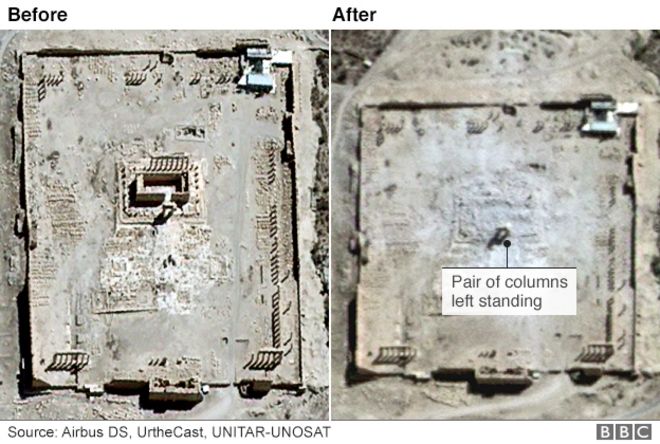
Opposite the triple arches and across the road had been the grandest of all Palmyran monuments, the Temple of Bel.  Since the secret camera couldn't photograph from that side of the bus, there are no new pictures of the devastated temple.  But we already know what happened to the Temple of Bel. 


The only surviving structure within the sanctuary is the archaeological dig-house (upper right). This had once been a village chief's dwelling, a handsome building surrounding a courtyard planted with date palms and terebinth trees. I lived there with the Dutch artist Bierenbroodspot many months at a time in the 1990s: from the terrace of the dig-house the ruins spread out in front, and its other side looked out over the remains of the green oasis.  Our last visit was in the winter of 1997 and it was remarkable for the two-tailed Hale-Bopp comet that hovered every night over the temple until the very last weeks of our stay. Sitting on the terrace, staring out at the utterly dark and silent temple, it was easy to think of portents, and how the cosmic indifference of Hale-Bopp would once have foretold the death of kings and the fall of empires. We could almost reach out and touch that ancient world, when every sign was meaningful.  I keep telling myself that the comet could not have foretold the coming of ISIS.

The Temple of Balshamin is gone.  The Arch of Triumph is gone. The tower tombs have been blown up.  Only rubble remains.
“The IS terrorists were looking for two tonnes of buried gold. When they didn’t find it they started executing people and destroying  Palmyra,” the son-in-law of Khaled al-Asaad told Expressen.
 I suppose what they could not understand was that Palmyra itself was the treasure.  And so they themselves destroyed the gold.
"I feel very sad. It makes me want to cry. There are no words."

Sources

All credit to the brave journalist, Kassem Hamadé, of the Swedish newspaper Espressen.  The story is filed under Hidden Camera Shows How IS Destroyed the Palmyra World Heritage

Note an old error crept into the text on the video: King Solomon did not found Tadmor.  That idea was based on a misreading of the place name "Tamar" in 1 Kings 9:18, conflating it with "Tadmor",  the Semitic name for Palmyra (both names meaning 'palm trees'). 

Illustrations

All stills from the video except that of the Temple of Bel which was published by BBCI

19 December 2015

Judith's Feast


The Scroll of Judith

You also, son of man, take a written scroll, feed your stomach and fill your belly with what I give you, and it will be as sweet as honey in your mouth.  

Thus begins the medieval Hebrew manuscript Megillat Yehudit (Scroll of Judith).*  Beneath the title, in smaller letters, is the instruction: "to be said on Hanukkah."

Okay, I know I'm a little late this year but I'll make it up in 2016. 

Anyway, the feast is real and the date is yours to choose.

In the apocryphal Book of Judith, the beautiful Judith leaves the besieged city of Bethulia intending to trick the invading general Holofernes.  In the Scroll, the city is Jerusalem and Holofernes is the enemy king.  In both versions, he lusts after her body: Come now, lie with me, my sister, for it is a great love I have for you, a love with all its rapture.

Judith takes food with her to tempt Holofernes: a jar of wine, a cruse of oil, barley groats, fig-cakes, white bread, and cheese. The cheese does the trick:  Judith feeds him pancakes with salty cheese; he gets thirsty and drinks too much wine (his heart was merry).  Drunk, he falls to the ground and sleeps.

Then she took the sword and went softly to him, for he was fast asleep. Then she held up her right and her left hand and she smote his head, she smote him and killed him and she cut off his head.

Dead drunk, you might say.  Still, she saved her city and, of course, her virtue, too. And that, they say, is the reason you eat cheese on Hanukkah -- which, I admit, does not make much sense to me.  

In the Scroll's entirely apocryphal story, Hanukkah becomes the feast of Judith:

Then Judith became queen over the land and judged Israel.  Because of this the children of Israel shall make a very great feast in their pots and cauldrons, with pieces of cheese, gladness and feasting, a good day, of sending portions to one another, baked pieces, food from the frying pan [pancakes] and dough kneaded until it is leavened so its glory will grow with honey, all manner of baked goods ... and the drinking was according to the law: none did compel, for thus the Queen Judith had appointed to all the officers of [this] house, that they should do according to every man's pleasure.

From the Scroll of Judith, written by Moses Shmeil Dascola (probably somewhere in the Provence), on the 30th day of the month of Silvan, 5162 [= 1402 CE].*

So, lifting a glass of sparkling wine (none did compel), I wish my readers Happy Feast Days and all the very best in 2016 CE!


*Translated with commentary by my namesake, Dr Susan Weingarten: 'Food, Sex, and Redemption in Megillat Yehudit (the "Scroll of Judith")', in The Sword of Judith: Judith Studies Across the Disciplines, Cambridge, 2010, 110-125.


Illustrations

Judith in pigmented plastic, plaster, paint, and steel armature with wheels, by the Polish artist Paweł Althamer. A plaster cast from the face of a living woman is formed into a mask, then embellished with extruded bandage-like polyethylene strips and fixed to a frame.

Photo credit for statue of Judith: Solomon R. Guggenheim Museum, New York Commissioned by Deutsche Bank AG in consultation with the Solomon R. Guggenheim Foundation for the Deutsche Guggenheim, Berlin.

Photo of the artist (left): Phaidon


Blog Archive