23 September 2012

BRAVO CARNIVALESQUE # 89

The 89th Carnival of Ancient and Medieval History Blogging.

Despite Zenobia's devotion to the women of the ancient world, I'm going to kick off this 89th Carnival by celebrating two male figures: two ancient Greeks to be exact, one quite luscious, the other just a wee bit odd. 


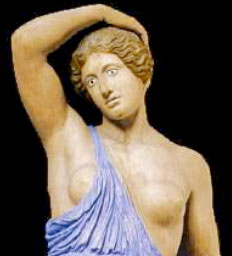
Oh to be in London now that the Motya Charioteer is there. 

This gorgeous marble sculpture (above) -- found on the tiny island of Motya off the west coast of Sicily -- was on loan to London for the length of the Olympic and Paralympic Games. 

Undoubtedly carved in Greece (Athens?) ca. 460 BCE, the young man is identified as a charioteer because he wears what is taken to be a 'regulation' charioteer's sleeveless chiton ... but -- dearie me -- I don't think his outfit looks designed for driving a 4-horse chariot at breakneck speed around eight miles of oval dirt track: not a chiton so see-through skin-tight, clinging to his bulges in so many homoerotic ripples (left). 

Having been muttering about this since I had the pleasure of viewing the guy and his gear up-close some years ago, I finally found someone who agrees with me.

David Lee writing at The Jackdaw: If this fellow is a charioteer, he can only be at the post-race press conference having slipped into something a little more comfortable, and flashy. 

Read his spot-on analysis (and pointed remarks on the chap’s superb buttocks) and drool over the in-your-face photos. 


Not done yet with drooling?  Reverse circumcision should calm you down.

Ancient History Boy's blog, He has a wife, you know, starts off a post on Greek medical practices with a survey of anaesthetics (largely opium), moves to saw-bones stuff and some astonishingly advanced prothetics (check out that sophisticated fake leg), before settling in for a good long natter about circumcision..

Now, Greeks (and Romans) weren’t fans of circumcision.  More to the point the Greeks weren’t keen on seeing the glans at the end of the male member -- that's the bulbous bit at the tip -- that can be covered by the foreskin on an uncircumcised penis.  To keep the glans concealed, athletes or simply those exercising naked in the public gym would use kynodesme (dog ties) -- small leather strips used to tie a knot at the end of the foreskin so it wouldn’t retract.

But what if you were a Syrian or Jew who had just arrived in Rome and wanted to conduct business in the baths, stripped to the buff as usual?  The way was open to reverse circumcision.  There were two options. Ancient History Boy tells you what they were... 

... and one might well need a dose of opium after that Full Monty.

High and mighty Amazons 
Speaking of regulated substances, how did saddle-sore Amazons relax and tend to their bodies after a hard day's galloping over the hot and dusty Scythian plains? 

According to Herodotus (whom you may or may not believe), Scythians didn't bathe very often: only in the spring, and only before getting toned up for a nice funeral.  But, then, they made up for lost time with mind-blowing steam-baths that made them "shout for joy".  Adrienne Mayor spills the beans on the blog Wonders & Marvels.  


Back on the straight and narrow, now for a dose of Biblical blogging.

Israeli scholars claim to have uncovered archaeological evidence of Samson.

Umm, no they didn't: and to their credit, they didn't claim any such thing -- but that didn't stop the media from headlining SAMSON AND THE LION.

Then went Samson down ... to the vineyards of Timnath and, behold, a young lion roared against him.  And the Spirit of the Lord came mightily upon him, and he rent him as he would have rent a kid....(Judges 14, 5-6)

With his bare hands, needless to say! 

What the archaeologists actually found was a small stone seal (left; measuring 1.5 cm [0.6"] across) at Tel Beit Shemesh, which depicts a large animal next to a small human figure. The seal has been dated to the 11th century BCE, i.e. the period of the legendary biblical judges - including Samson.  In Judges, Samson fights a lion. So, abracadabra, the seal 'proves' the biblical story.


The blogs PaleoJudaica and God And The Machine bring the media hype down to earth and it's worth looking at Samson chapter-and-verse through their expert eyes.  As for the seal, even if that crude quadruped is a lion (it has a curled tail), I wouldn't put money on that little man coming out on top. 

So, sad to say, there may never have been a Samson but, scarcely pausing for breath, the media circus moved on to the sensation of Jesus' wife.

"Jesus said to them, my wife...." 

A provocative scrap of papyrus from the 4th century makes a direct reference to Jesus having a wife, says Professor Karen L. King, a historian of early Christianity at Harvard Divinity School.

This tiny fragment, measuring 4 x 8 cm (1.5" x 3") may thus  cast new light on the history of early Christianity.  The text, written in Coptic (probably translated from a 2nd-century Greek text), contains a dialogue in which Jesus refers to "my wife," whom he identifies as Mary, and a woman who "will be able to be my disciple".

Naturally, what everyone wants to know is: was Dan Brown's thriller, the Da Vinci Code -- making Jesus and Mary Magdalene husband-and-wife -- true to life after all?  Not so fast!

Find out what the fragment does and does not say at some super learned blogs: 

(1) "A Coptic gospel that mentions Jesus' wife?" at PaleoJudaica -- and note that question mark! Is the fragment too good to be true?  Colour him sceptical. 

(2) "The Gospel of Jesus' Wife", reminding us of the Gnostic Gospel of Philip 59, which speaks about Jesus' relationship with his mother, his sister and his companion, all of whom were called Mary, over at NT Blog.

(3) a sharp analysis and slightly variant translation at The Forbidden Gospels.

(4) when a 'wife' is just a 'woman': what the Coptic word means by Craig Evans at Near Emmaus.

(5) and, wait for it ... Is it Real?: is the fragment genuine or (gasp!) a forgery? Follow the discussion in French and English on the Nag Hammadi Seminar Facebook page.

Stop Press: for the very latest take on the papyrus:  The Gospel of Jesus' Wife: The Story is Moving Fast!

And the Carnival is moving fast too, but, before leaving Roman times behind, I can't resist Raising the roof (and not the dead) at Herculaneum.

The extravagant decorations of the House of the Telephus Relief made it one of Herculaneum's most prestigious houses and a superb beach-side property (with cold and hot tub amenities and all mod cons) --  and spectacular views across the Bay of Naples. The roof went flying off in 79 CE, carried away by the force of the eruption of Vesuvius, and it settled on the beach below in 250 or so pieces.  Now, the multicoloured and gilded wooden ceiling has been reassembled and restored to something like its former glory.  Have a look at the grandiose results at World Archaeology.


Giant Roman Milk Pot

This pot would not even have got storage room in the elegant House of the Telephus Relief but, dirt common though it was, its Romano-British owner thought it well worth repairing when the darn thing broke.  They stapled the cracks together with horizontal lead strips laid outside and inside the pot.  And went on using it, perhaps for centuries: pre-break, it tested for containing milk, post-break probably for grain.  The History Blog has all the news of this seriously big great British pot 24" tall and 18" wide (61 x 46 cm).


A little pot of Gladiator Sweat instead? 

In the steamy hot room of the Roman baths, a slave scrapes the sweat, oil and dirt from a muscular gladiator's skin. The slave uses a strigil, a curved metal tool that performs the same task as the modern loofah.

But the strigil (left) is designed to collect the gladiator's gluey mixture of sweat and oil called gloios (γλοίος) in Greek and strigmentum in Latin. Why? Because ‘gladiator sweat’ was worth a lot of money.

Caroline Lawrence explains why it was worth its weight in gold in 'Love Potion Number IX' at  Wonders & Marvels.


Save this date: 19 August 14 CE

Science currently holds that time travel is impossible so I'm afraid you may have to miss that date.  Make do, instead, with its bimillennium celebration in 2014 -- 2000 years to the day after Augustus, first emperor of Rome, kicked the bucket.

We do love to celebrate round dates even though the  roundness of 60, 100, 200 years, whatever, is completely arbitrary.  Somehow, the apparent similarity between two dates separated by a perfect round number -- like 2000 -- has a strong psychological effect. 

Prepare to be psyched.

The way in which such an anniversary is commemorated speaks volumes about the interests, priorities, social structures and political relations in the society which celebrates it.  Mussolini went hog-wild with the bimillennium of Augustus’ birth on 23rd September 1938.  What a great chance for Il duce to signal the perfect parallels between himself and Augustus!  The event was celebrated on a grand scale, including a monster 'Mostra' (that is, exhibition: whence the poster, left) and the reconstruction of the Ara Pacis in Rome. 

Penelope Goodman tells us all about Mussolini's big-time party on her blog, Weavings and Unpickings, and now of her plans for a conference around the bimillennium of his death. A modern obituary, in fact.  I wonder what that will tell about ourselves, and our contemporary society.

Speaking of contemporary concerns and the alarms of our age, how about a a little murder and mayhem? 

Hostage-taking, anyone?

When we think of hostages we tend to think of men with pistols using some innocent as a human shield.  In a grislier mood, we might picture terrorists slitting a hostage's throat from ear to ear when they don't get what they want.  But in the ancient and medieval world hostage-taking was formalised and certainly not criminal. Conquered territories would give up their under-age princes who would be conveyed to an enemy capital or castle, there to be brought up in the winner's ways. A son of a Persian Emperor or a British tribal chief might, for example, find himself in Rome being educated among senator’s sons.  The idea was that, when he went home, he'd be a subservient bridge between top dog and underdog.

It didn't always work like that, especially not in the Middle Ages.  Sometimes, an errant dad got his son's head back instead.  Beachcombing tells us about the ups and downs of Hostage Taking in Ancient and Medieval Times

Now that we've entered the Dark Ages, we search for little beacons of light, such as Chris Cevasco (Author)'s blog which flashes red on 'Lady Godiva - the Naked Truth'.
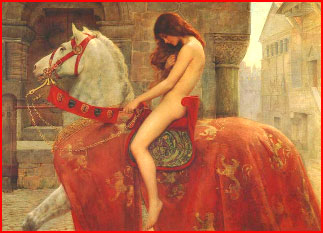
Mention Lady Godiva and, Chris tells us, the first thing most people think of is the line of chocolates bearing her name. 

Tchah!  Surely, Chris, readers of Zenobia recall higher things than confectionary -- something, for example, about her riding naked on the back of a horse.  Exactly as sprang to the mind, too, of the Pre-Raphaelite artist, John Collier (left). 

But who was Godiva, and why do we remember her at all?  

In truth, very little is known about her.  A mid-11th-century Anglo-Saxon countess, wealthy and pious, whose granddaughter Ealdgyth was Harold Godwineson’s queen when Harold fell at Hastings in 1066.  Godiva lived through the arrival of the Normans, dying less than a year after William the Conqueror took Harold’s throne.

So far, so goodly.

But hardly a reason to baptise any chocolates.  No, it took a cloistered monk to make her famous. The earliest account of her legendary naked ride appeared in Flores Historiarum (Flowers of History; 1326?), written by a monk of St. Albans Abbey.  Read what he had to say, and the later embellishments at Chris' blog

About the time that Godiva was allegedly mounting her horse, anyway in 1042, Edward the Confessor ascended to the throne of England, ending nearly three decades of rule by conquering Danish kings.

1066 and All That

Edward was the last Anglo-Saxon king (genuflect, please, before his image; left).  The great-great-great-great grandson of Alfred the Great, he died childless, leaving England open to conquest from overseas. 

To put it mildly, Edward had a turbulent childhood (well, who wouldn't if your father was Aethelred the Unready, the hapless king besieged by Vikings on all coasts and  Danish kinglets anywhere left undefended?).  When Edward was about ten, his father was deposed and the whole family went into exile under the protection of Edward’s uncle in Normandy. 

The snakes and ladders that followed were worthy of a French farce had the consequences not been so bloody serious.  When, for a brief time, there were more ups than downs, Edward was crowned King of England (April 3, 1042).  That didn't stop invasions, usurpations, and power struggles for a minute.  In 1051, it’s possible that young William, Duke of Normandy visited England and Edward may have promised him the throne at this time....

The whole nine yards at 'Edward the Confessor, King of England' on The Freelance History Writer blog.

Who would have imagined that Edward's promise was to cost Godiva's granddaughter (and her husband) the throne?  Edward didn't become a chocolate but, next best thing, he was canonized as a saint and confessor in 1161.

After the conquest, what did it mean when a writer used French or English?

As time went on, being English was increasingly being defined against being French, but records of government and law long remained multilingual.

The Bavardess blog considers the changes taking place in the 'public sphere' in England in Interpreting Medieval Sources: Orality, Aurality, and Textuality

That may sound daunting but it simply means that texts initially created as written documents also circulated orally whereupon they were read out and listened to in public.  So, it could happen that a French text was proclaimed in English, and then it might go through yet another round of translation and circulation as, for example, being copied into Latin chronicles. 

In those dark days, documents were rarely drawn up in English.  But such  happened in 1405 when some northern nobles agitated for good governance (a 'Northern Spring'?), drafting a set of articles demanding that King Henry IV take steps to reform the system.  The monastic chronicler Thomas Walsingham recorded their complaints, ending with this declaration:
These were the articles that were written in English, whose sense I have translated almost word for word, and have inserted them here as they were expressed, without any bias. [In other words, he has translated them from English into Latin] This seemed necessary to me because of the plainness and inelegance of the language.... 
England was still multilingual at the time although there were a growing number of literary works being written in English (Chaucer, Gower, and, most dangerous of all, Wycliffe's Bible).  Elegant or not, here we came!  

Chaucer was praised as "The first finder of our fair language." And this below may be its terminator:

“Wield the Skillet, Forge the Family Dinner,”

A recent ad campaign for Velveeta stars a manly, quasi-medieval blacksmith, chanting, There’s no more medieval prepared cheese product than Velveeta. That’s the message of Velveeta Shells and Cheesy's Eat Liquid Gold TV ads. When not smiting noodles, perhaps the blacksmith will find time to hammer Velveeta (or its curdler-in-chief, Kraft) who completely misunderstood the metaphor.

Jeff Sypeck at the blog Quid Plura tells what the admen got wrong.
Medieval people associated the consumption of liquid metal with horrific punishments and unbearable pain. In the 12th-century Anglo-Norman Voyage of St. Brendan, the saint discovers Judas on an island, where his unceasing torments include being forced to drink molten lead and copper....
Which doesn't taste nearly as nice as it sounds. Not convinced?  Try this real medieval text:
and one broʒt myche gold and syluer, and þat was molten and casten in hyr þrote, and þat ran out of hyr stomake. And he seide, “Take þe þis for þ[i] cursed and wikked coueitise…”*
Believe me, Velveeta, you won't like it.  And I wouldn't wish it even on a cheese dip.


Here endeth the 89th History Carnivaleque.  My thanks to all who sent me leads: we had a bumper crop of nominations this season.


"One brought much gold and silver, and that was melted and poured down her throat and that ran out of her stomach. And he said, "Take thee this for thy cursed and wicked covetousness."

Illustrations

All images are from the blogs highlighted with the exception of the papyrus fragment (Jesus' Wife) which comes from the Harvard Divinity School webpage.
.
.
.

03 September 2012

History Carnival Coming Up

Blogging Ancient/Medieval History

Kicking off the new blogging season!

The next ancient/medieval edition of Carnivalesque -- the monthly showcase for top history blogging -- will appear right here at Zenobia: Empress of the East on Sunday, 23rd September.

So please get inspired and send me links to the best ancient- and medieval-history blogging of the summer  season -- all of the fine, insightful, or just plain provoking posts that struck you while basking in Global Warming; or what you're reading right now, while prepping for the new school year.

Feel free [and especially!] to nominate your own writings as well.

You can email me directly at judith@judithweingarten.com or use the ancient/medieval nomination form.

If you're not familiar with history carnivals, hop over to the Carnivalesque Home Page where you'll find up-to-the-minute news on the ancient, medieval, and early modern history carnivals. The current Carnivalesque is up at The Georgian Bawdyhouse, casting a wicked light on all that's dearest to an 18th century slut's heart: foul crime, lewdness and disorder.  What took my fancy was the world's first comic strip -- a young scholar tempted into debauchery by Satan himself -- plus how to whiten your teeth with sulphuric acid and cuttlebone powder.  Plenty, in short, for a bawd to chew on.

Undoubtedly Zenobia, too, shall cover a gamut of  groovy activities -- all that  takes Zenobia's fancy -- for the ancient and medieval worlds.  

So, kindly get cracking and send me your nominations. 


Photo: Maracatu carnival dancers.  Photobucket image by Rodgj 
.
.


27 July 2012

First Minoan Olympic Race

"I hereby proclaim the opening of the Minoan Olympic Games at Knossos."


Or words to that effect, as spoken by King Minos ca 1500 B.C.E.

The 'Runner's Ring' from Kato Syme, Crete (Late Minoan I) shows a nude man running in double-float (both feet off the ground) above a stone pavement.  On the left is a priestess or goddess dressed in a flounced skirt; a priest wearing a ceremonial hide skirt awaits the victor on the right.  The priest holds out what looks like a set of stylized bull's horns (?) which I imagine to be the runner's prize.

In the beginning, the ancient Olympics had only a single footrace, one stade in length, a sprint down the length of the stadium (approx. 192 meters long).  With the discovery of the Minoan Runner's Ring, it is conceivable that the glory won by these first Olympic victors had its origin in far earlier times.*

For the rest of his life the victor enjoys a honey-sweet calm, Pindar writes.  And adds wisely, so much as games can provide it. (Ol. I 97-100)


* An ancestral sport?  The term dromeus, 'runner,' was applied to Cretan adult males when they came of age, which implies that footracing played an important part in every citizen's social and education tradition at least in the archaic period (Willetts, Ancient Crete, 115-16, 118, 121-22).  A possible mythological forerunner of the Cretan 'runner' might be Talos, the giant man of bronze, who ran around the island three times daily (Apollon 4.1638ff)).

Ring dimensions: D. bezel 1.8 x 0.9 cm; D hoop 1.25; Wt 2.07 gr

Illustration credit (NB: I have photographically reversed the image in order to illustrate the direction of action as would be seen on the ring's impression).  The ring was excavated at the Minoan rural sanctuary of Kato Syme on the southern slopes of Mt Dikte in central Crete.  The excavators identify the ring as the personal dedication of a victor in a footrace:


Photograph via Ioannis Georganas's blog, Mediterranean Archaeology, 26 April 2006.
.
.
.

22 July 2012

Lost in the Dust of the Marathon

Olympic history with a twist of lemon.

The first Olympic Games of the modern era -- as you've probably heard again and again as the PR machine shifts into overdrive for London 2012 -- took place in Athens in April 1896 with the participation of 245 athletes from 14 western nations.*  What was then a shiny new International Olympic Committee (IOC) decided to include a marathon event in the games in honour of ancient Greece's greatest military moment -- its victory over the Persian invaders in 490 BCE.

νικωμεν’ (We've won!)

The Olympic marathon was inspired by the improbable feat of Philippides, the dispatch-runner who carried news of the Greek victory from the battlefield near Marathon to Athens over 37-38 km (23 miles) of rocky mountainous terrain. "Joy to you, we've won!" he gasped as he reached the city gates, and died then and there, his last word being a sighing "Joy"; and off he went, a hero, to the Elysian Fields.

On April 10 (March 29 according to the  calendar then used in Greece), thirteen Greek and four foreign runners set out from Marathon to match this legendary run.  Only nine of the seventeen men completed the distance, the others  collapsed one after another along the brutal course.  The winner was a Greek named Spiridon Loues, a poor water-carrier by trade, whose commanding officer in military service had convinced him to join the race.  Thousands of rapturous spectators watched him cross the finish line:
 When Loues finally arrived in a stadium erupting with joy, two Greek princes – Crown Prince Constantine and Prince George – rushed to meet him and accompanied him on his final lap for a finishing time of 2:58:50, fuelled along the way by wine, milk, beer, an Easter egg, and some orange juice.
When Life Gives You Lemons instead... 

The first modern Olympics, needless to say, did not have any women athletes.  The founder of the IOC, Baron Pierre de Coubertin, always said that a "female Olympiad would be impractical, uninteresting, unaesthetic and incorrect." In this, he received the full support of Pope Pius XI, who seriously condemned the playing of sport by women.**  Quite right too.  A woman’s natural sporting achievement was to encourage her sons to be distinguished in sports and to applaud a man’s effort. So, the lovely lady holding the victor's wreath in the Olympic poster (top left) was meant to be the limit of female activity at the Games.

In spite of Coubertin’s efforts to keep out the gentler sex, an unofficial female competitor ran in the 1896 marathon, a poor Greek woman who became known as ‘Melpomene’, the Muse of Tragedy, whose real name was Stamati Revithi.

The supplement Les Jeux Olympiques of the Messager d’Athenes between 8 February and 18 April 1896 contained many references to the preparations and to the Olympic Games themselves. On 14 March under the heading, "A woman in the Marathon," it reads:
There was talk of a woman who had enrolled as a participant in the Marathon race. In the test run which she completed on her own on Thursday, she took 4½ hours to run the distance of 42 kilometres which separates Marathon from Athens. She stopped for about ten minutes half-way only to suck a few oranges. She is a woman of the people with marked features, of a tough and lively temperament. 
 She was not allowed to compete in the men’s race (registration was closed, they said), but would run by herself the next day. 

The Estia newspaper of Saturday, 23 March 1896, also refers to "the runner Mrs Revithi, the strange woman. who, having run a few days ago in the Marathon as a try-out intends to compete the day after tomorrow. Today she came to our offices and said ‘Should my shoes hinder me, I will remove them on the way and continue barefoot.'"  

Revithi arrived at the the small village of Marathon on Thursday, 9 April [28 March], where the athletes had already assembled for the following day's race. She attracted the attention of the reporters and was warmly greeted by Marathon's mayor, who sheltered her in his house. She answered the reporters' questions and was quick-witted when a male runner teased her, predicting that when she entered the Stadium, there would be no crowds left.  Revithi retorted that he should not insult women, since male Greek athletes had already been humiliated by the Americans.  In fact, Americans had won gold medals in nine of the twelve athletics events during the previous days.

On the morning of Friday, 29 March 1896, Stamata Revithi asked the old priest of Marathon to read a prayer for her so that she would quickly reach the Stadium.  The priest replied that he would be saying a prayer in the Church of Saint John, but only for the 'official athletes'.  The organizing committee backed him up, having refused her permission to enter the race and thus, presumably, not having a prayer. 

Nonetheless, on Saturday, 30 March 1896 at 8:00 a.m., Stamata Revithi was ready to run the marathon alone. Before setting off, she recorded the time at which she started and this document was signed by the school master, the mayor and the magistrate of Marathon. When the starter's gun sounded, she began to run along the side of the course.  Eventually she fell behind the men, but as she continued on, she passed runners who dropped out of the race in exhaustion. Having run the entire route at a brisk pace she arrived at the stadium, perspiring and covered in dust, about an hour and a half after Spiridon Loues won the race. Barred from entry into the now empty stadium, she ran her final lap around the outside of the building, finishing in either 4½ or 5½ hours (reports differ).

After her marathon run, athletics officials could not remember her name so they labeled her ‘Melpomene’, who is the Greek muse of Tragedy.  Looking at Stamata Revithi, they could see only tragedy, not her extraordinary feat.  She had finished approximately two hours after the winner and had beaten some of her male competitors.

There is no account of Revithi's life following the marathon.  The poor woman who hoped to get some fame or money from her run disappeared entirely.  She was truly "lost in the dust of history."

Elysium

The French athlete, Marie-Louise Ledru is credited with being the first woman to race the modern marathon distance of 42.195 km (25 miles): on September 29, 1918, Ledru reportedly completed the Tour de Paris Marathon with a time of 5 hours and 40 minutes. Violet Piercy of the United Kingdom was the first woman to complete an official marathon: on 3 October 1926, she clocked a time of 3:40 hours in a British race.  Women were finally allowed to run the Olympic marathon at the 1984 Summer Games, when American Joan Benoit won the inaugural race in a time of 2:24.52 hours.***

The women's marathon at London 2012 begins at 11 AM on Sunday, 5 August.  If you're watching, spare a thought for Stamata Revithi. 

Did she ever really exist?  I don't know.  The stories and witnesses cited seem rather dodgy and contradictory.  But she should have had her run and I hope she did.


* This week, to give it epic scale, over 10,000 athletes from 205 countries will be competing at the London Olympics.

** Pius XI finds a like-minded contemporary in Sheikh Abdulrahman Al Shathri, Saudi cleric and author of Girls' Sports and Scouting in Schools and Universities (2010), who warns that athletics "orient women toward a masculine physique, as their pelvis shrinks into the size of a male pelvis and their shoulders broaden." Despite this evident danger, Saudi Arabia is fielding two female athletes at London 2012 who will run, fully wrapped up and veiled.  See 'Two Steps Forward...'

*** Paula Radcliffe of Great Britain holds the current women's world record for the marathon which she set during the 2003 London Marathon with a time of 2:15:25.

Sources include L.P. DaCosta, Olympic Studies: Current Intellectual Crossroads, Ch. 15;  'Stamata Revithi ran the marathon in 1896 Olympics' at the The pink elephant; Charlie Lovett, 'The Fight to Establish the Women's Race' at Marathan Guide.com; Athanasios Tarasouleas, 'The Female Spiridon Loues' Karl Lennartz, 'Two Women Ran the Marathon in 1896'; Stamata Revithi at Wikipedia; V.J.Matthews, 'The "Hemerodromoi": Ultra Long-Distance Running in Antiquity', CW 1974, 161-69, who notes that the modern marathon distance of 26 miles 385 yards was set at the 1908 Olympics in order to finish the race in front of the royal box; for no better reason, this is the distance that has become standard for the race.

Illustrations

Top left: Official poster of the Athens Olympics, 1896.

Upper left: Spiridon Loues entering the Panathinaiko Stadium at the end of the marathon. Photo via The pink elephant online magazine

Lower left: Entirely fanciful drawing of Stamata Revithi by Athanasios Tarasouleas at STAMATA REVITHI, ALIAS “MELPOMENI"

Lower left: Watch marathon 2012 Olympics. 
.
.
.

18 June 2012

Zenobia on the Big Screen

  Did you know that over 60 films have been made about the life and loves of Cleopatra -- and who will ever forget Elizabeth Taylor playing the role of the Egyptian queen, although that was filmed almost 50 years ago (1963)?

Fair enough, she was unforgettable, but what about Zenobia?  Where is she in the stardom stakes?

Lonely as a cloud, it seems.  The scorecard:  Cleopatra 60, Zenobia 1.

The Syrian queen has appeared just once on the big screen.  And that was long ago, too (1959).  Admit it, you not only don't remember the film but, in truth, you've never heard of it.  

Now, Dr Maria Teresa Grassi of the University of Milan and Director of the Italian-Syrian Archaeological Mission at Palmyra, comes to your rescue ....

In an article aptly titled 'Zenobia: the Missing Myth', she pulls the film out of total neglect, a revival, you might say, of The Sign of Rome ('Nel Segno di Roma'); it was an Italian-French-German co-production, one of the earliest shared Euro-disasters.*   According to her -- and to everyone else who even noticed -- The Sign of Rome was a terrible film, and of no historical value whatsoever.  Who cares? For Zenobia was played by the hugely buxom Anita Ekberg (just a year before her sensational role in Fellini's La Dolce Vita).

Here's Ekberg as Zenobia:


Pretty luscious, you have to agree.  And her mountainous mammaries are put to best effect in a series of low-cut gowns, which prompted one reviewer to remark: actually, her huge bosom should have gotten a billing of their own. Filled with romance and subterfuge (everyone seems to have a secret agenda) and -- did I mention it? -- a strong smell of sex, it's a 'sword and sandal' film that manages to find time for two bump and grind belly-dances by hot Cuban starlet Chelo Alonso (seen sizzling below) . 

Belly-dances?  Hey, that's Turkish, isn't it?

Besides those erotic Turkish belly-dances, as Dr Grassi points out, with what I hope sounds like a laugh, The Sign of Rome is a total mismash of Orientalism: pseudo-Egyptian (as in the scene above) rubs shoulders with borrowings from Mesopotamia, Persia, and even India, along with a bit -- if only a little bit -- of Palmyra.

So, thank heavens, I do have something serious to say about The Sign of Rome


In one scene at least, the jewellery is spot-on.  According to Dr Grassi's report card, somebody did their homework. Ekberg (above) wears a gold diadem with two locks of hair combed up on either side.  Compare the lovely female figurine now in the Hermitage Museum (late-second, early third century CE; below left). And check out the star's gold hanging earrings: they look very much like those worn by Aththaia, daughter of Malchos (third century CE; below right) whose bust is in the Boston Museum of Fine Arts.


For the rest, we have villains: Semantio, a double-dealer plotting with the Persian king to sell out Zenobia -- and he looks the wicked part as he leers and all but curls his mustache.  Needless to say, we also have heroes: Marco Valerio, a handsome Roman consul; and, yes, Zenobia does fall in love with him; and, yes, she will marry him in the end and live happily ever after.

But, really, what it's all about is best summed by a picture, which isn't worth nearly a thousand words.


I bet you knew this would happen in the end.

But I promised you an erotic belly-dance, didn't I?  Here's Chelo Alonso wearing a frothy confection and in eye-opening competition with Anita Ekberg for the most enormous chest. 


Sorry, that's all for today.  I'm off to Crete later this morning ... and some real work, I suppose.  

Have a great summer.  I'll see you again in August.


Directed by Guido Brignone. Assistant directors Michele Lupo and Riccardo Freda. Sergio Leone is one of the script writers. The score is by noted composer Angelo Francesco Lavagnino.

Sources for this post: M. T. Grassi, 'Zenobia, 'un mito assente', in LANX 7 (2010) 299-314.  Brian Bankston, reviewing 'The Sign of Rome' on his blog, AliveNotDead, 16 September 2011.

Illustrations 

All from Brian Bankston's review with the exception of close-up of Anita Ekberg (second down, centre) which is from Dr Grassi's article and Aththaia, daughter of Malchos from the Boston Museum of Fine Arts.
.
.
.

02 June 2012

Rare new head of Nefertiti (Four Updates)

Tiny but choice!

Just breaking news: a new head of  Nefertiti has been identified (left).

This, we now must acknowledge, is a head of the famous Queen Nefertiti, wife of the pharaoh Akhenaten (1353-1336 BCE). After some serious detective work, Dr Christian E. Loeben, Egyptologist at the August Kestner Museum in Hanover, Germany, has established its true and fascinating identity. It had been thought, wrongly as it now turns out, that this fragment of a face depicted the unisex pharaoh himself.

Dr Loeben has been able to demonstrate convincingly that it is in fact the illustrious queen, whose most famous portrait is the polychrome bust kept in the Berlin Museum (below left).

It measures barely 5.5 cm (2.2") in height, but the red-brown quartzite* head is a tiny masterpiece of Egyptian art.

"Until now, no Egyptologist had noticed that at the time of Pharaoh Akhenaten, only women's portraits were done in quartzite. Nefertiti is the only possible option for this remarkably fine miniature portrait," says Loeben.

"This is a truly sensational discovery," chimes in Dr Christian Bayer,  Egyptologist at the University of Munster and specialist in Nefertiti: "It is very exciting to be able to add this extraordinary piece to the relatively limited collection of statues of Nefertiti."

The fact that this discovery has taken place this year is all the more remarkable given that it is exactly one hundred years since the German archaeologist Ludwig Borchardt found the world-famous bust of Nefertiti (left) in 1912, during his excavations at Tell el-Amarna, the new capital city founded by Akhenaten: 

Suddenly we had the most alive Egyptian artwork in our hands, Ludwig Borchardt wrote in his diary for 1912. You cannot describe it with words. You can only see it.

That "most beautiful woman in the world" now reigns over the Neues Museum in Berlin, enthroned alone in a domed room that overlooks the length of the Museum (see Zenobia's low-down on her contentious discovery and possessive tug-of-war between Germany and Egypt in Two-Timing Nefertiti II). 

The small quartzite head, on the contrary, is secluded in a private collection in Europe and is therefore not normally accessible to the public.

Queen Bee at BAAF

For the 10th jubilee edition of the Brussels Ancient Art Fair (BAAF), the organizers have arranged a large Egyptian art exhibition, entitled Ancient Egypt: Masterpieces from Collectors and Collections (June 6th to 10th). For the first time, the visitors will have the possibility to see mostly unknown Egyptian pieces, a majority of them coming from private collections. 

The new Nefertiti will undoubtedly be the Queen Bee among those 120 exhibits.  Dr Loeben describes his research in the limited-edition catalogue which will be sold during the BAAF exhibition (a snip at € 49).  It's worth more than a peek as, after 10 June, the head returns to its private quarters ... and who knows when it will be seen again.


I am most grateful to Dr Stephanie Budin for the first report of this new identification on Pandora's blog (Pandorastudies@yahoogroups.com).  There will surely be many updates.

* Quartzite is a hard (7 Mohs) metamorphic rock of nearly pure silica, coloured by a small amount of iron oxide.


Updated 4 June 2012

Well, I did say there would be many updates, but I hadn't reckoned on their coming so thick and fast.   

First, a new argument for the identification of the head as Nefertiti's:

SwissInfo.CH reports that details around the ear indicate that the head was wearing a certain crown, which would suggest it was the queen, and not Akhenaten (Details am Ohr wiesen darauf hin, dass die Figur eine bestimmte Krone trage und es sich um Nofretete handeln müsse.)

But, now, the opposition is massing as well.

An Egyptologist on the EEF-list  argues that the piece is a shabtis or funerary figurine and thus should not be judged by the rules for statuary.  Prof. Anneke Bart of St. Louis University points to three quartzite shabtis in the Metropolitan Museum of Art depicting Akhenaten and remarks that "the argument that it has to be the queen because it is made of quarzite is not really valid." And, for good measure, citing a shabti of the king in this collection: "With the size of the head being 5.5 cm, it is identical to the size of this head of a shabti."   

And, further, Lise Manniche (Copenhagen) notes "the prominent feature of what has been termed 'sfumato eyes', a detail that seems to be characteristic of, and perhaps even unique for, shabti figures of Akhenaten."

I wouldn't call it "Game, set, and match" but the argument is certainly heating up. 


Updated again 6 June 2012

Back to the EEF-list where a number of Egyptologists have plunged into the debate.  There are a few new arguments.

Does a shabti of Akhenaten always wear a beard?  If it does, this head must be female; if not, it still could be Akhenaten.  Right?

Martin Wolff (from France) says: "...all the known specimens for this pharaoh wear a beard and usually have no neck." 

But, rebuts Anneke Bart (see above), "There are however plenty of examples of [shabtis] of men without a beard." And she cites examples dating to before and after Akhenaten of kings without a beard.

So the question of whether or not shabtis of Akhenaten himself could be beardless is still open. 

The stone 

Maria Sansalone (Egittophilia Forum Admin) points to a large use of quartzite in the Amarna period, citing Relief n° 171, showing Akhenaten offering to the Aten, from the  Great Temple -- Copenhagen, Carlsberg Glyptotek (AEIN 1718) (http://www.flickr.com/photos/10647023@N04/3901689668/ 

The choice of red-brown quartzite, she suggests, alludes to the colour of the Sun.

It should be said, however, that Christian Loeben said that almost 100% of quartzite portraits were of women, which leaves some wiggle room for the head to be, exceptionally, of a male ruler.

The crown

Ah, the crown.  This, as Lutz Franke (from Germany) stresses, depends on whether or not the details above the ear of the head refer to the specific Blue Crown of Queen Nefertiti.  That's what she's wearing as the "most beautiful woman in the world" portrait in Berlin Museum.  

The argument may well hinge on such traces of her crown -- but that's not something we can determine from the published photograph (top left).  There's clearly tabs and things above the ear ... but what?. 

So, Nefertiti ... or not?  We'll probably have to wait until Christian Loeben comes out with his full case for identifying this head as a portrait of the queen.


A third update on 8 June 2012

Martin Wolff, who is quoted above on Akhenaten's beard, returns to the EEF-list to report on his re-examining many of the known shabtis of the pharaoh.  Yes!  There is one example that is -- and always was -- beardless: It's a shabti head in the Brooklyn Museum (left).  It's made of grey quartzite or, more likely (to my eyes, at least) of sandstone and its dimensions are very close to those of our rare new head. 

Eureka!  Or not?

Does one shabti make a summer?

But now Christian Loeben speaks for himself (his text and photographs are in the Ancient Egypt catalogue [link via Martin Wolff]), so you can read Dr Loeben's full case for the prosecution.  He discusses the stone and the crown but the crux of the matter is in the ear:

I've made the ear-plug clearer by circling in red
The clearest indication that the facial fragment exhibited here originated from a statuette featuring Queen Nefertiti comes from close examination of the left ear. The entirely preserved lower part of the ear (if indeed this is meant to be the earlobe) is disproportionately large. This is likely to be the circular disk of a mushroom-shaped ear-plug often displayed on such statuettes, as shown on both of Nefertiti's ears on a famous limestone exhibit (Berlin 21263 ). 

So, if Egyptologists agree that Akhenaten was never represented with ear-plugs, then it's more than likely that Dr Loeben is right in identifying the subject of the statuette as Queen Nefertiti. 

But will the Egyptologists agree? Stay tuned for more updates as they get their teeth in Christian Loeben's text.  I wouldn't bet good money yet on 'Game, set and match'. 


A fourth update on 12 June 2012

A consensus seemed to be forming, but it's not what you think!

Ear-plugs (or earrings)

Will it all come down to the ear-plugs --  and not the crown, as I previously thought?

There's general agreement that wearing ear-plugs or earrings in this period does point to a female.  Have a look at this plaster head (left), another artist's model from the same sculptor's workshop in Amarna as the Berlin Museum's Nefertiti ('most beautiful woman in the world').  It's thought to be a study of Kiya, a secondary wife to the pharaoh Akhenaten.  She, too, wears prominent ear-plugs or earrings.   And so do other models of the royal ladies.

Which is pretty good evidence, one would think, that the quartzite head does at least represent a royal Amarna female, even if not necessarily Nefertiti.  It could as well be Tiye, Meritaten, or any other female member of the family.  On the basis of this feature alone, it really can't be assigned to any particular individual lady.

But at least it's firmly female.  That's the consensus.

Or so I thought.

And lo and behold, Philip Arrhidaeus (of Flanders) has snatched away this simple certainty.  There's been a long discussion of the new head, too, on the Egypte forum Pr Kmt (in Dutch). 

The starting point is that Akhenaten was often depicted with pierced ears.

As Martin Wolff (on the EEF-list) had asked quite reasonably: "Why would Akhenaten have pierced ears if not to wear earrings?  The fact that to date we have never found a statue of him with earrings does not mean it never existed." 

In Ancient Egypt, indeed, never say 'never'.

Philip Arrhidaeus showed this relief on the Egypte forum (left).  The pharaoh is wearing an earring.  He also pointed to a drawing on an ostracon that was found at Amarna: the king is again depicted with an earring.

Neither image is of a statue, it is true.  So we haven't come full circle with our identification of the quartzite head.

Not yet.


Illustrations

Upper left:  photograph from the EEF BBS website (submitted by Raymond Betz).  Photo credit: Alain Speltdoorn.

Below left: Welt Online.

Illustrations added in third update

Above: Statue Head of Amenophis IV. Quartzite or sandstone, 2 3/16 x 2 1/16 in. (5.5 x 5.3 cm). Brooklyn Museum, Charles Edwin Wilbour Fund, 37.514. Creative Commons-BY-NC.

Below:
Face of Queen NefertitiAncient Egypt, Masterpieces from Collections and Collectors.


Illustrations added in fourth update


Above: plaster face from the Amarna workshop of the sculptor Thutmose.  Photo credit: Keith Schengili-Roberts (via Wikipedia).

Below: relief of Pharaoh Akhenaten, Royal Museum of Scotland, Edinburgh.

.
.


26 May 2012

Zenobia Drives Along the Appian Way


The Appian Way: Ghost Road, Queen of Roads


My review of The Appian Way: Ghost Road, Queen of Roads appeared this week in the Times Higher Education
 
Here's what I wrote:


24 May 2012

This delightful, literally lightweight book takes you on a brief journey from Brindisi in the heel of Italy's boot to Rome; but what an engaging journey! Robert Kaster and his wife travelled the length of the Appian Way, the first great Roman road, known far and wide in its time as regina viarum, "the Queen of Roads". Eventually, the Romans went road-wild and built a 75,000-mile network criss-crossing the Empire: compare the US' measly 46,000 miles of interstate highway.  That's the kind of nugget that Kaster, professor of Classics and Latin at Princeton University, uncovers at every stop along the Way. This little book fully punches above its weight.

The Via Appia was begun in 312BC by Appius Claudius Caecus, whose name still adorns it. He also happens to be "the first Roman we can fairly claim to know as an authentic historical person", says Kaster. His family was Sabine (as in "the rape of the Sabine women") and given land in Rome, where the Claudii clan flourished ever after: the Emperor Tiberius was a direct descendant. As censor, Appius excelled in firsts, building Rome's first aqueduct (the Aqua Appia) as well as the Via Appia. When completed, the Appia covered 353 miles, crossing marshes and half a dozen rivers, up and down hills and the sometimes precipitous Apennine Mountains -- all, of course, dug by hand, presumably the work of slaves and criminals. Kaster's back-of-the-envelope calculation tots up their shifting 180 million cu ft of earth and stone; and, yes, this does dwarf the 91,600,000 cu ft moved for the Great Pyramid at Giza.

A journey from one end of the Appia to the other would have taken two weeks on muleback. In contrast, the wheels of a rental Fiat took the Kasters to Rome in five leisurely days. Alas, truth to tell, with the exception of a mile-and-a-half stretch in the remote Monti Aurunci park, the original paved road is nowhere to be seen: you know that the road itself must have been some 100 yards to your left or right, but it is usually hard to establish where exactly. For most of the way, you're more or less on the real track, which probably lies 6ft under the modern road. What truly seizes the imagination, however, are the layers of time visible above the ground, all the monuments of conquering peoples who left their mark on Southern Italy - Byzantines, Normans, Swabians, Angevins, Aragonese - as one era rubs up against another. On the Appia, to give just one example, you can leave Taranto on the coast (founded by Sparta in the 8th century BC) in the morning, pass Castellaneta (birthplace of Rudolph Valentino), and arrive that afternoon at ancient Venosa, where the poet Horace was born in 65BC. The ruins of his Roman town and later Jewish catacombs are overlooked by a Romanesque church - with two 11th-century tombs of Norman dukes - built from the stones of the amphitheatre on the site of an earlier church that had itself been built over a Roman temple. The upper town is dominated by the massive bastions and towers of a 15th-century castle built by the Roman Orsini family. Nearby, a Counter-Reformation Purgatory church, decorated with skeletons and death's heads, warns you Memento mori (correctly translated: "Remember that you are dying!").

This kind of history throws off sparks. You put down The Appian Way and think of taking out your bike. A friend of mine rode it in four days. I asked him if the mountains were difficult to climb, and he replied: "No, hardly. After the Alps, the Apennines were comparatively easy." I might rent a Fiat instead.


The Appian Way: Ghost Road, Queen of Roads
By Robert A. Kaster
University of Chicago Press 124pp, £14.50
ISBN 9780226425719
Published 8 May 2012
.
.
.


07 May 2012

Roman Women Invented Microcredit


Or something very much like that.

Of course, Roman woman could not become bankers or money-lenders: they were officially banned from such professions.  (Callistratus, Dig. 2.13.12).  That restriction was merely icing on the cake of their general legal disabilities: 'on account of their lightness of the mind,’ as the second century jurist Gaius put it, Roman woman could not deal with financial activities independently at all.  Just like children, their male guardians - most commonly either their father or husband - would act on their behalf.  Although women could own property, they required their guardian’s consent if they wished to dispose of it.  

So, in theory, they couldn't buy or sell anything of any significance on their own.  They could neither undertake financial obligations nor release others from such obligations.

But now we know they did.

Some women in ancient Rome seem to have developed the concept of microcredit, that is, a loan of small amounts of money that allows people without independent resources to borrow money for business purposes.  A new study conducted by Carmen Lázaro, professor of Roman Law at the Universitat Jaume I, Valencia (Spain), shows that women managed to get around the legal rules that excluded them from activities related to banking and money-lending.  They created credit contracts for small amounts of money made by and for women and guaranteed repayment by accepting pledges of personal property as collateral.*

And, if the female creditors weren't paid back on time, you may be sure they demanded their pound of flesh; sometimes literally:

Two wax tablets found together with some silver vessels near the Palaestra Baths at Pompeii relate to a business deal between two women dating to 61 CE. A freedwoman, Poppaea Note, had borrowed money -- 1,450 sestertii (small brass coins) -- from the well-off woman Dicidia Margaris. As security she temporarily transferred ownership of two of her own male slaves to her creditor: 
Poppaea Note, freedwoman of Priscus, has sworn that the slaves Simplex and Petrinus, or by whatever names they are known, are hers and that she owns them and that these slaves are not pledged to anyone, nor does she share them with anyone else…
If Poppaea doesn't repay the loan by the next year, Dicidia Margaris has the right to sell Simplex and Petrinus at the slave auction held "at the Forum in Pompeii in broad daylight" and collect the debt that way.  As simple as that! 

The existence of this microcredit system has been winkled out from various written sources.  Inscriptions found in the Granio House at Pompeii, for example, reflect such financial transactions made between women.  A tough old bird named Faustilla was a money-lender and a kind of pawnbroker.  Three graffiti record sums that some female clients borrowed from her -- typically between 15 and 20 denarii (silver coins, each worth 4 sestertii) -- and the whopping interest rate they paid in return: from 3% per month and up to 45% annually.  Worse than credit cards!  Faustilla and other female money-lenders took personal items, such as jewellery or cloths or coats, as collateral.

Since money and jewellery were freely exchangeable, as Prof. Lázaro points out, these loans avoided the need to be approved by the guardians and therefore were not subject to legal formalities.  The capital of the money-lender would only generate obligations to the borrower so that the lender, too, could also avoid the legal intervention of her own guardian.  

As Carmen Lázaro says, it is "a business model that has the characteristics of what we know today as microcredit and allowed women to enjoy some freedom of action and avoid the prohibition in the rule of law."

The Sulpicii Archives

In 1959, about 170 waxed wooden tablets were discovered at Murecine, near Pompeii.  Most of the tablets date from the period 35-55 CE and are records from a consortium of bankers/moneylenders, the Sulpicii, and their clients.  There is no doubt that the loans that they made were of a commercial nature so it is all the more interesting that fourteen of the tablets mention women, both as debtors and as creditors, carrying out business in much the same way as men. 


The question is: how much control had these women over their transactions? 

Three tablets concern loans made to a woman called Euplia, a Greek from  the island of Melos, between March 42 and July 43 CE.  Euplia gives guarantees of repayment for loans made by another woman, Titinia Anthracis.  One tablet reads:
The accounts of Titinia Anthracis. Paid out to Euplia daughter of Theodorus from Melos, 1,600 sesterces on the authority of her [guardian], Epichares son of Aphrodisius from Athens.  She asked for and received counted out from the cash-box at home. Received: From the cashbox 1,600 sesterces.
This is not the only case where both debtor and creditor are women.  On another tablet, a man, N. Castricius Agathopus, guarantees the repayment of the debt on behalf of a woman, Faecia Prima (the debtor).  The male guarantor may or may not have also been Faecia's guardian.  Those roles are legally distinct.  The authority of a guardian was necessary for a woman to take on any obligation such as a debt but it was not part of his role to be a guarantor.  His function was not to protect the creditors but to protect the light-minded woman's property.  So, presumably, Faecia had to provide a guarantor for a loan that was otherwise unsecured, not because she was a woman but because her credit was not good enough for whatever sum she was borrowing.

The Merry Widow 

Thanks to Emperor Augustus, however, Faecia might have escaped the need for a male guardian entirely.  As one of this emperor's efforts to increase the Roman birthrate, he promulgated the jus trium liberorum (Latin for "the right of three children").  This meant that a freeborn woman who had three children and an ex-slavewoman with four children were freed from the guardianship to which women were otherwise always subject. The women’s jus liberorum was applied even when the children were no longer alive.  Thus, it is possible that Faecia Prima had this privilege and did not need a guardian's authority to contract a debt.  If the privileged woman was no longer under the power of her father or her husband, she could now act independently. 

This freedom of women in the field of business despite the prohibitions was in part due to the high possibility of widowhood and the need to continue business” as Prof. Lázaro emphasizes

Given that widowhood at a relatively early age was a reality for the majority of Roman women, a surprising number of women  would have been able to buy or sell property such as real estate and slaves quite on their own.  In Roman Egypt (where we have the best demographic records) fully 60% of women no longer had a husband by the time they reached their late forties.  So it could turn out that a woman with jus liberorum inherited, owned, and independently operated her husband’s estate upon his death. 

So, family businesses could be left to women by their husbands in their absence or after their death.  Whereupon, some women ended up as heads of shipping, textile manufacturing, and footwear companies, or traded luxury goods and food products, or managed rental accommodations.  And more.  These opportunities allowed women to amass significant financial resources that they could use to advance the political and social position of their family. Some backed their sons in political careers and arranged advantageous marriages for their daughters; others increased the family's landholdings or expanded or decorated the family residence; still others funded their own manumission from slavery.  By the end of the first century CE, the legal restrictions on women had been so relaxed as to be, in practical terms, non existent. 

Even so, Roman society was always grounded in masculine values as is apparent in the choice of virtues deemed proper to women — chastity, fertility, beauty, and so on — qualities that defined these women's lives in a man's world.  A funerary inscription of the 2nd century BCE evokes those values:
Friend, I have not much to say, stop and read it.
This tomb, which is not fair, is for a fair woman.
Her parents gave her the name Claudia.
She loved her husband in her heart.
She bore two sons, one of whom she left on earth, the other beneath it.
She was pleasant to talk with. She walked with grace. She kept the house. She worked in wool.
That is all. You may go.
And that, I think, never changed.


* For understanding microcredit as it works nowadays, see the excellent program of KIVA, About Microfinance and Loans That Change Lives.

I am grateful to the blogs Rogueclassicist and Past Horizons for headlining the new study by Carmen Lázaro.  

Sources used for this post, in addition to Prof. Lázaro's research report, "Women of ancient Rome prompted a similar system of microcredits to overcome legal exclusion", include J. Andreau, Banking and Business in the Roman World, Cambridge University Press, 1999; E.A. Meyer, Legitimacy and Law in the Roman World, Cambridge Univ. Press. 2004; and especially J.F. Gardner, Women in Business Life: Some Evidence from Puteoli, in P. Setälä, L. Savunen, Female Networks and the Public Sphere in Roman Society. Acta Instituti Romani Finlandiae, 22, Rome (1999) 11-27.

Illustrations

Top left: Marble bust of Claudia Olympias (first quarter 2nd century CE). Her name is a mixture of Roman and Greek names, a result perhaps of her citizen family's migration to Rome from the eastern Mediterranean or of her father's status as a freedman. This memorial, carved by a talented sculptor, was no doubt costly. Photo credit: VRoma Project's Image Archive.

Middle left: Marble monument of Petronia Hedone and her son (first quarter 2nd century CE). Her name suggests that she is a freedwoman of the Petronius family. Judging from the quality and decoration of the stone which she ordered, Hedone was wealthy. There is no mention of a husband (he may have pre-deceased her) or of a patron. Photo credit: VRoma Project's Image Archive.

Bottom left: Relief funéraire de L. Vibius, Vecilia Hila et leur fils (13BCE-15 CE).  Photo credit:ULB-Faculté de Philosophie et Lettres-Histoire de l'Art et Archéologie-Cécile Evers. Via Icononum.
.
.
.

Blog Archive